
$3.9 Million Stolen, Token Plummeted: Flow's Rollback Plan Triggers Eco War


Original Title: "Hacker Attack Causes Flow to Halve in Value, Rollback Plan Triggers Ecosystem Civil War"
Original Author: Asher, Odaily Planet Daily
Last Saturday afternoon, a sudden hacker attack threw the Flow network into chaos. This Layer 1 network built by the Dapper Labs team, designed for the next generation of applications, games, and digital assets, witnessed $3.9 million in assets being moved off-chain as an exploit at the execution layer was leveraged. Following the attack, its token FLOW experienced a temporary 50% drop, plummeting from $0.173 to $0.079, with the price currently rebounding slightly to around $0.107.
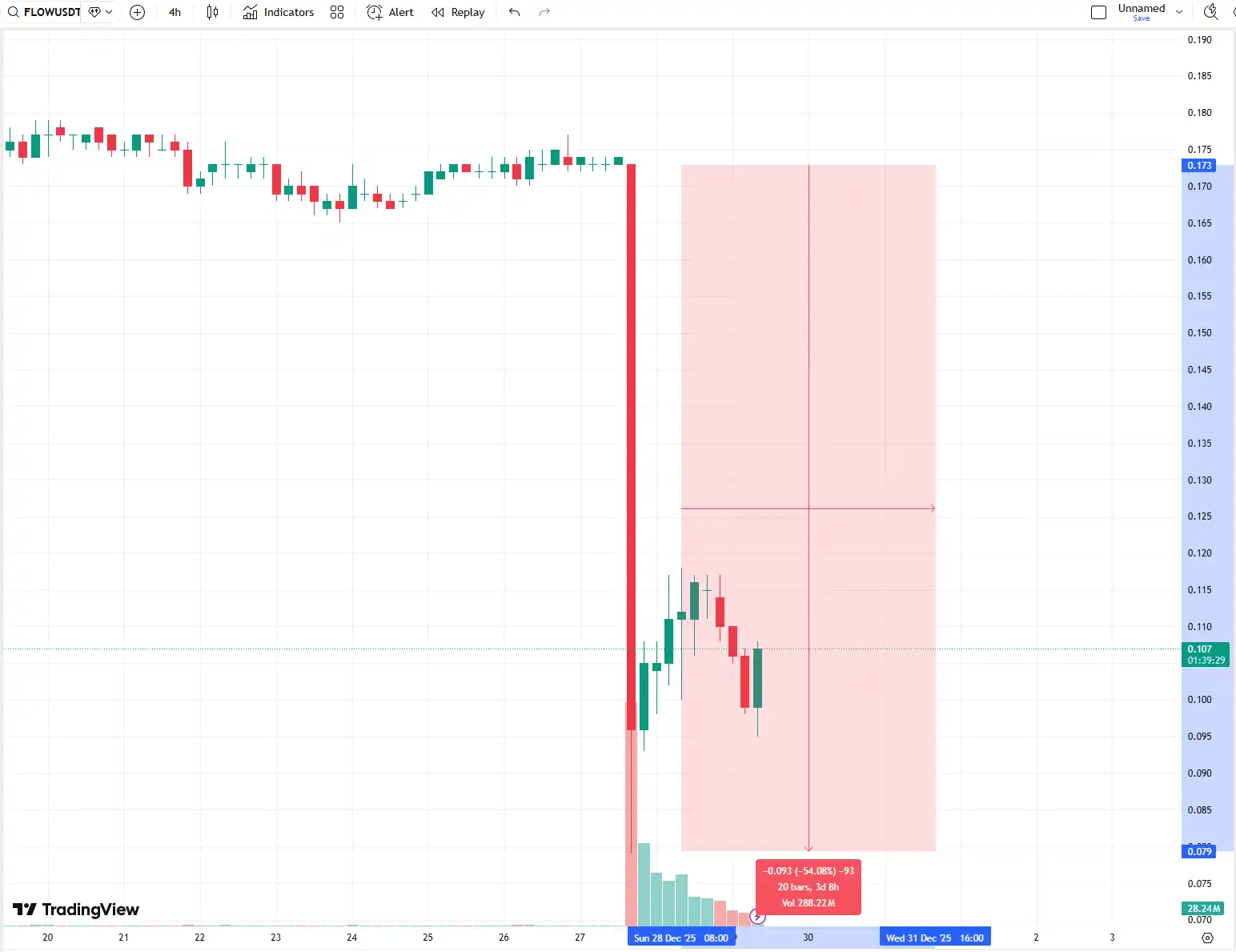
FLOW Candlestick Chart
Below, Odaily Planet Daily will summarize the recent Flow hack, official response, and why it sparked strong doubts from Flow partners and the community.
Flow Official Emergency Response: Network Isolation and Announcement of Rollback Plan
Following the attack, the Flow Foundation promptly responded and confirmed the event details. The attacker exploited an execution layer vulnerability to transfer around $3.9 million in assets, with user balances unaffected by the incident, and user deposits remaining secure. The related attack addresses have been blacklisted, and the money laundering trail is actively being traced, with the Foundation having submitted asset freeze requests to Circle, Tether, and several major exchanges.
To clean up illicit on-chain transactions and fix the vulnerability, the Flow Foundation has isolated the network and released the Mainnet 28 version with a bug fix. The Foundation's initial response plan is to rollback the network state to a checkpoint before the attack occurred, specifically at Cadence block height 137363395, thereby erasing all transaction records generated in approximately 6 hours. Whether the transactions were legitimate or not, they will all be removed, and users will need to resubmit their transactions after node restart. The Foundation believes this plan is the safest path to restore network integrity, emphasizing repeatedly that user funds will not be affected throughout the process, while committing to updating the community on progress every two hours.
While this rollback decision may seem decisive, it quickly ignited an ecosystem powder keg—since the hacker's funds had already been bridged out of the chain, the rollback would have no impact on the attacker and would only affect honest users and partners.
Cross-Chain Bridge Partners and Community Strongly Oppose, Rollback Plan Under Fire
After the rollback plan was announced, cross-chain bridge partners within the Flow ecosystem and community users quickly faced collective scrutiny. Alex Smirnov, co-founder of Flow's main cross-chain bridge partner deBridge, publicly criticized the decision on X Platform, stating that it was too hasty and did not involve any communication with key bridge partners beforehand. As a crucial asset pathway in the Flow ecosystem, deBridge did not receive any advance notice regarding the rollback.
Smirnov pointed out that the potential damage caused by the rollback could far exceed the initial hack itself. Since cross-chain assets have been transacted across multiple systems, forcing a rollback would result in serious issues such as asset duplication and inconsistent custody statuses, ultimately harming the bridges, users, and counterparties operating normally within the timeframe. He revealed that around $200,000 and $50,000 in deposits are within the rollback timeframe on deBridge, and if the rollback is executed, it could lead to funds disappearing into thin air on one side or extreme cases of asset double-spending.
Due to the aforementioned risks, Smirnov called on Flow validators to pause block production and validation until all compensation plans, partner coordination mechanisms, and independent security team intervention plans are clearly outlined. Similar issues are not isolated incidents. As the main cross-chain custodian of USDC on the Flow network, LayerZero also faces cross-chain transaction risks of around $220,000 and $180,000 within the rollback window.
In addition to the cross-chain bridge partners within the Flow ecosystem, on X Platform, users have started expressing concerns about fund security in a concentrated manner, developers have questioned the network's reliability and governance mechanisms under extreme circumstances, and investor sentiment has shifted towards caution, exacerbating selling pressure. Many voices directly point out that the rollback itself has exposed the on-chain centralization control, turning the original technical glitch into a trust crisis.
Some community perspectives further target the core principles of blockchain. Some believe that the rollback directly undermines transaction finality and immutability, making Flow appear more like a centrally controlled consortium chain at a critical moment. Others compare this to historical security incidents on other blockchains, indicating that similar situations are usually handled by isolating the attacker's address or freezing fund flows rather than performing a global network rollback.
Crypto KOL Wazz (@WazzCrypto) bluntly stated on X Platform that Flow's rollback decision is one of the worst handling methods he has ever seen. In his view, the attacker had already moved around $4 million worth of assets off-chain, hardly affected by the rollback, while the innocent users who were utilizing the network normally through the cross-chain bridge are the ones truly bearing the consequences.
Flow Official Shifts Stance: Abandons Rollback, Adopts Isolation Recovery Plan
Facing strong opposition from partners and the community, the Flow team has ultimately decided to abandon the network rollback and pivot to an "isolation recovery plan." This plan was developed through direct negotiation with cross-chain bridges, exchanges, and infrastructure partners and includes the following key points:
· No rollback/reorg, preserving all legitimate user activity;
· No need for partners to replay transactions;
· Over 99.9% of accounts unaffected, ready to resume normal operations upon restart;
· Upon restart, temporarily restrict accounts receiving illicitly minted tokens;
Furthermore, the network will undergo a phased recovery:
· Phase one, Cadence environment goes live, with EVM temporarily restricted;
· Phase two, Cadence fix (approximately 24 to 48 hours);
· Phase three, EVM fix and restart;
· Phase four, cross-chain bridges/exchanges resume operations, with the specific recovery timing to be determined by the operators based on stability confirmation.
Additionally, the team behind Flow, Dapper Labs, has expressed support for this plan on Platform X, stating, "Preserve legitimate activity, provide a clear recovery path."
This "rollback abandonment" stance has alleviated short-term ecosystem tension and averted potential systemic risk propagation from a rollback. As of now, the network is still in a phased coordination and recovery process, with officials indicating that user funds remain secure.
In an environment of high crypto market uncertainty, this crisis may become a significant turning point in Flow's development path, with its long-term impact awaiting further validation by time.
You may also like

Pantera Capital Partner: How Tokenization is Restructuring the Private Equity and Early Investment Ecosystem?

New York Proposes Stricter Stablecoin Issuer Rules Aligned With Federal GENIUS Act
NYDFS proposed stricter stablecoin issuer rules aligned with the GENIUS Act, covering reserves, custody, redemption timelines, audits, and capital buffers.
Every exchange is a "Universal Exchange."

The counterattack of traditional finance: Alliance chains are quietly reviving

CryptoQuant Says Bitcoin Profitable Supply Is Near 45% Pressure Zone as On-Chain Data Points to Market Repricing
CryptoQuant said Bitcoin’s profitable supply is nearing the 45% pressure zone, signaling rising market stress, unrealized losses, and a possible on-chain repricing phase.

Bitcoin Falls Below 200-Week Moving Average as On-Chain Data Shows Over Half of Supply in Loss
Bitcoin dropped below its 200-week moving average as on-chain data showed over 50% of circulating supply is now in loss, signaling rising market stress.

CFTC Reportedly Plans New Prediction Market Rules Focused on Manipulation Risk and Public Interest Review
The CFTC is reportedly preparing new prediction market rules focused on manipulation risk, public interest review, and retail trader protections.

Meet the new WEEX trial fund—your gateway to greater profits

WEEX Labs Lands at Dutch Blockchain Week: A Disruptive Crypto × AI Conversation Sets Sail in Amsterdam

SK Hynix Reportedly Plans U.S. ADR Listing as Early as August, With SEC Approval Possible in Late June
SK Hynix may pursue a U.S. ADR listing as early as August, with SEC approval reportedly possible in late June amid strong AI chip supply chain demand.

SpaceX vs Tesla vs xAI: Which Elon Musk Trade Has the Biggest Upside in 2026?
OpenAI Reveals It Has Confidentially Submitted an S-1 to the SEC, Keeping the Door Open for a Future IPO
On June 9, according to an OpenAI announcement, the company recently confidentially submitted a draft S-1 registration statement to the U.S. Securities and Exchange Commission (SEC), beginning the preliminary compliance process for a potential initial public offering. OpenAI said it chose to disclose this proactively because it expected the news might leak; however, the company has not yet set a specific listing timeline, and related arrangements may still take some time.

Latest research from 13 top universities including Cornell University: The current state, challenges, and misconceptions of the fusion of Crypto and AI
Deconstructing Anthropic: The Best AI Company, Possibly Also a Type of Organizational Invention
Apollo and Blackstone Reportedly Back $35 Billion Anthropic Chip Financing as Deal Details Remain Unclear
On June 9, according to currently available news alerts, Apollo and Blackstone Group participated in a $35 billion financing for an Anthropic “chip project.” Based on the original wording of the report, the funding has already been raised, but public information remains limited. The financing structure, use of proceeds, project entity, and whether Apollo and Blackstone participated through equity, debt, or project financing have not yet been disclosed.

Humanity Protocol Security Incident Escalates: More Than $31 Million Stolen From Related Addresses as Attacker Continues Selling H for ETH
On June 9, according to monitoring by Onchain Lens, more than $31 million has been stolen from addresses linked to Humanity Protocol, and the attack is still ongoing, with the hacker continuously swapping H tokens for ETH. Project founder Terence Kwok later confirmed the security incident on X, saying the issue involved a private key leak.

Bloomberg: As Bitcoin Weakens, Stablecoins and RWA Continue to Drive Expansion in Crypto Businesses
In June, Bloomberg reported that despite Bitcoin falling below $60,000 last week, wiping out about $235 billion in market value within seven days, and dropping close to 50% from last year’s peak, some core businesses in the crypto industry are still expanding, mainly in stablecoins, real-world asset tokenization (RWA), payments, and infrastructure. The report also noted that overall altcoin activity has contracted significantly: altcoin market capitalization has fallen from a peak of about $431 billion in November 2021 to around $170 billion, and among the tens of millions of tokens issued in recent years, fewer than 1,700 still maintain meaningful trading activity.

Galaxy Deep Research Report: How Hyperliquid's HIP-4 Upgrade Changes the Landscape of Prediction Markets?
Pantera Capital Partner: How Tokenization is Restructuring the Private Equity and Early Investment Ecosystem?
New York Proposes Stricter Stablecoin Issuer Rules Aligned With Federal GENIUS Act
NYDFS proposed stricter stablecoin issuer rules aligned with the GENIUS Act, covering reserves, custody, redemption timelines, audits, and capital buffers.
Every exchange is a "Universal Exchange."
The counterattack of traditional finance: Alliance chains are quietly reviving
CryptoQuant Says Bitcoin Profitable Supply Is Near 45% Pressure Zone as On-Chain Data Points to Market Repricing
CryptoQuant said Bitcoin’s profitable supply is nearing the 45% pressure zone, signaling rising market stress, unrealized losses, and a possible on-chain repricing phase.
Bitcoin Falls Below 200-Week Moving Average as On-Chain Data Shows Over Half of Supply in Loss
Bitcoin dropped below its 200-week moving average as on-chain data showed over 50% of circulating supply is now in loss, signaling rising market stress.


