
48-Hour Marathon Nets 186,000 SOL, Decrypting the Crypto Culture Experiment Triggered by PAIN


Original Article Title: "'Living Meme' PAIN: A Crypto Cultural Experiment from Pain to Prosperity"
Original Article Author: Alex Liu, Foresight News
Presale Timeline: 48-Hour Fundraising Nets $38 Million, 80% Refund Sparks Market Controversy
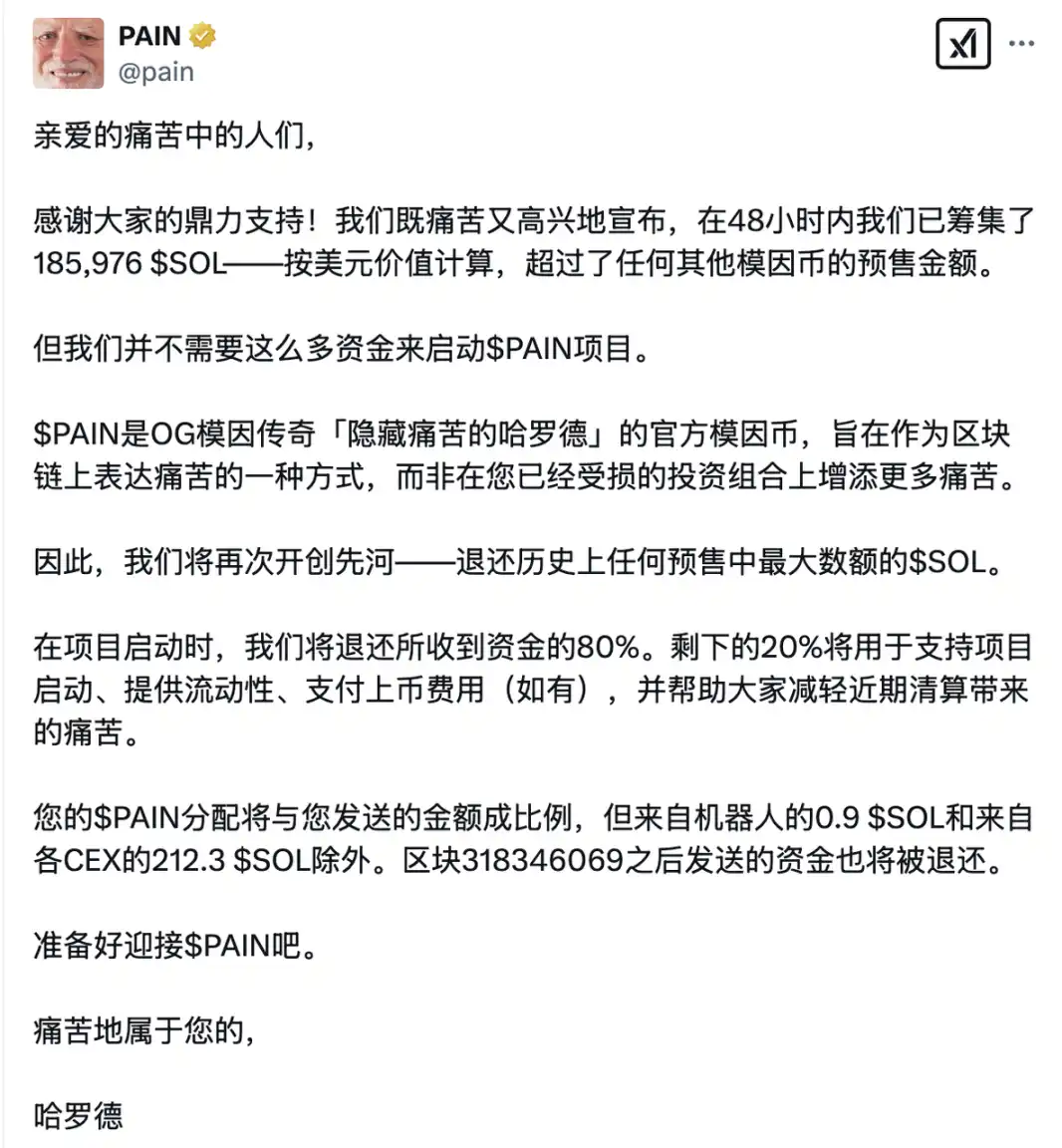
On February 2, 2025, a highly anticipated Meme coin presale within the crypto community commenced. The PAIN project, incubated by Memeland, raised a staggering 186,000 SOL tokens (approximately $38 million) within 48 hours, making it one of the largest Meme coin presales in history. However, the project team later announced a disruptive decision: to refund 80% of the funds raised, retaining only 20% for launch and liquidity. This move not only sparked discussions about the project's "integrity" but also quickly turned PAIN into a focal point of attention.
Origin: From "Smiling through Pain" to Crypto Symbol
The inspiration behind PAIN stems from the classic internet meme "Hide the Pain Harold," whose prototype is Hungarian photographer András Arató. In the early 2000s, his "smiling through pain" expression showcased in a photography equipment advertisement became an internet cultural symbol due to its strong contrast. For over a decade, Harold's image has been widely used to express life's frustrations and forced smiles, with Arató himself adopting the identity with a humorous attitude, becoming the "living meme."

Memeland's Hype: Celebrity Endorsements and Community Schism
As a project incubated by Memeland, PAIN's eruption was closely tied to the mother platform's resource allocation. By the end of October 2024, after the establishment of PAIN's official Twitter account, Memeland quickly laid the groundwork:
Celebrity Effect:
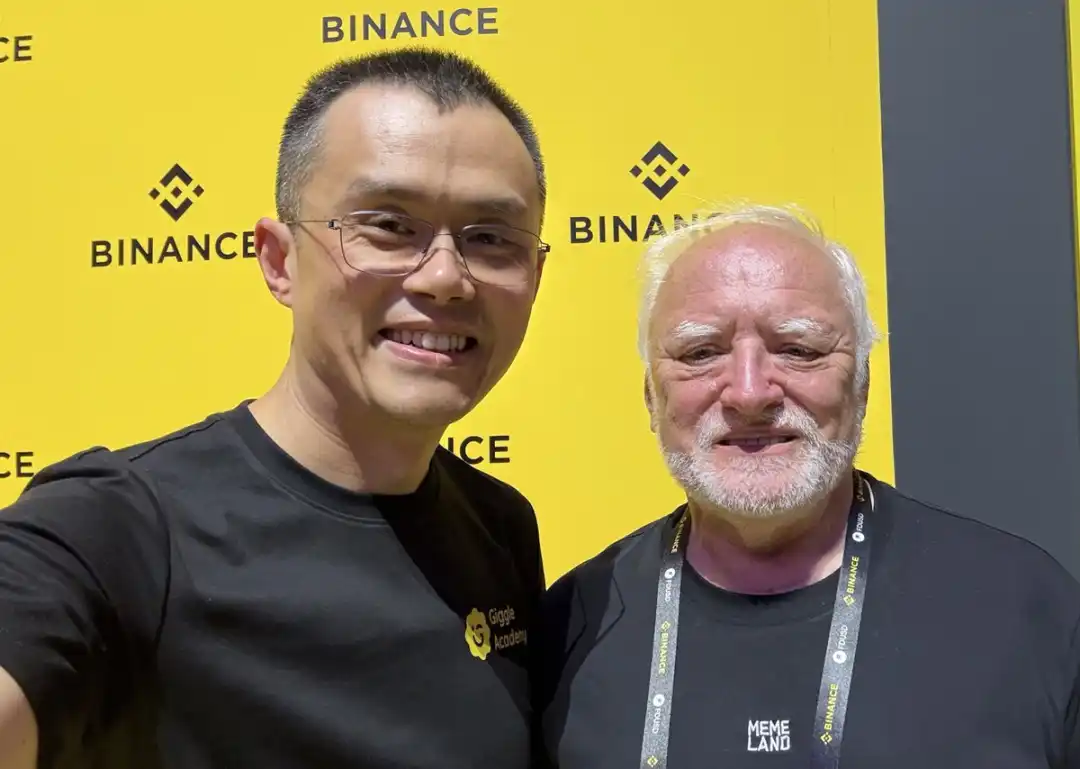
During the Binance Blockchain Week in the same October, a photo of Harold's prototype Arató with Binance founder CZ went viral. Memeland's token MEME had long been listed on Binance, and the occurrence of the photo was no doubt fueled by Memeland's efforts behind the scenes.
Community Collaboration:
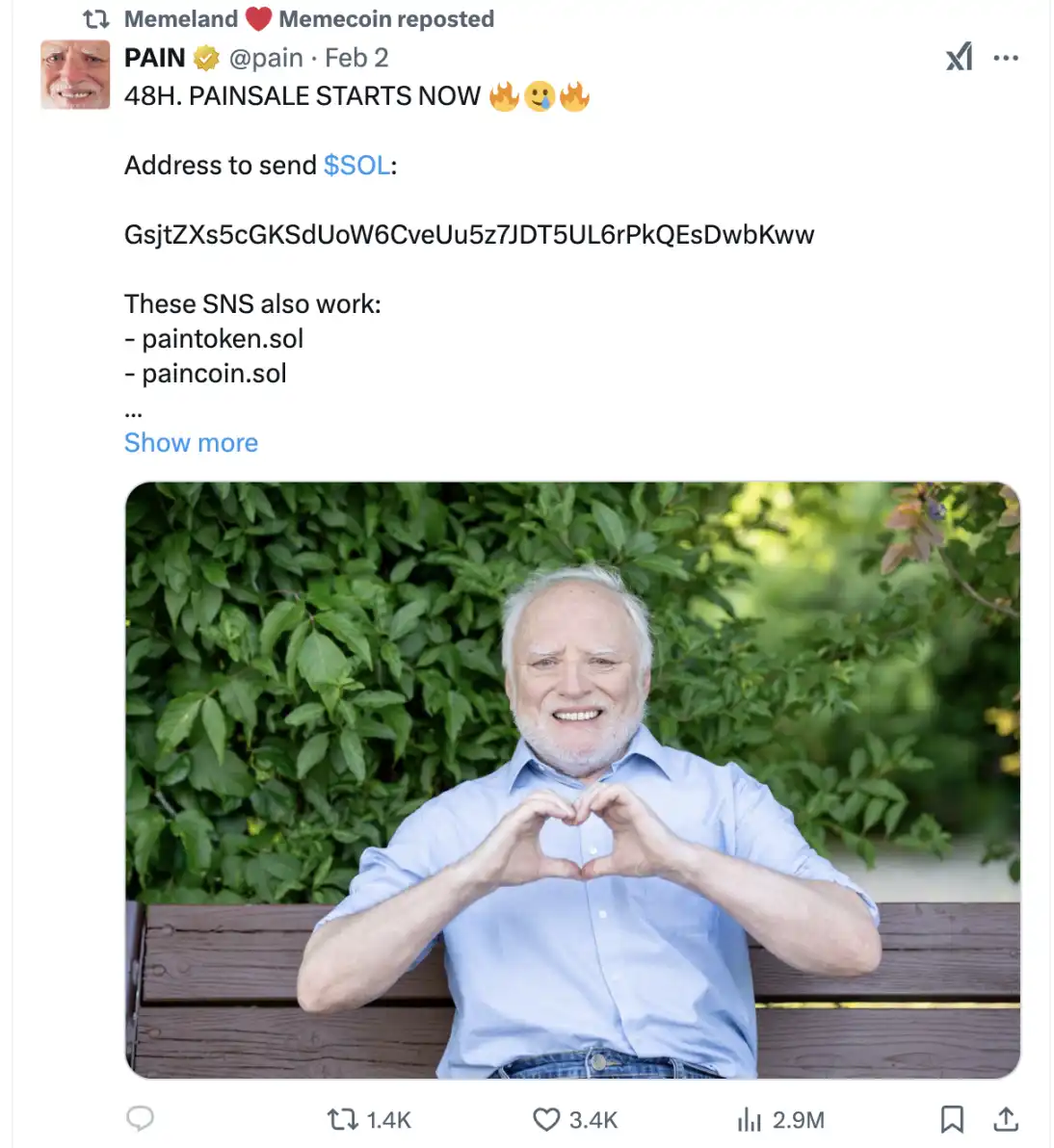
The Memeland official account has repeatedly retweeted PAIN updates, including the presale announcement, generating a resonance of traffic. (The presale is currently over, please do not send funds to the address in the image)
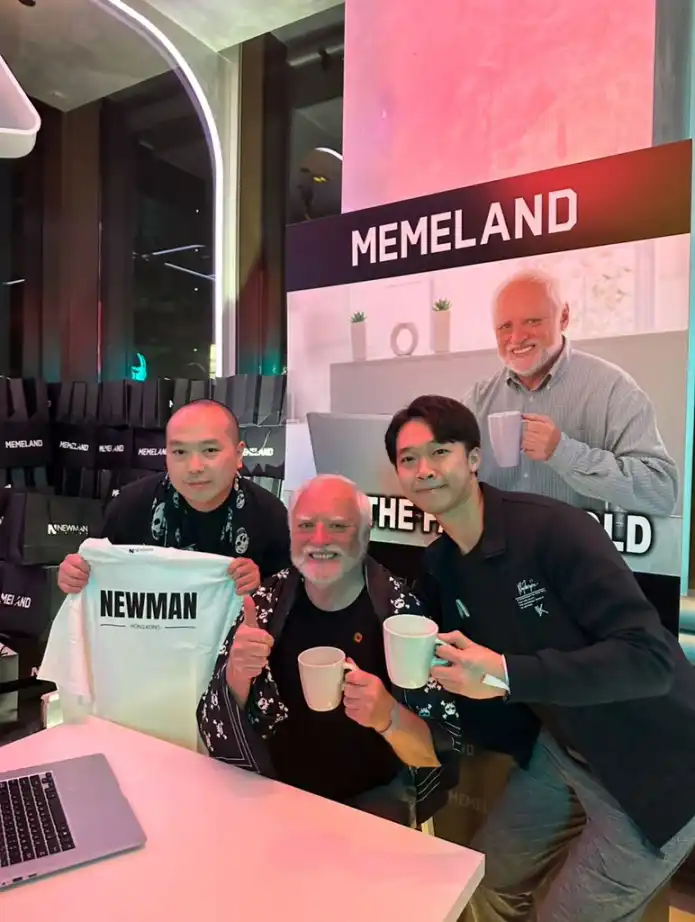
Memeland founder and Harold prototype Arató attended an offline blockchain event together.
Refund Event: Genuine Marketing or Risk Shifting?
After the presale, the project team announced a refund of 80% of the funds, retaining only 20% (approximately $7.6 million) for launch, providing liquidity, and paying CEX listing fees (if any). The official explanation stated that this was done to "reduce the burden on investors and demonstrate long-term commitment," but controversy ensued: Supporters believe that the refund reflects an "anti-rug pull" attitude, contrasting with most Meme projects that "raise funds and run"; while skeptics point out that the refunded SOL has depreciated due to market volatility, and the 20% retained funds still far exceed the launch needs of similar projects.
From a rational analysis perspective, the 80% refund amount is the highest among similar projects, and this portion of the funds can be seen as potential buying pressure after the token is listed, which indeed can be considered as protecting the returns of existing investors.
Regardless of the motive, this event objectively created a secondary spread for PAIN, achieving a significant victory in terms of traffic.
Future Challenge: The "Meme Coin" Paradox
The short-term success of PAIN relies on Memeland's community momentum and the innate virality of Meme culture (of course, not without the hype of Meme traders), but long-term development faces challenges: If Harold's "pain" core is overly commercialized, it may erode its original charm; and Meme coins rely on market hype, making them particularly vulnerable in a bear market.
The specific launch time of the PAIN token is not yet clear. Let us first observe its performance in the market before making judgments.
Conclusion
From Harold's wry smile to the successful presale of the PAIN token, this experiment has affirmed the absurdity and creativity of the crypto world. When "pain" becomes a tradable consensus, perhaps the true meme has already transcended the screen, embedded in the collective emotion of this era.
You may also like

How TradeXYZ, xStocks, and Alpaca break down the SpaceX IPO into three different strategies

Why Is BlackRock Investing $5 Billion in the SpaceX IPO?

Cryptocurrency market makers collectively seek change as it becomes increasingly difficult to make money

a16z Crypto Partner: Cash flow is the moat

Citibank releases "2030 Asset Tokenization Market Outlook": 6 major trends may create a $8.2 trillion market

The trillion-dollar valuation test: Are the three major super IPOs a celebration for tech stocks or a nightmare for the crypto market?

Morning Report | Digital Asset completes $355 million financing led by a16z Crypto; Meta completes operational separation from Manus
Morning News | CME Group launches Nasdaq Cryptocurrency Index futures; Asset management giant Janus Henderson strategically invests in Ethena

Bitcoin Layer 2 Network Botanix: Why Did We Choose to Dissolve?

Why did Oracle deliver the strongest financial report in history, yet its stock price fell?
When the P2P illicit funds from ten years ago turned into 60,000 bitcoins

Dialogue with OmenX Founder: Why does the prediction market need an evolution from "spot" to "derivatives"?
Galaxy in-depth report: Is Solana still worth paying attention to?

Young people in South Korea make a "final effort" in the epic bull market
The pricing controversy of Trade.xyz exposes the fatal weakness of Pre-IPO perpetual contracts
How much longer can Ethereum's last big buyer hold on?

World Cup 2026 Coming – WEEX Celebrates with $1M Prize Pool & Michael Owen Live

Morning Report | OpenAI has submitted an S-1 registration statement draft to the U.S. SEC; Morpho completes $175 million financing
How TradeXYZ, xStocks, and Alpaca break down the SpaceX IPO into three different strategies
Why Is BlackRock Investing $5 Billion in the SpaceX IPO?
Cryptocurrency market makers collectively seek change as it becomes increasingly difficult to make money
a16z Crypto Partner: Cash flow is the moat
Citibank releases "2030 Asset Tokenization Market Outlook": 6 major trends may create a $8.2 trillion market
The trillion-dollar valuation test: Are the three major super IPOs a celebration for tech stocks or a nightmare for the crypto market?


