
A Quick Guide to Understanding the Highlights of SVM Rising Star Fogo



As Solana makes its way back to the peak, the SVM track has become exceptionally lively, with Eclipse and Sonic in the lead and SOON and Fogo following closely behind, all backed by reputable teams and backers. Fogo, which recently announced the completion of two funding rounds, already has more than 3000 angel investors on its list.
What is Fogo?
Fogo is a new SVM chain in development that aims to enable on-chain "institutional-grade" financial services by combining traditional finance performance with decentralized infrastructure.
Currently in the developer network (devnet) phase, Fogo is said to have achieved over 54,000 transactions per second. The testnet is expected to launch in the first quarter of this year, with the mainnet projected for the second quarter.
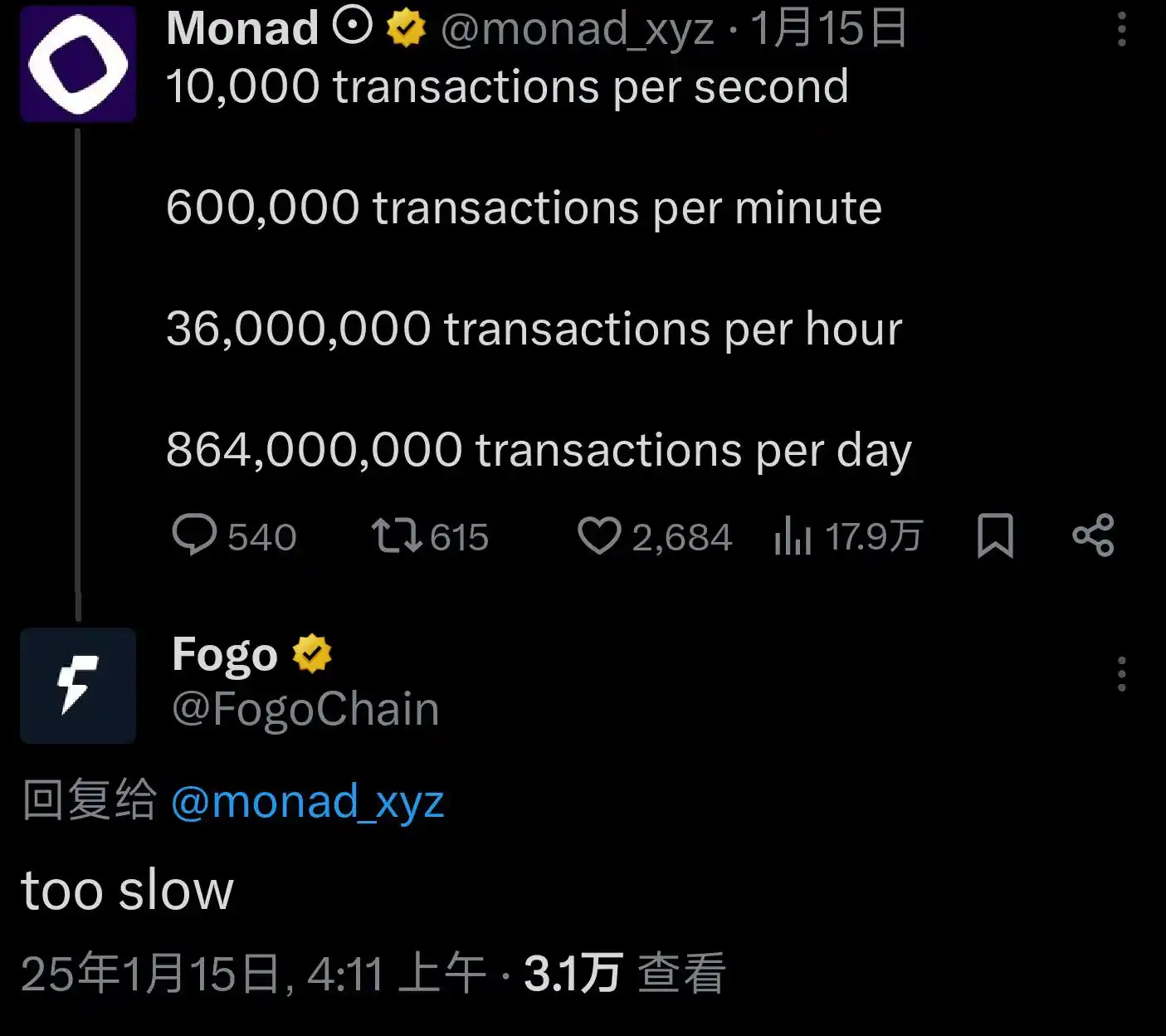
Furthermore, Fogo has already started taunting the new public chain Monad, calling it "too slow." According to the whitepaper, Fogo has three main features:
1. Unified client implementation based on Firedancer: Through a high-performance client implemented purely in Firedancer, Fogo can achieve a level of performance that other networks (including Solana) cannot reach.
Firedancer is Jump Crypto's high-performance Solana-compatible client implementation, demonstrating higher transaction processing throughput than current validator clients through optimized parallel processing, memory management, and SIMD instructions.
There are two versions of Firedancer: "Frankendancer," a hybrid version that uses Firedancer's processing engine and Rust validator's network stack, and a full Firedancer implementation with a complete C network stack rewrite, currently in late-stage development. Both versions maintain compatibility with the Solana protocol. Fogo will initially launch the network based on Frankendancer and then transition gradually to a pure Firedancer implementation.
2. Multi-local consensus and dynamic co-location: This allows validators to coordinate their physical locations at different times while maintaining distinct cryptographic identities for different regions, enabling Fogo to achieve block times and latencies far below those of other mainstream blockchains.
The inspiration for multi-local consensus comes from the "follow the sun" trading model in traditional financial markets. In this model, market-making and liquidity provision migrate between major financial centers as the trading day progresses, facilitating continuous market operation while maintaining concentrated liquidity in specific geographic regions.
III. Selected Validator Set: Through a carefully chosen validator set, FOGO incentivizes high-performance operation and prevents predatory behavior at the validator level.
During the initial stage, the validation node set will be screened through Proof-of-Authority and later transitioned to be directly managed by the validator set. By handing over the screening authority to the validator set, FOGO can impose social layer penalties on abusive behavior without increasing centralization.
Transacting Without SOL? Fogo's Future Expansion
In Fogo's whitepaper, there is a section dedicated to Fogo's future development plans. To expand network access and improve user experience, FOGO may introduce a fee_payer_unsigned transaction type, allowing transactions to be executed without SOL in the initiating account. This feature, combined with on-chain fee payment procedures, enables users to pay transaction fees using SPL tokens (such as TRUMP, MELANIA, or BARRON), while maintaining protocol security and validator compensation.
Users construct transactions that include their intended operations and SPL token payments to compensate the ultimate fee payer. These transactions can be validly signed without specifying the fee payer, allowing any party to complete the transaction by adding their signature and paying SOL fees. This mechanism effectively separates transaction authorization from fee payment, enabling accounts with zero balance to interact with the network as long as they hold other valuable assets.
This feature is achieved through minimal protocol modifications, requiring only the addition of a new transaction type and on-chain procedures to handle relay compensation. The system creates an efficient market for transaction relay services while preserving the security properties of the underlying protocol. Unlike more complex fee abstraction systems, this approach does not require changes to validator payment mechanisms or consensus rules.
Crypto OG Milk, SVM Rising Star Flush with Cash
On January 25, SVM L1 Fogo, with a $100 million token valuation, completed an $8 million funding round in "less than two hours" on the Echo platform, an angel investment platform founded by Cobie. The Echonomist led the round, with participation from 4 CMS Holdings, Big Brain Collective, and Patrons. Last month, Fogo had just completed a $5.5 million seed round, with Distributed Global leading the $5 million seed investment.
Fogo's co-founder and former Jump Crypto executive Robert Sagurton stated in an interview that there were four Echo investment groups involved in this round of funding:
• The Echonomist led by Cobie invested $6 million;
• 4 Ventures from CMS Holdings invested $1 million;
• Big Brain Collective led by The Block CEO Larry Cermak invested $500,000;
• And Patrons led by Synthetix and Infinex co-founder Kain Warwick invested $500,000.
At the same time, Fogo's founding team has strong connections to Solana, cryptocurrency, and traditional finance.
According to Sagurton's LinkedIn profile, he has worked at Jump Crypto for over five years, serving as Global Head of Digital Asset Sales and Business Advisor. Prior to joining Jump Crypto, Sagurton held positions at enterprise blockchain company R3, J.P. Morgan, Deutsche Bank, and Morgan Stanley.
Fogo's other co-founder is Douglas Colkitt, also the founder of Crocodile Labs, who developed the decentralized exchange protocol Ambient Finance (formerly known as CrocSwap). It is also planned to deploy Ambient on Fogo.
You may also like

Cryptocurrency market makers collectively seek change as it becomes increasingly difficult to make money

a16z Crypto Partner: Cash flow is the moat

Citibank releases "2030 Asset Tokenization Market Outlook": 6 major trends may create a $8.2 trillion market

The trillion-dollar valuation test: Are the three major super IPOs a celebration for tech stocks or a nightmare for the crypto market?

Morning Report | Digital Asset completes $355 million financing led by a16z Crypto; Meta completes operational separation from Manus

Morning News | CME Group launches Nasdaq Cryptocurrency Index futures; Asset management giant Janus Henderson strategically invests in Ethena

Bitcoin Layer 2 Network Botanix: Why Did We Choose to Dissolve?

Why did Oracle deliver the strongest financial report in history, yet its stock price fell?
When the P2P illicit funds from ten years ago turned into 60,000 bitcoins

Dialogue with OmenX Founder: Why does the prediction market need an evolution from "spot" to "derivatives"?
Galaxy in-depth report: Is Solana still worth paying attention to?

Young people in South Korea make a "final effort" in the epic bull market
The pricing controversy of Trade.xyz exposes the fatal weakness of Pre-IPO perpetual contracts
How much longer can Ethereum's last big buyer hold on?

World Cup 2026 Coming – WEEX Celebrates with $1M Prize Pool & Michael Owen Live

Morning Report | OpenAI has submitted an S-1 registration statement draft to the U.S. SEC; Morpho completes $175 million financing

Galaxy Deep Research Report: How Hyperliquid's HIP-4 Upgrade Changes the Landscape of Prediction Markets?

Latest research from 13 top universities including Cornell University: The current state, challenges, and misconceptions of the fusion of Crypto and AI
Cryptocurrency market makers collectively seek change as it becomes increasingly difficult to make money
a16z Crypto Partner: Cash flow is the moat
Citibank releases "2030 Asset Tokenization Market Outlook": 6 major trends may create a $8.2 trillion market
The trillion-dollar valuation test: Are the three major super IPOs a celebration for tech stocks or a nightmare for the crypto market?
Morning Report | Digital Asset completes $355 million financing led by a16z Crypto; Meta completes operational separation from Manus
Morning News | CME Group launches Nasdaq Cryptocurrency Index futures; Asset management giant Janus Henderson strategically invests in Ethena


