
- Buy Crypto
- Markets
 Futures
- Spot
- Copy Trade
- Earn
- More
A single tweet caused a 17% crash in oil prices, who's not a Meme yet

In 1974, then U.S. Secretary of State Henry Kissinger flew to Riyadh and reached a deal with Saudi Arabia that would change the global landscape: Saudi agreed to sell oil exclusively in exchange for U.S. dollars, which would then be recycled to purchase U.S. Treasury bonds.
At that time, Nixon had just severed the link between the dollar and gold, the U.S. was facing runaway inflation, the dollar reserves were dwindling, gold was flowing out in massive quantities, and the Bretton Woods system collapsed. Many believed that the golden era of the dollar was over.
However, the deal Kissinger struck with Saudi Arabia established what would later be known as the "Petrodollar" system. It was this system that allowed the dollar to survive for half a century after the collapse of the gold standard.
It is also for this reason that whenever someone threatens to block the oil lanes, it is not just an energy issue for the U.S., but also an assault on the foundation of the entire dollar system. This is why the Strait of Hormuz, a narrow waterway like a throat, has always been seen by the U.S. as a key point that must be defended over the past fifty years, even if it means using military force if necessary.
Understanding this historical background, fifty years later, helps us better understand today's situation.
Early this morning, while most people in China were still asleep, a violent tremor lasting less than an hour had already wiped out billions of dollars in market value on the global crude oil futures market.
It all started with a social media post.
U.S. Energy Secretary Chris Wright posted on Platform X, saying, "The U.S. Navy has successfully escorted an oil tanker through the Strait of Hormuz to ensure the continued flow of oil to the global market."
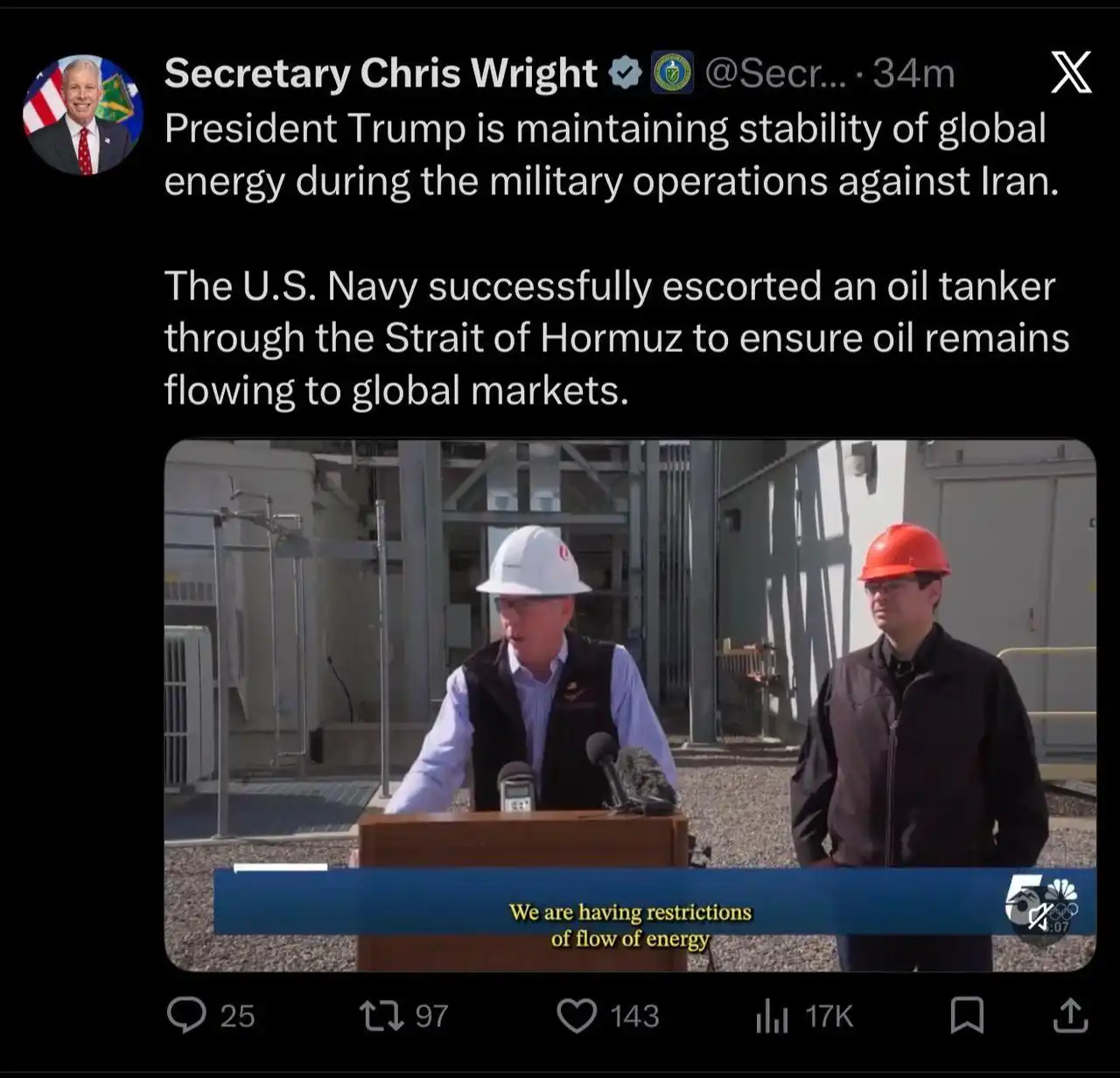
After this tweet, the WTI crude oil price plummeted in a few minutes, with a drop of up to 17%, briefly falling below $80 per barrel. In the previous weeks, due to the tense situation in the Middle East, Brent crude had just soared from $70 to $120.
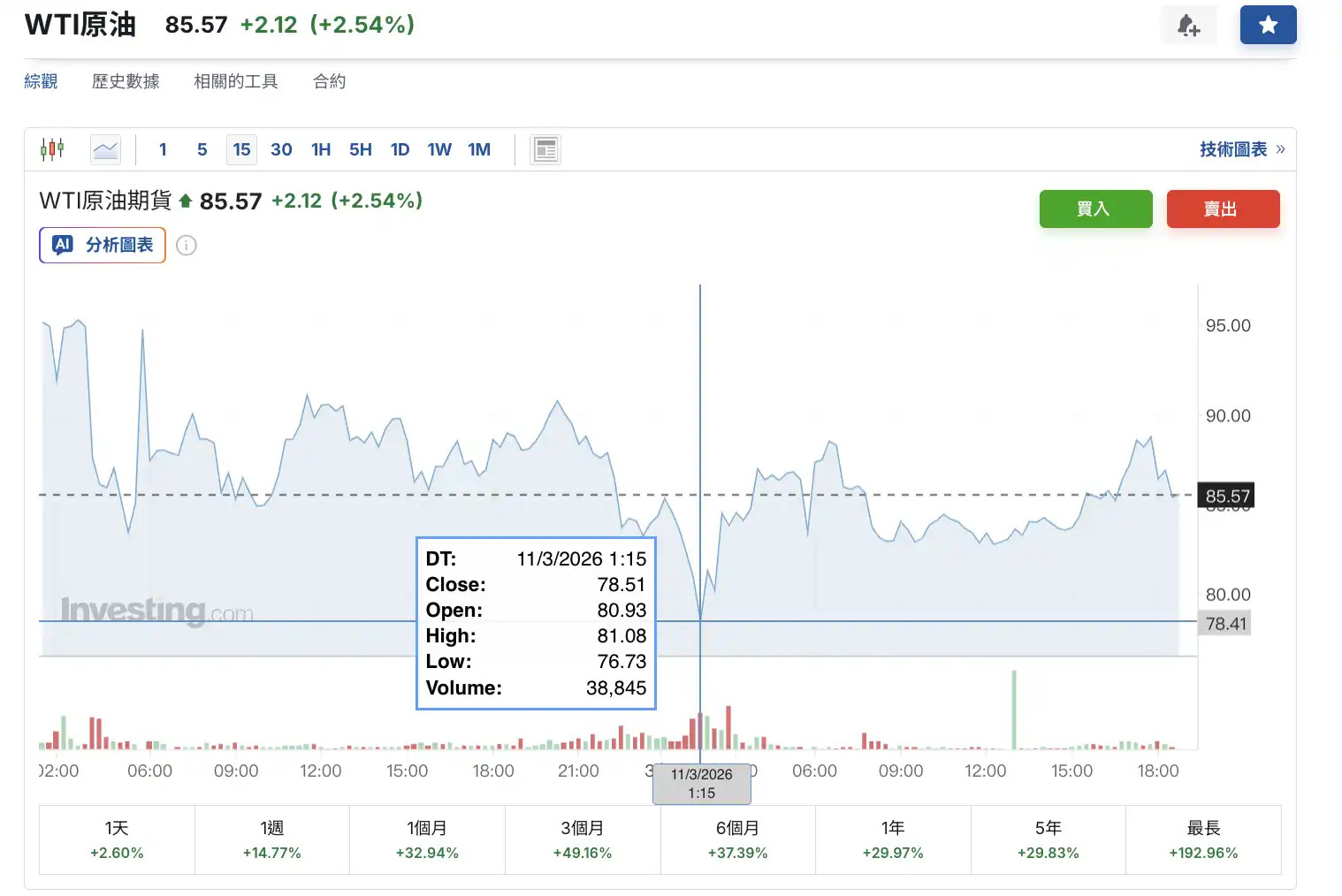
For those traders betting on further oil price increases, this moment was a nightmare.
However, the plot quickly reversed.
Less than an hour later, White House Press Secretary Karoline Leavitt urgently clarified during a press briefing: the U.S. Navy is currently not escorting any oil tankers. Subsequently, Energy Secretary Chris Wright quietly deleted the post without any explanation. The oil price then rebounded but could not return to its initial position.
A post, from publication to deletion, took less than sixty minutes. But the impact it left on the global financial market is far more than just that one hour.
Since the escalation of the US-Iran conflict at the end of February, the game around oil has continued to intensify. Especially after Iran announced the blockade of the Strait of Hormuz, this narrow waterway that handles about one-fifth of global oil transportation suddenly closed, causing a significant impact on the global energy market. As the situation escalated, international oil prices skyrocketed from $70 to $120 per barrel within a few days, putting the energy market in a highly tense state.
Almost all traders were waiting for the same signal: when will the Strait of Hormuz reopen? Under this collective anxiety, any slight movement could trigger drastic price swings. The rapid drop triggered by that post made by the Energy Minister was a concentrated reflection of this emotion.
So, why did oil prices plummet by 17% in just a few minutes? Because humans find it challenging to react that quickly, but algorithms can. In today's financial markets, a significant portion of trading volume comes from high-frequency trading algorithms and AI trading systems. They scan the entire internet in real time, including government officials' social media accounts, grab keywords, and automatically place orders.
There were three key words in that post: Navy, Escorted, Hormuz. The algorithm identified these words, then, combined with contextual semantics, quickly reached a conclusion: blockade lifted, supply restored, weakening the logic of price increase.
So the program immediately sold.
All of this happened in about 0.003 seconds.
Algorithms do not make calls to confirm if the oil tanker has indeed crossed the strait; they only recognize text, they only pursue speed. An unverified post, in this mechanistic "collective unconscious," was instantly converted into billions of dollars in market value evaporation.
A real oil tanker crossing the Hormuz Strait requires hours of sailing, actual military escort, fuel costs, and real-world risks. Whereas a post about "escort" took only 0.003 seconds to cause a significant price swing in this commodity.
In other words, crude oil, once dominated by supply and demand fundamentals, inventory data, and production agreements, has now, to some extent, become not much different from a meme.
During the last US election, Trump and Musk keenly grasped the sensitivity of it all. This is an information age, so one created Truth Social, while the other bought Twitter.
As the Information Age has progressed to this day, government officials' social media accounts have become one of the most sensitive sources of information in the market. This also means that power itself has begun to possess a certain Meme-like attribute: extremely fast propagation, high emotional intensity, and very prone to misinterpretation and amplification.
Traditional policy information dissemination is slow and rigorous. White House statements, State Department bulletins, Department of Defense press briefings, these mechanisms inherently involve verification, fact-checking, and layers of confirmation. However, when officials directly post policy-related information on X, these steps are skipped.
What we can foresee is that as we further enter the AI Agent era, both the capture of information and the speed of transactions will increase exponentially, with steep rises and falls occurring in milliseconds.
Viewed from a broader perspective, this may indicate a larger change: we are entering an era of "comprehensive asset Meme-ification." Almost any financial asset may, at some point, be driven by emotion, narrative, and social media.
Years ago, Kissinger used oil to extend the life of the dollar by fifty years. But he probably never imagined that one day oil itself would also become a kind of Meme.
No asset has an absolutely unbreakable fundamental moat. All moats are fundamentally based on some form of consensus. And under the dual acceleration of social media and algorithmic trading, this consensus is more fragile and dangerous than ever before.
Perhaps in some sense, this is also the triumph of the Meme.
You may also like

Whale Opens 20x Oil Short on Hyperliquid With 5.6M USDC at Risk
Key Takeaways A significant leveraged short position on crude oil has been initiated on Hyperliquid using 5.6 million…

Bitcoin: The Ultimate Hedge Against Chaos
Key Takeaways Michael Saylor, co-founder of Strategy, firmly believes Bitcoin is the ultimate hedge against macroeconomic chaos. Strategy…

“Set 10 Major Targets First,” Whale Reopens Long Positions in Bitcoin
Key Takeaways A prominent cryptocurrency whale known as @Jason60704294 has reopened a long position in Bitcoin. The whale…

Analysis: Despite Bitcoin’s Price Dip, Bullish Trends Persist
Key Takeaways Despite Bitcoin’s decline below $71,000, its bullish momentum remains strong, with significant buying activity from ETFs…

DeFi Protocol Neutrl Faces Potential Security Breach
Key Takeaways The DeFi protocol Neutrl has reported a suspected attack on its front-end interface, urging users to…

OpenClaw Developers Targeted by Sophisticated GitHub Phishing Campaign
Key Takeaways OpenClaw developers are being targeted by a phishing campaign using fake GitHub accounts. Attackers claim to…

User Loses $85,000 in sNUSD to Phishing Scam
Key Takeaways A user lost approximately $85,000 in sNUSD due to a phishing attack. The attack involved a…

Bitcoin Tumbles Below $71,000 Amid Global Market Volatility
Key Takeaways Bitcoin (BTC) recently experienced a sharp drop, falling below the $71,000 mark, a significant decline influenced…

Ethereum: A Closer Look at Recent Price Movements
Key Takeaways Ethereum’s price has recently fallen below $2200, showing a daily increase of 0.55%. Ethereum (ETH) operates…

Pudgy Penguins’ Game Sparks Security Warning Amid Growing Phishing Scams
Key Takeaways A phishing campaign is targeting the Pudgy Penguins’ newly-launched game, Pudgy World, to steal cryptocurrency wallet…

The Cryptocurrency Market Downturn: An In-Depth Look
Key Takeaways The cryptocurrency market is experiencing a downturn driven by geopolitical tensions and surging oil prices. Bitcoin…

Ethereum Whale Activity: Major Accumulation Detected
Key Takeaways A significant whale activity has been detected, involving the purchase of 10,811.34 ETH over two weeks.…
Cryptocurrency Market Update: Major Developments and Insights
Key Takeaways Sky co-founder Rune Christensen has leveraged strategic moves to short the S&P 500 and invest in…

Whale Trading Strategies: Insights into Massive Crypto Moves
Key Takeaways A notable whale, @Jason60704294, made a profit of $7.093 million by closing a short position during…

BlackRock’s Significant Crypto Withdrawal from Coinbase
Key Takeaways In a surprising move, BlackRock has withdrawn 2,267 BTC and 5,041 ETH from Coinbase in the…

Ancient Whale’s Bitcoin Sale Spurs Market Movements
Key Takeaways An ancient cryptocurrency whale offloaded 1,000 BTC, valued at approximately $71.57 million, causing significant ripples in…

SEC Clarifies How Federal Securities Laws Apply to Crypto Assets
Key Takeaways: The SEC and CFTC jointly released a comprehensive guidance classifying crypto assets into five distinct categories.…

SEC Greenlights Nasdaq for Tokenized Securities Trading
Key Takeaways: SEC approval allows Nasdaq to initiate tokenized securities trading, integrating blockchain into U.S. equity markets. Tokenized…
Whale Opens 20x Oil Short on Hyperliquid With 5.6M USDC at Risk
Key Takeaways A significant leveraged short position on crude oil has been initiated on Hyperliquid using 5.6 million…
Bitcoin: The Ultimate Hedge Against Chaos
Key Takeaways Michael Saylor, co-founder of Strategy, firmly believes Bitcoin is the ultimate hedge against macroeconomic chaos. Strategy…
“Set 10 Major Targets First,” Whale Reopens Long Positions in Bitcoin
Key Takeaways A prominent cryptocurrency whale known as @Jason60704294 has reopened a long position in Bitcoin. The whale…
Analysis: Despite Bitcoin’s Price Dip, Bullish Trends Persist
Key Takeaways Despite Bitcoin’s decline below $71,000, its bullish momentum remains strong, with significant buying activity from ETFs…
DeFi Protocol Neutrl Faces Potential Security Breach
Key Takeaways The DeFi protocol Neutrl has reported a suspected attack on its front-end interface, urging users to…
OpenClaw Developers Targeted by Sophisticated GitHub Phishing Campaign
Key Takeaways OpenClaw developers are being targeted by a phishing campaign using fake GitHub accounts. Attackers claim to…


 App
App