
After Microsoft rejected Bitcoin, what will Amazon and other technology giants do?


Original title: Why tech giants like Amazon may hesitate to adopt Bitcoin
Original author: DANIEL RAMIREZ-ESCUDERO
Original translation: Lawrence, MarsBit
Big tech companies have a lot of cash on hand. Currency depreciation makes them lose purchasing power. Is Bitcoin a financial solution to fight inflation? Amazon is the next to decide.

Big tech companies such as Amazon have a lot of cash on hand ($87 billion last year), but the purchasing power of this cash is declining as the currency depreciates.
The National Center for Public Policy Research (NCPPR), a think tank in Washington, DC, has submitted a proposal to shareholders to adopt Bitcoin as a solution. However, it is not clear whether the tech giants will benefit from it.
NCPPR has been pursuing this strategy at Microsoft and Amazon. At both companies, the think tank argues that including Bitcoin in its treasury would protect cash assets and shareholder value from inflation.
The proposal argues that the Consumer Price Index (CPI) holds inflation at 4.95%, an “extremely poor indicator” of true monetary depreciation, and suggests that actual inflation could be twice that.
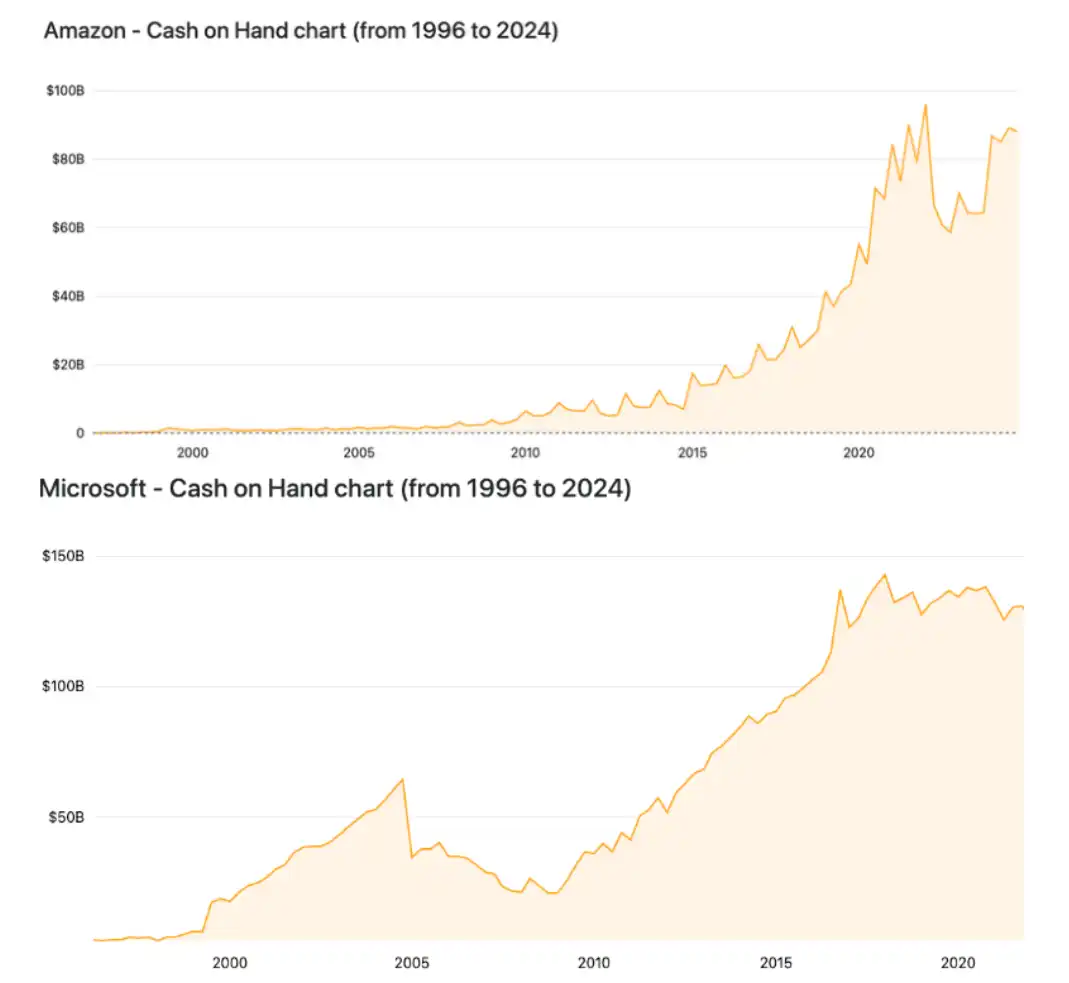
Microsoft and Amazon’s cash reserves from 1996 to 2024. Source: Companiesmarketcap
Microsoft has $78 billion in cash on hand, while Amazon has $87 billion. While Bitcoin could offer a potential hedge, does the risk outweigh the benefit?
Despite support from orange pill expert and business intelligence company MicroStrategy chairman Michael Saylor, Microsoft shareholders overwhelmingly voted down the NCPPR’s bitcoin reserve proposal, indicating that its alleged volatility was a negative factor.
Next up is Amazon. Will the vote be different this time?
Amazon isn’t as conservative a tech company as Microsoft
Nick Cowan, CEO of fintech firm Valereum, told Cointelegraph that Microsoft and Amazon may have similarities as tech giants, but their styles are very different.
“Amazon’s shareholder vote may indeed be different than Microsoft’s due to its reputation for innovation and risk tolerance.”
While Microsoft has historically been more conservative in its fiscal and strategic approach, Amazon has a track record of adopting emerging technologies and exploring new investments.
“Unlike Microsoft, Amazon’s higher propensity to innovate may align with Bitcoin’s diversification potential,” Cowan said.
Amazon will likely vote on the NCPPR proposal at its annual shareholder meeting in May 2025. The proposal urges the company to allocate more than the usual 1-2% of its portfolio to risky assets.
"Amazon should at least evaluate the benefits of holding a portion (even as little as 5%) of its Bitcoin assets."
Cowan believes this proportion is unlikely to be achieved. "A 5% Bitcoin allocation is ambitious and probably unrealistic for a company of Amazon's size," he said. "While Bitcoin provides diversification, its volatility and lack of tangible returns make it difficult to justify at such a level." He believes that "smaller experimental allocations similar to Tesla's approach may gain more shareholder support."
Tesla's purchase of Bitcoin in 2021 has brought significant profits to the company. Tesla initially purchased $1.5 billion worth of Bitcoin, but sold 70% of its initial holdings in 2021.
Nevertheless, Tesla still holds its Bitcoin reserves (9,720 BTC), which is valued at over $1.3 billion, according to BitcoinTreasuries.NET.
Amazon has billions of dollars in cash, so it could easily allocate a similar amount to Tesla.
While the NCPPR may sincerely want Amazon and Microsoft to adopt Bitcoin, Cowen believes the broader strategy is to amplify the message that Bitcoin can be considered an inflation hedge to "create potential momentum for institutional acceptance of Bitcoin."
NCPPR did not immediately respond to Cointelegraph’s request for comment.
Do tech giants need Bitcoin to enrich their wealth?
MicroStrategy has seen remarkable results in incorporating Bitcoin into its core financial strategy.
The company began buying Bitcoin on August 11, 2020, acquiring 21,454 BTC for $250 million. Since then, its share price has soared from $14 to $411, and its market capitalization has risen from $1.3 billion to nearly $100 billion.
Michael Saylor’s bet on Bitcoin as a hedge against inflation has far exceeded expectations, so why don’t tech giants follow Saylor’s financial model?
However, MicroStrategy’s approach is significantly different, using a lot of leverage, so its strategy is much riskier than Tesla’s buy-and-hold strategy.
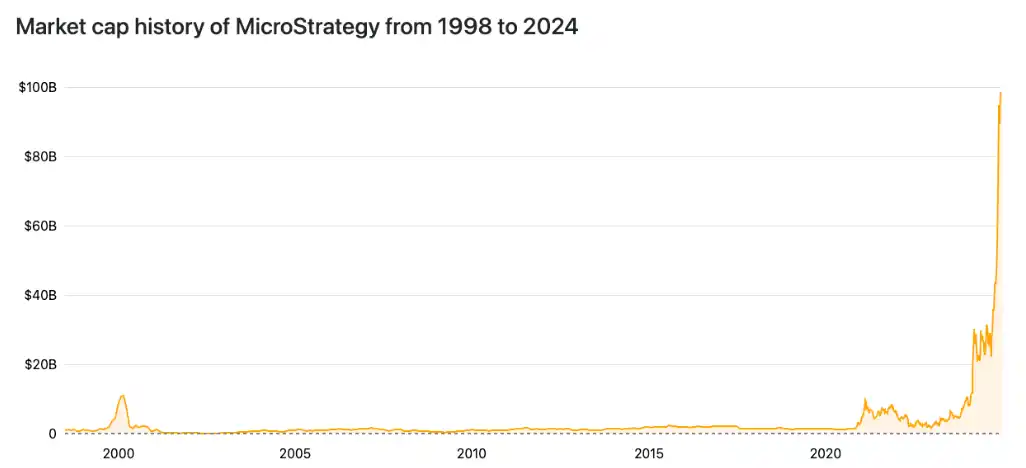
MicroStrategy’s market cap history from 1998 to 2024. Source: Companiesmarketcap
In addition, the ratio of Bitcoin to its total market cap turns its stock into a leveraged Bitcoin proxy.
According to the article, Amazon’s market cap is $2.4 trillion and Microsoft’s is $3.3 trillion, so its Bitcoin adoption effect would not be similar to MicroStrategy’s.
Cowen believes that Amazon is in no rush to adopt Bitcoin because its “core business is strong.” While reallocating some or all of its cash reserves into Bitcoin could provide a hedge against inflation, there are risks in deviating from its current financial strategy, which some shareholders may see as a potential burden on its profitable business model.
“The opportunity cost of holding a volatile asset like Bitcoin instead of investing in R&D or acquisitions would weigh heavily in a decision like this.”
“Putting a significant portion of funds in Bitcoin could impact Amazon’s ability to fund key growth areas like AWS, AI development, and logistics infrastructure,” he said. The shareholder vote will need to “strike a balance between speculative asset acquisitions and investments in key innovations that will determine Amazon’s competitive advantage.”
Bitcoin environmental issues could hold back shareholders
Big tech companies also have to consider public perception, as mainstream media has a big influence on their brands and stock prices. While Bitcoin's reputation has improved significantly, it is still associated with speculative trading assets, potential abuses and environmental issues.
"A negative PR narrative could obscure potential economic benefits, especially given Amazon's focus on ESG initiatives and its need to remain broadly appealing to stakeholders."
Amazon has revolutionized commerce by delivering goods quickly to your door. However, according to a 2022 report by environmental group Oceana, the impact of this model on the environment is alarming, generating more than 709 million pounds of plastic waste.
The company has pledged to achieve net zero carbon emissions by 2040, a decade ahead of the goals of the Paris Agreement.
The high energy consumption of Bitcoin mining has been heavily criticized by environmentalists. However, as mining infrastructure comes under more thorough scrutiny, that narrative is changing. Despite this shift, the risk of a PR backlash remains.
Amazon shareholders must decide whether the company can achieve positive results similar to Tesla or MicroStrategy by using Bitcoin to hedge against inflation, or whether it should avoid risk and focus on its core business model.
You may also like

Latest research from 13 top universities including Cornell University: The current state, challenges, and misconceptions of the fusion of Crypto and AI
Deconstructing Anthropic: The Best AI Company, Possibly Also a Type of Organizational Invention

Apollo and Blackstone Reportedly Back $35 Billion Anthropic Chip Financing as Deal Details Remain Unclear
On June 9, according to currently available news alerts, Apollo and Blackstone Group participated in a $35 billion financing for an Anthropic “chip project.” Based on the original wording of the report, the funding has already been raised, but public information remains limited. The financing structure, use of proceeds, project entity, and whether Apollo and Blackstone participated through equity, debt, or project financing have not yet been disclosed.

Humanity Protocol Security Incident Escalates: More Than $31 Million Stolen From Related Addresses as Attacker Continues Selling H for ETH
On June 9, according to monitoring by Onchain Lens, more than $31 million has been stolen from addresses linked to Humanity Protocol, and the attack is still ongoing, with the hacker continuously swapping H tokens for ETH. Project founder Terence Kwok later confirmed the security incident on X, saying the issue involved a private key leak.

Bloomberg: As Bitcoin Weakens, Stablecoins and RWA Continue to Drive Expansion in Crypto Businesses
In June, Bloomberg reported that despite Bitcoin falling below $60,000 last week, wiping out about $235 billion in market value within seven days, and dropping close to 50% from last year’s peak, some core businesses in the crypto industry are still expanding, mainly in stablecoins, real-world asset tokenization (RWA), payments, and infrastructure. The report also noted that overall altcoin activity has contracted significantly: altcoin market capitalization has fallen from a peak of about $431 billion in November 2021 to around $170 billion, and among the tens of millions of tokens issued in recent years, fewer than 1,700 still maintain meaningful trading activity.

Galaxy Deep Research Report: How Hyperliquid's HIP-4 Upgrade Changes the Landscape of Prediction Markets?
Binance Research: RWA Market Expected to Expand Nearly 6x from Early 2025, with Public Equities and Onchain Payments Heating Up Together
In June, Binance Research said in its monthly market report that the real-world asset (RWA) market is expected to grow by about 589% from the beginning of 2025. Bond- and money market fund-related RWA expanded by about $6.5 billion, up 83% year over year, while publicly traded equity RWAs grew by about 422%. The report also noted that monthly crypto debit card transaction volume exceeded $747 million in May, up 48.6% year to date.

Japan to Assess a Framework for Yen Stablecoins and Crypto ETFs as Asia’s Compliant Payments Narrative Heats Up
Recently, according to the original report, Japan is considering the launch of yen stablecoins and cryptocurrency ETFs. Public information remains limited at this stage, and there is still no complete policy text, regulatory draft, or clear implementation timeline, so this is better characterized as a “policy discussion” rather than formal implementation. The original wording also noted that advancing stablecoin regulation in Asia is driving XRP usage and supporting growth in the XRPL ecosystem. However, based on currently available public information, there is not enough evidence to directly establish a clear causal relationship between this round of discussion in Japan and XRP or XRPL.

ZachXBT: Humanity private key leak and abnormal surge in H token should be viewed separately
On June 9, according to related disclosures, on-chain investigator ZachXBT posted an update on Humanity’s roughly $31 million security incident, saying that after further analyzing fund flows, he currently tends to believe the project team was not involved in an “inside job” or a self-staged attack. According to him, the official explanation about the private key leak was broadly accurate, but before the token unlock, the price of H had been artificially pushed higher, and the hacker later took advantage of that market environment; therefore, the private key leak and the earlier abnormal price pumping should be regarded as two separate and independent events. This reframing has shifted the market’s understanding of the nature of the incident. Earlier discussion around Humanity had focused on whether the team directly participated in the attack or used the security incident to cover up internal operations. ZachXBT’s latest remarks shift the focus from “whether it was self-theft” to “whether there were pre-unlock market structure issues.” He also questioned whether the team may have.
Morning Report | OpenAI has submitted an S-1 registration statement draft to the U.S. SEC; Morpho completes $175 million financing

Morning Report | BitMine increased its holdings by 126,971 ETH last week; trader Eugene announced his exit from the crypto market

Wang Chuan: How can one not feel anxious after the neighbor Old Wang made thirty times profit by investing in storage stocks? (Seven) - A quarter-century cycle
Cryptocurrency CEXs are flocking to sell US stocks, and traditional brokerages are facing an "uninvited guest."
$75 billion in foreign capital has fled, and South Korean retail investors have absorbed it all using leverage

Japan’s Three Megabanks Plan Joint Stablecoin Issuance in Fiscal 2026
MUFG, SMBC, and Mizuho reportedly plan to jointly issue fiat-pegged stablecoins in fiscal 2026, signaling Japan’s growing push into bank-led digital payment infrastructure.

Humanity Discloses H Token Dual-Chain Attack Details, With Losses on Ethereum and BSC Exceeding $36 Million
Humanity said the H token attack across Ethereum and BSC caused more than $36 million in losses after leaked ProxyAdmin keys enabled malicious contract upgrades and token minting.
White House Discusses CLARITY Act With Law Enforcement Ahead of Senate Vote
The White House discussed the CLARITY Act with law enforcement ahead of a Senate vote, focusing on illicit finance risks and developer protections.

Bitcoin Trading Guide 2026: Strategies for Experienced Traders
Latest research from 13 top universities including Cornell University: The current state, challenges, and misconceptions of the fusion of Crypto and AI
Deconstructing Anthropic: The Best AI Company, Possibly Also a Type of Organizational Invention
Apollo and Blackstone Reportedly Back $35 Billion Anthropic Chip Financing as Deal Details Remain Unclear
On June 9, according to currently available news alerts, Apollo and Blackstone Group participated in a $35 billion financing for an Anthropic “chip project.” Based on the original wording of the report, the funding has already been raised, but public information remains limited. The financing structure, use of proceeds, project entity, and whether Apollo and Blackstone participated through equity, debt, or project financing have not yet been disclosed.
Humanity Protocol Security Incident Escalates: More Than $31 Million Stolen From Related Addresses as Attacker Continues Selling H for ETH
On June 9, according to monitoring by Onchain Lens, more than $31 million has been stolen from addresses linked to Humanity Protocol, and the attack is still ongoing, with the hacker continuously swapping H tokens for ETH. Project founder Terence Kwok later confirmed the security incident on X, saying the issue involved a private key leak.
Bloomberg: As Bitcoin Weakens, Stablecoins and RWA Continue to Drive Expansion in Crypto Businesses
In June, Bloomberg reported that despite Bitcoin falling below $60,000 last week, wiping out about $235 billion in market value within seven days, and dropping close to 50% from last year’s peak, some core businesses in the crypto industry are still expanding, mainly in stablecoins, real-world asset tokenization (RWA), payments, and infrastructure. The report also noted that overall altcoin activity has contracted significantly: altcoin market capitalization has fallen from a peak of about $431 billion in November 2021 to around $170 billion, and among the tens of millions of tokens issued in recent years, fewer than 1,700 still maintain meaningful trading activity.
Galaxy Deep Research Report: How Hyperliquid's HIP-4 Upgrade Changes the Landscape of Prediction Markets?


