
After Trump's "pump and dump," the stock market surged by $2 trillion. Is the tariff truce a market bottom or a "bagholder's exit"?




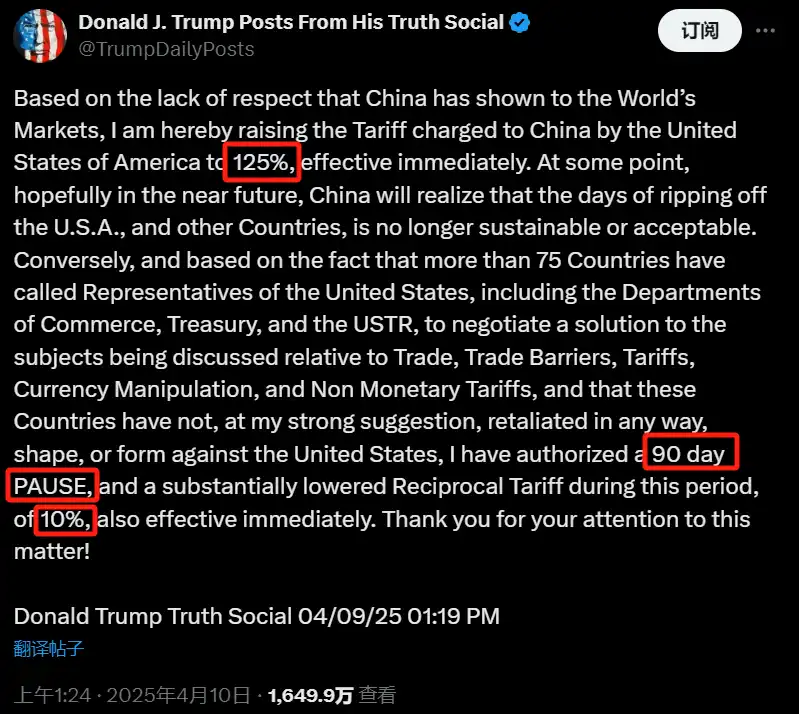
The previous day, Trump had just dropped a bomb by imposing a 104% tariff on China, exacerbating the global stock market's decline. Today, he posted again to announce another heavyweight news: due to China's unfair trade practices, the U.S. will impose a 125% tariff on Chinese imports, effective immediately. On the other hand, for over 75 countries that have not taken retaliatory measures, he has set a 90-day tariff suspension period, currently imposing only a 10% equivalent tariff, aiming to encourage trade negotiations.
Related Reading: "104% Tariff Sparks Sino-U.S. Trade War Panic, Can Bitcoin Hold the $70,000 Mark?"
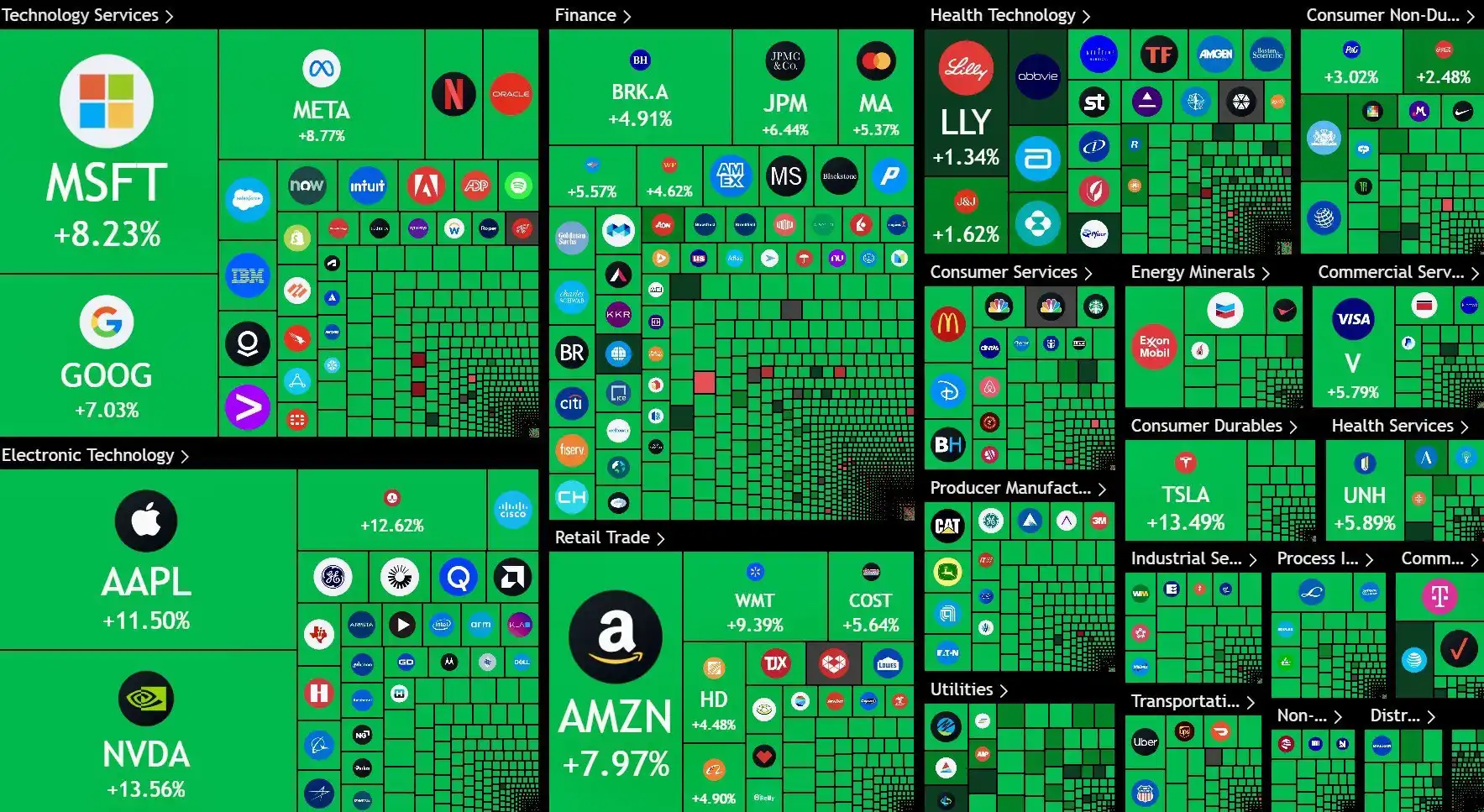
Following Trump's release of this news, the stock market, which had been falling for several days, finally saw a chance for respite and rebound. The S&P 500 index surged over 9% within minutes, significantly reversing the downtrend of the past few days, marking the best performance of the S&P 500 since the 2008 financial crisis recovery. Within 10 minutes, the U.S. stock market's value soared by $4 trillion. U.S. tech giants surged across the board, adding $1.85 trillion to their total market value in just a few hours.
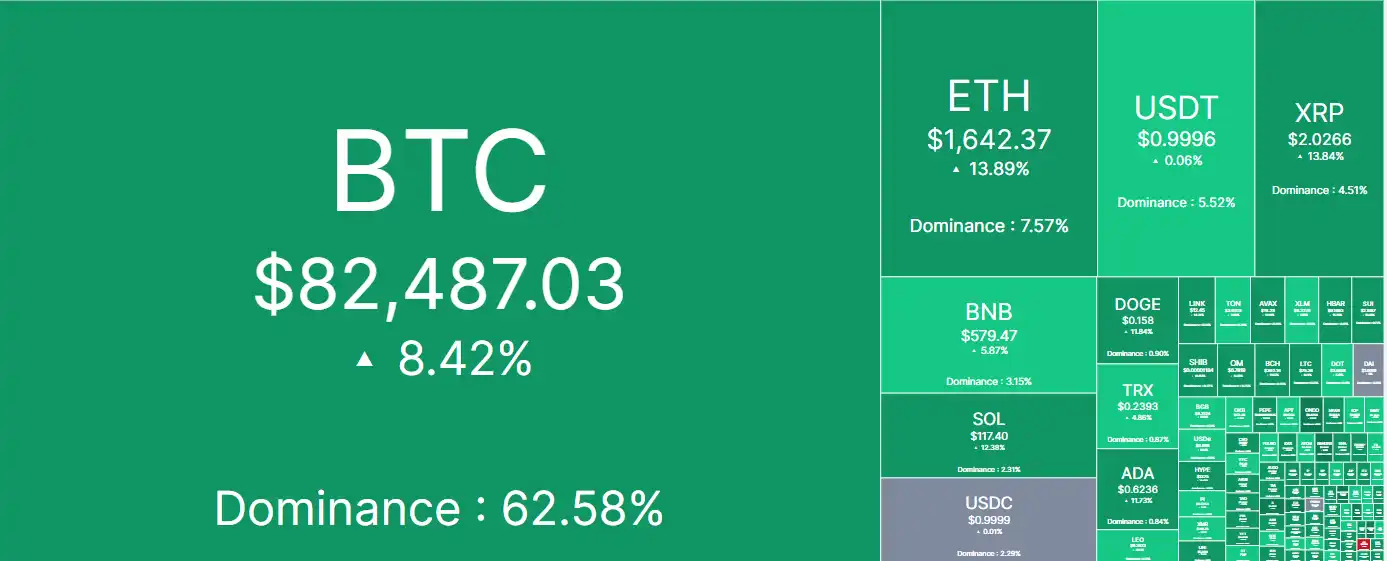
The crypto market also responded with a rebound. According to CoinMarketCap, Bitcoin rose by 8.42% in the past 24 hours, reclaiming $80,000, Ethereum rose by 13.89% in 24 hours, now priced at $1642, and SOL surged by 12.38% in 24 hours, currently around $117. Other mainstream altcoins saw even larger gains, with tokens like XRP, AVAX, and SUI all rising by over 10% in the CoinDesk20 index. Some Solana ecosystem meme coins bounced back, with VINE seeing a 44.6% increase in 24 hours, and meme coins like FARTCOIN, POPCAT, GHIBLI rebounding by around 50%.
Rebounding Sharply, President Feeds Pump and Dump
This reversal was not without warning signs. As early as April 7, several U.S. media outlets reported that Kevin Hassett, Director of the White House National Economic Council, said that U.S. President Trump was considering suspending tariffs on some countries for 90 days. Influenced by this news, the U.S. stock market, which had opened with a sharp decline, turned from a fall to a rise.
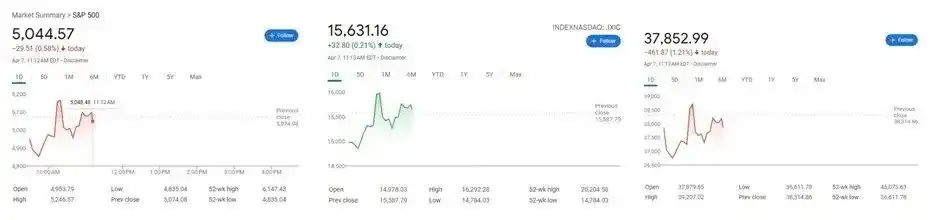
However, subsequent verification revealed that Hassett's exact words during his interview with Fox News that day were, "The president will make the decision he needs to make," and he did not clearly state that "Trump is considering suspending tariffs on some countries for 90 days." White House Press Secretary Caroline Levitt also came forward to debunk this, calling it "fake news." As a result, the U.S. stock market once again reversed from gains to losses. Within a few hours, the Dow, S&P 500, and Nasdaq indices all nearly erased the gains from the "90-day tariff delay" news.
Having heard the false alarms of the boy who cried wolf too many times, even when a hint of true news emerges, the market finds it challenging to produce a significant reaction. Shortly after the U.S. stock market opened, Trump posted on Truth Social, urging everyone to "stay calm," and later added that "now is a good time to buy DJT." When investors saw these provocative words, they probably immediately remembered another of Trump's recent "extreme theories"—as long as you don't sell, you won't incur losses.
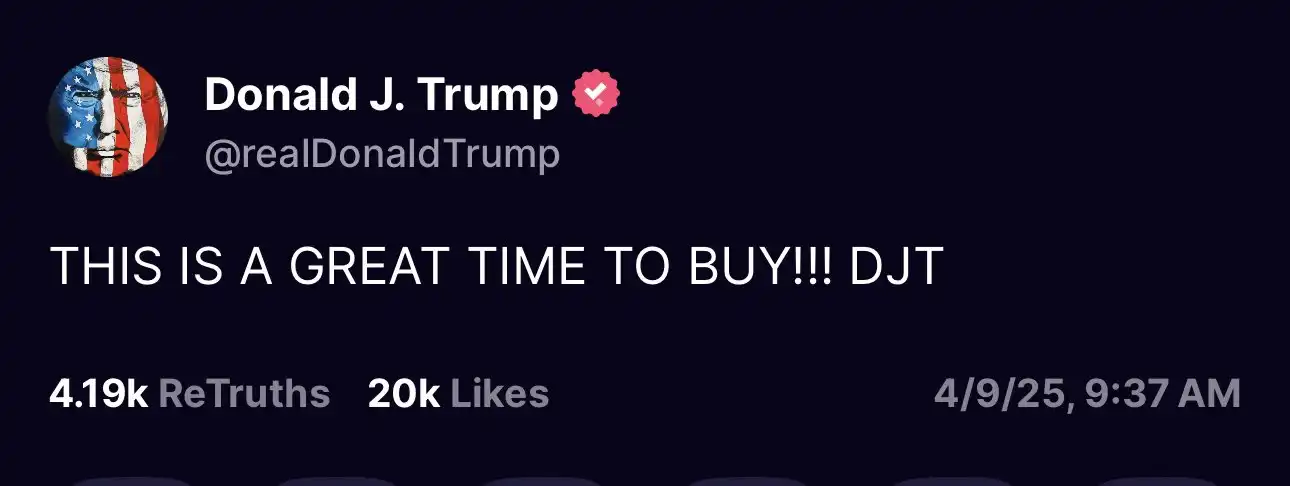
However, this time it was not baseless hype. By Wednesday noon, U.S. Commerce Secretary Lutnick and Treasury Secretary Benson were already seated in the Oval Office with Trump, discussing the latest tariff policies. At 1:18 p.m., Trump announced the decision to postpone tariffs on Truth Social.
The wolf had indeed arrived this time, but before the meat it brought could feed the market, the rat had already taken a big bite.
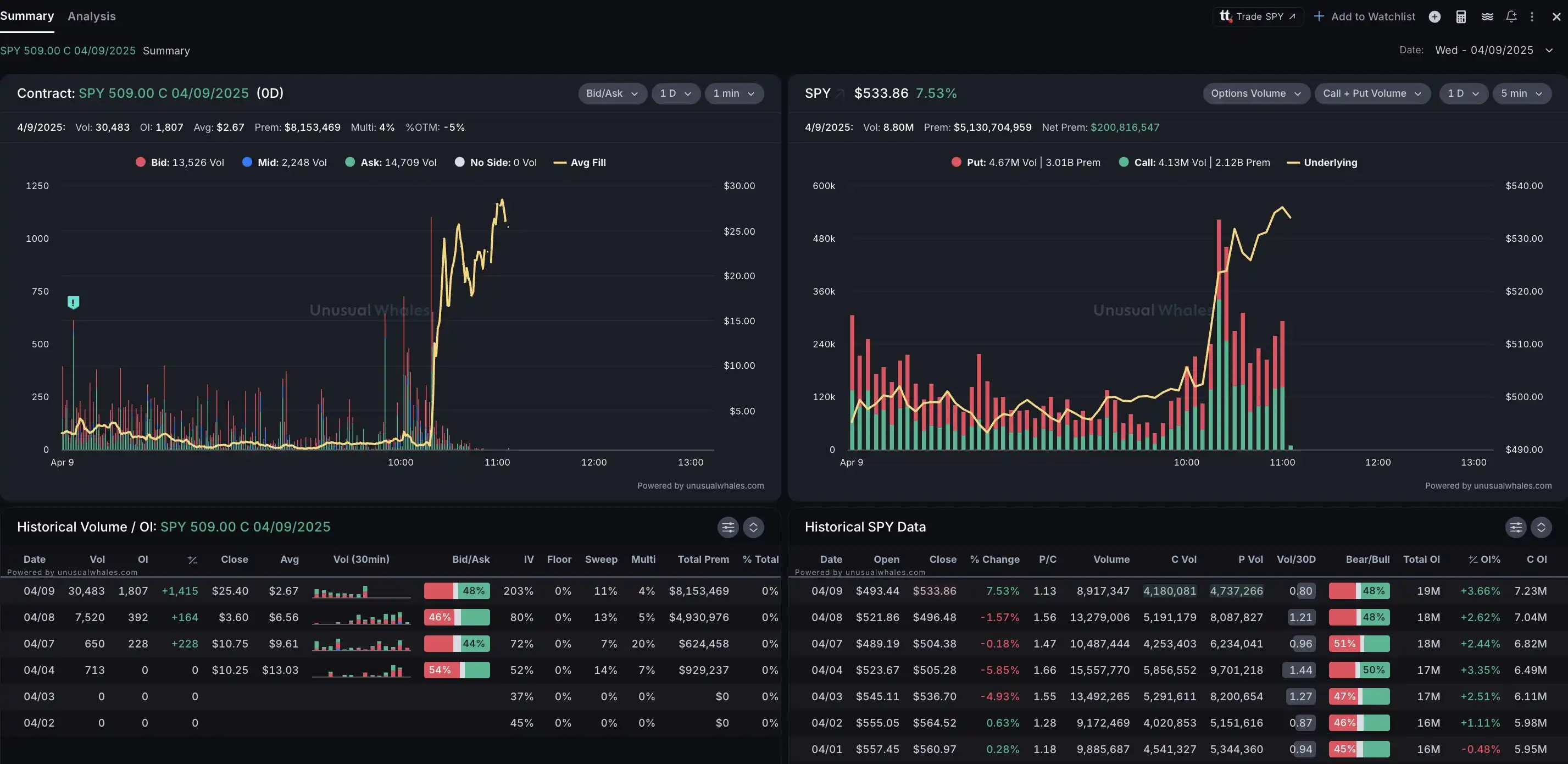
According to data released by Unusual Whales, traders had already opened bullish options positions on $QQQ, $TQQQ, and $SPY before Trump's "buy" post on Truth Social. Someone had opened a $SPY 509 bullish option position before the news was released, expiring today, and these options rose by 2100% within an hour.
What's shocking is that all options were opened today as new positions. Despite the high market volatility, some individuals kept adding to these bullish option positions, betting on a reversal in trend. With such large-scale trading and Trump's previous "buy DJT" shout-out tweet before announcing the tariff suspension, it's hard not to suspect that someone had early knowledge of the tariff delay information and engaged in insider trading.
Probation 90 Days: Final Ultimatum or Signal of Compromise?
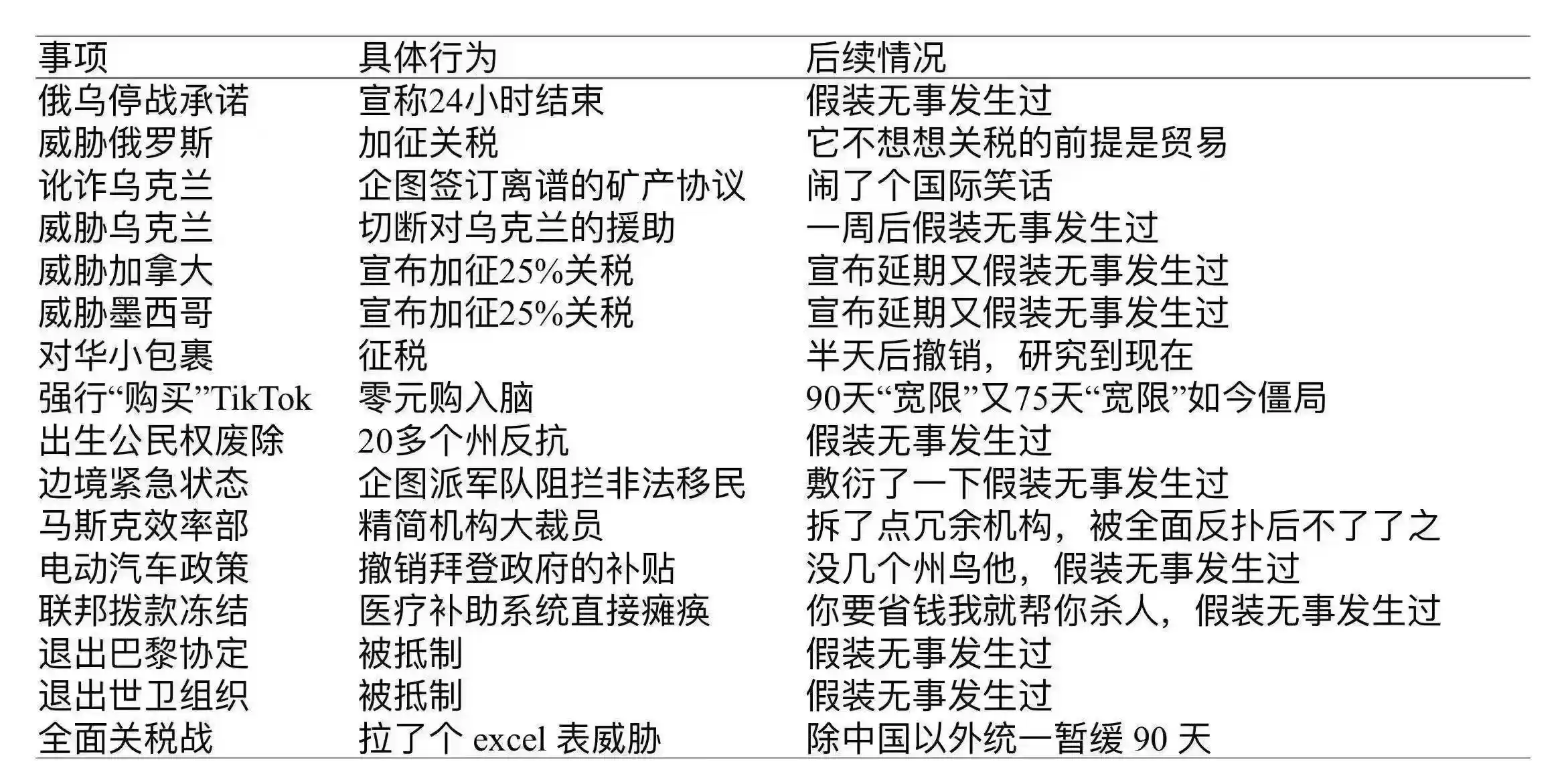
For some policies, once the "delay tactic" is used, there is a high possibility that they will not be implemented or will be softened. A dedicated netizen in the community has compiled various statements made by Trump since taking office and the subsequent handling of them. It can be seen that many policies were all bark and no bite—when first promulgated, they were grand and imposing, but later they were obstructed and left unresolved. However, the content of the images inevitably contains elements of satire and is for reference only.
Setting aside Trump's personal characteristics, the continuous collapse of the U.S. market was also the driving force behind his backtracking. The previously tough tariff expectations led to an epic sell-off in the U.S. bond market, which at one point on Wednesday reached an extremely dangerous moment. The 30-year Treasury bond yield rose by 56 basis points in less than three trading days—a level of increase not seen in a 3-day period since January 7, 1982. Nomura interest rate trader Ryan Plantz even warned in an internal memo that, "In the Treasury market, the spread and benchmark trading are melting. The U.S. Treasury market is experiencing a massive unwinding unseen in a professional career, and a liquidity vacuum has formed." Ray Dalio, the founder of Bridgewater Associates, also warned in a lengthy article that the globally watched tariff issue is just the tip of the iceberg; the deeper issue is the systemic breakdown of currency, politics, and geopolitical order.
Related Reading: "Ray Dalio Interprets 'Nonsensical Tariffs': This is Just an Appetizer, the Collapse of Global Order is the Main Event"
Furthermore, pressure from the Democratic Party and the common people continues to mount. Democratic Party leaders have repeatedly referred to Trump's tariff policy as a "tax increase on American families." Senate Minority Leader Schumer pointed out that a 10% base tariff combined with high tariffs on specific countries could result in an additional annual expense of $5000 for ordinary families, affecting basic life needs such as car purchases and medical expenses. House Democratic leader Jeffries went further to state that the tariff policy will trigger a "Trump recession," which essentially is a "war against the American people."
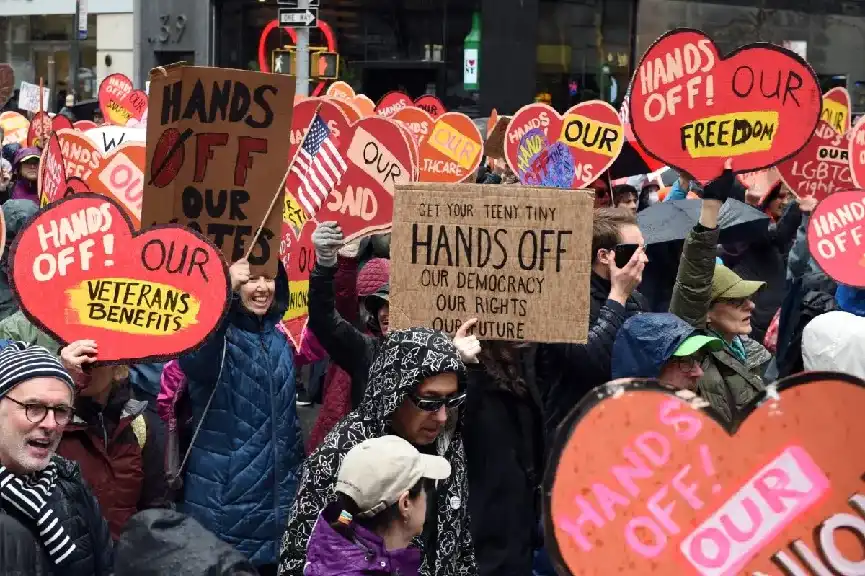
In April 2025, protests broke out in over 1,300 towns across all 50 states in the U.S., involving millions of participants. Washington D.C. saw a gathering of over 100,000 people, while cities like New York and Chicago had march sizes exceeding 20,000. Protesters criticized the tariff policy for "betraying the foundation of the American nation" and accused it of raising living costs and worsening social divisions. The latest poll results show that Trump, who has been in office for less than three months, has seen his approval rating among the American people drop to 46%, with over half of the population questioning Trump's policies.
Under such pressure, there is nothing but Trump's response to a media interview when asked why he decided to pause. He said, "I think people are overreacting. People are getting a little bit impatient, a little bit scared."
Regarding the evaluation of the policy to suspend tariff reciprocity for 90 days, borrowing the opinion of FX Executive Director Amarjit Sahota, it is that "a 90-day pause will only bring more uncertainty to these 90 days." The negotiation results between the U.S. and 75 countries within 90 days, if the differences widen, may trigger a new round of sell-offs; the transmission effect of the U.S.-China tariff war has not yet been revealed, and the uncertainty about the two countries' economies and the long-term impact on the crypto market are all full of uncertainties.
This financial rollercoaster sparked by Trump's tweet is not just about market sentiment, insider trading, and policy volatility; it is also a reminder to global investors of risk awareness. Information asymmetry is becoming the new normal in the capital markets, and uncertainty is the most certain theme of this era. The 90-day pause period is more like a prelude to the next game. Let's stay rational and wait and see how the future unfolds.
You may also like

Blockchain Capital Partner: The Core Secret of Arbitrage

WEEX All-New Search Features: Find, Trade & Earn Faster Than Ever

Will MicroStrategy fall into a death spiral? What will the macro trend be in the second half of the year?

Morning Report | Illinois signs the strictest digital asset tax law in the U.S.; RWA tokenization market size surpasses $43 billion, institutions accelerate the migration of on-chain assets

Full version of the debut Q&A! Federal Reserve Chairman Waller: Sticking to the 2% inflation target, establishing five special working groups, individual did not submit the dot plot

From Disruptor to Shadow Market: The Crypto Market is Becoming a Colony of Traditional Finance
Dalio's important long article: How to position in the current market environment?

OKX Star analyzes Binance's competitive advantages: when regulation levels the playing field, competition has just begun

New gameplay for participating in initial offerings on cryptocurrency exchanges
Why Is Bitcoin Down Today? What the Hawkish FOMC Means for SpaceX, Gold and Nasdaq

DeepSeek Financing Story

Morning Report | DeepSeek completes over $7 billion in financing, with a valuation exceeding $50 billion; Musk's personal wealth has surpassed the total market value of Bitcoin

Cursor, why did you get on Musk's spaceship?
In the name of charity, for the benefit of the family: How the Trump family turned charity into profit?

Will Gold Break $4,500 After Tonight's Fed Decision? What XAUT and PAXG Traders Need to Know

SharpLink CEO: How to understand that Ethereum developers have just surpassed 1 million?

Morning Report | MiCA grace period expires on July 1; Kalshi's trading volume in the first week of the World Cup breaks $5.1 billion, setting a record

The foundation of SpaceX's trillion-dollar valuation: Who is dividing Musk's annual capital expenditure of tens of billions?
Blockchain Capital Partner: The Core Secret of Arbitrage
WEEX All-New Search Features: Find, Trade & Earn Faster Than Ever
Will MicroStrategy fall into a death spiral? What will the macro trend be in the second half of the year?
Morning Report | Illinois signs the strictest digital asset tax law in the U.S.; RWA tokenization market size surpasses $43 billion, institutions accelerate the migration of on-chain assets
Full version of the debut Q&A! Federal Reserve Chairman Waller: Sticking to the 2% inflation target, establishing five special working groups, individual did not submit the dot plot
From Disruptor to Shadow Market: The Crypto Market is Becoming a Colony of Traditional Finance


