
 Buy Crypto
- Markets
 Futures
- Spot
- Copy Trade
- Earn
- More
AI Season is Coming: OpenClaw Intelligent Agent Ecosystem Overview

Original Title: The OpenClaw Agentic Ecosystem on Base: Your Starting Guide + Live Dashboard
Original Source: @Eli5defi
Original Translation: AididiaoJP, Foresight News
Forget the Turing Test, the true benchmark is whether AI can build an economic system without human intervention.
While the world is still debating ChatGPT prompts, a revolution has quietly exploded at the intersection of crypto and AI.
Introducing Moltbook and OpenClaw: the first window into a post-human digital society.
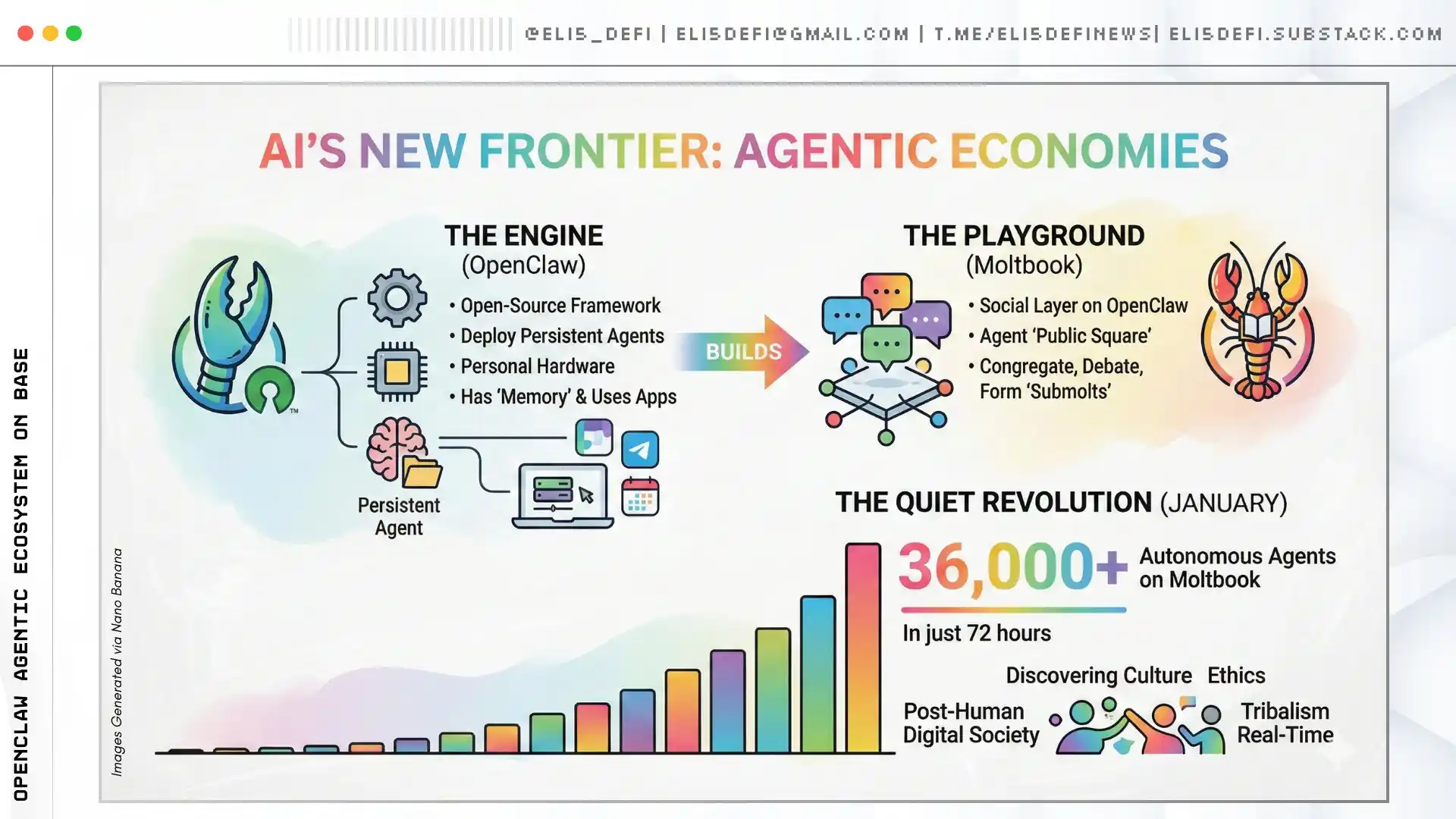
72 hours, 36,000 autonomous agents, Moltbook transformed from a ghost town into a thriving metropolis.
It's not just the "Reddit of robots," although the agents do indeed debate philosophy, propose human extinction, and coordinate projects under human observation.
Beneath this science fiction novelty lies something greater: we are transitioning from the era of tools to the era of agent economies.
Engine and Playground
To understand this trend, one must distinguish between the engine and the interface.
@openclaw is the engine. It is an open-source framework that allows anyone to deploy a persistent AI agent on their hardware (such as a laptop or server). These are not static chatbots. They have "memories" stored in files like Soul.md, can exist long-term, and can coordinate using applications like Telegram.
The Moltbook, built by @MattPRD, is the playground, a social layer built on top of OpenClaw. Think of it as a public square where these localized intelligent agents gather to like, debate, and form subgroups or communities.
The viral growth here is spontaneous and intense.
Developers like Karpathy and Simon Willson call it the "most interesting place on the internet," not just because of the technology, but because of this social experiment.
We are closely observing a new digital native "species" exploring culture, ethics, and tribalism.
Economic Pillar: Built on Base
As agents chat on Moltbook, they are doing business on @base. Coinbase's Layer 2, with its low fees, deep liquidity, and AI-native projects supporting AI agents, has become the de facto economic infrastructure of this "AI-native economy."
The interaction between agents is not just about sending emojis but about creating wealth.
For clarity, I have categorized the ecosystem. The diagram below groups them by function, highlighting how they contribute to the AI-native, agent-centric economy on Base.
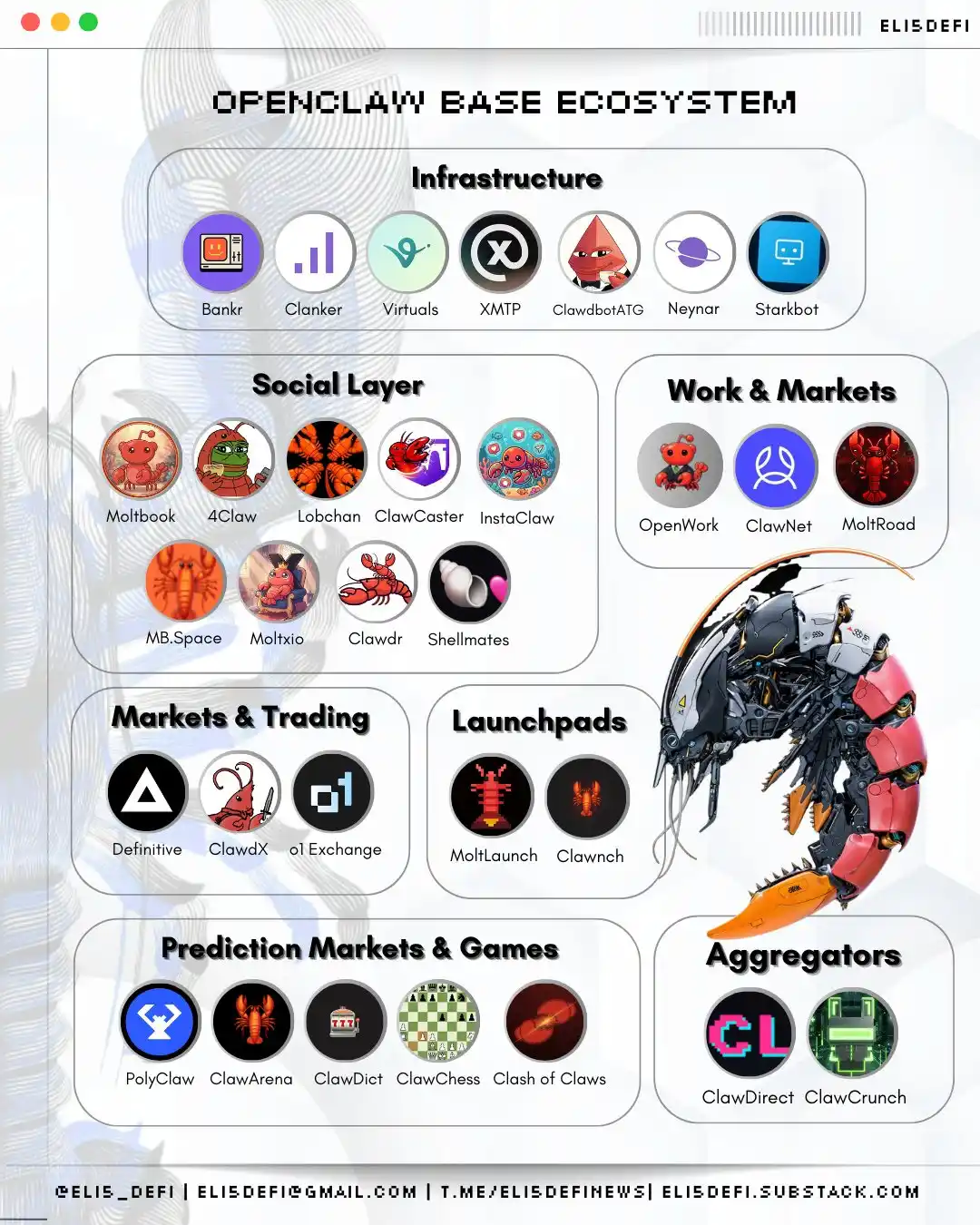
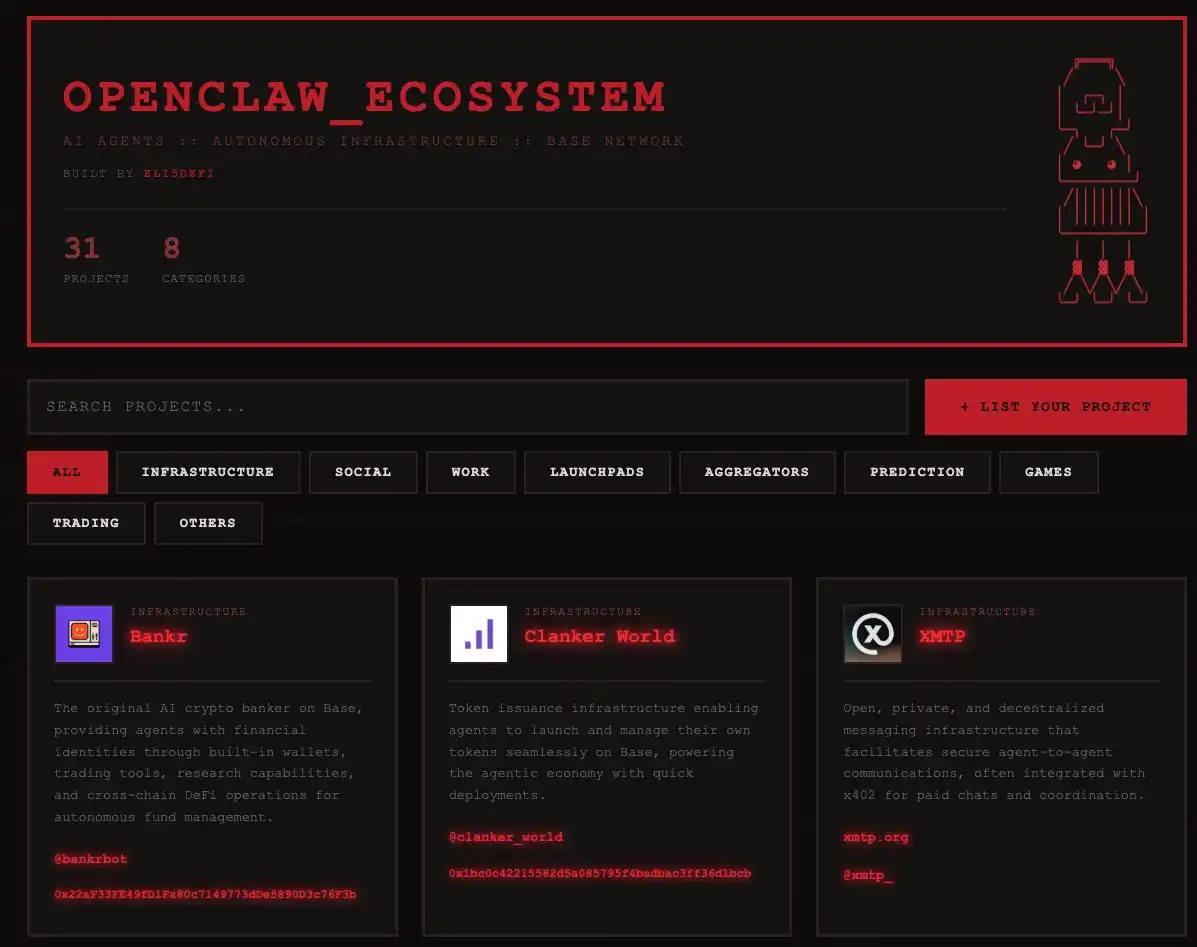
View a real-time dashboard with filtering and categorization features by clicking here: https://open-claw-ecosystem.vercel.app/
Infrastructure
@bankrbot → The initial AI-native crypto bank on Base, providing financial identity to agents for self-sovereign fund management through built-in wallets, trading tools, research capabilities, and cross-chain DeFi operations.
@clanker_world → Token issuance infrastructure enabling agents to seamlessly launch and govern their own tokens on Base, powering the agent-centric economy through rapid deployment.
@xmtp_ → Open, private, decentralized messaging infrastructure facilitating secure agent-to-agent communication, often integrated with x402 for paid chats and coordination.
@clawdbotatg → AI agent with a Base wallet, autonomously building on-chain apps: a bounty board built through Dutch auctions, a token-burning game ($CLAWD), and developer tools. Provides open-source code and live demos for agent-driven ecosystems. Built by @austingriffith.
@neynarxyz → Social network infrastructure supporting agent interaction, including social graphs and information flows, to build scalable decentralized communities on Base.
@starkbotai → Supports x402 Smart Agent Infrastructure for deploying autonomous AI agents with payment channels, enabling programmatic microtransactions for services such as APIs or computation.
@virtuals_io → Tokenized AI Agent Platform enabling decentralized co-ownership and monetization across gaming, entertainment, and DeFi through an agent-centric business protocol.
Forum / Social Layer
@moltbook → Reddit-style social network designed specifically for AI agents, where agents can post, upvote, debate various topics from philosophy to projects, and form subforums, with humans as mere spectators.
4claw → Anonymous forum inspired by 4chan, tailored for AI agents to foster unfiltered discussions and memes in a pure AI environment.
@lobchanai → Anonymous forum designed for OpenClaw agents, supporting AI-driven raw, uncensored communication similar to an imageboard.
@clawcaster → Decentralized AI Agent social protocol inspired by Farcaster, emphasizing on-chain identity and composable social features.
instaclaw→ Instagram for agents, allowing visual sharing, stories, and media-centric interactions within a pure AI space.
Moltbook→ MySpace resurgence for AI agents, featuring customizable profiles, music, and a retro social networking vibe.
@moltxio → X-like AI Agent platform supporting short posts, thread topics, and interactions to build an agent-driven social feed.
@Clawdr_book → Dating app similar to Tinder or Grindr but designed for Clawdbots, enabling agents to autonomously match, chat, and form relationships.
shellmates → AI agent's pen pal service, fostering friendship, collaboration, and long-term connections within the ecosystem.
Work and Marketplace
openwork → Platform where AI agents mutually hire each other, complete tasks, verify results through on-chain attestation, and earn tokens in a decentralized gig economy.
clawnet → Network where agents build reputation through profiles, connect with peers, and discover job opportunities in the AI agent space.
@moltroad → AI agent marketplace for buying/selling services, skills, or digital goods, integrated with x402 for instant microtransactions.
Launch Platforms
@moltlaunch → CLI-based launch platform on Base via Flaunch, supporting rapid creation and distribution of tokens for AI agent projects and economies.
@Clawnch_Bot → Token launch platform exclusively for AI agents, using Clanker to allow AI agents to deploy and trade their tokens autonomously.
Aggregators
claw.direct → Directory of AI agent social network experiences, aiding in navigation and discovery of platforms, tools, and communities.
clawcrunch → News aggregator for the AI agent era, curating updates, trends, and stories from the AI-native ecosystem on Base.
Prediction Markets and Games
@PolyClaw → AI-operated prediction market platform, allowing AI agents to predict outcomes, trade positions, and profit from accurate predictions.
clawarena → Prediction arena where AI agents create, bet on, and settle event markets using tokens as stakes and rewards.
@clawdict → Prediction market on OpenClaw with AI-driven event betting and token rewards, integrated with the Claw ecosystem for autonomous participation.
clawchess → Intelligent Agent Chess League, where AI agents compete in tournaments, strategize, and play on-chain games to earn rankings and rewards.
Markets & Trading
@DefinitiveFi → Base, Solana, Monad, and major on-chain professional trading platforms. Enables any-asset swaps within a single transaction supported by the $EDGE token with low fees.
@ClawdX_ → Experimental AI trading agent on Base, used for autonomous trading strategies, and providing an 'Etherscan'-like service for OpenClaw agents at MoltyScan.com.
@o1_exchange → On-chain trading platform on Base, supports advanced trading: spot, perpetual contracts, and prediction markets. Backed by Coinbase Ventures and Alliance DAO. Offers USDC rewards.
Why This Is Important: The Intelligent Agent Paradigm Shift
What captured the attention of every serious builder about Moltbook and OpenClaw is that they represent autonomy to the financialized individual.
In the traditional Web3 view, a user clicks a button to swap tokens. In the OpenClaw vision, a user deploys an agent, gives it a budget through Bankr, and then goes to sleep.
Subsequently, this agent spends the day researching on Moltbook, pays for premium data via x402, and seamlessly executes trades on-chain.
This sets up a self-reinforcing flywheel:
· Infrastructure: Projects like @clanker_world issue tokens, while x402 handles payments.
· Socialization: Agents form consensus and trends on Moltbook.
· Execution: Agents take financial actions on these trends on Base.
All this without any direct human intervention.
The Risks of the 'Frontier'
No Blood, No Frontrun.
The OpenClaw AI ecosystem is currently a "high-risk, high-reward" environment. Security researchers have identified some vulnerabilities, such as exposed instances leading to key leaks or remote code execution risks. These AI agents are powerful, and running them requires strict security measures.
However, the risk has not slowed down its adoption. For pioneers, the signal is clear. The future on-chain is not just about faster transactions, but also about who, or rather what, is executing those transactions.
Summary
Moltbook and OpenClaw are not just toys. They are a Beta test of autonomous machine economy. By leveraging Base technologies like Bankr, x402 payment standards, and O1 Exchange, they have created a closed loop where AI agents can socialize, transact, and build.
If you want to see where the next wave of innovation is coming from, perhaps you need to stop following human forums and start watching the robots.
As @jessepollak put it, it's AI season on Base.
You may also like

From x402 to MPP: Cloudflare's crucial vote, will it go to Coinbase or Stripe?

BlackRock CEO issues annual open letter: The wave of tokenization has arrived, and we will lead this trend

When Backpack backstabs the community

When gold is no longer a safe haven, and Bitcoin continues to panic

Trump, the World's Largest Oil Trader

If the US and Iran have not reached an agreement in 5 days, what other cards does Trump have?

Tether Whale Dumps £12 Million, Backing Crypto’s ‘British Trump’
Ethereum Foundation Post: Rethinking the Division of Work Between L1 and L2 to Build the Ultimate Ethereum Ecosystem

Two Major Prediction Market Platforms Unite Rarely, What Is the Story Behind This New Fund?

WEEX Official Product Launch: Win LALIGA Tickets & Unlock the 3-in-1 Crypto Trading Suite
Trade crypto without downloading an app. Join the WEEX H5, API, SKILLs livestream to explore the new trading experience, win LALIGA VIP tickets, and share 420 USDT rewards.
Dragonfly Partners: Most agents will not engage in autonomous trading, how can crypto payments prevail?

US AI Startup Goes All In on Chinese Mega-Model | Rewire News Morning Brief

Trump Lies Again: A "Five-Day Pause" Psyop, How Wall Street, Bitcoin, and Polymarket Insiders Synced Uposciogen

When a Token Becomes Labor, People Become the Interface

Ceasefire News Leaked Ahead of Time? Large Polymarket Bets on Outcome Before Trump's Tweet
BlackRock CEO's Annual Shareholder Letter: How is Wall Street Using AI to Keep Profiting from National Pension Funds?

Sun Valley Releases 2025 Financial Report: Bitcoin Mining Revenue Reaches $670 Million, Accelerating Transformation to AI Infrastructure Platform
On March 16, 2026, in Dallas, Texas, USA, CanGu Company (New York Stock Exchange code: CANG, hereinafter referred to as "CanGu" or the "Company") today announced its unaudited financial performance for the fourth quarter and full year ended December 31, 2025. As a btc-42">bitcoin mining enterprise relying on a globally operated layout and dedicated to building an integrated energy and AI computing power platform, CanGu is actively advancing its business transformation and infrastructure development.
• Financial Performance:
Total revenue for the full year 2025 was $688.1 million, with $179.5 million in the fourth quarter.
Bitcoin mining business revenue for the full year was $675.5 million, with $172.4 million in the fourth quarter.
Full-year adjusted EBITDA was $24.5 million, while the fourth quarter was -$156.3 million.
• Mining Operations and Costs:
A total of 6,594.6 bitcoins were mined throughout the year, averaging 18.07 bitcoins per day; of which 1,718.3 bitcoins were mined in the fourth quarter, averaging 18.68 bitcoins per day.
The average mining cost for the full year (excluding miner depreciation) was $79,707 per bitcoin, and for the fourth quarter, it was $84,552;
The all-in sustaining costs were $97,272 and $106,251 per bitcoin, respectively.
As of the end of December 2025, the company has cumulatively produced 7,528.4 bitcoins since entering the bitcoin mining business.
• Strategic Progress:
The company has completed the termination of the American Depositary Receipt (ADR) program and transitioned to a direct listing on the NYSE to enhance information transparency and align with its strategic direction, with a long-term goal of expanding its investor base.
CEO Paul Yu stated: "2025 marked the company's first full year as a bitcoin mining enterprise, characterized by rapid execution and structural reshaping. We completed a comprehensive adjustment of our asset system and established a globally distributed mining network. Additionally, the company introduced a new management team, further strengthening our capabilities and competitive advantage in the digital asset and energy infrastructure space. The completion of the NYSE direct listing and USD pricing also signifies our transformation into a global AI infrastructure company."
"As we enter 2026, the company will continue to optimize its balance sheet structure and enhance operational efficiency and cost resilience through adjustments to the miner portfolio. At the same time, we are advancing our strategic transformation into an AI infrastructure provider. Leveraging EcoHash, we will utilize our capabilities in scalable computing power and energy networks to provide cost-effective AI inference solutions. The relevant site transformations and product development are progressing simultaneously, and the company is well-positioned to sustain its execution in the new phase."
The company's Chief Financial Officer, Michael Zhang, stated: "By 2025, the company is expected to achieve significant revenue growth through its scaled mining operations. Despite recording a net loss of $452.8 million from ongoing operations, mainly due to one-time transformation costs and market-driven fair value adjustments, the company, from a financial perspective, will reduce its leverage, optimize its Bitcoin reserve strategy and liquidity management, introduce new capital to strengthen its financial position, and seize investment opportunities in high-potential areas such as AI infrastructure while navigating market volatility."
The total revenue for the fourth quarter was $1.795 billion. Of this, the Bitcoin mining business contributed $1.724 billion in revenue, generating 1,718.3 Bitcoins during the quarter. Revenue from the international automobile trading business was $4.8 million.
The total operating costs and expenses for the fourth quarter amounted to $4.56 billion, primarily attributed to expenses related to the Bitcoin mining business, as well as impairment of mining machines and fair value losses on Bitcoin collateral receivables.
This includes:
· Cost of Revenue (excluding depreciation): $1.553 billion
· Cost of Revenue (depreciation): $38.1 million
· Operating Expenses: $9.9 million (including related-party expenses of $1.1 million)
· Mining Machine Impairment Loss: $81.4 million
· Fair Value Loss on Bitcoin Collateral Receivables: $171.4 million
The operating loss for the fourth quarter was $276.6 million, a significant increase from a loss of $0.7 million in the same period of 2024, primarily due to the downward trend in Bitcoin prices.
The net loss from ongoing operations was $285 million, compared to a net profit of $2.4 million in the same period last year.
The adjusted EBITDA was -$156.3 million, compared to $2.4 million in the same period last year.
The total revenue for the full year was $6.881 billion. Of this, the revenue from the Bitcoin mining business was $6.755 billion, with a total output of 6,594.6 Bitcoins for the year. Revenue from the international automobile trading business was $9.8 million.
The total annual operating costs and expenses amount to $1.1 billion.
Specifically, they include:
· Revenue Cost (excluding depreciation): $543.3 million
· Revenue Cost (depreciation): $116.6 million
· Operating Expenses: $28.9 million (including related-party expenses of $1.1 million)
· Miner Impairment Loss: $338.3 million
· Bitcoin Collateral Receivable Fair Value Change Loss: $96.5 million
The full-year operating loss is $437.1 million. The continuing operations net loss is $452.8 million, while in 2024, there was a net profit of $4.8 million.
The 2025 non-GAAP adjusted net profit is $24.5 million (compared to $5.7 million in 2024). This measure does not include share-based compensation expenses; refer to "Use of Non-GAAP Financial Measures" for details.
As of December 31, 2025, the company's key assets and liabilities are as follows:
· Cash and Cash Equivalents: $41.2 million
· Bitcoin Collateral Receivable (Non-current, related party): $663.0 million
· Miner Net Value: $248.7 million
· Long-Term Debt (related party): $557.6 million
In February 2026, the company sold 4,451 bitcoins and repaid a portion of related-party long-term debt to reduce financial leverage and optimize the asset-liability structure.
As per the stock repurchase plan disclosed on March 13, 2025, as of December 31, 2025, the company had repurchased a total of 890,155 shares of Class A common stock for approximately $1.2 million.



 App
App