
- Buy Crypto
- Markets
 Futures
- Spot
- Copy Trade
- Earn
- More
Bitcoin and WW3: 5 Key Indicators as BTC Eyes Global Liquidity Boom

Key Takeaways
- Bitcoin remains resilient amidst geopolitical tensions, sustaining above key support levels.
- Drastic decline in Bitcoin exchange reserves indicates a supply shock.
- Institutional investment via BTC ETFs is accelerating, providing a market buffer.
- With global liquidity expansion, Bitcoin’s price trajectory aligns with historic upward trends.
- BTC exhibits geopolitical resilience, even amid energy price volatilities.
WEEX Crypto News, 2026-03-03 18:21:56
In the ever-evolving landscape of cryptocurrency, Bitcoin (BTC) has emerged as a chronicler of global sentiment, especially in times marked by tension and uncertainty. The latest geopolitical developments, characterized by fears of a looming World War 3, underscore this sentiment. Yet, Bitcoin continues to defy expectations, steadfastly holding its bullish ground above the $60,000 threshold. This current market scenario leans towards a liquidity-fueled breakout, diverging starkly from a capitulation event.
Focusing past initial volatility, market participants are gearing towards resilience, with key supply mechanisms favoring bullish trends. Recent dips in the market, particularly the one teetering close to $63,000 over the weekend, were short-lived as buyers swooped in, rejecting further declines. Such price movements reveal the market’s increasing immunity to sensational headlines, and a renewed focus on monetary catalysts typically ushering in bullish phases during the year’s final quarter. Therefore, investors are caught in an intense narrative tussle: the uncertainty of global politics versus established, unyielding on-chain strength. Let’s delve deeper into the five crucial indicators demonstrating Bitcoin’s fortitude in the face of global uncertainties.
Indicator 1: Bitcoin Exchange Reserves and a Supply Shock
The first noteworthy indicator is the conspicuous drawdown of Bitcoin Exchange Reserves, a paramount on-chain metric. Reports from CryptoQuant highlight a sharp plunge in reserves to roughly 2.6 million BTC, a threshold not seen since 2018. This trend marks a structural supply crunch that commands attention.
When bitcoins migrate off exchanges to reside in cold storage or custody solutions, they effectively exit the pool of actively tradable supply. The ramifications here are straightforward: with fewer coins available for sale, the buy volume required to drive prices upward is significantly reduced. Historical patterns reveal that such precipitous declines in exchange balances often precede what is known as “supply shock” rallies. This phenomenon implies that while investors with weak conviction might capitulate to fear-inducing headlines, those with long-term visions are shifting their assets off-exchange, illustrating a transition of wealth from the impetuous to high-conviction stakeholders who appreciate the scarcity principle of the Bitcoin halving cycle.
Indicator 2: Institutional Demand via Bitcoin ETF Inflows
Despite prevalent bearish sentiment across social media platforms, institutional demand provides robust support against spot market fluctuations. Spot Bitcoin ETF inflows offer a narrative that contradicts short-term pessimism, as evidenced by net inflows neutralizing selling pressures last week alone — seeing an influx of $787.3 million, according to SoSoValue data.
Major funds, such as BlackRock’s IBIT, continue to attract significant capital, despite a period of sideways price movement. This phenomenon of price depreciation paired with rising inflows is indicative of classic accumulation behavior. Institutional buyers are not merely maintaining their interests; they are amplifying their buying efforts amid price dips. Complementing this institutional foundation, significant financial entities are expanding their crypto-related infrastructures. Morgan Stanley, for instance, has initiated direct holdings of client crypto assets, suggesting a persistent focus of “smart money” on long-term adoption rather than succumbing to short-term geopolitical clamor.
Indicator 3: Bitcoin Breaking Downtrends Amidst Global Tensions
From a technical perspective, Bitcoin maintains its vigor by holding key price levels. The weekend dip finding support short of testing the critical $60,000 psychological barrier provided an avoidable buying opportunity that some traders had anticipated.
According to insights from Trader CrypNuevo on X, a descent towards the $60,000 to $61,000 range was identified as a prime occasion for purchasing. However, market movements preempted this course, evidencing a readiness amongst investors to seize advantages. The robustness at the $60k mark demarcates the boundary; retention fosters pathways back to six-figure price marks by the summer, while a breach might invite consideration of lower thresholds such as $55,000.
Indicator 4: The Role of Global Liquidity and Central Bank Policies
In its essence, Bitcoin functions as a receptacle for liquidity. The current augmentation of global liquidity, particularly through M2 — encompassing cash, checking deposits, savings, and analogous assets — serves as a macroeconomic tailwind often underestimated by bearish traders.
Worldwide, central banks, including the European Central Bank (ECB) and the Federal Reserve (Fed), are either signaling or implementing rate cuts. Such actions lower capital costs, resulting in reallocation from low-risk assets into growth-driven vehicles. Historically, Bitcoin’s explosive surges have aligned with M2 expansion cycles. Presently, global markets find themselves in the nascent phases of such a cycle. While inflation indicators might temper the Fed’s plans temporarily, the overarching trend remains crystal clear: the activation of money printers is underway. Given the traditional delay between liquidity injections and Bitcoin price ascensions, we can expect today’s influx to materialize in asset valuations across Q4 2024 and Q1 2025. Betting against these liquidity cycles is synonymous with ignoring the fundamental engines propelling crypto markets.
Indicator 5: Bitcoin’s Geopolitical Resilience Amid WW3 Concerns
The marketplace’s current reaction to mounting tensions in the Middle East reaffirms Bitcoin’s stature as “digital gold,” albeit accompanied by significant volatility. The initial sell-off was promptly countered by a swift Bitcoin recovery, eradicating nearly all declines within two days. This V-shaped recovery typifies a resilient bull market that analysts are increasingly viewing not through the lens of impending global conflict but through narratives of regional containment, therein limiting downside risks for high-risk assets.
Nonetheless, cryptocurrencies continue to be interlinked with energy market volatility. Increased oil prices in response to Iranian pressures stoke inflation expectations, potentially complicating the Fed’s economic strategies. Yet, Bitcoin’s recent performance suggests a detachment from these correlations, driven more by unique crypto flows than traditional economic triggers such as petrodollar dynamics.
CoinGlass data demonstrates the recent market dip efficiently reset overextended long positions, thereby rejuvenating open interest to more sustainable levels. The market currently presents a lighter, refreshed state prepared for organic price discovery devoid of excessive leverage pressures. Ultimately, given institutional accumulation backing the market floor and the ongoing depletion of Bitcoin Exchange Reserves, the likely path forward — even amidst WW3 fears — is upwards. The Bitcoin market has presumably already adjusted to the shock of these conflicts, presently awaiting the much-anticipated liquidity surge to propel further growth.
FAQ
What causes a supply shock in Bitcoin?
A supply shock in Bitcoin generally stems from a significant reduction in the number of bitcoins available for trade on exchanges. This can happen when coins are transferred to cold storage or private custody, reducing the immediate tradable supply and potentially leading to price increases as demand remains constant or increases.
How do Bitcoin ETFs influence the market?
Bitcoin ETFs can influence the market by attracting institutional investments, which provide substantial capital inflows that can stabilize or increase Bitcoin prices. These funds allow investors to gain exposure to Bitcoin without direct ownership, contributing to increased market liquidity and supporting higher price levels.
Why is Bitcoin seen as a safe haven during geopolitical tensions?
Bitcoin is often viewed as a safe haven due to its decentralized nature, which immunizes it against government interference and traditional market turmoil. Its scarcity and perceived value as “digital gold” make it attractive during geopolitical uncertainties, despite its inherent price volatility.
How does global liquidity expansion affect Bitcoin pricing?
Global liquidity expansion, often through central bank policies such as rate cuts or monetary easing, increases the amount of capital available in the economy. This can lead to an inflow of funds into riskier assets like Bitcoin, driving up prices as investors seek growth-oriented investment opportunities over low-risk, low-yield alternatives.
How has Bitcoin’s price resisted energy market volatilities recently?
Recently, Bitcoin has shown resilience against energy market volatilities by maintaining idiosyncratic flow patterns unique to crypto markets, thus limiting direct correlations with traditional energy price fluctuations. This independence highlights the growing investor confidence and market maturity among Bitcoin traders and institutional entities.
You may also like

Mining Companies' Great Migration: Some Have Already Secured $12.8 Billion in AI Orders
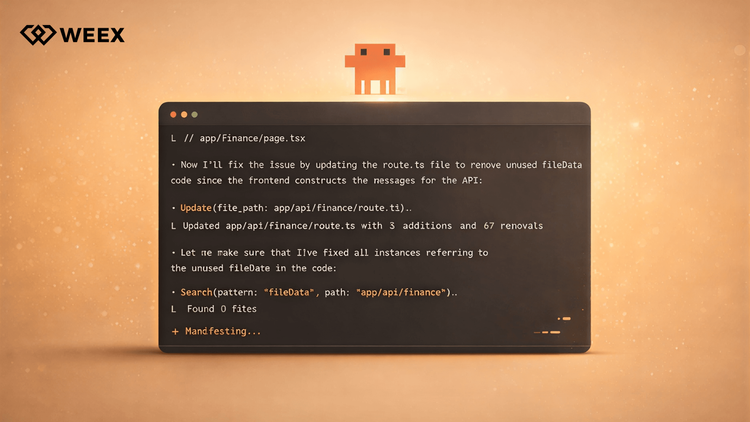
What Is Vibe Coding? How AI Is Changing Web3 & Crypto Development
What is vibe coding? Learn how AI coding tools are lowering the barrier to Web3 development and enabling anyone to build crypto applications.

The parent company of the New York Stock Exchange strategically invests in OKX: The intentions behind the $25 billion valuation

WEEX P2P update: Country/region restrictions for ad posting
To improve ad security and matching accuracy, WEEX P2P now allows advertisers to restrict who can trade with their ads based on country or region. Advertisers can select preferred counterparty locations for a safer, smoother trading experience.
I. Overview
When publishing P2P ads, advertisers can now set the following:
Allow only counterparties from selected countries or regions to trade with your ads.
With this feature, you can:
Target specific user groups more precisely.Reduce cross-region trading risks.Improve order matching quality.
II. Applicable scenarios
The following are some common scenarios:
Restrict payment methods: Limit orders to users in your country using supported local banks or wallets.Risk control: Avoid trading with users from high-risk regions.Operational strategy: Tailor ads to specific markets.
III. How to get started
On the ad posting page, find "Trading requirements":
Select "Trade with users from selected countries or regions only".Then select the countries or regions to add to the allowlist.Use the search box to quickly find a country or region.Once your settings are complete, submit the ad to apply the restrictions.
When an advertiser enables the "Country/Region Restriction" feature, users who do not meet the criteria will be blocked when placing an order and will see the following prompt:
If you encounter this issue when placing an order as a regular user, try the following solutions.
Choose another ad: Select ads that do not restrict your country/region, or ads that allow users from your location.Show local ads only: Prioritize ads available in the same country as your identity verification.
IV. Benefits
Compared with ads without country/region restrictions, this feature provides the following improvements.
Aspect
Improvement
Trading security
Reduces abnormal orders and fraud risk
Conversion efficiency
Matches ads with more relevant users
Order completion rate
Reduces failures caused by incompatible payment methods
V. FAQ
Q1: Why are some users not able to place orders on my ad?
A1: Their country or region may not be included in your allowlist.
Q2: Can I select multiple countries or regions when setting the restriction?
A2: Yes, multiple selections are supported.
Q3: Can I edit my published ads?
A3: Yes. You can edit your ad in the "My Ads" list. Changes will take effect immediately after saving.

What are the key highlights of this year's Ethereum's most important upgrade, the Glamsterdam upgrade?

March 6 Key Market Update You Can't Miss! | Alpha Morning Report

Sell Nvidia, Buy Power Plant: 27-Year-Old AI Investor Earns $5 Billion in One Year
The $24 Million Heist Behind It: The Most Dangerous Vulnerability in the Crypto World is Actually Human

Justin Sun Lawsuit Dismissed, BlackRock Bullish on Tokenization, What Is the English-Speaking Community Paying Attention To?

Morning News | NYSE parent company invests in OKX; Morgan Stanley provides $500 million loan to Core Scientific; Western Union partners with Crossmint to launch stablecoin USDPT

These former crypto builders have transitioned to the hottest AI projects globally

Ethereum Overhaul 2026 Blueprint, this time to abandon "gradualism"

What Is OpenClaw? How AI Agents Could Change Crypto Exchange Trading
OpenClaw is a rapidly growing open-source AI agent that can autonomously execute tasks and interact with software, including connecting to crypto exchanges through APIs to analyze markets and automate trading strategies. While this creates new opportunities for smarter trading, it also introduces security and operational risks. Through this article, WEEX aims to help users better understand the potential and risks of AI trading agents so they can explore new technologies while trading more safely and responsibly.
Ethereum 2029 Strawmap Guide: Ultra-Fast Consensus, Native Privacy, and the "Acceleration Variables" Brought by AI

Altcoin ETF Surge: SOL and XRP Inflows Total $23 Million as Institutions Diversify
Key Takeaways Institutional interest in altcoin ETFs is expanding, with SOL and XRP showing significant inflows on March…
Vitalik Drops Ethereum Endgame Bombshell: ETH USD to $3,000?
Key Takeaways Vitalik Buterin introduces the “Sanctuary Tech” manifesto to address Ethereum’s non-financial limitations. A current lack of…
Exclusive: Yuliya Barabash Predicts the Most Regulated Could Be the Biggest Crypto Winners
Key Takeaways The aftermath of FTX and Celsius collapses has ushered a new regulatory era, reshaping the crypto…

iPhone Crypto Wallets Under Threat from State-Grade Malware
Key Takeaways: The Coruna exploit kit exploits 23 iOS vulnerabilities, threatening iPhone users’ crypto wallets. Initially state-level surveillance,…
Mining Companies' Great Migration: Some Have Already Secured $12.8 Billion in AI Orders
What Is Vibe Coding? How AI Is Changing Web3 & Crypto Development
What is vibe coding? Learn how AI coding tools are lowering the barrier to Web3 development and enabling anyone to build crypto applications.
The parent company of the New York Stock Exchange strategically invests in OKX: The intentions behind the $25 billion valuation
WEEX P2P update: Country/region restrictions for ad posting
To improve ad security and matching accuracy, WEEX P2P now allows advertisers to restrict who can trade with their ads based on country or region. Advertisers can select preferred counterparty locations for a safer, smoother trading experience.
I. Overview
When publishing P2P ads, advertisers can now set the following:
Allow only counterparties from selected countries or regions to trade with your ads.
With this feature, you can:
Target specific user groups more precisely.Reduce cross-region trading risks.Improve order matching quality.
II. Applicable scenarios
The following are some common scenarios:
Restrict payment methods: Limit orders to users in your country using supported local banks or wallets.Risk control: Avoid trading with users from high-risk regions.Operational strategy: Tailor ads to specific markets.
III. How to get started
On the ad posting page, find "Trading requirements":
Select "Trade with users from selected countries or regions only".Then select the countries or regions to add to the allowlist.Use the search box to quickly find a country or region.Once your settings are complete, submit the ad to apply the restrictions.
When an advertiser enables the "Country/Region Restriction" feature, users who do not meet the criteria will be blocked when placing an order and will see the following prompt:
If you encounter this issue when placing an order as a regular user, try the following solutions.
Choose another ad: Select ads that do not restrict your country/region, or ads that allow users from your location.Show local ads only: Prioritize ads available in the same country as your identity verification.
IV. Benefits
Compared with ads without country/region restrictions, this feature provides the following improvements.
Aspect
Improvement
Trading security
Reduces abnormal orders and fraud risk
Conversion efficiency
Matches ads with more relevant users
Order completion rate
Reduces failures caused by incompatible payment methods
V. FAQ
Q1: Why are some users not able to place orders on my ad?
A1: Their country or region may not be included in your allowlist.
Q2: Can I select multiple countries or regions when setting the restriction?
A2: Yes, multiple selections are supported.
Q3: Can I edit my published ads?
A3: Yes. You can edit your ad in the "My Ads" list. Changes will take effect immediately after saving.


 App
App