
 Buy Crypto
- Markets
 Futures
- Spot
- Copy Trade
- Earn
- More
Bitwise: The bear market started in January 2025, so the good news didn't matter

Original Title: Crypto Winter Started in January 2025
Original Author: @Matt_Hougan
Translation: Peggy, BlockBeats
Editor's Note: In a dislocation where good news abounds but prices continue to weaken, Bitwise Chief Investment Officer (CIO) Matt Hougan points out that this is not a normal pullback in a bull market, but rather a crypto winter that began in early 2025 and was once masked by institutional funds.
Bitwise is one of the world's largest cryptocurrency index fund providers, managing assets of over $3 billion. Hougan formerly served as CEO of ETF.com and Inside ETFs, and was one of the key creators of an institutional-grade ETF classification and rating system.
By comparing the performance of different assets, the article further reveals that institutional investability is determining who can weather the winter, while the retail-dominated market has in fact entered a deep bear market. Historical experience indicates that crypto winters often end in exhaustion rather than a sudden turnaround. When pessimism becomes the mainstream narrative, the turning point of the cycle is often not far away.
The following is the original text:
In fact, we have been in a crypto winter since January 2025. It is highly likely that we are now closer to the end point than the starting point.
This is a full-fledged crypto winter.
Crypto Twitter has only recently begun to realize this, but the fact could not be clearer: Bitcoin has dropped 39% from its historical high in October 2025, Ethereum has dropped 53%, and many other crypto assets have seen even more devastating declines.
This is not a so-called "bull market correction" or a "brief retracement." This is a full-throttle crypto winter, akin to the 2022 crypto winter — a "The Revenant" style of extreme survival. It was triggered by multiple factors acting together: excessive leverage, massive profit-taking by early holders (OG), and so on.
Truly recognizing and accepting this fact has made the perspective unusually clear.
Why, amid positive developments in adoption, regulation, and various areas, are crypto asset prices still falling?
Because we are in the depths of a crypto winter.
Why, with a new Fed chair who supports Bitcoin, is the "fear and greed index" of the crypto market still approaching historically high levels of fear?
Because we are in the midst of the crypto winter.
If you've experienced a previous winter, whether in 2018 or 2022, you surely remember that during the deepest cold, good news doesn't matter. Even if Wall Street is aggressively hiring, Morgan Stanley is ramping up its crypto efforts, the market won't bounce back. These factors matter in the long run, not now.
The crypto winter doesn't end in excitement; it ends in utter exhaustion.
So, when will the end come?
The good news is: closer than you imagine.
A History of Crypto Winters
From historical experience, a crypto winter typically lasts about 13 months. For example, Bitcoin peaked in December 2017 and bottomed in December 2018; it peaked again in October 2021 and bottomed in November 2022.
Following this pattern, the road ahead seems arduous. After all, Bitcoin is set to peak in October 2025. Should we then hibernate until next November?
I don't think so.
The more I analyze this "winter," the more I realize it actually started back in January 2025. We just didn't notice then—ETF inflows and Digital Asset Treasury (DAT) allocations masked the true market conditions.
ETF and DAT Flows Masked the 2025 Winter
Take a close look at this chart: it shows the performance of the Bitwise Top 10 Market Cap Crypto Index constituents since January 1, 2025.
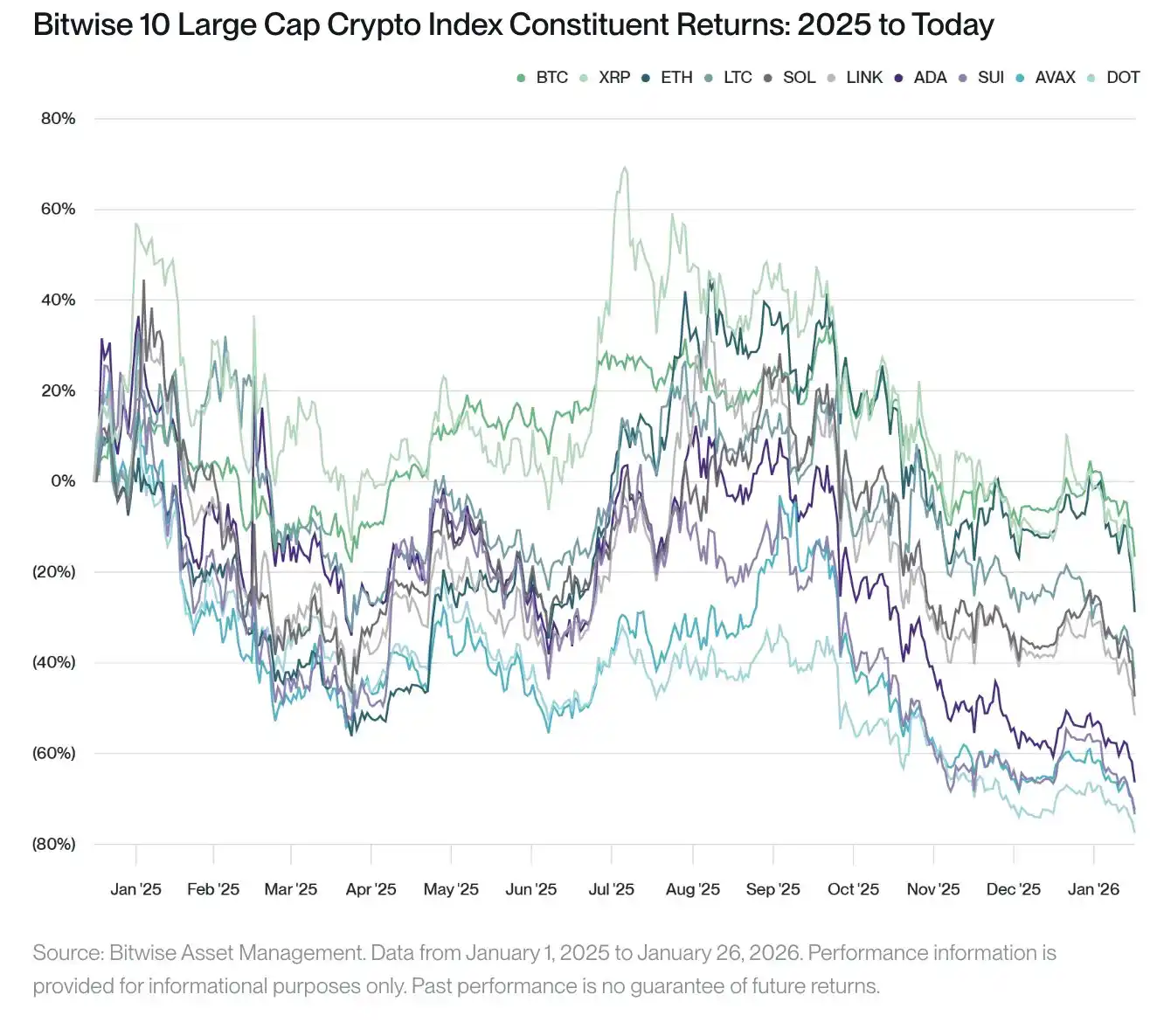
It can be clearly divided into three groups of assets.
The first group of assets (BTC, ETH, XRP) has performed decently, with declines ranging from 10.3% to 19.9%.
The second group of assets (SOL, LTC, LINK) went through a standard bear market, dropping between 36.9% and 46.2%.
Meanwhile, the third group of assets (ADA, AVAX, SUI, DOT) faced a "slaughterhouse" drop, plummeting by 61.9% to 74.7%.
The core factor distinguishing these three groups of assets is essentially one: whether institutions can invest in them.
The first group of assets has benefited all year from extensive ETF/Digital Asset Treasury (DAT) support (XRP also benefited additionally from its legal victory against the SEC); the second group of assets only received ETF approval in 2025; and the third group of assets has never had access to such channels.
Just look at the third group—you will see that they rely entirely on support from crypto-native capital.
The institutional support received by the first group of assets is at a historic level. For example, during the time period shown in this chart, ETFs and DATs collectively purchased 744,417 bitcoins, valued at around $75 billion. Imagine where Bitcoin would fall without this $75 billion support? My estimate is: potentially a 60% decline.
Since January 2025, the retail-dominated crypto market has been enduring a harsh winter. It's just that institutional capital has "embellished" this reality for certain assets for a period of time.
The Darkest Hour is Just Before Dawn
One thing to keep in mind right now is: there is indeed a plethora of bullish news in the crypto industry.
Regulatory progress is real; institutional adoption is real; stablecoins and asset tokenization are real; Wall Street's embrace is also real.
In a bear market, bullish news may be overlooked, but it does not disappear; instead, it is stored as potential energy. Once the gloom disperses, and sentiment returns to normal, this stored energy often unleashes in a powerful manner.
So, what could cause the clouds to part?
Strong economic growth triggering a round of aggressive risk-on rebound; Positive policy surprises from the Clarity Act; Signs of Bitcoin adoption at the sovereign nation level; or simply, the passage of time itself.
As a veteran of multiple crypto winters, I can tell you: the feeling before the end of a winter cycle often feels like it does now—desperate, powerless, universally fatigued. But this market correction has not altered any of the fundamental realities of the crypto industry.
I believe the rebound will arrive sooner than most expect. After all, it has been winter since January 2025—the spring is bound to be not far away.
Risk Warning and Important Disclaimer
Not Investment Advice; Risk of Loss: Before making any investment decision, each investor should conduct their own independent examination and research, including carefully considering the investment's objectives and risks, based on their own particular financial circumstances. Such investment decisions should be made based upon your own judgment and not in reliance on any view expressed in this translation.
Cryptocurrencies are a digital representation of value that functions as a medium of exchange, a unit of account, or a store of value, but they do not have legal tender status. Cryptocurrencies can be exchanged for U.S. dollars or other currencies in some regions around the world, but they are not backed or supported by any government or central bank. Their value is derived purely from market supply and demand dynamics, and their value is highly volatile compared to traditional currencies, stocks, or bonds.
Cryptocurrency trading carries significant risks, including price volatility, flash crashes, market manipulation risks, cybersecurity risks, and the risk of partial or total loss of capital. Additionally, cryptocurrency markets and exchanges are not regulated or subject to the same investor protections as stocks, options, futures, or foreign exchange markets.
Cryptocurrency trading requires a deep understanding of the market. When attempting to profit from cryptocurrency trading, you are competing directly with global traders. Prior to engaging in large-scale cryptocurrency trading, you should have the requisite knowledge and experience. Cryptocurrency trading can lead to rapid and substantial financial losses; under certain market conditions, you may find it difficult or impossible to liquidate a position at a reasonable price quickly.
The views expressed in this translation reflect the judgment of the market environment at a specific point in time and do not constitute a prediction or guarantee of future events or results, and they may be added to, revised, or adjusted as discussions progress. The information in this translation does not constitute, and should not be construed as, accounting, legal, tax, or investment advice. Consult your own accountant, legal counsel, tax advisor, or other professional advisor regarding matters discussed in this translation.
You may also like

From x402 to MPP: Cloudflare's crucial vote, will it go to Coinbase or Stripe?

BlackRock CEO issues annual open letter: The wave of tokenization has arrived, and we will lead this trend

When Backpack backstabs the community

When gold is no longer a safe haven, and Bitcoin continues to panic

Trump, the World's Largest Oil Trader

If the US and Iran have not reached an agreement in 5 days, what other cards does Trump have?

Tether Whale Dumps £12 Million, Backing Crypto’s ‘British Trump’
Ethereum Foundation Post: Rethinking the Division of Work Between L1 and L2 to Build the Ultimate Ethereum Ecosystem

Two Major Prediction Market Platforms Unite Rarely, What Is the Story Behind This New Fund?

WEEX Official Product Launch: Win LALIGA Tickets & Unlock the 3-in-1 Crypto Trading Suite
Trade crypto without downloading an app. Join the WEEX H5, API, SKILLs livestream to explore the new trading experience, win LALIGA VIP tickets, and share 420 USDT rewards.
Dragonfly Partners: Most agents will not engage in autonomous trading, how can crypto payments prevail?

US AI Startup Goes All In on Chinese Mega-Model | Rewire News Morning Brief

Trump Lies Again: A "Five-Day Pause" Psyop, How Wall Street, Bitcoin, and Polymarket Insiders Synced Uposciogen

When a Token Becomes Labor, People Become the Interface

Ceasefire News Leaked Ahead of Time? Large Polymarket Bets on Outcome Before Trump's Tweet
BlackRock CEO's Annual Shareholder Letter: How is Wall Street Using AI to Keep Profiting from National Pension Funds?

Sun Valley Releases 2025 Financial Report: Bitcoin Mining Revenue Reaches $670 Million, Accelerating Transformation to AI Infrastructure Platform
On March 16, 2026, in Dallas, Texas, USA, CanGu Company (New York Stock Exchange code: CANG, hereinafter referred to as "CanGu" or the "Company") today announced its unaudited financial performance for the fourth quarter and full year ended December 31, 2025. As a btc-42">bitcoin mining enterprise relying on a globally operated layout and dedicated to building an integrated energy and AI computing power platform, CanGu is actively advancing its business transformation and infrastructure development.
• Financial Performance:
Total revenue for the full year 2025 was $688.1 million, with $179.5 million in the fourth quarter.
Bitcoin mining business revenue for the full year was $675.5 million, with $172.4 million in the fourth quarter.
Full-year adjusted EBITDA was $24.5 million, while the fourth quarter was -$156.3 million.
• Mining Operations and Costs:
A total of 6,594.6 bitcoins were mined throughout the year, averaging 18.07 bitcoins per day; of which 1,718.3 bitcoins were mined in the fourth quarter, averaging 18.68 bitcoins per day.
The average mining cost for the full year (excluding miner depreciation) was $79,707 per bitcoin, and for the fourth quarter, it was $84,552;
The all-in sustaining costs were $97,272 and $106,251 per bitcoin, respectively.
As of the end of December 2025, the company has cumulatively produced 7,528.4 bitcoins since entering the bitcoin mining business.
• Strategic Progress:
The company has completed the termination of the American Depositary Receipt (ADR) program and transitioned to a direct listing on the NYSE to enhance information transparency and align with its strategic direction, with a long-term goal of expanding its investor base.
CEO Paul Yu stated: "2025 marked the company's first full year as a bitcoin mining enterprise, characterized by rapid execution and structural reshaping. We completed a comprehensive adjustment of our asset system and established a globally distributed mining network. Additionally, the company introduced a new management team, further strengthening our capabilities and competitive advantage in the digital asset and energy infrastructure space. The completion of the NYSE direct listing and USD pricing also signifies our transformation into a global AI infrastructure company."
"As we enter 2026, the company will continue to optimize its balance sheet structure and enhance operational efficiency and cost resilience through adjustments to the miner portfolio. At the same time, we are advancing our strategic transformation into an AI infrastructure provider. Leveraging EcoHash, we will utilize our capabilities in scalable computing power and energy networks to provide cost-effective AI inference solutions. The relevant site transformations and product development are progressing simultaneously, and the company is well-positioned to sustain its execution in the new phase."
The company's Chief Financial Officer, Michael Zhang, stated: "By 2025, the company is expected to achieve significant revenue growth through its scaled mining operations. Despite recording a net loss of $452.8 million from ongoing operations, mainly due to one-time transformation costs and market-driven fair value adjustments, the company, from a financial perspective, will reduce its leverage, optimize its Bitcoin reserve strategy and liquidity management, introduce new capital to strengthen its financial position, and seize investment opportunities in high-potential areas such as AI infrastructure while navigating market volatility."
The total revenue for the fourth quarter was $1.795 billion. Of this, the Bitcoin mining business contributed $1.724 billion in revenue, generating 1,718.3 Bitcoins during the quarter. Revenue from the international automobile trading business was $4.8 million.
The total operating costs and expenses for the fourth quarter amounted to $4.56 billion, primarily attributed to expenses related to the Bitcoin mining business, as well as impairment of mining machines and fair value losses on Bitcoin collateral receivables.
This includes:
· Cost of Revenue (excluding depreciation): $1.553 billion
· Cost of Revenue (depreciation): $38.1 million
· Operating Expenses: $9.9 million (including related-party expenses of $1.1 million)
· Mining Machine Impairment Loss: $81.4 million
· Fair Value Loss on Bitcoin Collateral Receivables: $171.4 million
The operating loss for the fourth quarter was $276.6 million, a significant increase from a loss of $0.7 million in the same period of 2024, primarily due to the downward trend in Bitcoin prices.
The net loss from ongoing operations was $285 million, compared to a net profit of $2.4 million in the same period last year.
The adjusted EBITDA was -$156.3 million, compared to $2.4 million in the same period last year.
The total revenue for the full year was $6.881 billion. Of this, the revenue from the Bitcoin mining business was $6.755 billion, with a total output of 6,594.6 Bitcoins for the year. Revenue from the international automobile trading business was $9.8 million.
The total annual operating costs and expenses amount to $1.1 billion.
Specifically, they include:
· Revenue Cost (excluding depreciation): $543.3 million
· Revenue Cost (depreciation): $116.6 million
· Operating Expenses: $28.9 million (including related-party expenses of $1.1 million)
· Miner Impairment Loss: $338.3 million
· Bitcoin Collateral Receivable Fair Value Change Loss: $96.5 million
The full-year operating loss is $437.1 million. The continuing operations net loss is $452.8 million, while in 2024, there was a net profit of $4.8 million.
The 2025 non-GAAP adjusted net profit is $24.5 million (compared to $5.7 million in 2024). This measure does not include share-based compensation expenses; refer to "Use of Non-GAAP Financial Measures" for details.
As of December 31, 2025, the company's key assets and liabilities are as follows:
· Cash and Cash Equivalents: $41.2 million
· Bitcoin Collateral Receivable (Non-current, related party): $663.0 million
· Miner Net Value: $248.7 million
· Long-Term Debt (related party): $557.6 million
In February 2026, the company sold 4,451 bitcoins and repaid a portion of related-party long-term debt to reduce financial leverage and optimize the asset-liability structure.
As per the stock repurchase plan disclosed on March 13, 2025, as of December 31, 2025, the company had repurchased a total of 890,155 shares of Class A common stock for approximately $1.2 million.



 App
App