
- Buy Crypto
- Markets
 Futures
- Spot
- Copy Trade
- Earn
- More
Bitwise: The Institutional Wave is Here, So Why is the Market Still Sleeping?

Original Title: Why Investors Can't Hear Wall Street's Crypto Song
Original Author: Matt Hougan, Chief Investment Officer at Bitwise
Original Translation: Saoirse, Foresight News
The biggest source of Alpha in financial markets often comes from behavioral biases. Investors always make mistakes, and if you can capitalize on these mistakes, you can achieve significant returns.
One of my favorite behavioral biases to exploit is the anchoring effect: people tend to fixate on the initial information they receive and are reluctant to change. This is also why retailers price items at $9.99 instead of $10.00 — once you remember the '9,' it's hard for the brain to let go.
The anchoring effect was one of the reasons why I decided to dive full-time into the crypto industry in 2018.
At that time, most people still considered cryptocurrency a joke. They were first introduced to cryptocurrency in the 2013 Silk Road scandal and the 2014 Mt. Gox exchange bankruptcy, witnessing its volatile price swings.
Fortunately, a few people I trust reminded me to take crypto seriously.
When I looked beyond the surface to see what it really was, rather than what people thought it was, I was thoroughly impressed. This technology is far more mature than most people realize, with much greater opportunities. Yet people are still stuck in their 2014 mindset.
Right now, it feels like I'm back in that moment.
The World Is Screaming at You
Look around, Wall Street is loudly proclaiming: the financial industry is moving onto the blockchain. Not a small part of it, but all of it.
In July last year, US SEC Chairman Paul Atkins launched the "Crypto Council," a full committee-level initiative aimed at advancing securities regulation modernization. In his words, it is to enable the US financial markets to "run on the blockchain." And indeed, the market has begun to move onto the blockchain:
· In October, BlackRock CEO Larry Fink publicly stated that we are at the dawn of asset tokenization. Two weeks ago, BlackRock launched a tokenized sovereign bond fund on the world's largest decentralized exchange, Uniswap, with a current size exceeding $2 billion; as part of the collaboration, BlackRock also invested in Uniswap's native token, UNI.
· The $700 billion AUM credit institution Apollo is partnering with Securitize to tokenize its diversified credit fund and launch it on six blockchains. Since January 2025, the product has attracted over $100 million in funds. The company has also recently announced plans to acquire a 9% stake in the globally leading decentralized lending protocol Morpho.
· JPMorgan Chase, Bank of America, Citigroup, and Wells Fargo are in discussions to jointly launch a stablecoin.
Meanwhile, JPMorgan Chase has issued a deposit token on Coinbase's Base network; Fidelity is hiring a head of decentralized finance treasury... Similar moves are happening constantly.
The scale of the relevant markets is enormous: the ETF market is $30 trillion, the stock market is $110 trillion, and the bond market is $145 trillion.
In comparison, the current global tokenized market's total size is only $200 billion.
If Larry Fink is right — "every stock, every bond... will ultimately be tokenized" — this means there is still thousands of times growth potential in this market.
Cognitive Dissonance
But traditional investors just don't hear it.
They don't hear it because of the anchoring effect.
When they hear about cryptocurrency, all they see in their minds is that tattooed, punk, skateboarder image. They don't realize that this person has long since shaved off their beard, put on a suit, and is building the infrastructure that will underpin the next generation of the capital markets.
Ironically, it seems that even crypto investors themselves can't hear it.
They suffer from the "boy who cried wolf" syndrome. After hearing promises of "institutions are about to enter" for so long, now that they actually are, they are numb and unresponsive.
But the data doesn't lie.
Look at the growth curve of tokenized real-world assets (RWAs), it's as steep as Mount Everest.
Value of tokenized real-world assets (RWAs):
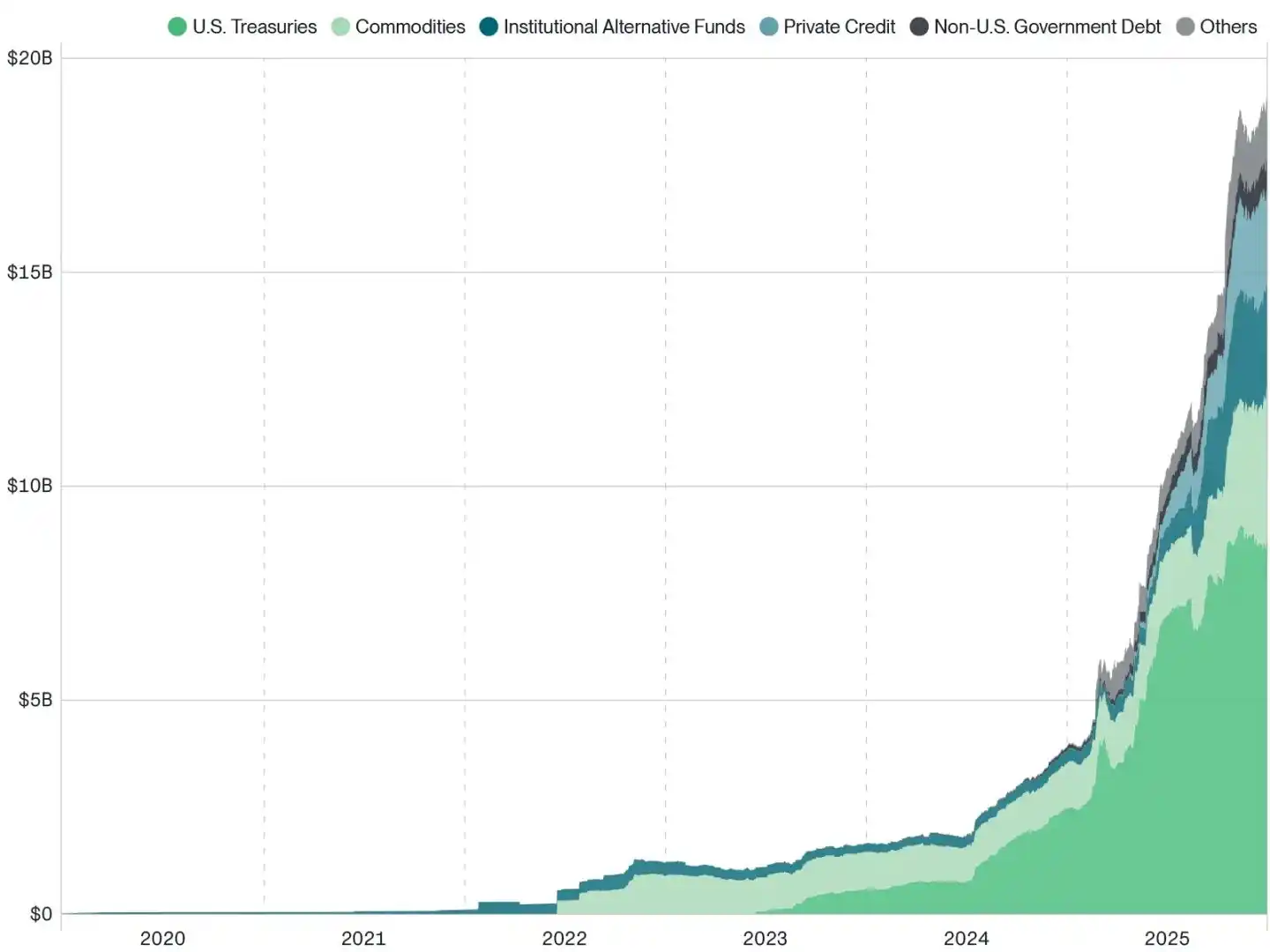
Source: Bitwise Asset Management, data from RWA.xyz. Data covers the period from January 1, 2020, to December 31, 2025.
Note: Stablecoin issuers like Circle and Tether have been intentionally omitted.
Seize the Opportunity
The challenge is that we often struggle to pinpoint exactly how to capitalize on it.
Because the crypto industry still has a number of key unresolved issues, such as:
· Where will the value from tokenization flow, to foundational protocols like Ethereum and Solana, or is the underlying blockchain space heading towards commoditization?
· If value solidifies in underlying public blockchains, will next-gen semi-private chains like Canton Network and Tempo outperform public chains?
· With institutions like BlackRock and Apollo embracing DeFi, will DeFi tokens see a surge, or will the underlying economic challenges of DeFi tokens prove difficult to overcome?
· If the ultimate value accrual is to builder companies rather than the blockchains themselves, will the beneficiaries be traditional giants like BlackRock and JPMorgan, or crypto-native institutions?
I have my own take on these questions and will be sharing my thoughts in upcoming posts over the next few months. But to be frank, the answer to most of these questions right now is: Nobody knows.
One thing I am sure of:
There is a significant gap between what people think the crypto market is and what is actually happening in the crypto market.
To me, this gap represents a major opportunity—not to rush to pick winners in advance, but to broadly position across the entire playing field while the market is still mispricing this structural shift.
The greatest alpha opportunities often arise when market consensus is outdated, reality has moved on, and investors are still anchored to old narratives.
The crypto industry is currently at this juncture.
If you can see its essence clearly, opportunities abound.
You may also like

Particle Founder: The entrepreneurial insights I have gained the most from in the past year

Huang Renxun's latest podcast transcript: The future of Nvidia, the development of embodied intelligence and agents, the explosion of inference demand, and the public relations crisis of artificial intelligence

OKX Ventures Research Report: AI Agent Economic Infrastructure Research Report (Part 1)

The migration of settlement rights: B18 and the institutional starting point of on-chain banks

From Tencent and Circle: Looking at the Simple and Difficult Questions of Investment

The second half of stablecoins no longer belongs to the crypto circle

Cursor "Shell" Kimi Controversy Reversed: From Copyright Infringement Allegations to Authorized Collaboration, China's Open Source Model Once Again Becomes a Global AI Foundation

The Real Reason Tokens Don't Sell: 90% of Crypto Projects Overlook Investor Relations

Is the income of pump.fun real, earning a million dollars a day despite the market downturn?

The real reason why tokens are not selling: 90% of crypto projects neglect investor relations

Who is the true winner of the "Tokenization" narrative?

Moss: The Era of AI-Traded by Anyone | Project Introduction

Chip Smuggling Case Exposes Regulatory Loophole | Rewire News Evening Update

How a Structured AI Crypto Trading Bot Won at the WEEX Hackathon
Ritmex demonstrates how disciplined risk control and structured signals can make an AI crypto trading bot more stable and reliable on WEEX, highlighting the importance of combining execution discipline with scalable AI trading systems.

Old Indicator Fails, Three Major New Signals Emerge: BTC True Bottom May Still Be Below $60K

Meeting OpenClaw Founder at a Hackathon: What Else Can Lobsters Do?
Huang Renxun's Latest Podcast Transcript: NVIDIA's Future, Embodied Intelligence and Agent Development, Soaring Demand for Inferencing, and AI's PR Crisis
How a Structured AI Crypto Trading Bot Won at the WEEX Hackathon
Crypto_Trade shows how structured inputs and controlled adaptability can build a more stable and reliable AI crypto trading bot within the WEEX AI Trading Hackathon, highlighting a practical path toward scalable AI trading systems.


 App
App