
Circle: Not Every Company Can Issue a Stablecoin


Original Article Title: The Stablecoin Trap: Issuing a Stablecoin Without the Infrastructure to Run One
Original Author: Kash Razzaghi, Circle
Translation: Peggy, BlockBeats
Editor's Note: With regulatory clarity and institutional entry, stablecoins are evolving from a technical tool into critical financial infrastructure. This article points out that issuing a stablecoin is not a simple technical choice but a long-term strategic decision involving trust, liquidity, and compliance capabilities. Most projects falter before achieving scale, naturally converging the market around a few mature networks. For most businesses, the real question is not "whether to issue a coin" but "how to effectively use a stablecoin to create growth opportunities for the business."
Below is the original article:
Over the past few months, I have repeatedly engaged in a familiar type of conversation with executives of some of the world's largest companies. They have shown a strong interest in stablecoins that enable near-instantaneous, cross-border transfer, such as digital dollars and euros like USDC and EURC. Many of them are also pondering: Should we issue our own stablecoin?
This impulse is understandable. This market has already reached a significant scale with sustained growth momentum. In 2025, the total market value of stablecoins increased from around $205 billion on January 1, 2025, to over $300 billion by December 31, 2025. USDC issued by Circle remains one of the core assets in this category, closing the year-end of 2025 with a market cap exceeding $75 billion.
But before truly entering the space, every business should first ask itself a question: Do you simply want to use a stablecoin for your business, or do you intend to genuinely engage in the "stablecoin issuance" business?
This is not a technical issue but a strategic one: Does issuing currency belong to the core of your business model?
Relatively speaking, creating a stablecoin on the blockchain is actually the easiest part. Essentially, it is merely a software engineering practice: to write and deploy a blockchain-based token contract. As long as there is an engineering team, or in some cases, with the help of white-label partners, a token can go live in a relatively short amount of time. However, once the product is operational, stablecoin operation means supporting a 24/7 financial infrastructure.
To operate a trusted, regulated stablecoin that can meet the expectations of institutions, regulators, and millions of users, real-time reserve management across different market cycles is necessary. This includes daily reconciliation with multiple banking partners, independent audits, and compliance and regulatory reporting across multiple jurisdictions. This requires building a round-the-clock compliance, risk management, fund management, and liquidity operation system with clear upgrade and contingency mechanisms under pressure scenarios with zero tolerance for errors. These capabilities are by no means something that can be "outsourced once and then ignored"; as scale grows, they continuously accumulate, amplify in cost, complexity, and reputational risk.
From a systemic perspective, each new closed-loop stablecoin further fragments liquidity and trust. Each issuer is duplicating efforts to build reserves, compliance systems, and redemption channels, weakening the stablecoin's overall depth and resilience in times of stress. In contrast, integrating with USDC from day one combines liquidity, standards, and operational capabilities into a widely adopted unified network.
For corporate executives evaluating this decision, the operational differences between these two paths become particularly clear:
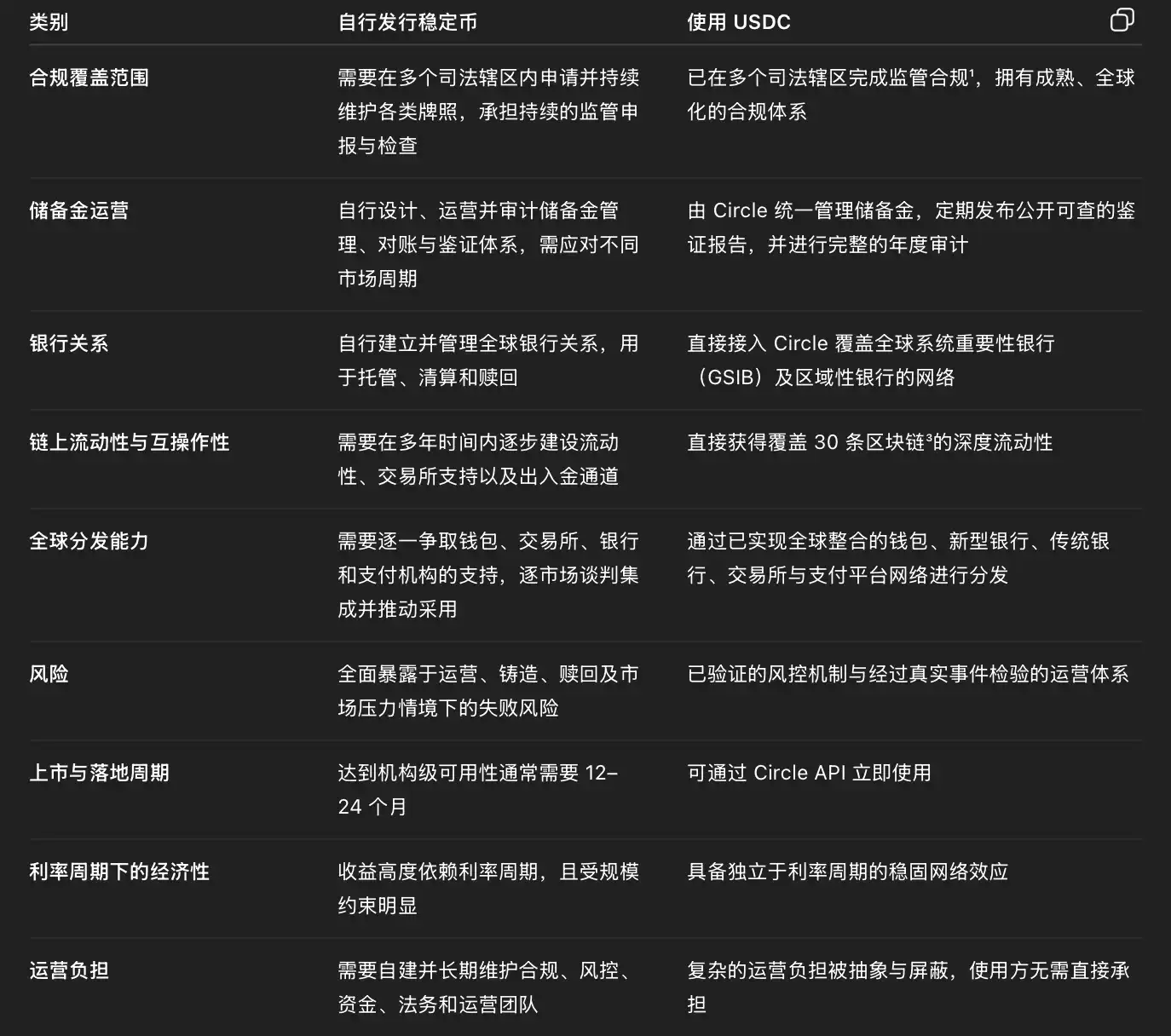
The Temptation of Shortcuts
Currently, from fintech companies, payment institutions to crypto projects, a large number of newcomers are exploring or directly launching their stablecoins. The growth of the stablecoin market in 2025 reflects both a gradually clearer regulatory environment and rising institutional interest. However, despite hundreds of stablecoin projects being launched, about 95% have never truly achieved persistent, global scale.
Some believe they can replicate the same economic returns without bearing heavy operational costs. The reality is not so romantic. Whether issuing on their own or through white-label services, you enter an industry where trust, liquidity, and scale are a matter of life and death.
Sometimes, the cost of mistakes is even measured in the "trillions." According to media reports earlier this year, a certain issuer accidentally minted $300 trillion in tokens due to an operational error. Although it was fixed within minutes, it was enough to make headlines. In another instance, a well-known stablecoin briefly depegged during a market volatility, once again illustrating that even small infrastructure flaws can be magnified and cascaded under pressure.
These events remind us that the ability of a stablecoin to hold its ground depends on operational rigor under high-pressure environments. Both the market and policymakers are closely watching.
Trust is the True Network Effect
Anyone can create a token on the blockchain. In fact, there are already thousands—most minted in minutes and just as quickly forgotten. Even in the stablecoin sub-market, with over 300 projects launched, only a handful truly carry almost all real-world usage and value; while the vast majority, about 95%, have never truly succeeded.
The difference lies not in technology but in scale and trust. The real challenge of stablecoins begins during the expansion phase: how to sustain liquidity, redemption, compliance, and system availability as transaction volumes grow across markets and cycles.
You can mint a token in minutes, but you can't mint trust in minutes. Trust comes from transparency, scale, and cross-market cycle consistency in redemption, accruing over time. This is why the stablecoin market ultimately consolidates in the hands of a few issuers — and why as of January 30, 2026, USDC has settled over $600 trillion in historical volume.
Instead of Reinventing the Wheel, Choose to Collaborate
For most businesses, the right question is not "How do we issue our stablecoin?" but "How do we integrate a stablecoin into our business to unlock new growth?"
With USDC and EURC, businesses can embed digital dollars and euros today, gaining near-instant settlement, global coverage, and cross-chain interoperability across dozens of blockchains without dealing with the complexity of reserve management and regulatory compliance.
Co-Writing the Next Chapter
The stablecoin industry is entering a new phase. Policymakers are setting clearer rules, institutions are raising their standards, and the market is gradually converging on a simple consensus: trust, liquidity, and compliance are the true moats.
The goal is not to have more stablecoins but to have fewer but better stablecoins — capable of meeting current needs with shared liquidity, transparent reserves, and cross-cycle verified performance.
For institutions crafting a stablecoin strategy, the first step should not be deciding "what to mint" but deciding "who to mint with." If you want to leverage stablecoins for your business without becoming a stablecoin issuer, the enduring choice is clear: talk to Circle, use USDC.
You may also like

Will MicroStrategy fall into a death spiral? What will the macro trend be in the second half of the year?

Morning Report | Illinois signs the strictest digital asset tax law in the U.S.; RWA tokenization market size surpasses $43 billion, institutions accelerate the migration of on-chain assets

Full version of the debut Q&A! Federal Reserve Chairman Waller: Sticking to the 2% inflation target, establishing five special working groups, individual did not submit the dot plot

From Disruptor to Shadow Market: The Crypto Market is Becoming a Colony of Traditional Finance
Dalio's important long article: How to position in the current market environment?

OKX Star analyzes Binance's competitive advantages: when regulation levels the playing field, competition has just begun

New gameplay for participating in initial offerings on cryptocurrency exchanges
Why Is Bitcoin Down Today? What the Hawkish FOMC Means for SpaceX, Gold and Nasdaq

DeepSeek Financing Story

Morning Report | DeepSeek completes over $7 billion in financing, with a valuation exceeding $50 billion; Musk's personal wealth has surpassed the total market value of Bitcoin

Cursor, why did you get on Musk's spaceship?
In the name of charity, for the benefit of the family: How the Trump family turned charity into profit?

Will Gold Break $4,500 After Tonight's Fed Decision? What XAUT and PAXG Traders Need to Know

SharpLink CEO: How to understand that Ethereum developers have just surpassed 1 million?

Morning Report | MiCA grace period expires on July 1; Kalshi's trading volume in the first week of the World Cup breaks $5.1 billion, setting a record

The foundation of SpaceX's trillion-dollar valuation: Who is dividing Musk's annual capital expenditure of tens of billions?
How to exit after asset tokenization?

The stablecoin positioning battle escalates: When compliance is just a ticket to entry, will USD1 become the biggest winner?
Will MicroStrategy fall into a death spiral? What will the macro trend be in the second half of the year?
Morning Report | Illinois signs the strictest digital asset tax law in the U.S.; RWA tokenization market size surpasses $43 billion, institutions accelerate the migration of on-chain assets
Full version of the debut Q&A! Federal Reserve Chairman Waller: Sticking to the 2% inflation target, establishing five special working groups, individual did not submit the dot plot
From Disruptor to Shadow Market: The Crypto Market is Becoming a Colony of Traditional Finance
Dalio's important long article: How to position in the current market environment?
OKX Star analyzes Binance's competitive advantages: when regulation levels the playing field, competition has just begun


