
Contrarian Breakthrough: Who Is Quietly Leading the Exchange Platform Token Race?

Source: Cointelegraph
Reporter: Eva Xiang

Recently, the global cryptocurrency market has experienced significant volatility and adjustment, with most assets facing downward pressure. However, in the niche track of native tokens issued by mainstream exchanges, we have observed significant performance divergence. Among them, Gate.io's native token GateToken (GT) has demonstrated remarkable relative strength, becoming the focus of market attention.
1. Data Comparison: GT's Price Increase Takes the Lead Among Mainstream Exchange Tokens
The most intuitive way to measure asset performance is through price trends. According to public data, in the past 90 days, the performance of several major exchange tokens has shown significant differences:
GateToken (GT): Achieved a price increase of approximately +20.68%
OKX Token (OKB): Recorded a price increase of approximately +10.5%
Binance Coin (BNB): Experienced a price decrease of approximately -19.05%
Bitget Token (BGB): Underwent a significant decline of approximately -35.53%
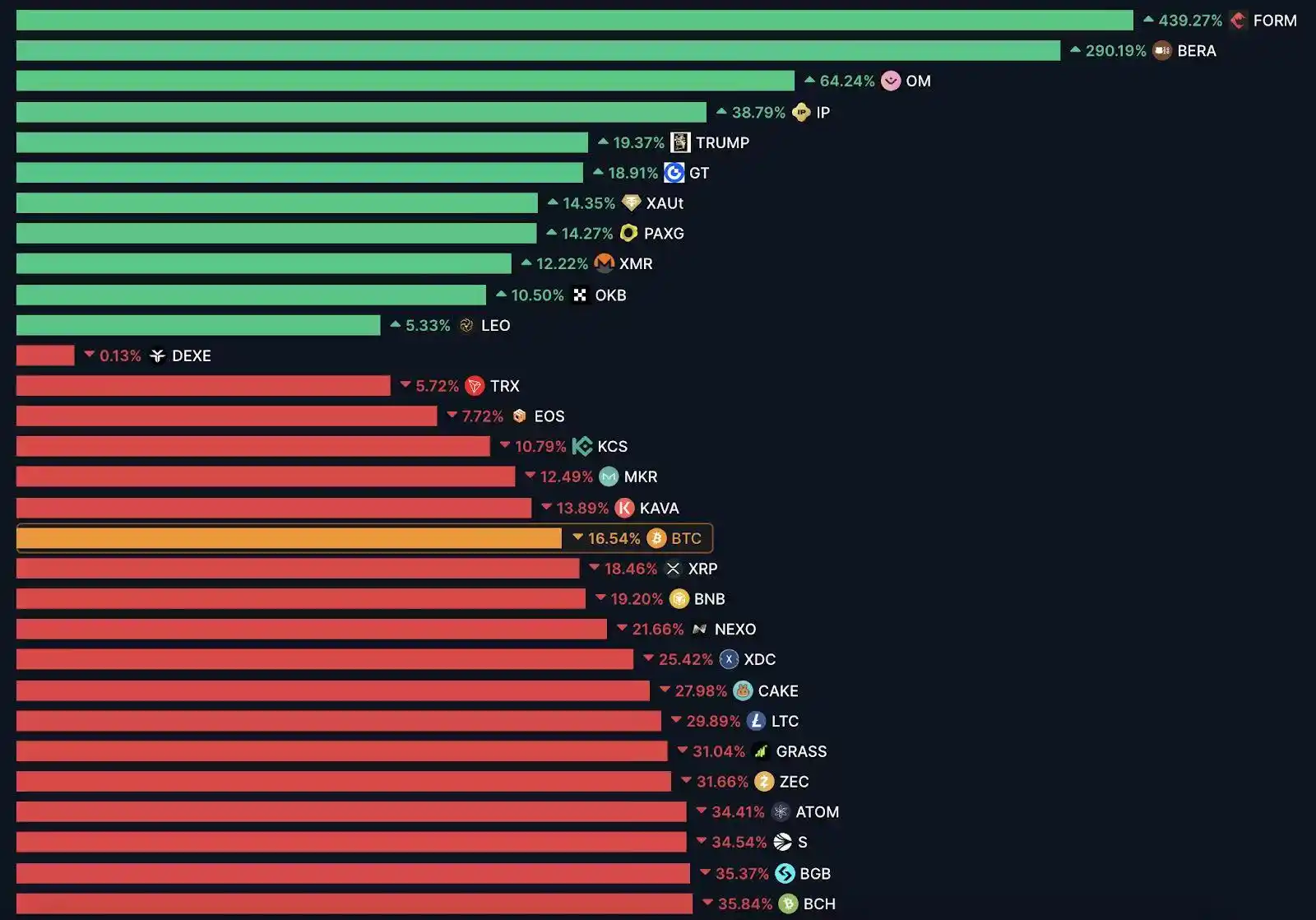
This set of data clearly outlines the recent landscape of the exchange token market: in the same market cycle and macro environment, GT not only achieved positive growth but also surpassed the modest increase of OKB significantly, standing in stark contrast to the sharp declines of BNB and BGB. With a price increase of over 20%, GT undoubtedly takes the lead among mainstream exchange tokens, and its relative strength is particularly prominent in the current market environment.
2. Analysis of GT's Competitive Advantages: Why Can It Stand Out in a Correcting Market?
For GT to achieve such a remarkable price increase amid a market-wide correction, there must be factors supporting its competitive advantage. Although the value proposition of exchange tokens is complex and diverse, it is usually closely related to the following points, and GT may have demonstrated unique strengths in these areas:
1. Market Confidence and Platform Expectations: The price of a platform token is often a barometer of the market's confidence and expectations for the exchange's future development. The contra-market rise of GT may partially reflect market participants' recognition of Gate.io's long-term stable operation, continuous innovation capabilities, and user base growth. During market downturns, funds tend to gravitate towards assets with a greater safety margin or growth potential. GT's performance may be a manifestation of this risk-averse or value discovery sentiment.
2. Intrinsic Economic Model and Supply-Demand Dynamics: GT has a relatively sound deflationary mechanism (such as using a portion of platform revenue for buyback and burn) and diverse use cases (e.g., fee discounts, Startup participation rights, GateChain fuel, etc.). These mechanisms may provide GT with a more solid value foundation and internal demand during market fluctuations, making its supply-demand dynamics relatively healthier compared to some competitors, thereby demonstrating stronger resilience to price declines and even the ability to rise against the trend.
3. Valuation and Market Positioning: Compared to some platform tokens with already substantial market capitalization, GT may still be in a relatively undervalued position or in a growth period, offering greater elasticity and space for market cap growth. During market rotations or in search of new growth points, some funds may flow from assets with high valuations to targets like GT that exhibit strong growth momentum and have a relatively moderate market cap.
4. User Stickiness and Community Consensus: An active and loyal user community is crucial for the stability of a platform token's value. The user base Gate.io has accumulated over the long term, along with the community consensus formed around GT, may act as stabilizers when market panic spreads, with holders more inclined to long-term holding rather than panic selling.
It is important to emphasize that the above analysis is based on the general market trends and publicly available information about GT, and the specific reasons may be the result of multiple overlapping factors. However, GT's excellent performance does indeed indicate some of its distinctive competitive advantages in the current market environment.
Three, Dollar-Cost Averaging Perspective: Why is GT More Worthy of Attention?
For long-term investors, choosing the right target is crucial. The core logic of dollar-cost averaging is to buy in batches at different market stages to smooth out costs and share in long-term growth. When choosing targets for dollar-cost averaging, factors such as the asset's long-term potential, risk resistance, and performance in market downturns are all important considerations.
From recent performance, GT has exhibited several qualities that are worth attention from dollar-cost averaging investors:
1. Bear Market Resilience: As shown in the previous data, GT demonstrated significant anti-downtrend and even counter-trend abilities during an overall market downturn. This indicates that its value support is relatively robust and can better protect portfolio value in extreme market conditions. For dollar-cost averaging, this means that chips accumulated in the bottom range of the market may have a higher safety margin and future rebound potential.
2. Relative Strength: Compared to platform coins such as BNB and BGB, which experienced significant declines during the same period, GT's strong performance itself is a signal. Investing funds into relatively stronger assets theoretically allows for faster value recovery and growth when the market heats up. GT's recent leadership trend makes it a notable choice among similar assets.
3. Growth Potential: While past performance is not indicative of the future, GT's continued value capture ability (through its economic model and use cases) and the development potential of the Gate.io platform have laid the foundation for its long-term value growth. Dollar-cost averaging is an effective strategy to capture this long-term value growth.
Of course, any investment decision should be based on comprehensive research and risk assessment. Dollar-cost averaging GT also faces multiple risks such as market volatility, regulatory policy changes, and platform operational risks. However, it is undeniable that based on market data and performance in the past 90 days, GT has indeed exhibited greater resilience and attractiveness compared to some mainstream platform coins, making it an option worth considering for dollar-cost averaging.
Finally:
In the recent cryptocurrency market correction, GateToken (GT) stood out among mainstream platform coins with a 90-day gain of over 20%, outperforming OKB, BNB, and BGB. This differentiated market performance may stem from market confidence in the Gate.io platform, GT's robust economic model and supply-demand dynamics, relatively reasonable valuation, and strong community consensus, among other factors. For investors adopting a dollar-cost averaging strategy, GT's demonstrated bear market resilience and relative strength make it a target worth closely monitoring and researching. In a market full of uncertainty, GT's impressive data provides a clear case study of value and resilience.
Related Recommended: Gate.io Founder Dr. Han: New Tariff Policy Can Be Seen as an Opportunity to Promote the Upgrade and Long-term Development of the Crypto Industry
This article is a contribution and does not represent the views of BlockBeats.
You may also like

Will MicroStrategy fall into a death spiral? What will the macro trend be in the second half of the year?

Morning Report | Illinois signs the strictest digital asset tax law in the U.S.; RWA tokenization market size surpasses $43 billion, institutions accelerate the migration of on-chain assets

Full version of the debut Q&A! Federal Reserve Chairman Waller: Sticking to the 2% inflation target, establishing five special working groups, individual did not submit the dot plot

From Disruptor to Shadow Market: The Crypto Market is Becoming a Colony of Traditional Finance
Dalio's important long article: How to position in the current market environment?

OKX Star analyzes Binance's competitive advantages: when regulation levels the playing field, competition has just begun

New gameplay for participating in initial offerings on cryptocurrency exchanges
Why Is Bitcoin Down Today? What the Hawkish FOMC Means for SpaceX, Gold and Nasdaq

DeepSeek Financing Story

Morning Report | DeepSeek completes over $7 billion in financing, with a valuation exceeding $50 billion; Musk's personal wealth has surpassed the total market value of Bitcoin

Cursor, why did you get on Musk's spaceship?
In the name of charity, for the benefit of the family: How the Trump family turned charity into profit?

Will Gold Break $4,500 After Tonight's Fed Decision? What XAUT and PAXG Traders Need to Know

SharpLink CEO: How to understand that Ethereum developers have just surpassed 1 million?

Morning Report | MiCA grace period expires on July 1; Kalshi's trading volume in the first week of the World Cup breaks $5.1 billion, setting a record

The foundation of SpaceX's trillion-dollar valuation: Who is dividing Musk's annual capital expenditure of tens of billions?
How to exit after asset tokenization?

The stablecoin positioning battle escalates: When compliance is just a ticket to entry, will USD1 become the biggest winner?
Will MicroStrategy fall into a death spiral? What will the macro trend be in the second half of the year?
Morning Report | Illinois signs the strictest digital asset tax law in the U.S.; RWA tokenization market size surpasses $43 billion, institutions accelerate the migration of on-chain assets
Full version of the debut Q&A! Federal Reserve Chairman Waller: Sticking to the 2% inflation target, establishing five special working groups, individual did not submit the dot plot
From Disruptor to Shadow Market: The Crypto Market is Becoming a Colony of Traditional Finance
Dalio's important long article: How to position in the current market environment?
OKX Star analyzes Binance's competitive advantages: when regulation levels the playing field, competition has just begun


