
Debriefing the Fed's 10-Year Rate Cycle: Where Will Bitcoin Go under Three Scenario Analyses?


Original Article Title: "Revisiting the Fed's 10-Year Interest Rate Cycle: Where Will Bitcoin Go Under Three Scenario Paths?"
Original Source: Biteye
Over the past decade, Bitcoin's bull tops and bear bottoms have mirrored the Federal Reserve's interest rate policy.
· Tops usually occur during the strongest rate hike expectations
· Bottoms, on the other hand, coincide with expectations shifting towards rate cuts
· Now, the market stands at a three-way fork in the road:
· Rate hike restart → Double bottom?
· Rate cut in the second half of the year → Rally after consolidation?
· Mid-year rate cut → Bull market acceleration?
These paths will determine the next phase of Bitcoin's journey.
This article will dissect the price movement of BTC under three scenarios, providing a comprehensive understanding of the macroeconomic and price game theory.
I. Revisiting the Fed's 10-Year Interest Rate Policy, How Does Bitcoin's "Top" and "Bottom" Align?
Over the past decade (approximately 2015-2025), the Federal Reserve has gone through a complete cycle of rate hikes, rate cuts, re-hikes, and pauses. Reviewing this history, we find a significant and intriguing correlation between Bitcoin's price turning points and the Federal Reserve's policy milestones, especially the market's anticipatory "pre-reaction" phenomenon.
Starting with the conclusions:
1. Bitcoin's bull tops often lead the start or acceleration of rate hikes, with the market preemptively trading a tightening expectation.
2. Bitcoin's bear bottoms typically appear towards the late stage of rate hikes, during pause periods, or just before the start of a rate cut cycle. The market seeks bottoms when the most pessimistic or accommodative expectations emerge.
3. Quantitative Easing (QE) or rapid rate cuts such as "emergency easing" serve as significant catalysts for bull markets.
Below is a comparison table of the Federal Reserve's major rate policy over the past decade and key Bitcoin price movements:
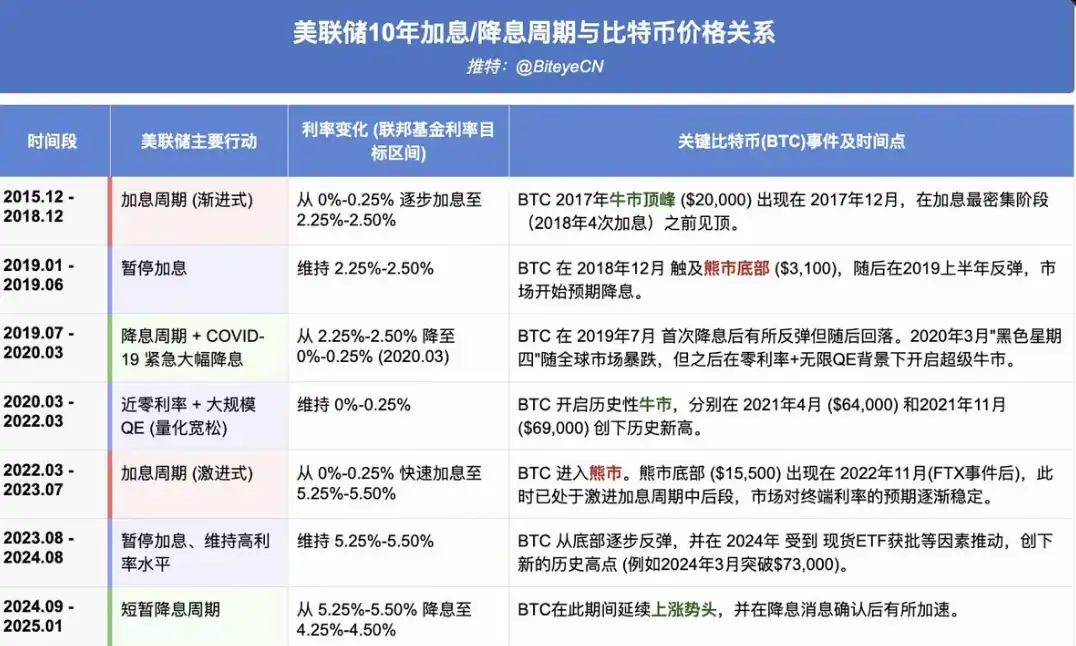
This table clearly illustrates the "time gap" between key turning points in Bitcoin's price and the Federal Reserve's policy cycle. Whether in 2017 or 2021, the peaks of bull markets occurred either just before the "hammer" of rate hikes fell or at the peak of rate hike intensity. Bear market bottoms, on the other hand, often coincided with expectations shifting towards rate cuts.
We are currently in a period of "pausing rate hikes" and "brief rate cuts," with the market awaiting the next clear directional signal—whether we will see another round of rate cuts, entering a phase of quantitative easing "liquidity injection."
2. Interest Rate Projection: Based on Three Institutional Forecast Scenarios
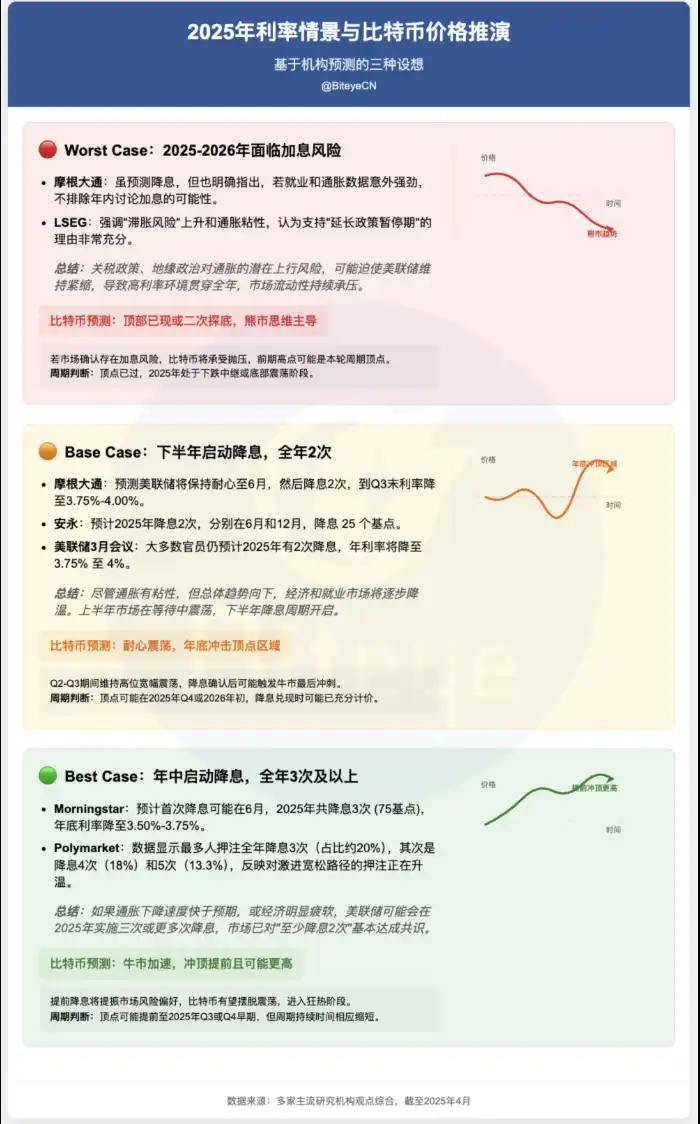
Currently (April 2025), there is a significant market divergence regarding the Federal Reserve's next move. Drawing on the recent views of several mainstream research institutions, we have summarized three possible scenarios:
1. Worst Case: Facing Rate Hike Risks in 2025-2026
· J.P. Morgan (March Early Report View): While predicting a rate cut, it also clearly points out that if unexpected strong employment and inflation data emerge, the possibility of discussing a rate hike within the year cannot be ruled out.
· LSEG (London Stock Exchange Group, Early April Report View): Emphasizing the rising risk of "stagflation" and inflation stickiness, it believes that there are very compelling reasons to support an "extended policy pause period."
Tariff policies, geopolitical risks for inflation's potential upside, all of these factors could compel the Federal Reserve to maintain tightening, potentially leading to a high-interest rate environment throughout the year, with ongoing market liquidity pressure.
2. Base Case: Rate Cut Initiation in the Second Half, Twice in the Year
· J.P. Morgan (March Early Report View): Predicts that the Federal Reserve will remain patient until June, then cut rates twice, with rates expected to reach 3.75%-4.00% by the end of Q3.
· EY (Ernst & Young, March Report View): Expects 2 rate cuts in 2025, in June and December, each cut by 25 basis points.
· Federal Reserve March Meeting: Most officials still expect 2 rate cuts in 2025, with the annual rate dropping to 3.75% to 4%.
These views suggest that despite sticky inflation, the overall trend is downward, and the economy and job market will gradually cool. The first half of the year sees market fluctuations while the second half opens the rate-cutting cycle.
3. Best Case: Rate Cut Initiation Mid-Year, Three or More Times in the Year
· Morningstar (March 28th Report View): Predicts the first rate cut may occur in June, with a total of 3 cuts in 2025 (75 basis points), bringing the year-end rate to 3.50%-3.75%.
· Polymarket: According to Polymarket data, the most popular scenario is for 3 rate cuts in the year (75 basis points), accounting for approximately 20%. Next are 4 cuts (100 basis points) and 5 cuts (125 basis points), at 18% and 13.3%, respectively, reflecting some market bets on an increasingly dovish path. The previously favored "only 2 cuts" scenario at the beginning of the year now has a support rate of around 13%. Overall, the market has generally reached a consensus on "at least 2 rate cuts in 2025," but there is still a significant divergence on whether a more aggressive easing cycle will occur, with expectations not yet anchored.
These views suggest that if inflation declines faster than expected or the economy shows significant weakness, the Fed may implement three or more rate cuts in 2025.
Three, Bitcoin Price Analysis: How Will Bitcoin's Price Trend Under Three Interest Rate Scenarios?
Based on the above three plausible interest rate scenarios, we conducted an analysis of Bitcoin's future price trends:
1. Worst Case (Facing Rate Hike Risk in 2025-2026): Top Formed or Double Bottom, Bearish Sentiment Prevails
· Price Trend Analysis: If the market confirms the existence of a rate hike risk, Bitcoin will likely face selling pressure in Q2 2025 and beyond. The previous high is likely the ultimate peak of this cycle. Market sentiment will turn bearish, possibly leading to a deep retracement, testing key support levels below, and even the possibility of a double bottom.
· Cycle Peak Assessment: It can be reasonably certain that the peak has passed, and 2025 is likely in a continued downtrend or bottoming phase.
2. Base Case (Rate Cuts Start in the Second Half, Twice in the Year): Patient Consolidation, End-of-Year Surge Towards the Peak
· Price Trend Analysis: During Q2-Q3, while awaiting clear signals of rate cuts, Bitcoin is likely to maintain a high-level wide-ranging consolidation. Market sentiment will fluctuate with data releases. Once rate cut expectations are confirmed at the end of Q3 or in Q4 and the first rate cut is implemented, it may trigger the final surge of the bull market. However, this is more likely a "last-minute" rally driven by sentiment and liquidity expectations.
· Cycle Peak Assessment: Possibly in Q4 2025 or early 2026, in line with some predictions from the halving cycle model. It should be noted that when the rate cut news is priced in, the market may have fully priced it, or even experience a "sell the news" pullback. The real price peak may come when rate cut expectations are at their peak but not yet fully realized.
3. Best Case (Rate Cuts Start in Mid-Year, Three or More Times in the Year): Bull Market Acceleration, Early and Potentially Higher Peak
· Price Trend Analysis: If an unexpected economic slowdown forces the Fed to cut rates early, it will greatly boost market risk appetite. Bitcoin is expected to quickly break out of consolidation, launch a strong offensive, and lead the entire crypto market into a frenzy.
· Cycle Peak Assessment: Possibly as early as Q3 or early Q4 2025. Earlier arrival of liquidity easing may help push prices to higher levels, but the duration of the entire cycle will be shortened accordingly.
Four, Conclusion
The Fed's rate decisions remain the anchor of global asset pricing, especially for highly volatile assets like Bitcoin. Although the market has been joking about a "bear market," according to predictions from major institutions, we are currently at a crucial juncture of expectations. While reducing positions, perhaps a glimmer of hope can still be retained.
You may also like

Will MicroStrategy fall into a death spiral? What will the macro trend be in the second half of the year?

Morning Report | Illinois signs the strictest digital asset tax law in the U.S.; RWA tokenization market size surpasses $43 billion, institutions accelerate the migration of on-chain assets

Full version of the debut Q&A! Federal Reserve Chairman Waller: Sticking to the 2% inflation target, establishing five special working groups, individual did not submit the dot plot

From Disruptor to Shadow Market: The Crypto Market is Becoming a Colony of Traditional Finance
Dalio's important long article: How to position in the current market environment?

OKX Star analyzes Binance's competitive advantages: when regulation levels the playing field, competition has just begun

New gameplay for participating in initial offerings on cryptocurrency exchanges
Why Is Bitcoin Down Today? What the Hawkish FOMC Means for SpaceX, Gold and Nasdaq

DeepSeek Financing Story

Morning Report | DeepSeek completes over $7 billion in financing, with a valuation exceeding $50 billion; Musk's personal wealth has surpassed the total market value of Bitcoin

Cursor, why did you get on Musk's spaceship?
In the name of charity, for the benefit of the family: How the Trump family turned charity into profit?

Will Gold Break $4,500 After Tonight's Fed Decision? What XAUT and PAXG Traders Need to Know

SharpLink CEO: How to understand that Ethereum developers have just surpassed 1 million?

Morning Report | MiCA grace period expires on July 1; Kalshi's trading volume in the first week of the World Cup breaks $5.1 billion, setting a record

The foundation of SpaceX's trillion-dollar valuation: Who is dividing Musk's annual capital expenditure of tens of billions?
How to exit after asset tokenization?

The stablecoin positioning battle escalates: When compliance is just a ticket to entry, will USD1 become the biggest winner?
Will MicroStrategy fall into a death spiral? What will the macro trend be in the second half of the year?
Morning Report | Illinois signs the strictest digital asset tax law in the U.S.; RWA tokenization market size surpasses $43 billion, institutions accelerate the migration of on-chain assets
Full version of the debut Q&A! Federal Reserve Chairman Waller: Sticking to the 2% inflation target, establishing five special working groups, individual did not submit the dot plot
From Disruptor to Shadow Market: The Crypto Market is Becoming a Colony of Traditional Finance
Dalio's important long article: How to position in the current market environment?
OKX Star analyzes Binance's competitive advantages: when regulation levels the playing field, competition has just begun


