
- Buy Crypto
- Markets
 Futures
- Spot
- Copy Trade
- Earn
- More
Disappearing Liquidity: Unpacking the Multiple Factors Behind the Cryptocurrency Market's Decline

Original Author: The Kobeissi Letter
Original Translation: zhouzhou, BlockBeats
Editor's Note: This article analyzes the recent downturn in the crypto market, which has been attributed to various factors including the Bybit hack, Ethereum's weakness, the return of stock market volatility, among others. Particularly in a scenario of reduced liquidity, the cryptocurrency market has lost some momentum. Despite the market correction, this does not signify the arrival of a long-term bear market. A technical pullback is healthy, and the crypto market still requires liquidity to thrive.
Below is the original content (slightly rephrased for better readability):
Has liquidity in the cryptocurrency market suddenly disappeared? Over the past week, the crypto market has shed $325 billion in market value.
Today, at 5:00 PM Eastern Time, the market lost $100 billion in just 1 hour, with no significant news events.
What is happening in the crypto market?
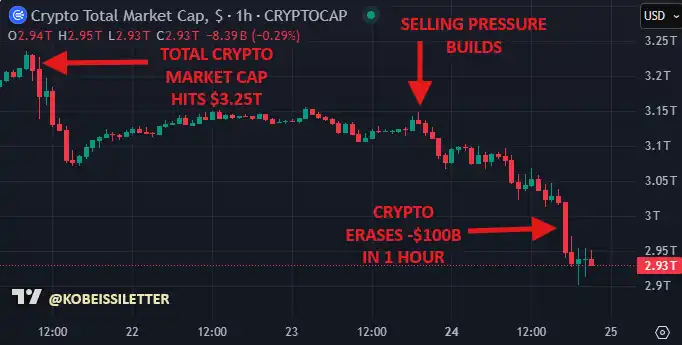
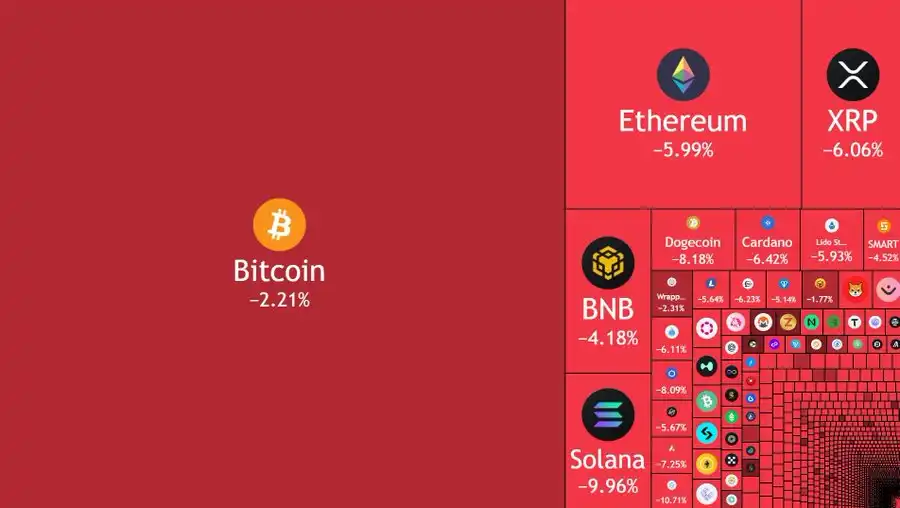
In the past 24 hours alone, we have seen around $150 billion liquidated from the crypto market. The sell-off spread, with almost all crypto assets experiencing significant declines. Even the memecoin market seems to have lost a considerable portion of its liquidity.
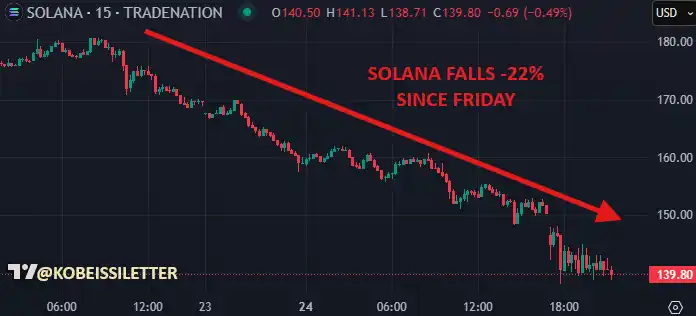
All of this seemingly started with Solana, which has dropped by 22% since last Friday. During the memecoin craze, Solana exhibited extremely strong relative strength. However, as the memecoin frenzy gradually faded, Solana also began to retreat. For a while, Solana's sell-off was mostly independent of Bitcoin's movements.
However, as the S&P 500 index began to decline on Friday, Bitcoin also started to follow suit. As shown below, the S&P 500's drop accelerated the sell-off in Bitcoin. Currently, after breaking below the $98,000 support today, Bitcoin has lost its relative strength.

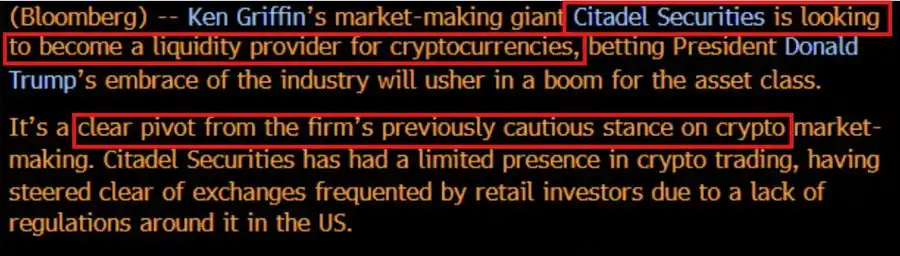
This is quite strange and happened just after Citadel made a significant shift in its cryptocurrency stance. Today, Bloomberg reported that Citadel Securities, a $650 billion market cap company, is seeking to become a liquidity provider for Bitcoin and cryptocurrencies, with the market treating this news as a 'sell the news' event.
The market sentiment also seems to have been hit by the Bybit hack on February 21, with Arkham Intelligence calling it the "largest financial theft in history." The closest comparable event was the theft of the Central Bank of Iraq in March 2003, resulting in a $1 billion loss.
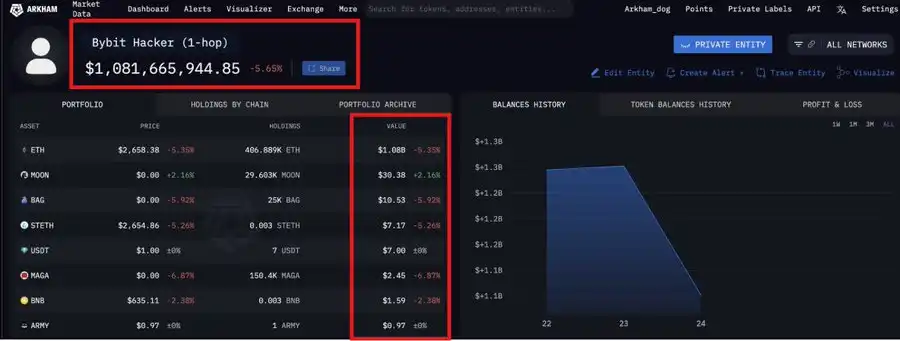
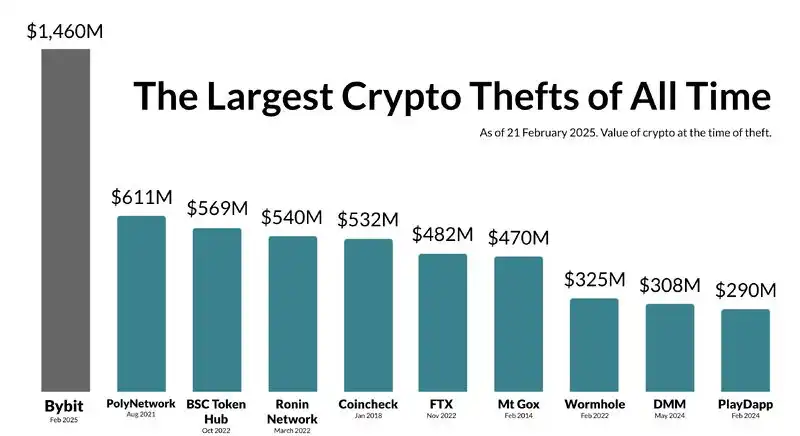
In fact, the losses from the Bybit hack event are more than twice the size of the second-largest hack in crypto history. The largest cryptocurrency hack in 2021 was the $611 million PolyNetwork hack. Ethereum's weakness has also added more pressure to the entire crypto market, with the hack event further eroding market confidence.
The technical aspect also seems to have lost momentum. However, this does not mean that the crypto market is about to enter a prolonged bear market. In this bull market cycle, we have seen numerous instances of Bitcoin retracements exceeding 10%, and a technical pullback is considered healthy.

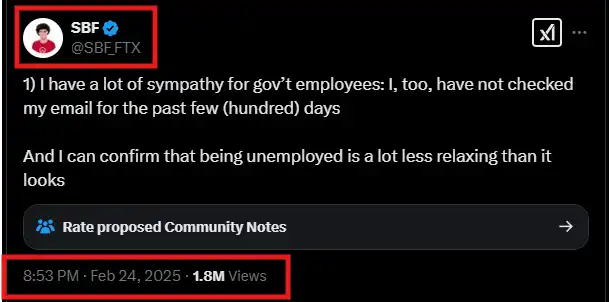
Adding to the woes, Sam Bankman-Fried returned to X platform during the crypto market crash, with SBF expressing his "sympathy for government employees." This comes at a time when DOGE and Elon Musk are preparing for more large-scale layoffs in the federal government.
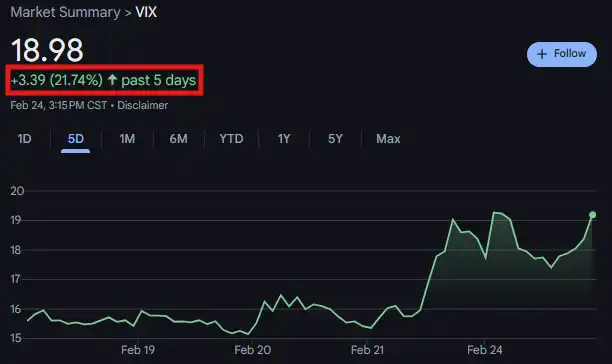
Finally, as stock market volatility returns, risk assets like Bitcoin experience pullbacks. We have seen historically high risk appetite levels in 2024 and entering 2025. The pullback in risk appetite indicates a reduction in liquidity in the crypto market, a scenario that has happened before.
Overall, currently there is no single factor driving the cryptocurrency selloff, but rather a combination of multiple factors that have led to a decrease in liquidity. The crypto market needs liquidity to thrive.
You may also like

Exchanging 200,000 for nearly 100 million, DeFi stablecoins face another attack

The underlying business agreement of the trillion-dollar Agent economy: Understanding ERC-8183, it's not just about payments, but the future

When Wall Street's ETH begins to "yield": Looking at the asset properties of Ethereum from BlackRock's ETHB

The Power of Agency: The Agentic Wallet and the Next Decade of Wallets

Understanding x402 and MPP in One Article: Two Routes for Agent Payments

Particle Founder: The entrepreneurial insights I have gained the most from in the past year

Huang Renxun's latest podcast transcript: The future of Nvidia, the development of embodied intelligence and agents, the explosion of inference demand, and the public relations crisis of artificial intelligence

OKX Ventures Research Report: AI Agent Economic Infrastructure Research Report (Part 1)

The migration of settlement rights: B18 and the institutional starting point of on-chain banks

From Tencent and Circle: Looking at the Simple and Difficult Questions of Investment

The second half of stablecoins no longer belongs to the crypto circle

Cursor "Shell" Kimi Controversy Reversed: From Copyright Infringement Allegations to Authorized Collaboration, China's Open Source Model Once Again Becomes a Global AI Foundation

The Real Reason Tokens Don't Sell: 90% of Crypto Projects Overlook Investor Relations

Is the income of pump.fun real, earning a million dollars a day despite the market downturn?

The real reason why tokens are not selling: 90% of crypto projects neglect investor relations

Who is the true winner of the "Tokenization" narrative?

Moss: The Era of AI-Traded by Anyone | Project Introduction


 App
App