
Dissecting Saylor's Bitcoin Financial Magic: Stock Price Triples Since Last October


Original Article Title: Update on Strategy and Saylor
Original Author: JAY
Original Translation: Deep Tide TechFlow
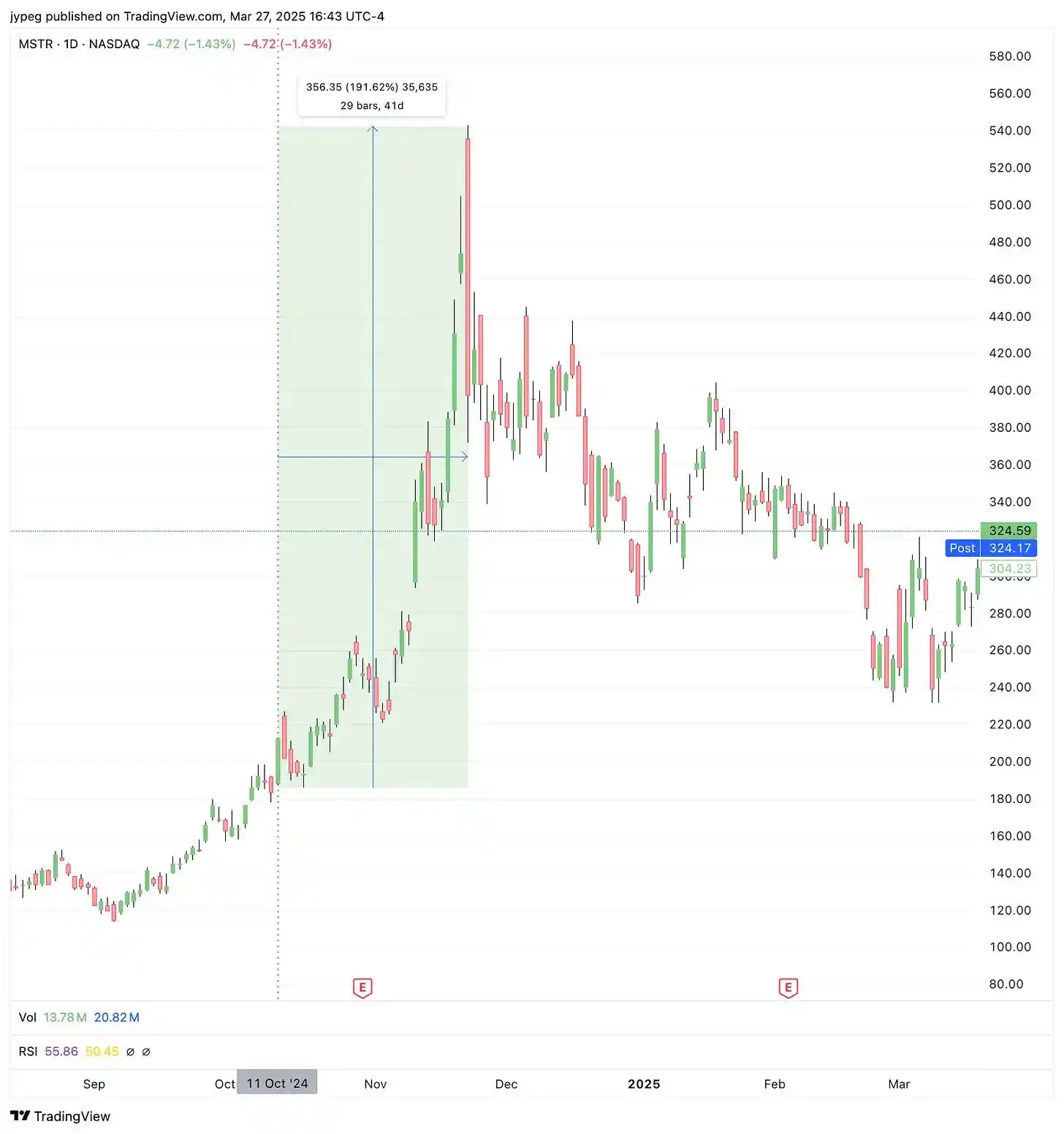
Since October 2024, the price of Strategy (MSTR) has experienced dramatic fluctuations. Soaring from $188 to $540, nearly tripling in value, but then falling back and stabilizing in the $300 low range.
Behind this price movement are a series of significant initiatives driven by company founder Michael Saylor, including changing the company name to Strategy, purchasing over 506,000 bitcoins (BTC), and issuing two new preferred stocks STRK and STRF.
However, there are many inaccurate interpretations in the market regarding how Strategy operates. To help investors more clearly assess whether Saylor's Bitcoin reserve strategy is sustainable, we attempt to simplify its core logic.
Saylor's Bitcoin Reserve Strategy: Two Key Points
Saylor's financial strategy can be summarized in the following two points:
1. Sell Stock Options to Realize Gains Upfront
Strategy sets the exercise price for MSTR stock purchase or conversion options at a range of 30% to 300% of the current stock price and collects all gains upfront through structured transactions. This is mainly achieved through issuing convertible bonds and preferred stocks STRK and STRF.
2. Dilute Stock at Opportune Times
Utilizing the At-the-Market (ATM) mechanism, to issue MSTR stock at market prices when market conditions are favorable to further raise funds.
It is important to note that Saylor does not have a clear plan to repay the principal of these options or bonds. His core goal is to maintain the long-term operation of the financing plan, paying interest until the MSTR stock price rises to the relevant exercise price.
The core advantage of this strategy lies in its highly flexible financing approach. Using this strategy, Saylor can choose the best fundraising tools based on market conditions:
· When implied volatility is high, issue convertible bonds;
· When MSTR stock's Net Asset Value (NAV) premium is high, issue more shares through the ATM mechanism;
If the above conditions are not met, issue more preferred stock (such as STRK or STRF).
Externally, there may be concerns about the high leverage risk of this strategy, but data shows that these concerns are unfounded. Here are key financial data points for MSTR:
· Market Cap: $850 billion;
· Bitcoin Holdings Market Value: Approximately $44 billion (506,000 BTC);
· Total Debt: $8.2 billion, with an annual interest rate of only 0.421%, resulting in annual interest expense of around $34 million;
· Preferred Stock Dividend Payments: STRK pays $58.4 million annually, while STRF pays $85 million annually.
An analysis of these data through ratio analysis reveals that Saylor's use of leverage is actually very limited, and the cost of debt is extremely low.
Bitcoin Reserve Strategy vs. Traditional Banking Model
Strategy's Bitcoin reserve strategy can be somewhat compared to the operational model of traditional banks. The core operating logic of both is as follows:
Traditional Banking Model
Banks amplify leverage through fractional reserve systems to increase returns, but this model occasionally leads to bank bankruptcies.
Receive customer deposits; use deposit funds to purchase "safe" government-backed debt (such as treasury securities, mortgage-backed securities, etc.); pay depositors interest lower than the return on debt investments.
Bitcoin Reserve Strategy
Unlike traditional banks, Strategy's Bitcoin reserve strategy does not use excessive leverage because, in case of trouble, the government will not provide a bailout similar to the banking industry.
Raise funds (similar to banks receiving deposits); purchase Bitcoin with the raised funds (rather than government-backed debt); pay investors MSTR stock returns and periodic interest or dividends.
Although the operating methods differ, the core goal of both models is to achieve profitability through fund management. Banks rely on net interest margin (the difference between debt investment returns and deposit interest) to benefit depositors with a portion of the debt interest passed on through the bank. Bitcoin reserve companies rely on Bitcoin's capital appreciation to benefit investors through the volatility of Bitcoin's price (refer to more detailed information to understand how this trading works and why this model is advantageous to convertible bond buyers). This appreciation mainly comes from the rise in Bitcoin prices or the depreciation of the US dollar against Bitcoin.
The Future Potential of Bitcoin Reserve Strategy
Michael Saylor is one of the most steadfast advocates of the Bitcoin reserve strategy. His asset management model has successfully attracted many companies to follow suit, prompting the U.S. government to begin exploring similar reserve strategies. The continuous rise of MSTR and Bitcoin prices has served as the best "advertisement" for this strategy, further driving market recognition of the Bitcoin reserve concept.
Although those who truly understand and accept Saylor's strategy are still in the minority, as Bitcoin and MSTR develop, the market impact and sustainability of this strategy are growing. Market attention and feedback, in turn, have driven the success of the strategy, and this "reflexivity" may bring longer-term development potential to the Bitcoin reserve strategy.
You may also like

Why Is Bitcoin Down Today? What the Hawkish FOMC Means for SpaceX, Gold and Nasdaq

OKX Star analyzes Binance's competitive advantages: when regulation levels the playing field, competition has just begun

Full version of the debut Q&A! Federal Reserve Chairman Waller: Sticking to the 2% inflation target, establishing five special working groups, individual did not submit the dot plot

From Disruptor to Shadow Market: The Crypto Market is Becoming a Colony of Traditional Finance

Dalio's important long article: How to position in the current market environment?

DeepSeek Financing Story

Morning Report | Illinois signs the strictest digital asset tax law in the U.S.; RWA tokenization market size surpasses $43 billion, institutions accelerate the migration of on-chain assets
Morning Report | DeepSeek completes over $7 billion in financing, with a valuation exceeding $50 billion; Musk's personal wealth has surpassed the total market value of Bitcoin

Cursor, why did you get on Musk's spaceship?
In the name of charity, for the benefit of the family: How the Trump family turned charity into profit?

Will Gold Break $4,500 After Tonight's Fed Decision? What XAUT and PAXG Traders Need to Know
SharpLink CEO: How to understand that Ethereum developers have just surpassed 1 million?

Morning Report | MiCA grace period expires on July 1; Kalshi's trading volume in the first week of the World Cup breaks $5.1 billion, setting a record

The foundation of SpaceX's trillion-dollar valuation: Who is dividing Musk's annual capital expenditure of tens of billions?
How to exit after asset tokenization?
The stablecoin positioning battle escalates: When compliance is just a ticket to entry, will USD1 become the biggest winner?

A16Z: The sun bears witness, SpaceX is worth 7.5 trillion

Mergers and acquisitions in the cryptocurrency market are exceptionally active
Why Is Bitcoin Down Today? What the Hawkish FOMC Means for SpaceX, Gold and Nasdaq
OKX Star analyzes Binance's competitive advantages: when regulation levels the playing field, competition has just begun
Full version of the debut Q&A! Federal Reserve Chairman Waller: Sticking to the 2% inflation target, establishing five special working groups, individual did not submit the dot plot
From Disruptor to Shadow Market: The Crypto Market is Becoming a Colony of Traditional Finance
Dalio's important long article: How to position in the current market environment?
DeepSeek Financing Story


