
Ethereum in a Bull Market: An Undervalued Blue Chip or a Slowing Giant?



Original Article Title: "Ethereum in a Bull Market: Undervalued Blue Chip or Slow-moving Giant?"
Original Article Author: Frank, PANews
As the bull market transitions into alt season, time seems to be running out for ETH. Since the beginning of this bull cycle in late 2023, ETH's performance has been closely watched. However, it seems that ETH has somewhat underperformed over the past year. Most notably, in terms of price appreciation, from October 2023 to the present, the maximum increase has been 170%, struggling to break through the $4000 mark significantly. On the other hand, during the same period, BTC saw a maximum increase of over 300%, and SOL's surge exceeded 1300%. Many believed that ETH represented an opportunity in the alt season, but with several older altcoins experiencing significant short-term gains recently, ETH's momentum appears to be lacking.
As the flagship public blockchain, is Ethereum objectively undervalued by the market or is it performing as expected? Though old, is it still able to deliver?
On-chain Data Stagnant for a Year
From on-chain data, PANews can clearly observe that Ethereum has not experienced significant growth over the past year, showing a lack of decline but not much growth either.
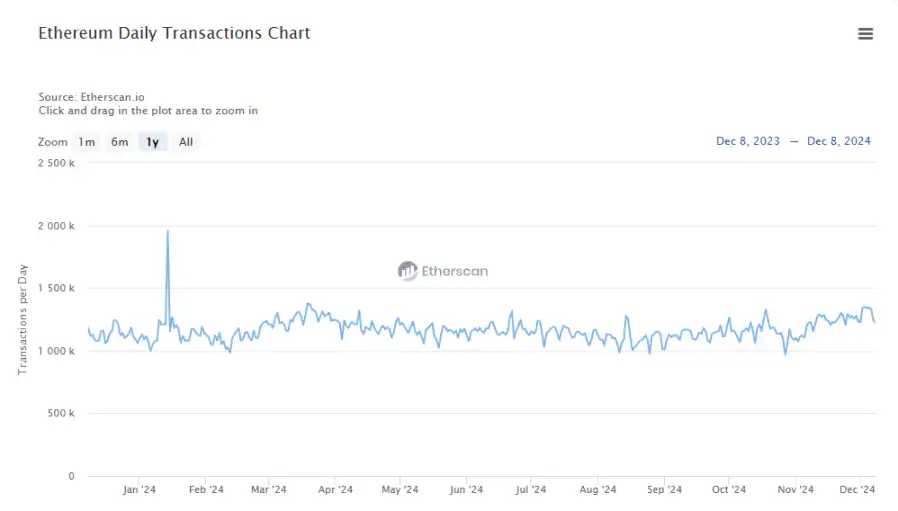
The daily transaction count is a crucial indicator of activity. Looking at the Ethereum daily transaction count chart over the past year resembles an ECG graph, showing stable but slightly fluctuating activity. On December 8, 2023, the total transaction volume on the Ethereum mainnet was 1.18 million transactions, and after a year, on December 8, 2024, this figure was 1.22 million transactions, nearly unchanged. During this year, only in January 2024 did it briefly spike to 1.96 million transactions. The rest of the time, it remained between 1 million and 1.3 million transactions.
The trend of Gas fees more vividly reflects on-chain activity. At the end of 2023 and the beginning of 2024, Ethereum's Gas fees were still relatively high, averaging above 40 Gwei and reaching around 100 Gwei at peak times. With the rise of new public chains like Solana, one can clearly see the reduction in Ethereum's Gas fees on the chart, especially in July to September, dropping to as low as 0.3 Gwei. Even with a recent rebound, it mostly hovers below 20 Gwei. Initially, the Layer 2 solutions surged mainly due to Ethereum's high Gas fees. Now, Ethereum's Gas fees have finally come down, but it seems users have disappeared. Or rather, as users leave, Ethereum truly lowers its fees.
As for active addresses, it also follows a curve pattern similar to the daily average transaction signing. According to data from the Ethereum browser, the daily active Ethereum address count and ERC20 address count have not seen significant growth, and the data level remains similar to the period before the bull market started.
User Flow to L2, Funds Stay on L1
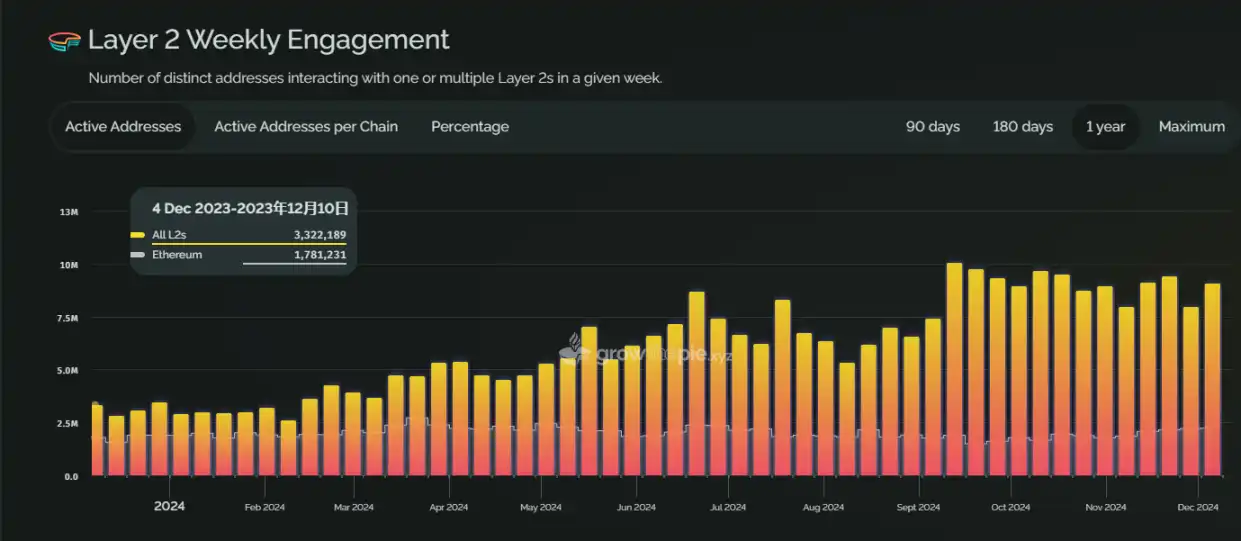
Where did Ethereum's users specifically go? Looking at the weekly on-chain activity data from a year ago, the on-chain active address count of Ethereum accounted for approximately 50% of all Layer2. However, as time has passed, up to the current data, we can see that the active address count on Layer2 is generally on the rise, while the proportion of active addresses on the Ethereum mainnet is around 24% of the overall Layer2.
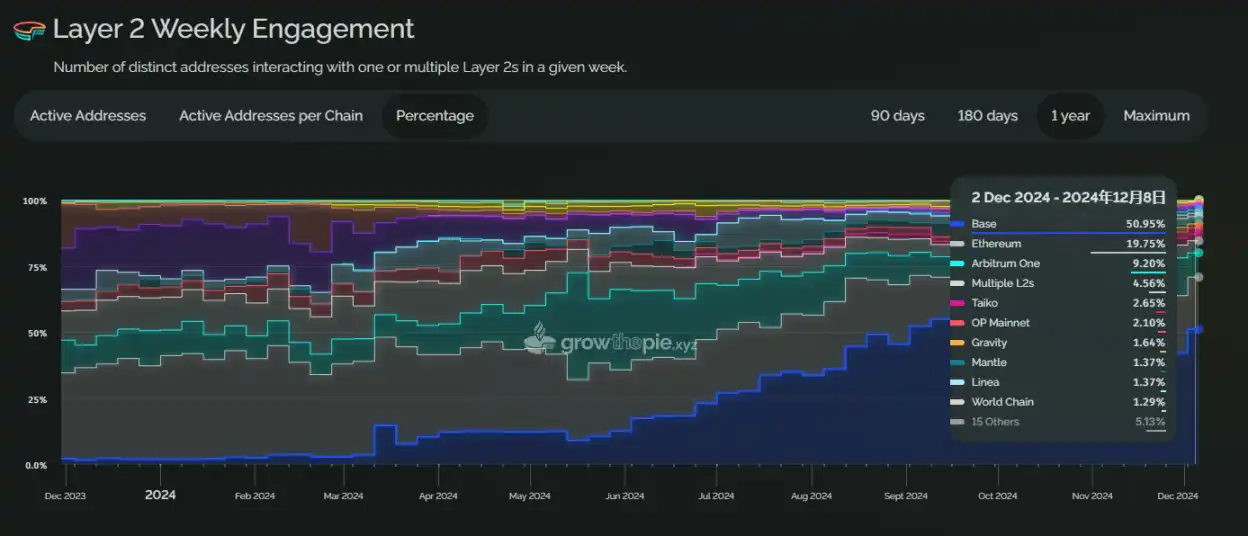
Looking at the performance of each chain separately, in December 2023, the Ethereum mainnet had the highest activity rate, accounting for about 32.48%. By December 2024, the most active chain had changed to Base, with a share rising to 50%, Ethereum mainnet in second place at 19%, and Arbitrum in third at 9.2%.
However, in Total Value Locked (TVL), the Ethereum mainnet still appears to be the first choice for whales. Looking at the total amount of stablecoins locked on-chain, the proportion on the Ethereum mainnet was around 95% in December of last year, slightly down now but still around 91%. Moreover, TVL data has almost been the only data showing a significant increase on the Ethereum mainnet over the past year. In December 2023, the TVL on the Ethereum mainnet was about $28.8 billion, and by December 2024, this data had risen to around $77.5 billion. The growth rate is about 2.69 times, surpassing the growth rate of Ethereum's price. This growth is also related to the price surge during the bull market. In Layer2, Arbitrum and Base are second and third, respectively, in stablecoin TVL.

In terms of revenue, the Ethereum mainnet is also the most profitable chain within the Ethereum ecosystem. Over the past year, Ethereum's revenue share has consistently remained above 80%, reaching 92% as of December 8. Base Chain has become the second-highest revenue-generating chain in the Ethereum ecosystem this year.
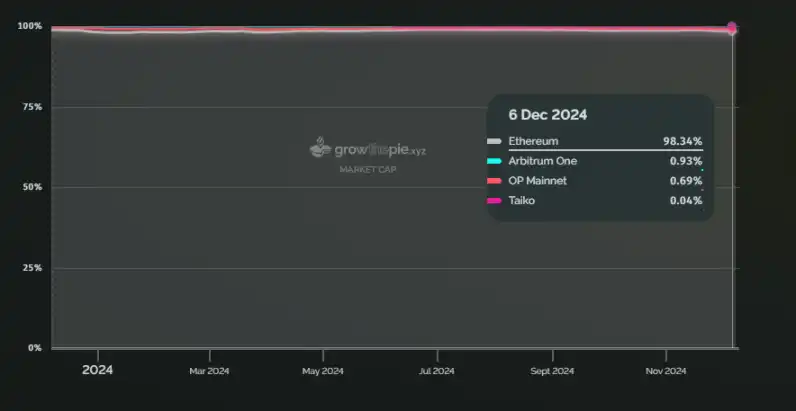
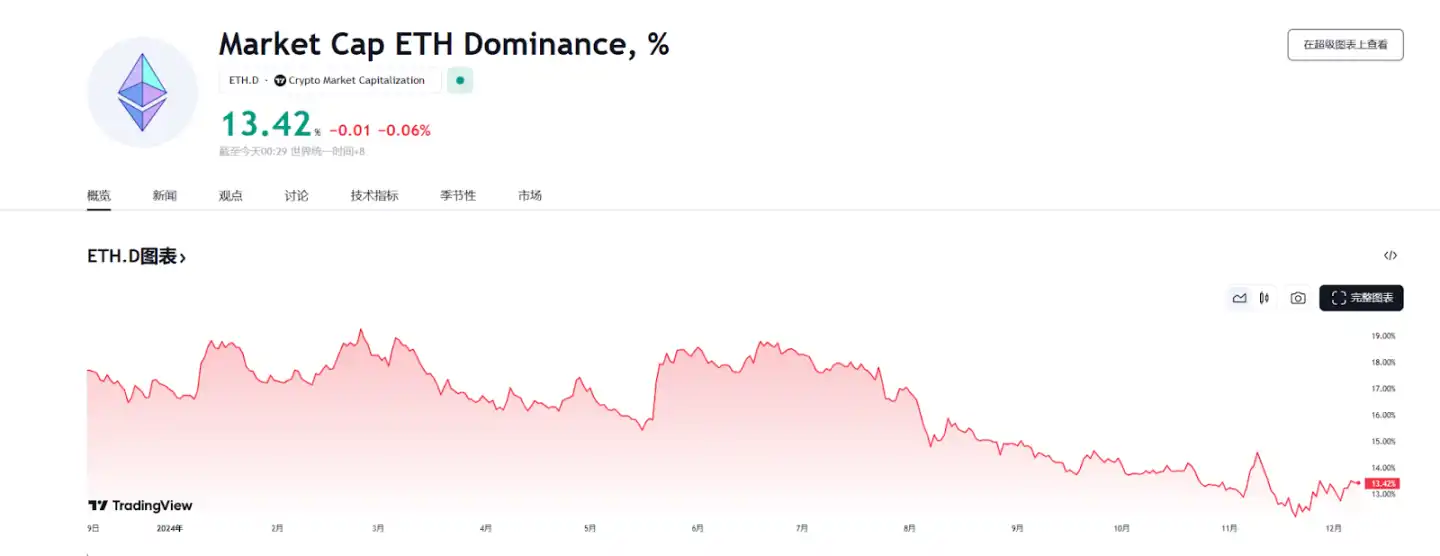
Ethereum's market capitalization has also remained at around 98%, despite a decrease in on-chain activity. The market cap proportion seems to be generally consistent with the TVL proportion. Additionally, looking at the entire crypto market share, Ethereum's market cap proportion has indeed been continuously decreasing over the past year, currently standing at around 13.4%.
However, considering the growth of TVL, most large funds still choose to keep their funds on the Ethereum mainnet. Comparing the ratio of total TVL to active user count, Ethereum's mainnet has a value of $178,700, Base is around $3,315, and Solana is around $1,972. From this perspective, Ethereum still maintains the highest value per user across the entire network.
Uniswap Exodus Could Spell Greater Concern
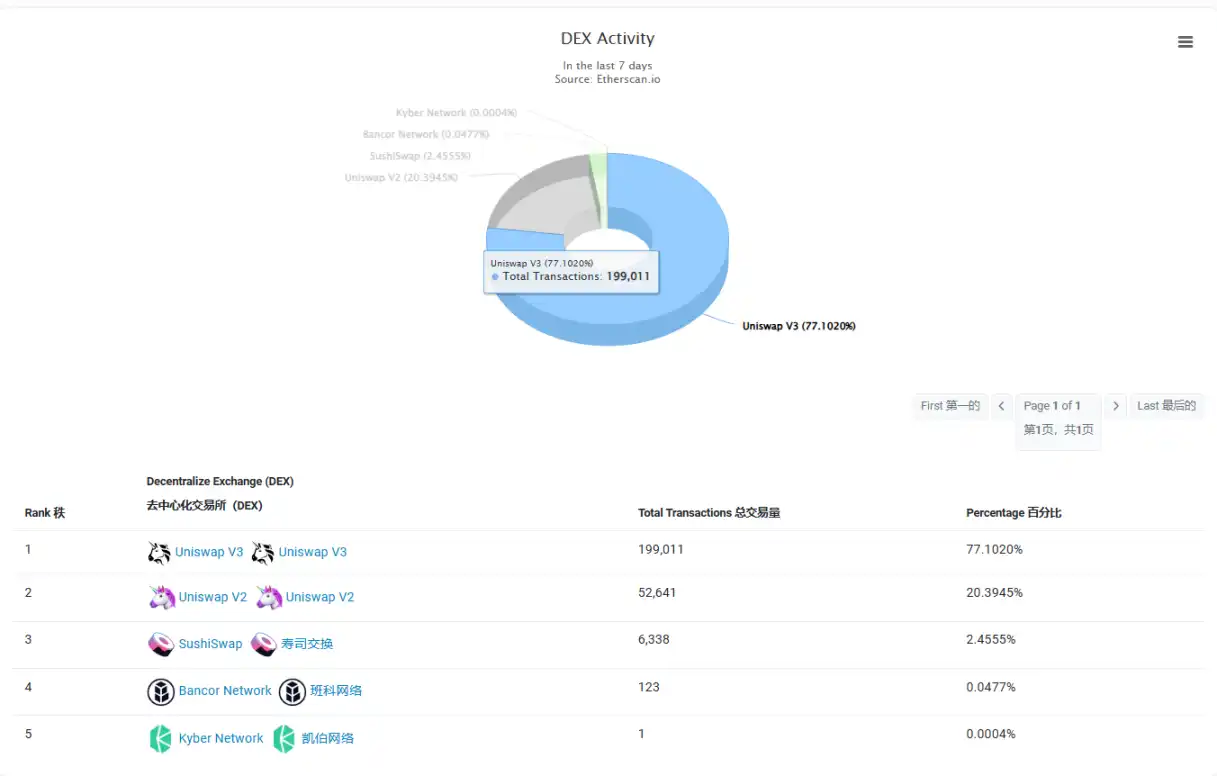
From various data points, Uniswap is currently the undisputed largest application on Ethereum. In terms of DEX activity, Uniswap V2 and V3 together account for over 97% of the transaction volume on the Ethereum mainnet. On Ethereum's burn leaderboard, Uniswap has also consistently held the top position. As of December 9, in the past 30 days, Uniswap burned a total of 6,372 Ether, while Ethereum transfers only burned 4,594 Ether.
Once Uniswap shifts most of its trading activity to its self-built Unichain, Ethereum mainnet's activity and burn count may drop significantly. According to Forbes, as Uniswap transitions to its own chain, Ethereum network validators could lose an estimated $400 million to $500 million in annual revenue. However, more concerning than this economic loss is the threat to Ethereum's fundamental narrative as a deflationary currency. Uniswap's general router is the largest gas fee consumer, accounting for 14.5% of Ethereum's gas fees, equivalent to burning $1.6 billion worth of Ether.
Summarizing the performance of the above indicators, we can draw some key conclusions. Ethereum mainnet's on-chain network activity has not grown in the past year and its share within the entire Ethereum ecosystem is gradually declining. At least, this suggests that new users are mostly opting for other Layer 2 solutions or other blockchains (after all, emerging blockchains like Solana, Sui, Aptos, etc., are showing rapid growth in these metrics).
Therefore, circling back to the initial topic, has Ethereum's fundamental changed significantly? Or is ETH undervalued? Considering the data above, Ethereum mainnet seems to be transforming into a reservoir for whales and institutional funds. Even with a significant decrease in gas fees, Ethereum Mainnet still cannot compete with Layer 2 or other blockchains in terms of transaction fees and speed. Thus, Ethereum mainnet is clearly no longer just a retail investor club and does not have a community size advantage in the current popular MEME and other trends. It is more suited for players with lower frequency requirements and higher asset security demands. From this perspective, we can only say that Ethereum mainnet's ecosystem role is undergoing a transformation, with liquidity and security becoming Ethereum mainnet's final moat.
You may also like

Morning Report | OpenAI has submitted an S-1 registration statement draft to the U.S. SEC; Morpho completes $175 million financing

Galaxy Deep Research Report: How Hyperliquid's HIP-4 Upgrade Changes the Landscape of Prediction Markets?

Latest research from 13 top universities including Cornell University: The current state, challenges, and misconceptions of the fusion of Crypto and AI

Deconstructing Anthropic: The Best AI Company, Possibly Also a Type of Organizational Invention

Every exchange is a "Universal Exchange."

The counterattack of traditional finance: Alliance chains are quietly reviving
Pantera Capital Partner: How Tokenization is Restructuring the Private Equity and Early Investment Ecosystem?

Mastercard Launches Agent Pay for AI, Plans to Record AI Agent Payment Authorizations on Polygon
Mastercard launched Agent Pay for AI, a new payment protocol designed to help AI agents make small payments such as pay-per-use access to data and APIs. The system plans to record human-granted AI agent permissions on Polygon, focusing on verifiable authorization, identity, and payment controls.

Curve Deploys Llamalend v2 on Optimism With 250,000 OP Incentives
Curve launched Llamalend v2 on Optimism with 250,000 OP incentives from the Optimism Foundation. The upgrade expands Llamalend beyond its earlier crvUSD-focused model, adding broader collateral support, LlamaRisk market reviews, and the ability to use Curve LP tokens as collateral.

Raydium Old Liquidity Pool Reportedly Exploited, With $1.34 Million Moved to Ethereum and Tornado Cash
An old Raydium liquidity pool was reportedly exploited for around $1.34 million in USDC, RAY, and wSOL, with the stolen funds bridged to Ethereum and deposited into Tornado Cash. The incident highlights the tail risks of legacy DeFi pools, old contracts, and cross-chain fund laundering paths.
Kalshi Executive Challenges “SBF Backed AI Unicorns” Narrative, Says Leopold Aschenbrenner Was Key Figure
Kalshi executive John Wang questioned the “SBF backed AI unicorns” narrative, saying Leopold Aschenbrenner was the key figure behind major AI investment decisions.

New York Proposes Stricter Stablecoin Issuer Rules Aligned With Federal GENIUS Act
NYDFS proposed stricter stablecoin issuer rules aligned with the GENIUS Act, covering reserves, custody, redemption timelines, audits, and capital buffers.

CryptoQuant Says Bitcoin Profitable Supply Is Near 45% Pressure Zone as On-Chain Data Points to Market Repricing
CryptoQuant said Bitcoin’s profitable supply is nearing the 45% pressure zone, signaling rising market stress, unrealized losses, and a possible on-chain repricing phase.

Bitcoin Falls Below 200-Week Moving Average as On-Chain Data Shows Over Half of Supply in Loss
Bitcoin dropped below its 200-week moving average as on-chain data showed over 50% of circulating supply is now in loss, signaling rising market stress.

CFTC Reportedly Plans New Prediction Market Rules Focused on Manipulation Risk and Public Interest Review
The CFTC is reportedly preparing new prediction market rules focused on manipulation risk, public interest review, and retail trader protections.

Meet the new WEEX trial fund—your gateway to greater profits

WEEX Labs Lands at Dutch Blockchain Week: A Disruptive Crypto × AI Conversation Sets Sail in Amsterdam
SK Hynix Reportedly Plans U.S. ADR Listing as Early as August, With SEC Approval Possible in Late June
SK Hynix may pursue a U.S. ADR listing as early as August, with SEC approval reportedly possible in late June amid strong AI chip supply chain demand.
Morning Report | OpenAI has submitted an S-1 registration statement draft to the U.S. SEC; Morpho completes $175 million financing
Galaxy Deep Research Report: How Hyperliquid's HIP-4 Upgrade Changes the Landscape of Prediction Markets?
Latest research from 13 top universities including Cornell University: The current state, challenges, and misconceptions of the fusion of Crypto and AI
Deconstructing Anthropic: The Best AI Company, Possibly Also a Type of Organizational Invention
Every exchange is a "Universal Exchange."
The counterattack of traditional finance: Alliance chains are quietly reviving


