
Exchange Owners Share a Drink, Settling a $1 Billion Crypto Feud - Coin Circle Rule



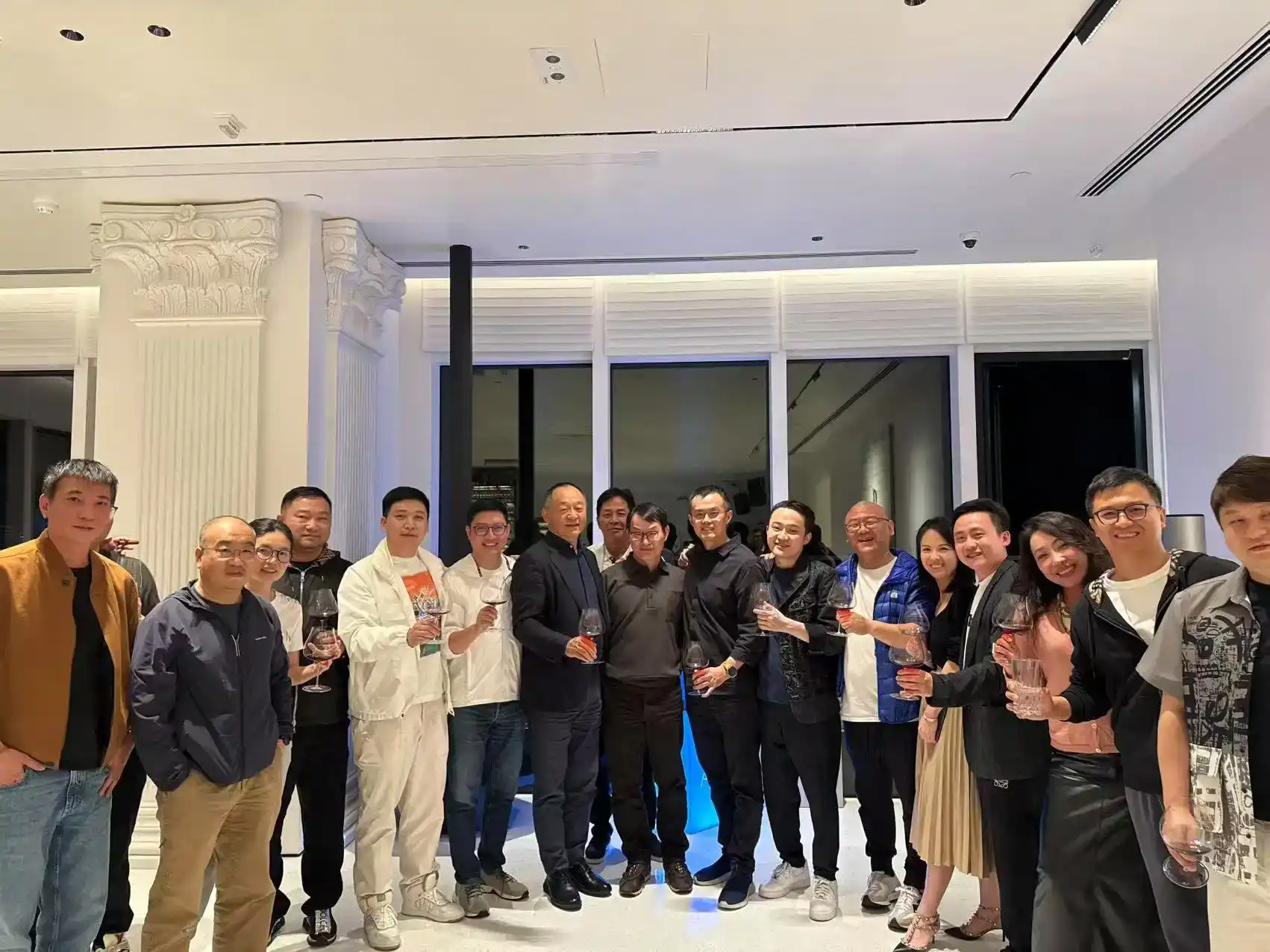
On April 5, 2025, in the night scene of Victoria Harbour, the "BUIDL 2025" Web3 Industry Summit was underway. Amidst the clinking of glasses, a group photo quickly went viral: Huobi founder Li Lin, Binance founder CZ, and TRON founder Justin Sun were at the center stage, raising their glasses in celebration, with bright smiles, surrounded by other cryptocurrency industry tycoons.
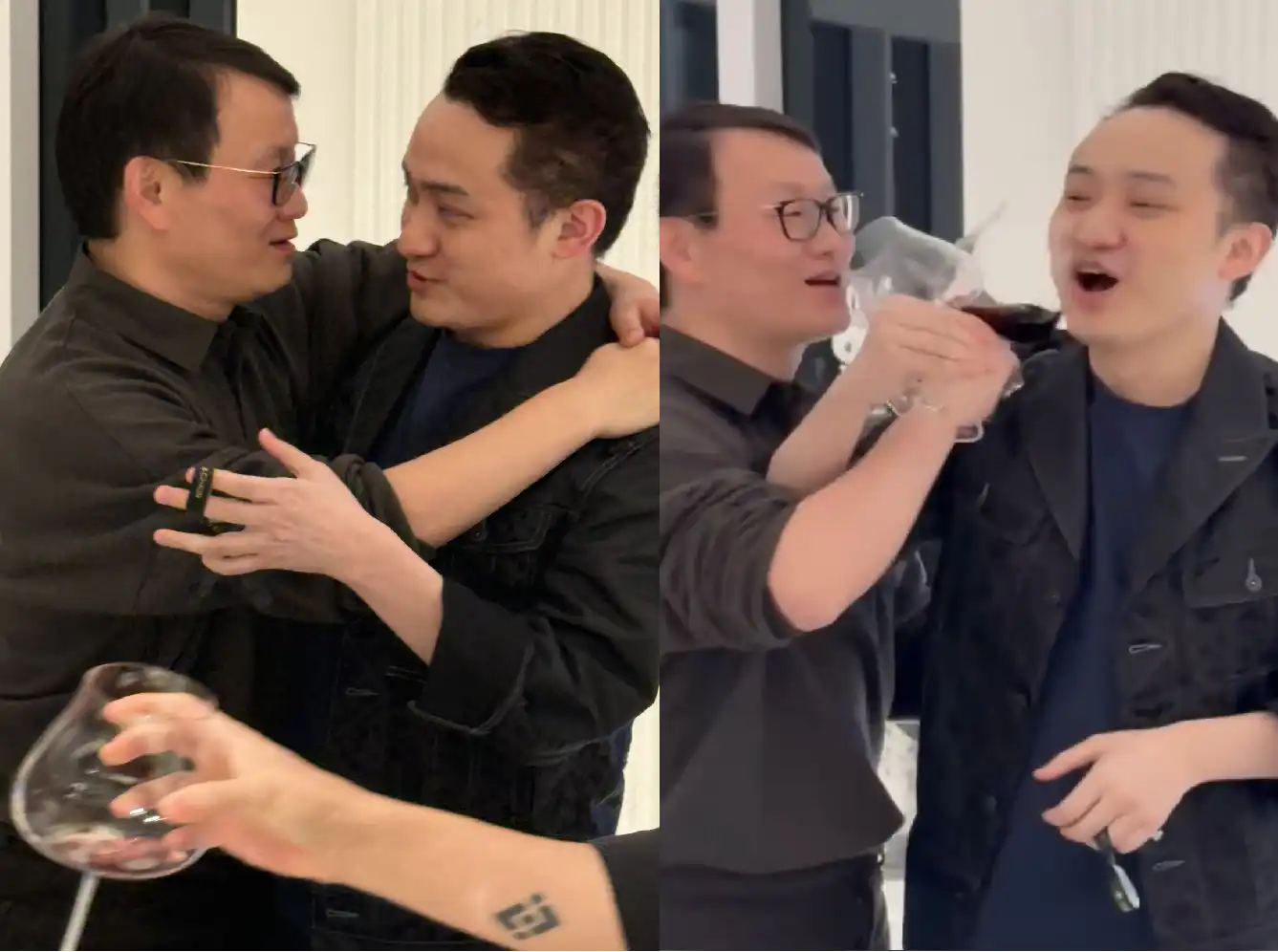
Another more eye-catching photo circulating at the conference was of Justin Sun and Li Lin embracing and toasting. Just two months ago, Sun publicly criticized Li Lin for concealing a financial loophole in Huobi. The two were in a tense standoff, seemingly unwilling to back down. Could it be that merely two months had passed, and they had set aside their past differences?
These two photos seemed to encapsulate a glimpse of the "Golden Age" of the crypto industry—full of undercurrents of enmity as well as a symbiotic scene of intertwined interests. Their appearance together not only reflected the subtle dynamics of personal relationships but also bore witness to the crypto industry's transformation from grassroots to regulatory compliance. Now, let's take a look at the love-hate relationships among industry titans.
Li Lin and Justin Sun: Unable to Sever Debts and Complicated Relations
Li Lin and Justin Sun had a major dispute over the Huobi acquisition, widely known within the industry. The origins of the issue can be traced back to October 8, 2022, when Huobi founder Li Lin sold his shares to the Hong Kong-based Hundred Realms Capital affiliated with Justin Sun. Three years after the completion of the transaction, in February 2025, Justin Sun suddenly accused Li Lin of withholding due diligence materials, claiming there was a $30 million "financial loophole" within Huobi that he had to personally cover.
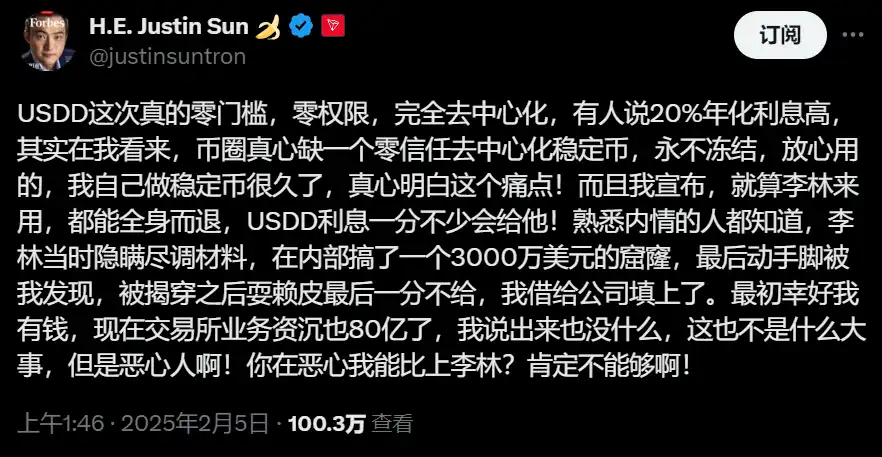
In response, Li Lin published a lengthy article stating that at the time of the 2022 transaction, there were disagreements between the parties on how to calculate user assets, and there was an adequate reserve fund set aside. The alleged "$30 million financial loophole" mentioned by Justin Sun was actually a result of liquidation losses from the exchange's margin trading during extreme market conditions. The issue had already been addressed using company revenue and should not be deemed an undisclosed "financial loophole."
In reality, this was not the first confrontation between the two, as Sun and Li's feud began shortly after the Huobi sale.
In May 2023, Justin Sun accused Li Lin's brother, Li Wei, of illicitly acquiring and selling a large amount of zero-cost HT through improper means and expressed the intention to retrieve and destroy these tokens to protect the HT community's interests. Subsequently, Huobi founder Li Lin responded in his circle of friends, stating that he hoped for evidence from Sun and that if it was confirmed that Li Wei had obtained zero-cost HT through illegal means, he was willing to compensate Huobi Company ten times the HT amount in his personal capacity. If the allegations were false, he hoped Huobi would return the users' legitimate assets.
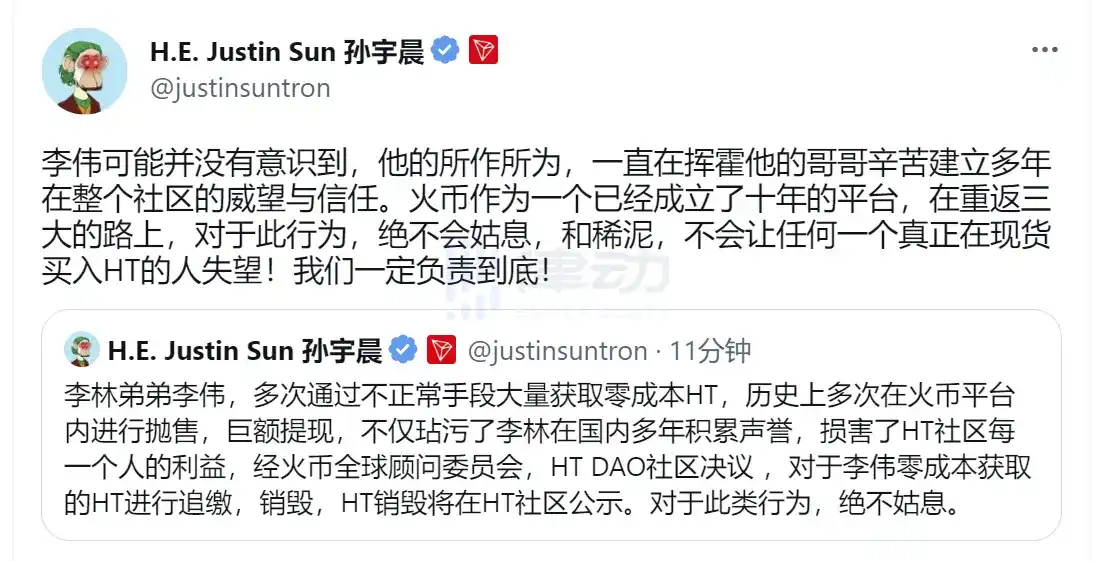
Sun Yuchen did not provide concrete evidence in the follow-up, and the accusatory tweet was also deleted. Although it raised widespread community doubts about Huobi's internal management, ultimately this disclosure came to nothing. However, the love-hate relationship between Li Lin and Sun Yuchen did not end there. In February 2025, due to a $30 million "financial loophole," the two cryptocurrency bigwigs once again engaged in a public opinion war on the internet.
Furthermore, the photo of Sun Yuchen and Li Lin embracing and toasting, which was taken at the conference, led to more speculation about their relationship. In the photo, the two were smiling and intimate, behaving like long-lost friends, completely unlike two months ago when they had a $30 million financial dispute. This may be a staged performance of cryptocurrency bigwigs in public settings, or perhaps it is a reconciliation behind closed doors, leaving the mystery of the Sun-Lin "love-hate" relationship.
Speaking of toasting, Li Lin is not the only one who has toasted with other cryptocurrency bigwigs. Back in 2018, Li Lin drank and toasted with OKEx's founder, Star Xu, while eating barbecue by the roadside. They also toasted at dinner parties. When OKEx couldn't withdraw coins, Star Xu was invited for tea, and Li Lin voiced his support for Star Xu in the community. Although there is an element of play-acting, it indeed expressed the mutual respect among entrepreneurs in the cryptocurrency industry, which is flourishing and full of opportunities and risks, with the vision of jointly making the cryptocurrency industry stronger and better. Later on, Star Xu called out to Li Lin: "Drinking a toast makes true brothers. Thanks to Huobi's Li Lin for stepping forward to heal my pain."

CZ and Sun Yuchen: Frenemies, Love-Hate Relationship
Sun Yuchen and CZ are both regarded as leaders in the crypto field. Sun Yuchen founded TRON and led Huobi HTX, while CZ founded Binance, creating an ecosystem of complementarity and competition. Both have graced the cover of Forbes magazine, showcasing their global influence. As industry pioneers, the ups and downs between them are also part of the history of the cryptocurrency industry.
As early as 2015, He Yi, Sun Yuchen, and Luo Min, CEO of Qudian, appeared together on the reality show "Only You Can't". They wore jumpsuits with goat horns and white hats and performed a song called the "Twisted Goat Song." At that time, He Yi and CZ had only known each other for a year and were both working at OKCoin, holding the positions of Vice President and CTO, respectively. The gears of fate quietly turned, and these young people, still immersed in the excitement of entering a new industry, may have difficulty imagining that the future of the cryptocurrency industry will be disrupted because of them.
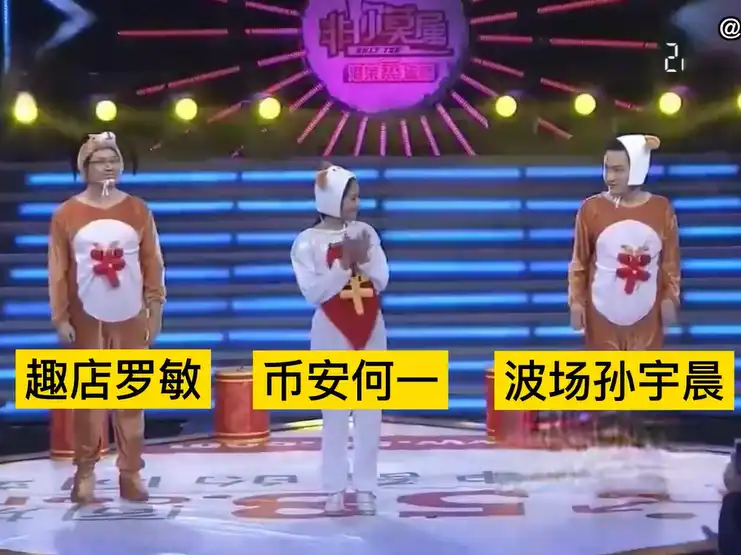
The early years of the crypto world were full of infinite possibilities and imagination, with Justin Sun and CZ in a stage of mutual cooperation and mutual achievement.
In October 2018, Justin Sun and CZ met at the Geneva World Investment Forum. At the time, it was the 73rd anniversary of the founding of the United Nations. Binance established a blockchain charity foundation and launched a blockchain-based donation platform to support countries such as Uganda affected by floods and landslides. The Tron Foundation also donated $3 million to support blockchain charity work.
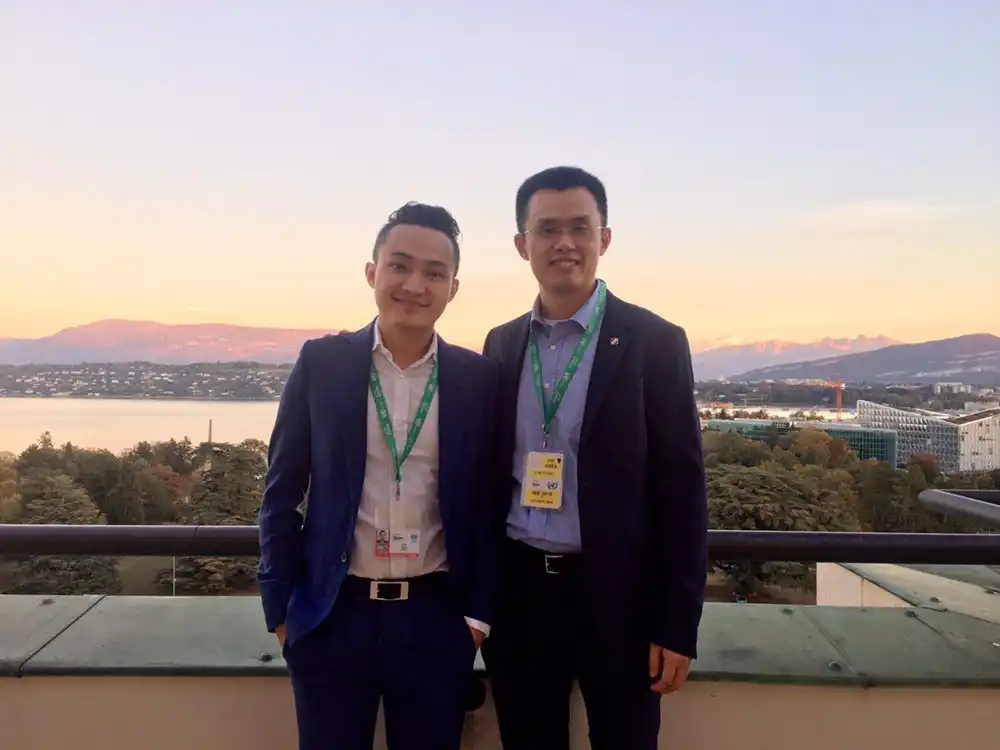
2019 was a "honeymoon period" for Justin Sun and CZ. On January 28, BitTorrent (BTT), a project previously acquired by Justin Sun, completed the issuance of 5.94 billion BTT on the Binance Launchpad blockchain asset issuance platform in about 14 minutes, raising $7.1 million. BitTorrent became Binance's first IEO project, marking the beginning of CZ's and Justin Sun's early cooperation. In April, after TRON launched TRC20-USDT, Binance quickly provided support and launched the "Earn 16% APY by Staking TRC20-USDT" activity to introduce a large amount of liquidity to the TRON ecosystem. At the same time, Justin Sun frequently promoted Binance on Weibo and Twitter, vigorously publicizing this cooperation achievement. During that time, their cooperation was exemplary—Justin Sun used Binance's platform influence to promote the TRON ecosystem, while Binance attracted more USDT users by leveraging TRON's new chain and high-interest rate subsidies, achieving a win-win situation.
In September 2019, Binance and Paxos Trust Company's collaboration launched the stablecoin Binance USD (BUSD), which surpassed a market cap of $1 billion in less than two years. On September 5, 2022, shortly after BUSD's market cap reached $20 billion, Binance announced that it would stop using the three stablecoins—USDC, USDP, and TUSD—competing with BUSD, officially declaring war on the stablecoin giant USDC.
The smooth issuance and great success of BUSD allowed CZ to gradually build his own crypto empire leveraging the platform's strengths. Just a month after Binance announced the redemption plan, on October 28, 2022, Huobi Global, which had just been taken over by Justin Sun 20 days earlier, announced that HUSD triggered the Eleventh Article of Huobi Global Token Management Rules, halting HUSD trading and implementing delisting on the same day, with users' HUSD directly converted to USDT. This news caused a stir in the market as HUSD lost its peg, rapidly devalued, plummeting to $0.3 on November 1, and thereafter declined continuously, completely withdrawing from the stablecoin competitive market.
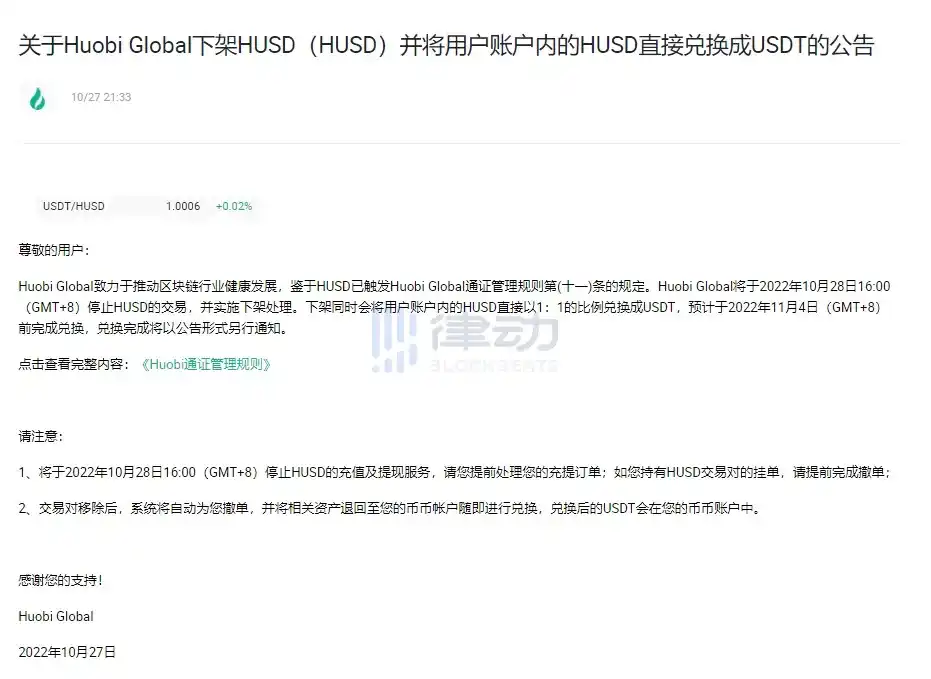
Interestingly, HUSD is also a stablecoin project launched through a partnership between Huobi and Paxos. In a blog post commemorating the one-year anniversary of HUSD in July 2022, the Paxos team wrote, "Paxos now supports 3 of the top 6 stablecoins in the world, and we are proud of this fact. As the first regulated trust company and qualified custodian for digital assets, Paxos has unique expertise in this market."
Following the anniversary blog post, one month later, Paxos co-founder Rich Teo was seen dining at a high-end restaurant overseas with Binance CEO CZ, causing some controversy within the crypto community. Two months later, HUSD announced its termination, and Paxos became the "full-time steward" of BUSD. Speculation arose within the community that this dinner meeting may have involved strategic discussions about the stablecoin market, potentially influencing Huobi's decision regarding HUSD. However, these speculations lack direct evidence and have not been officially confirmed.

Related Reading: "The Four-Year Rise and Fall of the $15 Billion Stablecoin Empire: The Ambitions and Regrets of BUSD"
Two months after the delisting of HUSD, on December 30, 2022, Binance announced the completion of the integration of Binance-Peg BUSD on the TRON network. Deposits and withdrawals of BUSD are now open on the TRON network, and Justin Sun actively promoted the collaboration with Binance on Twitter. Regardless of any past disagreements between the two over stablecoin partnerships, at least for now, everything seems to be in a harmonious and prosperous state.
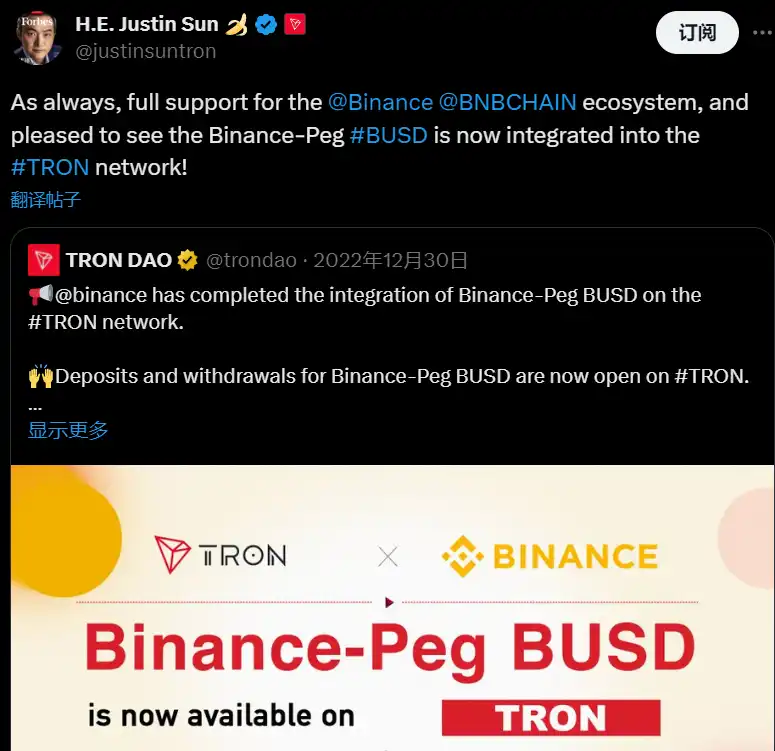
However, the two individuals' game of stablecoins continues behind the scenes.
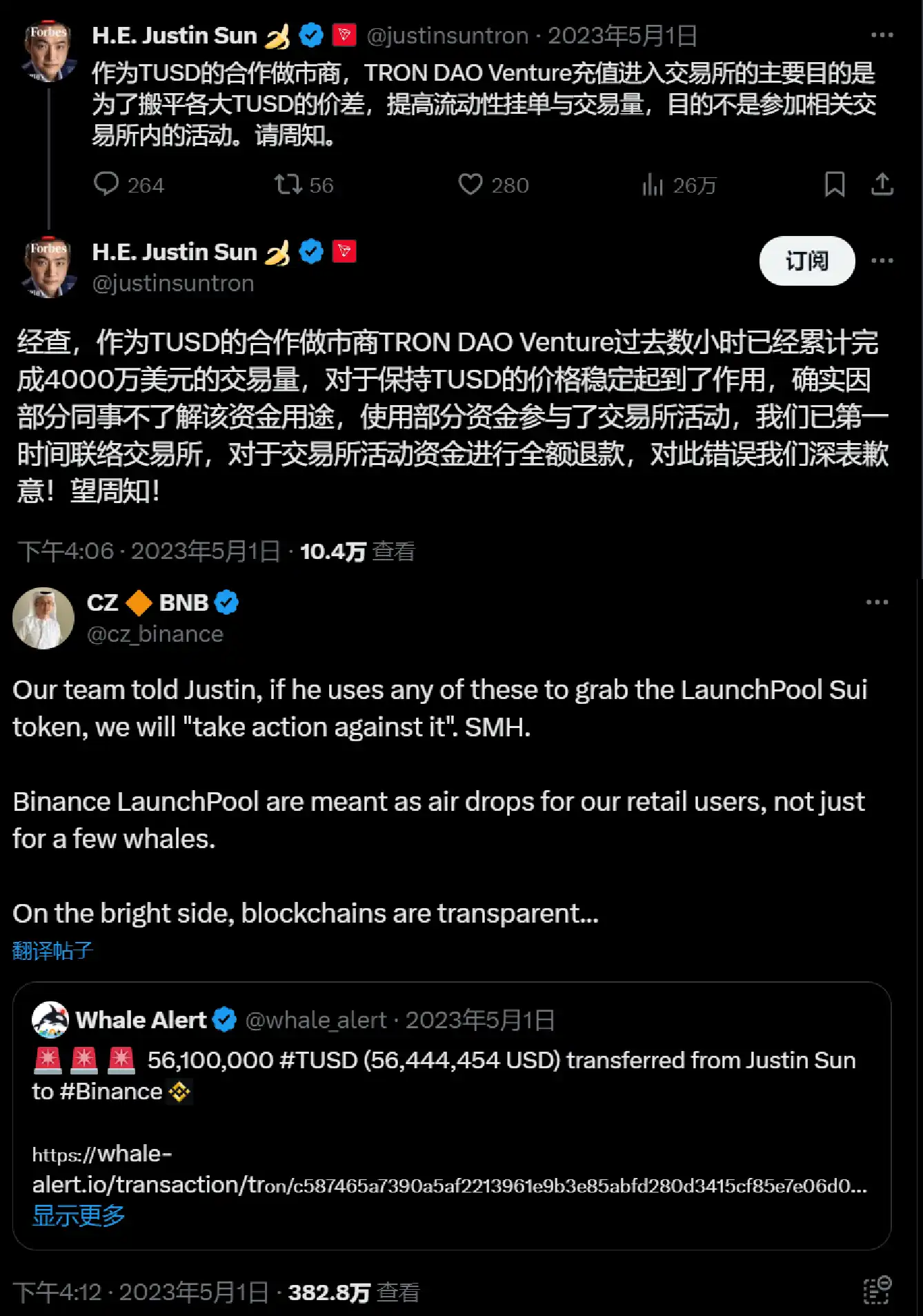
In May 2023, Justin Sun transferred 405 million TUSD to Binance, allegedly to participate in Binance LaunchPool's SUI token mining activity. This sparked debates within the crypto community, with some accusing CZ of assisting a whale by enabling Sun to acquire the new SUI token through Binance's exchange pool incentives, suggesting potential "insider trading." As the public opinion intensified, Sun clarified that the initial purpose of the transfer was to act as a TUSD market maker to "arbitrage the spread" and improve liquidity, not to participate in the event. Any funds mistakenly used in the event were refunded through contact with the exchange. Subsequently, CZ publicly stated that if Sun used the TUSD for mining, action would be taken, emphasizing that LaunchPool serves retail users, not whales. The $405 million drama concluded within the disclaimers of the two bosses.
It is worth noting that TUSD is the "successor token" to BUSD. On February 13, 2023, SEC enforcement officials issued a "Wells Notice" to Paxos, stating that the BUSD issued and listed by Paxos is an unregistered security, and they plan to sue Paxos for violating investor protection laws. Under strong regulatory intervention, Binance continued to delist BUSD trading pairs, and BUSD, which once had a market capitalization of up to $22 billion, gradually faded from the stage of history. Subsequently, Binance turned its attention to another stablecoin—TUSD. Binance took a series of measures, such as adding TUSD trading pairs, opening a TUSD Pool on Launchpool, and offering zero fees on BTC/TUSD trading pairs, vigorously supporting the BTC/TUSD trading pair. In March 2023, the BTC/TUSD trading pair surpassed the BTC/USDT trading pair, becoming Binance's largest trading pair in terms of trading volume. After Binance halted BUSD issuances, its support for TUSD, USDC, and other stablecoins put additional pressure on Justin Sun's TRC-USDT.
Related reading: "TUSD, It's Time to Reacquaint Yourself with the Binance Newcomer"
On April 3, 2025, Justin Sun suddenly accused First Digital Trust (FDT) of insolvency, unable to fulfill customer fund redemptions. FDT is the issuer of the stablecoin FDUSD and the asset management institution for TUSD. On the same day, in a live press conference, Justin Sun stated that as early as 2023, Techteryx had investigated FDT and discovered that a large amount of client funds under custody had been misappropriated. At that time, Justin Sun personally provided assistance to Techteryx with his own funds, ensuring that TUSD had sufficient liquidity. TrueCoin was suspected of colluding with FDT to illegally transfer $456 million of TUSD reserve funds to a company in Dubai. First Digital later responded to the accusations, stating that the dispute only involved TUSD and was completely unrelated to FDUSD, and that First Digital had the full ability to make payments.
Undoubtedly, this move and Binance's subsequent suspected "informing large holders only in small circles and cutting retail investors" behavior once again plunged CZ and He Yi into an urgent public relations crisis, sparking dissatisfaction with centralized exchanges in the market. Justin Sun's role in this episode appears much more righteous, exposing insider trading and safeguarding all investors' rights. Perhaps Justin Sun's original intention was simply to reclaim his $500 million deposit, which is not directly related to Binance. However, during the brief decoupling of FDUSD, Binance, caught in the crossfire, was still embroiled in a public opinion battle.
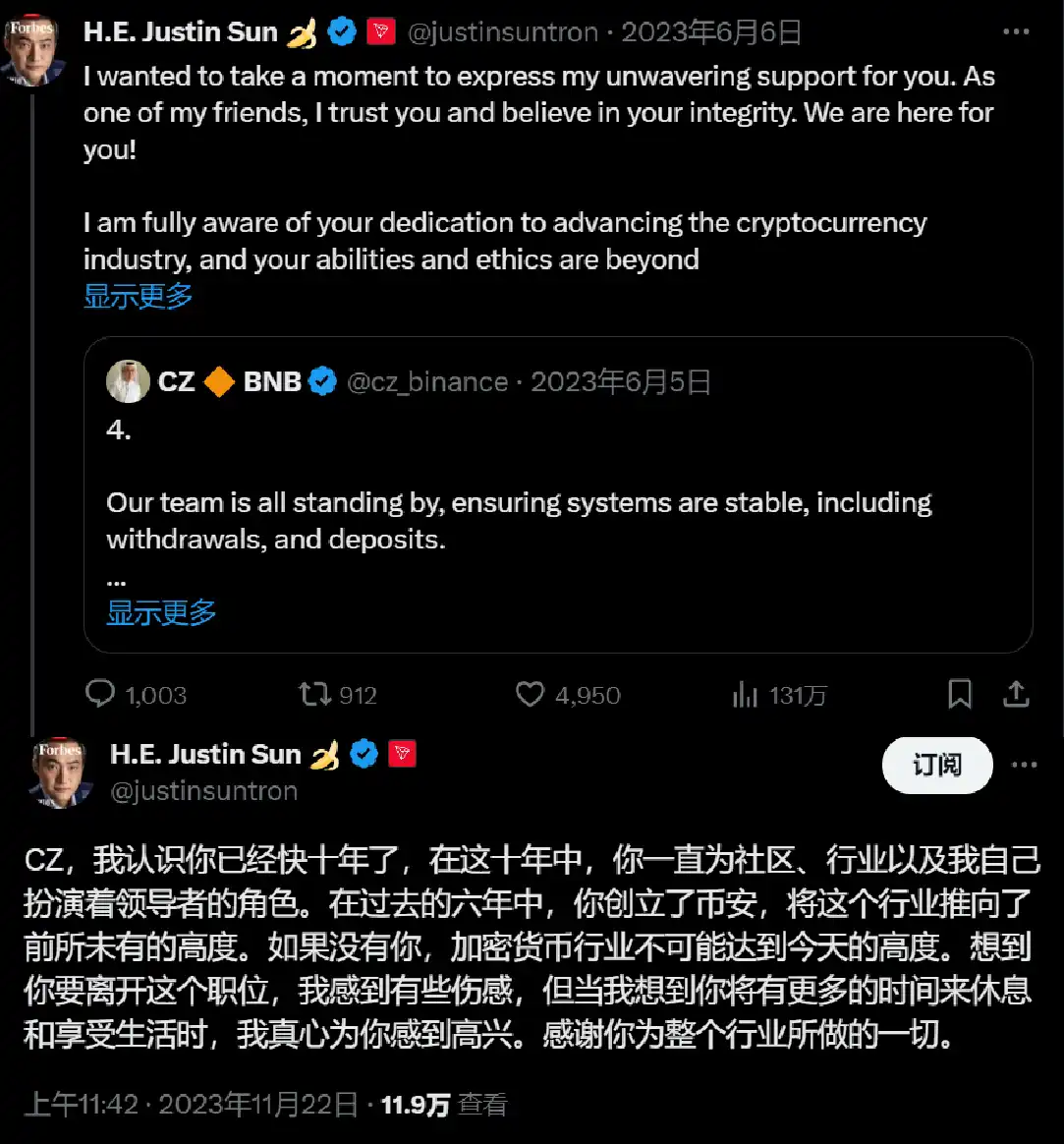
Despite the rivalry between the two in business, Sun Yuchen has publicly spoken up for CZ in the crypto circle on multiple occasions. Following the June 2023 SEC lawsuit against Binance incident, Sun Yuchen openly expressed support for CZ on social media, stating, "As a friend of CZ, I am willing to resolutely support CZ and believe that justice will prevail." In November 2023, CZ announced his resignation as Binance CEO, and Sun Yuchen highly praised CZ's contributions on social media, mentioning their nearly decade-long acquaintance, applauding his leadership and industry drive, stating that he "has propelled the industry to unprecedented heights," and emphasizing continuing to strengthen cooperation with Binance in the future.
When photos of a "wine-sharing ceremony" between Li Lin and Sun Yuchen flooded social media, and when CZ and Sun Yuchen were seen laughing together at a summit, onlookers found it difficult to distinguish whether this was a scripted scene or a genuine reconciliation. However, perhaps the answer is not essential—within the crypto industry, a consensus of interest is far more cohesive than personal grievances. From the early days of the grassroots community to the current wave of compliance, the rivalry history of these tycoons is precisely a footnote to the industry's evolution; their enmity and cooperation are fundamentally exploring a path that aligns with regulatory frameworks while staying true to the blockchain's original intention.
Just as Sun Yuchen said in a Forbes interview: "True innovators must adhere to long-termism." As the smiles in the group photo are frozen in time, the vibrant night in Hong Kong still shines, and the script of the crypto industry continues to be written—the next scene may be more intense competition or another hand-in-hand moment in crisis. The only certainty is that the allure of this industry lies within the stories of these "frenemies."
You may also like

Will MicroStrategy fall into a death spiral? What will the macro trend be in the second half of the year?

Morning Report | Illinois signs the strictest digital asset tax law in the U.S.; RWA tokenization market size surpasses $43 billion, institutions accelerate the migration of on-chain assets

Full version of the debut Q&A! Federal Reserve Chairman Waller: Sticking to the 2% inflation target, establishing five special working groups, individual did not submit the dot plot

From Disruptor to Shadow Market: The Crypto Market is Becoming a Colony of Traditional Finance
Dalio's important long article: How to position in the current market environment?

OKX Star analyzes Binance's competitive advantages: when regulation levels the playing field, competition has just begun

New gameplay for participating in initial offerings on cryptocurrency exchanges
Why Is Bitcoin Down Today? What the Hawkish FOMC Means for SpaceX, Gold and Nasdaq

DeepSeek Financing Story

Morning Report | DeepSeek completes over $7 billion in financing, with a valuation exceeding $50 billion; Musk's personal wealth has surpassed the total market value of Bitcoin

Cursor, why did you get on Musk's spaceship?
In the name of charity, for the benefit of the family: How the Trump family turned charity into profit?

Will Gold Break $4,500 After Tonight's Fed Decision? What XAUT and PAXG Traders Need to Know

SharpLink CEO: How to understand that Ethereum developers have just surpassed 1 million?

Morning Report | MiCA grace period expires on July 1; Kalshi's trading volume in the first week of the World Cup breaks $5.1 billion, setting a record

The foundation of SpaceX's trillion-dollar valuation: Who is dividing Musk's annual capital expenditure of tens of billions?
How to exit after asset tokenization?

The stablecoin positioning battle escalates: When compliance is just a ticket to entry, will USD1 become the biggest winner?
Will MicroStrategy fall into a death spiral? What will the macro trend be in the second half of the year?
Morning Report | Illinois signs the strictest digital asset tax law in the U.S.; RWA tokenization market size surpasses $43 billion, institutions accelerate the migration of on-chain assets
Full version of the debut Q&A! Federal Reserve Chairman Waller: Sticking to the 2% inflation target, establishing five special working groups, individual did not submit the dot plot
From Disruptor to Shadow Market: The Crypto Market is Becoming a Colony of Traditional Finance
Dalio's important long article: How to position in the current market environment?
OKX Star analyzes Binance's competitive advantages: when regulation levels the playing field, competition has just begun


