
 Buy Crypto
- Markets
 Futures
- Spot
- Copy Trade
- Earn
- More
From Libya to Iran: The Land of Blackouts, the Land of Uninterrupted Bitcoin Miners

Original Title: "From Libya to Iran: A Tale of Two Countries — One Plagued by Power Outages, the Other Powering Bitcoin Miners"
Original Author: Chainalysis
Introduction: The "Export Industry" of Power-Outage Nations: How Electricity Fuels Bitcoin
A summer night in Tehran, the heatwave feeling like an airtight net, making it hard to breathe.
In the midst of the recurring power crisis in recent years, the summer of 2025 became one of the most unbearable moments for this Iranian capital city; that year, the city experienced one of the most extreme heatwaves in nearly half a century, with temperatures repeatedly exceeding 40 degrees Celsius, 27 provinces forced into power rationing, and several government offices and schools closed. In many local hospitals, doctors had to rely on diesel generators to maintain power — if the blackout persisted for too long, ventilators in the intensive care units might stop running.
But on the city's outskirts, behind walls, another sound was more piercing: industrial fans roaring deafeningly, rows of bitcoin miners running at full capacity; LED indicator lights of all sizes blinking like a sea of stars in the night, and the power here hardly ever went out.
In another North African country on the opposite shore of the Mediterranean, Libya, the same scene unfolds every day. Residents in the eastern region have long been accustomed to scheduled power outages of 6 to 8 hours each day; food in refrigerators often spoils, and children need to do their homework by candlelight. But in abandoned steel factories outside the city, smuggled old mining rigs run non-stop day and night, converting this country's nearly free electricity into bitcoin, which is then exchanged for dollars through cryptocurrency trading platforms.
This is one of the most absurd energy stories of the 21st century: in two countries ravaged by sanctions and civil war, electricity is no longer just a public service but is treated as a hard currency that can be "exported."
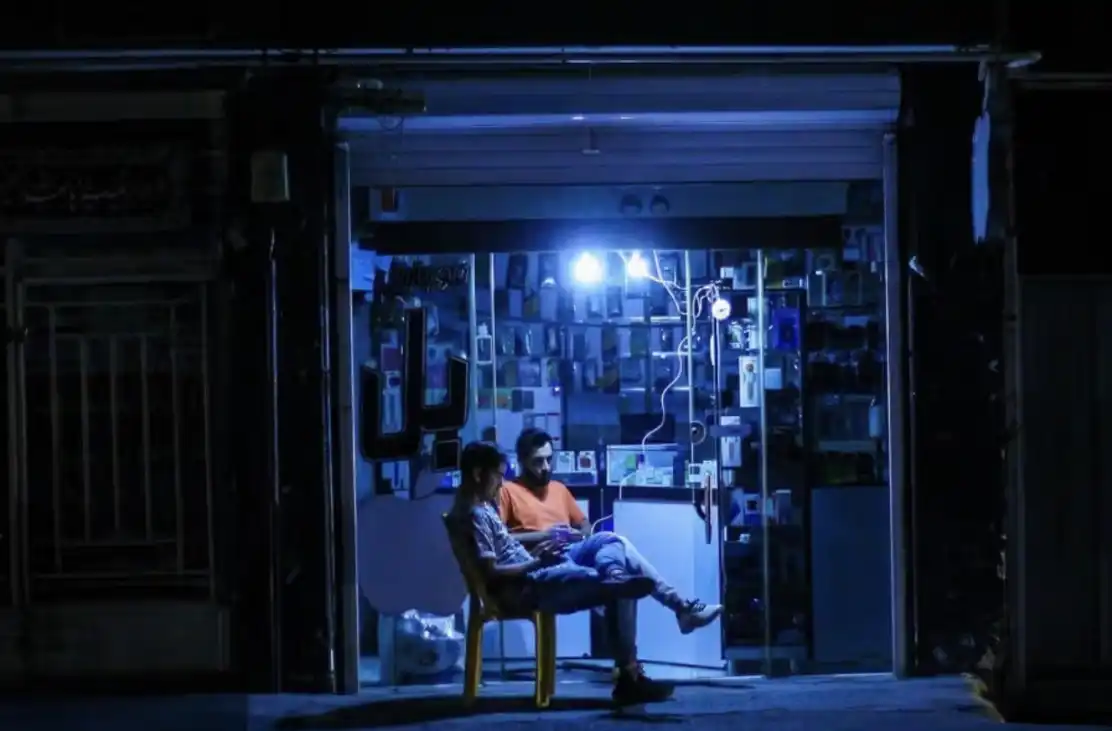
Image Description: Two Iranian men sitting outside their mobile phone shop, with only emergency lights illuminating the shop, as the street is pitch black due to a blackout
Chapter 1: Power Squeeze: When Energy Becomes a Financial Tool
The essence of Bitcoin mining is an energy arbitrage game. Anywhere in the world, as long as the electricity price is low enough, miners can be profitable. In places like Texas or Iceland, mining operators carefully calculate the cost of each kilowatt-hour, and only the latest generation of efficient mining rigs can survive in the competition. But in Iran and Libya, the game rules are entirely different.
In Iran, industrial electricity prices are as low as $0.01 per kilowatt-hour, while Libya takes it to the extreme—its residential electricity price is around $0.004 per kilowatt-hour, one of the lowest in the world. Such low electricity prices are made possible by massive government fuel subsidies and artificial price suppression. In a normal market, such prices wouldn't even cover the cost of electricity generation.
But for miners, this is paradise. Even outdated mining rigs, discarded from China or Kazakhstan—equipment that has become electronic waste in developed countries—can still easily turn a profit here. According to official data, in 2021, Libya's Bitcoin hashrate accounted for about 0.6% of the global total, surpassing all other Arab and African countries, and even some European economies.
This figure may seem small, but in the context of Libya, it is incredibly absurd. This is a country with only 7 million people, a 40% electricity grid loss rate, and daily rotating power outages. During peak periods, Bitcoin mining consumed about 2% of the country's total electricity generation, equivalent to 0.855 terawatt-hours (TWh) per year.
In Iran, the situation is even more extreme. Despite being home to the world's fourth-largest oil reserves and second-largest natural gas reserves, the country should theoretically not face power shortages. However, due to U.S. sanctions cutting off its access to advanced power generation equipment and technology, along with an aging and poorly managed grid, Iran's power supply has long been strained. The explosive growth of Bitcoin mining is now pushing this to the breaking point.
This is not your typical industrial expansion. This is a squeeze on public resources—when electricity is treated as "hard money" that can bypass the financial system, it is no longer prioritized for hospitals, schools, and residents but flows to those machines that can convert it into dollars.
Chapter 2: Two Countries, Dual Mining History
Iran: From "Energy Export" to "Hashrate Export"
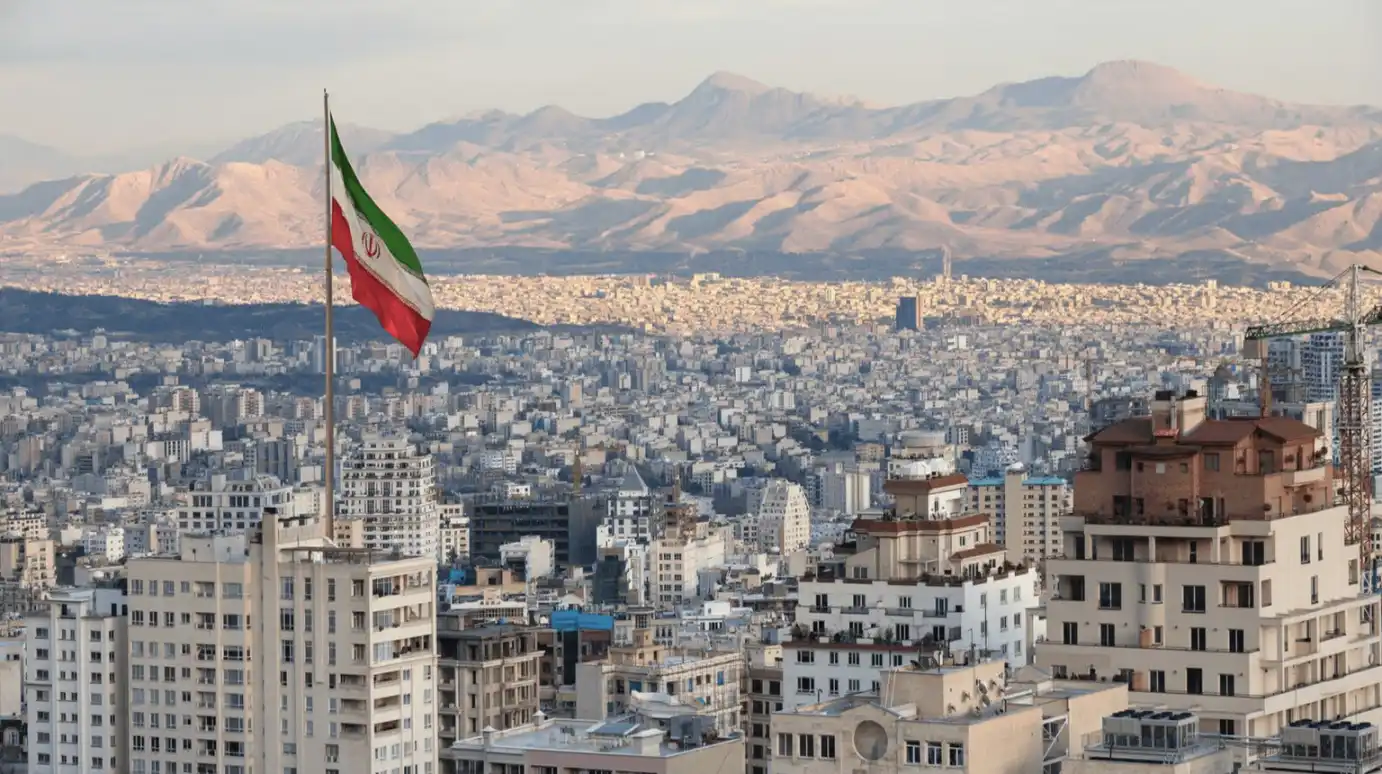
Under extreme sanction pressure, Iran chose to legalize Bitcoin mining, converting domestic cheap electricity into a globally tradable digital asset.
In 2018, the Trump administration withdrew from the Iran nuclear agreement, reapplying "maximum pressure" sanctions on Iran. Iran was kicked out of the SWIFT international payment system, unable to use dollars for international trade, its oil exports plummeted, and its foreign exchange reserves depleted. In this scenario, Bitcoin mining provided a convenient "energy realization" loophole: no need for SWIFT, no need for correspondent banks, just the need for electricity, mining rigs, and a pathway to sell the coins.
In 2019, the Iranian government officially recognized cryptocurrency mining as a legal industry and established a licensing regime. The policy design seemed quite "modern": miners could apply for a license to operate mining farms at a discounted electricity rate, but they must sell the mined Bitcoin to the Central Bank of Iran.
In theory, this was a win-win-win scenario— the country exchanged cheap electricity for Bitcoin, then used Bitcoin to obtain foreign exchange or imported goods; miners gained stable profits; the grid load could be planned and regulated.
However, reality quickly deviated from the plan: where there are licenses, there is a broader gray area.
By 2021, then-President Rouhani publicly admitted that about 85% of mining activities in Iran were unlicensed; underground mining farms sprung up like mushrooms, from abandoned factories to mosque basements, from government office buildings to ordinary residential homes, mining rigs were everywhere. The deeper the electricity subsidy, the stronger the arbitrage motive; the looser the regulation, the more like a "default welfare" electricity theft became.
Faced with a worsening power crisis and illegal mining consuming over 2 gigawatts, the Iranian government announced a temporary nationwide ban on all cryptocurrency mining activities from May to September of that year, lasting for four months. This was the most severe nationwide ban since legalization in 2019.
During this period, the government organized large-scale crackdowns: the Ministry of Energy, police, and local authorities raided thousands of illegal mining farms, confiscating tens of thousands of mining rigs in just the second half of 2021.
However, after the ban was lifted, mining activities quickly rebounded. Many confiscated mining rigs were put back into operation, and the scale of underground mining farms increased rather than decreased. This "rectification" was seen by the public as a short-lived performance: seeming to crack down on illegal activities on the surface but actually failing to address the deep-rooted issues, instead allowing some well-connected mining farms to expand.
More importantly, multiple investigations and reports have indicated that some entities closely associated with the authorities have substantially intervened in this industry, forming "privileged mining farms" with independent power supply and law enforcement exemptions.
When there are "untouchable hands" behind the mining farms, the so-called rectification becomes a political show; and the public narrative is even sharper: "We endure the darkness just to keep the Bitcoin mining rigs running."

Source: Financial Times
Libya: Cheap Electricity, Shadow Mining

A slogan on the walls of the streets of Libya condemns "the illegal trade of relief goods," reflecting civilian moral outrage caused by unfair resource distribution—a similar sentiment that has quietly fermented against the backdrop of electricity subsidies being hijacked for mining.
Libya's mining scenario is more like "barbaric growth under institutional absence."
Libya, this North African country (with a population of about 7.3-7.5 million and an area of nearly 1.76 million square kilometers, is the fourth largest country in Africa), is located on the south coast of the Mediterranean Sea, bordering countries such as Egypt, Tunisia, and Algeria. Since the fall of the Gaddafi regime in 2011, the country has been in a long period of turmoil: repeated civil wars, proliferation of armed factions, severe national institutional division, forming a state of "managed fragmentation" (that is, the level of violence is relatively controllable, but unified governance is lacking).
What truly drove Libya to become a mining hotbed is its absurd electricity pricing structure. As one of Africa's largest oil-producing countries, the Libyan government has long provided huge subsidies for electricity prices, keeping them at $0.0040 per kilowatt-hour—this price is even lower than the fuel cost of electricity generation. In a normal country, such subsidies are meant to protect the livelihoods of people. But in Libya, it has become a huge arbitrage opportunity.
Thus, a classic arbitrage model emerged:
· Old mining machines that have been phased out in Europe and the United States can still be profitable in Libya;
· Industrial zones, abandoned factories, warehouses naturally suited to conceal high electricity loads;
· Equipment imports are restricted, but gray channels and smuggling allow machines to keep flowing in;
Although the Central Bank (CBL) declared virtual currency transactions illegal in 2018 and the Ministry of Economy banned the import of mining equipment in 2022, mining itself has not been explicitly prohibited by national law, with enforcement relying more on peripheral charges such as "illegal electricity use" and "smuggling." Enforcement is weak in the reality of power fragmentation, leading to the continued expansion of the gray area.
This "ban but not eradicate" state is a typical manifestation of power fragmentation—the bans of the Central Bank and the Ministry of Economy are often difficult to enforce in the eastern Benghazi or southern regions, where local armed groups or militias sometimes even tolerate or protect mining sites, allowing mining to grow wildly in gray areas.
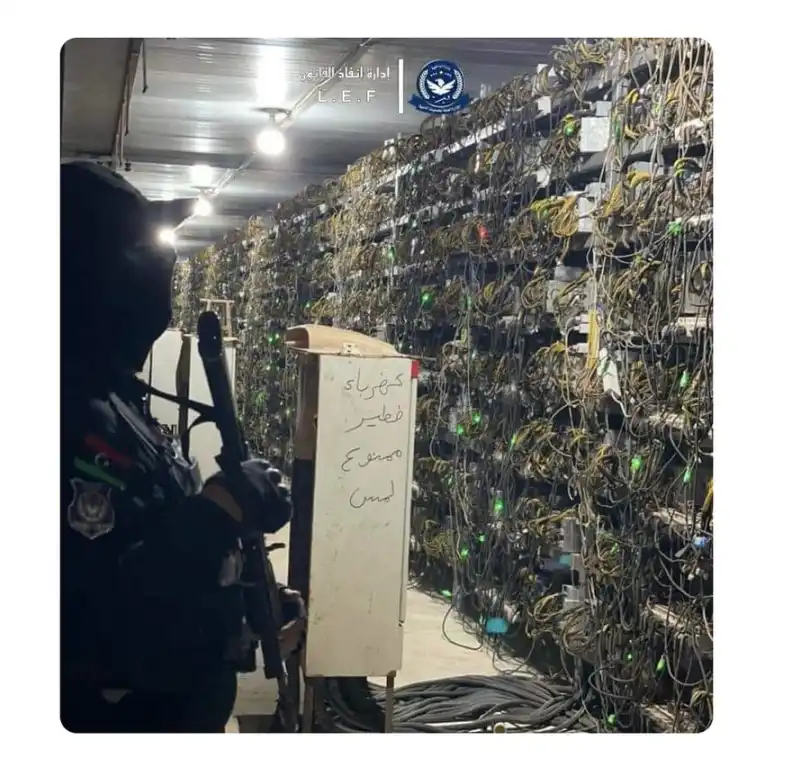
Source: @emad_badi on X
What is even more absurd is that a significant portion of these mining farms are operated by foreigners. In November 2025, Libyan prosecutors sentenced 9 individuals operating mining farms inside the Zliten Steel Plant to three years in prison, confiscated their equipment, and seized illegal gains. In multiple prior raids, law enforcement authorities arrested dozens of Asian citizens operating industrial-scale mining farms using old mining machines discarded from China or Kazakhstan.
These old devices have long been unprofitable in developed countries, but in Libya, they are still a money-making machine. Due to the low electricity prices, even the least energy-efficient mining rigs can turn a profit. That is why Libya has become the resurrection site of the global "mining graveyard" — where electronic waste phased out in Texas or Iceland has been given a second lease on life here.
Chapter 3: The Collapse of the Power Grid and Energy Privatization

Iran and Libya took two different paths: one sought to integrate Bitcoin mining into the national machinery, while the other let it roam in the shadows of the system for an extended period. But they reached the same endpoint — an expanding power grid deficit and the political consequences of resource allocation began to emerge.
This is not merely a technical malfunction but a result of political economy. Subsidized electricity rates created the illusion of "cheap electricity"; mining, on the other hand, offered the temptation of "monetizable electricity"; and power structures determined who could cash in on this temptation.
When mining rigs share the same power grid as hospitals, factories, and residents, the conflict is no longer abstract. The power outages damage not only refrigerators and air conditioners but also surgical lights, blood bank refrigeration, and industrial assembly lines. Every blackout is a silent examination of the public resource allocation.
The issue lies in the highly "portable" nature of mining rewards. Electricity is local, and the costs are borne by society; Bitcoin is global, and its value can quickly move across borders. The result is an extremely asymmetric structure: society bears the electricity consumption and the blackouts, while a few capture the benefits that can flow across borders.
In countries with sound institutions and abundant energy, Bitcoin mining is usually discussed as an industrial activity; but in countries like Iran and Libya, the nature of the problem has changed.
An Emerging Industry or Resource Plunder?
Globally, Bitcoin mining is seen as an emerging industry, even a symbol of the "digital economy." However, in the cases of Iran and Libya, it appears more like an experiment in the privatization of public resources.
If it is called an industry, it should at least create jobs, pay taxes, be regulated, and provide a net benefit to society. However, in these two countries, mining is highly automated, creates almost no jobs, many mining facilities are in illegal or semi-legal status with limited tax contributions, and even licensed mining facilities lack transparency in their revenue distribution.
Cheap electricity was originally intended to ensure the well-being of the people. In Iran, energy subsidies are part of the "social contract" since the Islamic Revolution — the government subsidizes electricity prices with oil revenue, and the people accept authoritarian rule. In Libya, electricity subsidies are also a core part of the welfare system left over from the Gaddafi era.
But when these subsidies are used for Bitcoin mining, their nature undergoes a fundamental change. Electricity is no longer a public service but a means used by a few to create private wealth. The general public not only does not benefit from it but instead pays the price — more frequent power outages, higher costs of diesel generators, and more fragile healthcare and education services.
More importantly, mining has not brought real foreign exchange income to these countries. In theory, the Iranian government requires miners to sell Bitcoin to the central bank, but the actual enforcement is questionable. In Libya, there is no such mechanism at all. Most Bitcoin is exchanged for dollars or other currencies through overseas trading platforms, then flows out through underground money exchangers or cryptocurrency channels. This money neither enters the national treasury nor circulates back into the real economy but becomes the private wealth of a few.
In this sense, Bitcoin mining is more like a new form of "resource curse." It does not create wealth through production and innovation but seizes public resources through price distortions and institutional gaps. The most vulnerable groups are often the ones who pay the price.
Conclusion: The True Cost of a Bitcoin

In an increasingly resource-constrained world, electricity is no longer just a tool to illuminate the dark but has become a commodity that can be converted, traded, and even plundered. When a country treats electricity as a "hard currency" for export, it is effectively consuming the future that should have been used for people's well-being and development.
The issue is not with Bitcoin itself but with who has control over the allocation of public resources. When this power is unchecked, the so-called "industry" is reduced to another form of plunder.
And those sitting in the dark are still waiting for the light to come back on.
“Not everything that is faced can be changed, but nothing can be changed until it is faced.”
You may also like

From x402 to MPP: Cloudflare's crucial vote, will it go to Coinbase or Stripe?

BlackRock CEO issues annual open letter: The wave of tokenization has arrived, and we will lead this trend

When Backpack backstabs the community

When gold is no longer a safe haven, and Bitcoin continues to panic

Trump, the World's Largest Oil Trader

If the US and Iran have not reached an agreement in 5 days, what other cards does Trump have?

Tether Whale Dumps £12 Million, Backing Crypto’s ‘British Trump’
Ethereum Foundation Post: Rethinking the Division of Work Between L1 and L2 to Build the Ultimate Ethereum Ecosystem

Two Major Prediction Market Platforms Unite Rarely, What Is the Story Behind This New Fund?

WEEX Official Product Launch: Win LALIGA Tickets & Unlock the 3-in-1 Crypto Trading Suite
Trade crypto without downloading an app. Join the WEEX H5, API, SKILLs livestream to explore the new trading experience, win LALIGA VIP tickets, and share 420 USDT rewards.
Dragonfly Partners: Most agents will not engage in autonomous trading, how can crypto payments prevail?

US AI Startup Goes All In on Chinese Mega-Model | Rewire News Morning Brief

Trump Lies Again: A "Five-Day Pause" Psyop, How Wall Street, Bitcoin, and Polymarket Insiders Synced Uposciogen

When a Token Becomes Labor, People Become the Interface

Ceasefire News Leaked Ahead of Time? Large Polymarket Bets on Outcome Before Trump's Tweet
BlackRock CEO's Annual Shareholder Letter: How is Wall Street Using AI to Keep Profiting from National Pension Funds?

Sun Valley Releases 2025 Financial Report: Bitcoin Mining Revenue Reaches $670 Million, Accelerating Transformation to AI Infrastructure Platform
On March 16, 2026, in Dallas, Texas, USA, CanGu Company (New York Stock Exchange code: CANG, hereinafter referred to as "CanGu" or the "Company") today announced its unaudited financial performance for the fourth quarter and full year ended December 31, 2025. As a btc-42">bitcoin mining enterprise relying on a globally operated layout and dedicated to building an integrated energy and AI computing power platform, CanGu is actively advancing its business transformation and infrastructure development.
• Financial Performance:
Total revenue for the full year 2025 was $688.1 million, with $179.5 million in the fourth quarter.
Bitcoin mining business revenue for the full year was $675.5 million, with $172.4 million in the fourth quarter.
Full-year adjusted EBITDA was $24.5 million, while the fourth quarter was -$156.3 million.
• Mining Operations and Costs:
A total of 6,594.6 bitcoins were mined throughout the year, averaging 18.07 bitcoins per day; of which 1,718.3 bitcoins were mined in the fourth quarter, averaging 18.68 bitcoins per day.
The average mining cost for the full year (excluding miner depreciation) was $79,707 per bitcoin, and for the fourth quarter, it was $84,552;
The all-in sustaining costs were $97,272 and $106,251 per bitcoin, respectively.
As of the end of December 2025, the company has cumulatively produced 7,528.4 bitcoins since entering the bitcoin mining business.
• Strategic Progress:
The company has completed the termination of the American Depositary Receipt (ADR) program and transitioned to a direct listing on the NYSE to enhance information transparency and align with its strategic direction, with a long-term goal of expanding its investor base.
CEO Paul Yu stated: "2025 marked the company's first full year as a bitcoin mining enterprise, characterized by rapid execution and structural reshaping. We completed a comprehensive adjustment of our asset system and established a globally distributed mining network. Additionally, the company introduced a new management team, further strengthening our capabilities and competitive advantage in the digital asset and energy infrastructure space. The completion of the NYSE direct listing and USD pricing also signifies our transformation into a global AI infrastructure company."
"As we enter 2026, the company will continue to optimize its balance sheet structure and enhance operational efficiency and cost resilience through adjustments to the miner portfolio. At the same time, we are advancing our strategic transformation into an AI infrastructure provider. Leveraging EcoHash, we will utilize our capabilities in scalable computing power and energy networks to provide cost-effective AI inference solutions. The relevant site transformations and product development are progressing simultaneously, and the company is well-positioned to sustain its execution in the new phase."
The company's Chief Financial Officer, Michael Zhang, stated: "By 2025, the company is expected to achieve significant revenue growth through its scaled mining operations. Despite recording a net loss of $452.8 million from ongoing operations, mainly due to one-time transformation costs and market-driven fair value adjustments, the company, from a financial perspective, will reduce its leverage, optimize its Bitcoin reserve strategy and liquidity management, introduce new capital to strengthen its financial position, and seize investment opportunities in high-potential areas such as AI infrastructure while navigating market volatility."
The total revenue for the fourth quarter was $1.795 billion. Of this, the Bitcoin mining business contributed $1.724 billion in revenue, generating 1,718.3 Bitcoins during the quarter. Revenue from the international automobile trading business was $4.8 million.
The total operating costs and expenses for the fourth quarter amounted to $4.56 billion, primarily attributed to expenses related to the Bitcoin mining business, as well as impairment of mining machines and fair value losses on Bitcoin collateral receivables.
This includes:
· Cost of Revenue (excluding depreciation): $1.553 billion
· Cost of Revenue (depreciation): $38.1 million
· Operating Expenses: $9.9 million (including related-party expenses of $1.1 million)
· Mining Machine Impairment Loss: $81.4 million
· Fair Value Loss on Bitcoin Collateral Receivables: $171.4 million
The operating loss for the fourth quarter was $276.6 million, a significant increase from a loss of $0.7 million in the same period of 2024, primarily due to the downward trend in Bitcoin prices.
The net loss from ongoing operations was $285 million, compared to a net profit of $2.4 million in the same period last year.
The adjusted EBITDA was -$156.3 million, compared to $2.4 million in the same period last year.
The total revenue for the full year was $6.881 billion. Of this, the revenue from the Bitcoin mining business was $6.755 billion, with a total output of 6,594.6 Bitcoins for the year. Revenue from the international automobile trading business was $9.8 million.
The total annual operating costs and expenses amount to $1.1 billion.
Specifically, they include:
· Revenue Cost (excluding depreciation): $543.3 million
· Revenue Cost (depreciation): $116.6 million
· Operating Expenses: $28.9 million (including related-party expenses of $1.1 million)
· Miner Impairment Loss: $338.3 million
· Bitcoin Collateral Receivable Fair Value Change Loss: $96.5 million
The full-year operating loss is $437.1 million. The continuing operations net loss is $452.8 million, while in 2024, there was a net profit of $4.8 million.
The 2025 non-GAAP adjusted net profit is $24.5 million (compared to $5.7 million in 2024). This measure does not include share-based compensation expenses; refer to "Use of Non-GAAP Financial Measures" for details.
As of December 31, 2025, the company's key assets and liabilities are as follows:
· Cash and Cash Equivalents: $41.2 million
· Bitcoin Collateral Receivable (Non-current, related party): $663.0 million
· Miner Net Value: $248.7 million
· Long-Term Debt (related party): $557.6 million
In February 2026, the company sold 4,451 bitcoins and repaid a portion of related-party long-term debt to reduce financial leverage and optimize the asset-liability structure.
As per the stock repurchase plan disclosed on March 13, 2025, as of December 31, 2025, the company had repurchased a total of 890,155 shares of Class A common stock for approximately $1.2 million.



 App
App