
Historical Perspective: The 12 Months Post-Election Are Typically the Golden Period of a Crypto Bull Market


Original Article Title: Republican Victory Ushers in a New Era for Crypto
Original Article Author: Kelvin Koh, Spartan Group
Original Article Translation: Fu Ruhe, Odaily Planet Daily
The 2024 U.S. presidential election has become one of the most watched elections in recent years. Despite widespread expectations of a fiercely contested election, the election results still took many by surprise. Not only did Trump convincingly win the presidential election, but the Republican Party also secured a majority in both the Senate and the House. Such a sweeping victory will give the Republican Party enough political leverage to drive multiple reforms in the coming years. The cryptocurrency field is expected to undergo significant changes, and we believe the next 12 months will be a bullish period for crypto assets.
One key difference in the 2024 election compared to the past is the emergence of a "crypto agenda," with the winning president and his core advisory team holding a crypto-friendly stance. Crypto companies strongly supported Trump and key Republican candidates through donations. Therefore, it is not surprising that the crypto industry has become one of the major beneficiaries of the Republican Party's resounding victory.
There has been much discussion about the significance of this election for the crypto industry, but here are some of the key impacts:
· Changes in SEC Policy. Under Gary Gensler's leadership, the SEC and other appointed officials of the Biden administration have implemented aggressive regulation on the crypto industry. Despite industry calls for regulatory guidance, the SEC has continued to pursue enforcement actions. During Gensler's tenure, over 2,700 enforcement actions were initiated, resulting in total fines of up to $210 billion. This has made it difficult for many projects to operate in the U.S. Trump clearly stated during his campaign that if elected, he would replace Gensler. As expected, last week Gensler announced that he would step down as SEC chairman on January 20, 2025. Several nominees have already been named to succeed him, and they are generally seen as more supportive of the crypto industry. This means that existing enforcement actions may be reversed, and the SEC will adopt a more cooperative regulatory approach.
· Improvement in Congressional Environment. In the past, a major challenge facing the crypto industry was the difficulty of passing any favorable bills in the U.S. Congress, as most lawmakers lacked an understanding of cryptocurrency. However, after this election, about two-thirds of Congress members are considered crypto-friendly. This could lead to a regulatory framework that supports innovation, making it easier for projects to raise funds and clearing obstacles for institutional capital to enter the crypto space.
· Proposal for a Strategic Bitcoin Reserve. During his campaign, Trump mentioned to his crypto supporters that if elected, he would push for the establishment of a Strategic Bitcoin Reserve instead of having the U.S. government continue to dispose of previously seized bitcoins. This proposal quickly gained attention after the election. If this proposal were to be implemented, the market would start speculating whether this means the U.S. government would become a net buyer rather than a seller of Bitcoin. If MicroStrategy alone can influence the price of Bitcoin, imagine the impact of the U.S. government establishing a Strategic Bitcoin Reserve. More importantly, how would other countries react to this? Would they also come up with similar plans?
· Support for DeFi. Even before the election, a team supported by Trump had launched World Liberty Financial in September 2024, aiming to provide decentralized lending services and governance through the native token WLF. The project has raised over $50 million to date, with the latest investment coming from crypto entrepreneur Justin Sun, who invested $30 million this week. WLF plans to raise a total of $300 million. Whether it reaches $300 million or $50 million, the significance of this project goes far beyond the amount raised—it has provided a huge boost to DeFi developers and innovators. Importantly, a DeFi project supported by the incoming U.S. president will have a profound impact on the entire industry.
Each of the above events alone is enough to have a significant driving force on the crypto market, and the combined impact of these events on the crypto industry is profound. The market has not yet fully reflected the potential impact of these changes, which is why the U.S. media refers to this period as the "golden age of crypto."
In addition to all of the above, Trump has also expressed his desire for the U.S. to become the "global capital of crypto." To some extent, the U.S. is already the de facto leading crypto nation. Many major infrastructure projects, some of the largest blockchain infrastructure companies, and decentralized applications originated in the U.S. The U.S. also has the world's largest licensed cryptocurrency exchanges, the largest crypto investment banks, and the largest Web3 venture capital pool. Furthermore, the U.S. controls around 40% of the global Bitcoin mining hash rate (compared to 17% in 2021), making it the largest center for Bitcoin mining, partly due to policy changes in China. Most of the world's crypto trading is also denominated in dollars, and major stablecoins are pegged to the dollar. Therefore, the U.S. is already a global crypto hub in many ways. However, if the U.S. government plans to consolidate or further expand its dominance, what does this mean for other governments, especially major financial centers like London, Tokyo, Dubai, and Hong Kong? More importantly, can Europe afford to miss out on the Web3 innovation era and once again lag behind after the Web2 era?
Some people may question whether Trump will actually fulfill these promises, but I believe the likelihood of fulfillment is high. Trump does not follow traditional rules, and the political leverage brought by this election victory is very strong. Additionally, Trump has two native cryptocurrency advisors—Elon Musk and JD Vance. The new Secretary of Commerce, Howard Lutnick, also serves as the Chairman and CEO of Cantor Fitzgerald, which has just acquired a 5% stake in Tether (the issuer of the world's largest stablecoin USDT). With a more crypto-friendly Congress, pushing forward these measures should not be difficult.
Historical Data: Strong Cryptocurrency Price Performance in the 12 Months Following the U.S. Election, Altcoins Outperform Bitcoin
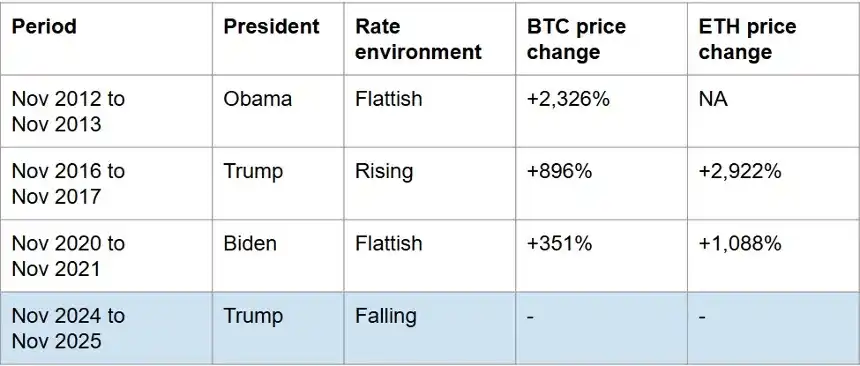
Against this background, discussing the impact of all this on cryptocurrency asset prices becomes particularly important. As seen in the table below, historically, the 12 months following a U.S. election have typically been a period of strong cryptocurrency price performance.
There are two main observations here:
· Regardless of who wins the presidential election and the interest rate environment, cryptocurrency assets have performed very well in the 12 months following the U.S. election. We attribute this to two factors:
a) Clarity brought by the election results and optimism about the new government;
b) The continued momentum of the Bitcoin halving cycle/cryptocurrency cycle.
· In the 12 months following the last two elections, altcoins (represented by ETH) have returned about three times as much as Bitcoin.
30 days after the 2024 election, Bitcoin rose by 46%, and Ethereum rose by 58%. We believe there is still significant upside potential in the next 11 months.
To better understand the opportunity with altcoins, let's look at the chart below, which shows the performance of altcoins relative to Bitcoin. It can be seen that there are stages within the cycle where altcoins significantly outperform Bitcoin. We refer to these stages as "altcoin cycles" or "altcoin seasons." The most recent major altcoin cycle occurred in January 2021 and peaked in November 2021. The previous cycle started in February 2017 and peaked in January 2018.

It is worth noting that these altcoin cycles roughly overlap with the 12-month period following the election. We believe the main reason is the strong price performance in the initial weeks after the election and the shift in investor sentiment towards risk appetite. Additionally, this trend has also attracted retail funds into the cryptocurrency asset class, with retail funds often preferring smaller and mid-sized tokens with higher risk due to the lack of liquidity constraints from institutional investors. Furthermore, at this point in the cycle, altcoins tend to underperform, making their risk-return profile more attractive compared to large-cap tokens. This is also the case in this cycle.
If this historical relationship holds, then we should expect the altcoin season to be imminent.
You may also like

ZachXBT: Humanity private key leak and abnormal surge in H token should be viewed separately
On June 9, according to related disclosures, on-chain investigator ZachXBT posted an update on Humanity’s roughly $31 million security incident, saying that after further analyzing fund flows, he currently tends to believe the project team was not involved in an “inside job” or a self-staged attack. According to him, the official explanation about the private key leak was broadly accurate, but before the token unlock, the price of H had been artificially pushed higher, and the hacker later took advantage of that market environment; therefore, the private key leak and the earlier abnormal price pumping should be regarded as two separate and independent events. This reframing has shifted the market’s understanding of the nature of the incident. Earlier discussion around Humanity had focused on whether the team directly participated in the attack or used the security incident to cover up internal operations. ZachXBT’s latest remarks shift the focus from “whether it was self-theft” to “whether there were pre-unlock market structure issues.” He also questioned whether the team may have.

Morning Report | OpenAI has submitted an S-1 registration statement draft to the U.S. SEC; Morpho completes $175 million financing

Morning Report | BitMine increased its holdings by 126,971 ETH last week; trader Eugene announced his exit from the crypto market

Wang Chuan: How can one not feel anxious after the neighbor Old Wang made thirty times profit by investing in storage stocks? (Seven) - A quarter-century cycle

Cryptocurrency CEXs are flocking to sell US stocks, and traditional brokerages are facing an "uninvited guest."

$75 billion in foreign capital has fled, and South Korean retail investors have absorbed it all using leverage

Japan’s Three Megabanks Plan Joint Stablecoin Issuance in Fiscal 2026
MUFG, SMBC, and Mizuho reportedly plan to jointly issue fiat-pegged stablecoins in fiscal 2026, signaling Japan’s growing push into bank-led digital payment infrastructure.

Humanity Discloses H Token Dual-Chain Attack Details, With Losses on Ethereum and BSC Exceeding $36 Million
Humanity said the H token attack across Ethereum and BSC caused more than $36 million in losses after leaked ProxyAdmin keys enabled malicious contract upgrades and token minting.
White House Discusses CLARITY Act With Law Enforcement Ahead of Senate Vote
The White House discussed the CLARITY Act with law enforcement ahead of a Senate vote, focusing on illicit finance risks and developer protections.

Bitcoin Trading Guide 2026: Strategies for Experienced Traders

What Is XAUT and PAXG? Why Tokenized Gold Is Booming in 2026

Will the SpaceX IPO Hurt Bitcoin? Here's What Traders Are Watching

Foreign selling in the South Korean stock market accelerates, with cumulative net sales reportedly reaching $75 billion this year
On June 9, The Kobeissi Letter, citing Goldman Sachs data, reported that global investors are selling South Korean stocks at an unusually rapid pace. In the latest trading session, foreign investors sold about $801 million worth of Kospi constituent stocks again; total foreign outflows last week reached about $10 billion, and the market has been in net foreign selling on nearly every trading day over the past month. According to the data cited in the report, foreign investors have sold about $75 billion worth of South Korean stocks so far this year. Meanwhile, South Korean retail and institutional investors together recorded roughly $69 billion in net buying over the same period, suggesting that the market’s main buying support has come from domestic capital rather than returning overseas funds. The information currently disclosed still mainly comes from The Kobeissi Letter’s retelling and Goldman Sachs data summaries, while public details on the statistical period and the specific definition of “selling” remain relatively limited.

Fortune Warns of Strategy’s Financing Structure Risks as Bitcoin Premium Narrows
Fortune warned that Strategy’s Bitcoin treasury model faces growing financing risks as MSTR’s net asset premium narrows and preferred stock dividend pressure increases.

Ferrari Challenge Le Mans: Carl Moon to Dominate in WEEX Livery

Sahara AI Responds to SAHARA’s Sharp Drop: No Contract or Product Security Issues Found, Internal Investigation Underway
Sahara AI responded to SAHARA’s 60% price drop, saying no token contract or product security issues have been found and an internal investigation is underway.

WEEX Deposit/Withdrawal Dynamic Island: Your Asset Status, Always in Sight
Scaling Crypto Derivatives: The Digital Asset Infrastructure Behind High-Volume Trading
In the fast-moving digital asset ecosystem, derivatives platforms face an extreme architectural test. High-leverage futures markets demand more than just standard security—they require absolute operational precision, zero-latency matching engines, and ironclad structural scalability, all while navigating intense market volatility.
As global platforms scale to meet these demands, the industry is shifting away from rigid, monolithic setups toward a more agile, "decoupled" infrastructure philosophy.
The Blueprint for High-Volume Copy TradingFor elite global exchanges like WEEX (founded in 2018), this architectural choice becomes critical when scaling high-volume retail features like social copy trading. When thousands of users automatically mirror the real-time strategies of elite traders simultaneously, it triggers sudden, monumental spikes in concurrent transactional volume.
To prevent execution latency or settlement bottlenecks during these peak volatility events, a platform's primary engine must remain entirely dedicated to risk management, copy-trade synchronization, and order matching.
The Architectural Rule: New-generation platforms must separate front-end user execution engines from heavy backend infrastructural overhead to eliminate operational friction.
By separating these layers, platforms can maintain complete sovereignty over their trading environments and user experiences while strategically aligning with institutional-grade infrastructure ecosystems. This strategic framework allows modern exchanges to leverage advanced Digital Asset Custody infrastructure such as Cobo’s behind the scenes, ensuring that backend wallet management scales elastically alongside trading spikes.
Capitalizing on Market Momentum and 400× LeverageIn a derivatives arena where platforms offer up to 400× leverage on perpetual contracts, capital efficiency and market agility are core business metrics. To capture market momentum, an exchange needs the ability to rapidly expand its asset offerings, supporting everything from legacy crypto assets to sudden, trending altcoins across a massive library of trading pairs.
Adopting a flexible, scalable Wallet-as-a-Service (WaaS) solution such as Cobo’s could completely rewrite the development timeline for high-growth exchanges. Instead of spending months of engineering capital building out custom backend wallet architectures for every new blockchain network, platforms can deploy localized infrastructure in days.
This agility allows platforms to instantly scale their listings to over a thousand trading pairs without compromising security or delaying time-to-market. It mirrors the exact operational advantages seen during high-velocity market events, similar to how advanced wallet infrastructure empowers platforms during sudden asset surges; allowing exchanges to pass that speed and liquidity directly to their global user base.
A Mature Foundation for GrowthThe synergy between trusted infrastructure ecosystems and global trading platforms represents the natural evolution of a maturing crypto market. As WEEX continues to scale its global spot and derivatives offerings for over 6 million users, adopting robust backend paradigms proves that platforms no longer have to compromise between cutting-edge trading velocity and uncompromised structural security.
ZachXBT: Humanity private key leak and abnormal surge in H token should be viewed separately
On June 9, according to related disclosures, on-chain investigator ZachXBT posted an update on Humanity’s roughly $31 million security incident, saying that after further analyzing fund flows, he currently tends to believe the project team was not involved in an “inside job” or a self-staged attack. According to him, the official explanation about the private key leak was broadly accurate, but before the token unlock, the price of H had been artificially pushed higher, and the hacker later took advantage of that market environment; therefore, the private key leak and the earlier abnormal price pumping should be regarded as two separate and independent events. This reframing has shifted the market’s understanding of the nature of the incident. Earlier discussion around Humanity had focused on whether the team directly participated in the attack or used the security incident to cover up internal operations. ZachXBT’s latest remarks shift the focus from “whether it was self-theft” to “whether there were pre-unlock market structure issues.” He also questioned whether the team may have.
Morning Report | OpenAI has submitted an S-1 registration statement draft to the U.S. SEC; Morpho completes $175 million financing
Morning Report | BitMine increased its holdings by 126,971 ETH last week; trader Eugene announced his exit from the crypto market
Wang Chuan: How can one not feel anxious after the neighbor Old Wang made thirty times profit by investing in storage stocks? (Seven) - A quarter-century cycle
Cryptocurrency CEXs are flocking to sell US stocks, and traditional brokerages are facing an "uninvited guest."
$75 billion in foreign capital has fled, and South Korean retail investors have absorbed it all using leverage


