
- Buy Crypto
- Markets
 Futures
- Spot
- Copy Trade
- Earn
- More
How Bad Are the Midterm Elections for the Crypto Industry?

Original Article Title: Mapping Out Crypto's Midterms Fate
Original Article Author: David Christopher, Bankless
Translation: Peggy, BlockBeats
Editor's Note: The 2026 U.S. midterm elections may become a key variable in the fate of the crypto industry.
From the expected outcomes, the prediction markets generally believe that the Democratic Party has a higher probability of regaining control of the House of Representatives, and may even not rule out controlling both the House and the Senate. Once this scenario unfolds, control of key congressional committees will shift, with Maxine Waters and Elizabeth Warren respectively leading the House Financial Services Committee and the Senate Banking Committee.
However, what truly needs attention is not "who supports crypto," but "who controls the agenda."
This article, based on a cross-analysis of prediction markets, candidate positions, and congressional structure, points out an underestimated risk: even if bipartisan support is emerging, if it cannot enter the committee process, this support is almost meaningless in practice. Control over hearings, deliberations, and schedules allows a committee to directly decide the fate of a bill without a vote.
Structurally, this is the core contradiction at present: although a considerable proportion of Democratic Party members have shifted to support crypto in specific bills, this support has not translated into dominance at the committee level. In the crucial moments that truly decide the fate of legislation, the overall situation still shows a bias towards caution or even opposition.
With the potential power reshuffle that the midterm elections may bring, the crypto industry faces not just short-term policy fluctuations, but a deeper institutional uncertainty: the path to regulatory clarity may be disrupted before it truly unfolds.
Therefore, a relatively clear scenario can be envisioned: in a baseline scenario, regulatory progress will enter a period of stagnation; whereas in a more pessimistic scenario, core legislation regarding stablecoins and market structure may be completely stalled, almost nullifying short-term policy favorability.
Below is the original article:
Just how bad could this midterm election be for the crypto industry? As the likelihood of the Democratic Party sweeping the House and Senate in the midterms continues to rise, I wanted to take a closer look at what the existing polls are really telling us and what that means for the future of the crypto industry.
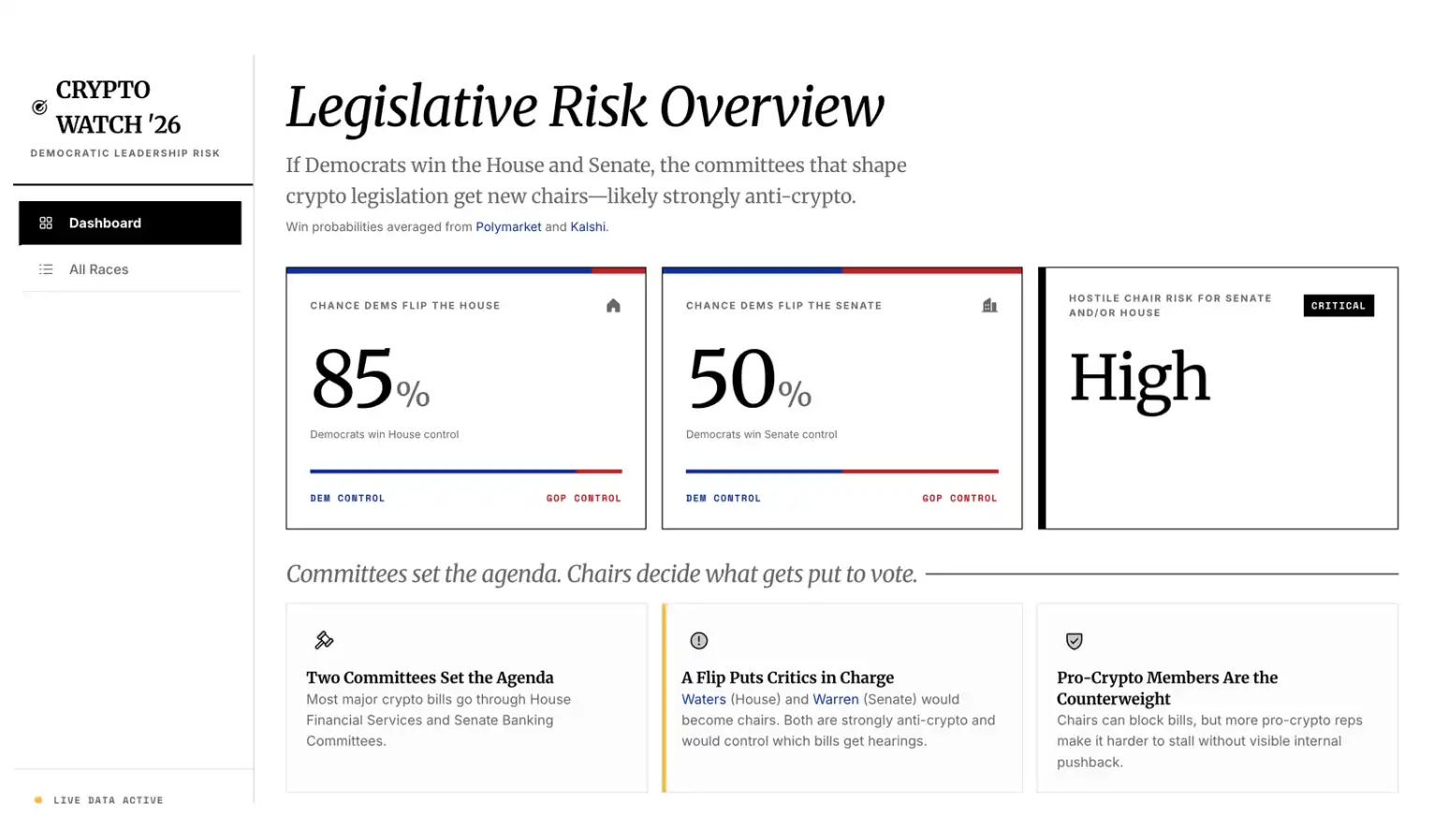
To do this, I referenced data from prediction markets and databases that track candidates' stances on the crypto industry, such as Stand with Crypto (SWC). While integrating this information, I also conveniently built a visualization dashboard: after receiving the data, I built the frontend with Cursor, connected the logic with Claude Code, and finally deployed it through Vercel.
While the data is still being filled in, I have established a database that tracks districts where Democratic candidates are leading and maps them to their stances on crypto issues and potential congressional committees they may join. This has allowed me to sketch out the outline of the policy landscape for the coming months: on the surface, it still seems to have room for maneuver, but upon closer inspection, internally it harbors some deeper structural issues.
A Surprising Point
First, the Democratic Party's support for the crypto industry is actually greater than outsiders imagine—at least on certain specific bills.
In the House, 101 Democratic members (about 48% of the caucus) voted in support of the GENIUS Act; in the Senate, 18 Democratic members (about 40%) also voted to advance the bill through the process. This indeed forms a bipartisan support coalition. However, this support is bill-specific, and once it reaches the committee stage, where the actual legislating begins, this coalition will quickly fall apart.
And this is where the problem lies.
Where the Power Comes From
Crypto-related legislation never goes directly to a floor vote.
Whether it's stablecoins, market structure, or the SEC's regulatory authority, all content must first go through committee consideration. The House Financial Services Committee (HFSC) and the Senate Banking Committee are the two crucial places where crypto bills live or die (for bills involving market structure, the Agriculture Committee also needs to be involved to cover the CFTC regulatory part). Committee chairs decide which issues get hearings, which ones get marked up, and which ones quietly get stuck in procedural purgatory. If a chair is opposed to a bill, they don't even need to call for a vote; they can just not schedule it, effectively burying it.
The past few Republican chairs have shown how this power can be wielded to advance the legislative process. For example, Senate Banking Committee Chair Tim Scott pushed the GENIUS Act through the committee and guided it to passage in the Senate; former House Financial Services Committee Chair Patrick McHenry led the way on the FIT21 Act, the first key crypto market structure bill to pass in the House. Current Chair French Hill has continued this momentum, advancing relevant legislation including the CLARITY Act (though currently stalled in the Senate) and holding hearings on digital assets and capital market modernization.
What Would Happen If the Democratic Party Wins Big?
In the U.S. Congress, the majority party controls all committee chairmanships, without exception.
If the Democratic Party takes the House, they will lead all House committees; if they also take the Senate, they will control all Senate committees. Within the majority party, chairs are usually determined by seniority.
In the House Financial Services Committee, the most senior Democrat is Maxine Waters; in the Senate Banking Committee, it's Elizabeth Warren. It's well known that these two lawmakers have opposed nearly all major crypto bills. Warren famously opposed the GENIUS Act during deliberation, citing national security concerns, while Waters dubbed it a full-fledged crypto scam.
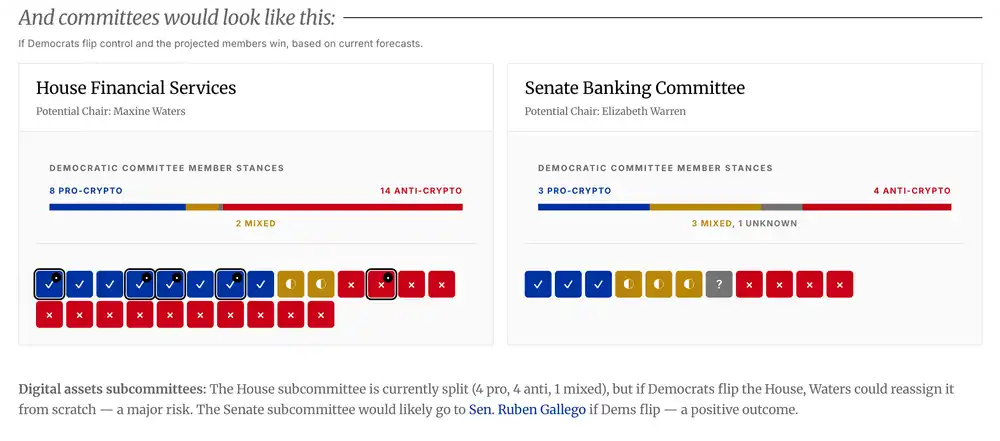
Of greater significance is the House's mechanism: once partisan control changes, all subcommittee rosters are reshuffled. The majority party not only decides seat ratios but also influences freshman assignments. At that point, Waters will wield significant influence over the HFSC's membership and its subcommittee leadership, including the selection of the head of the Digital Assets Subcommittee. While she cannot single-handedly decide all appointments (party leadership and the caucus will also be involved), she can steer the overall structure toward a more anti-crypto camp aligned with her positions.
In fact, the current Democratic composition of the HFSC itself leans towards a critical stance on the crypto industry, with members like Brad Sherman, Stephen Lynch, Emanuel Cleaver, Sylvia Garcia, and others. While there are Democratic lawmakers who support crypto, such as Jim Himes, Bill Foster, Ritchie Torres, Josh Gottheimer, and Vicente Gonzalez, who can to some extent provide a balance, under Waters' chairmanship, they do not have agenda-setting power.
Situation in the Senate: Decent but Still Constrained
The Senate Banking Committee's landscape is relatively less grim. If chaired by Elizabeth Warren, the committee would have a mixed structure: there are members who relatively support crypto, such as Mark Warner, Ruben Gallego, Angela Alsobrooks, as well as clear anti-crypto voices like Tina Smith, and some members with relatively ambivalent positions.
Here is a marginally positive development: If the Democratic Party takes the Senate, then Gallego, who performs well in the Stand with Crypto (SWC) scoring system, is likely to chair the Digital Assets Subcommittee. While Warren still controls the agenda of the entire committee, Gallego can at least carve out some space at the subcommittee level for the pro-crypto voice.
What really matters are these election seats
A more immediate issue is that currently, most pro-crypto Democratic lawmakers are not on the House Financial Services Committee (HFSC) or the Senate Banking Committee.
They can certainly vote in favor of bills when they come to the full chamber, and they can to some extent pressure party leadership (although in the increasingly polarized context of the crypto issue, most may not be willing to stick their necks out). But what they cannot do is: force a committee chair to move a piece of legislation through the process.
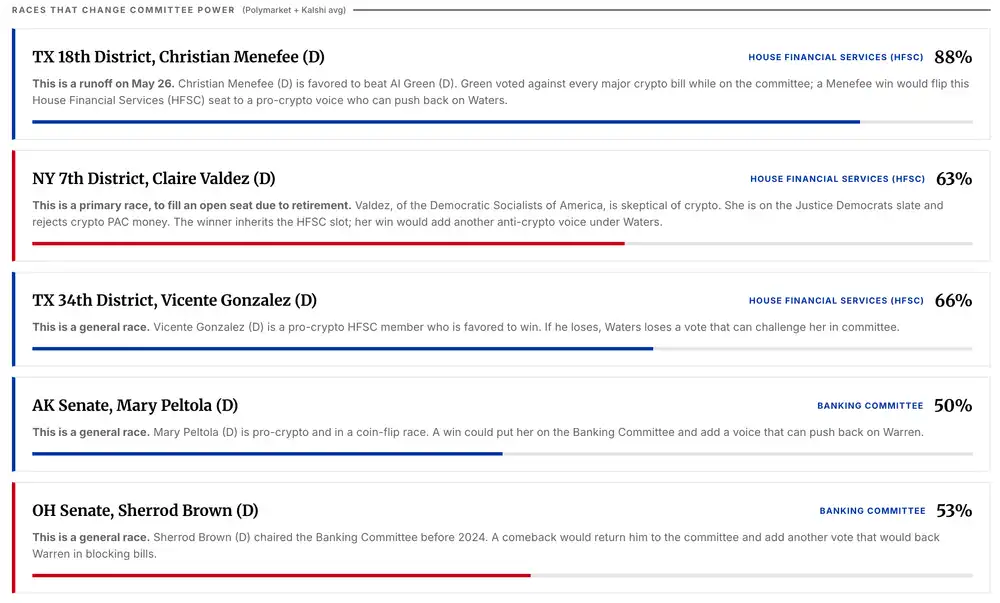
Therefore, what will truly influence the direction of crypto policy are the results of a few key races—those elections that will directly change the makeup of committees, deciding whether a bill even gets a chance to be discussed, not just voted on.
Midterm election takeaways
The outlook for the House is quite dire, it must be said.
If there is an 85% probability of a Democratic takeover of the House, then it is an almost certainty that Maxine Waters will assume the chairmanship of the House Financial Services Committee (HFSC). She can not only rearrange the seats on various subcommittees but also sets the agenda. The so-called bright spots are very few—such as Menefee possibly replacing Green or Gonzalez for reelection—these can only provide a certain degree of balance, but they won't change the fundamental issue of who wields the gavel.
The Senate becomes the remaining critical battleground, but the situation worsened further last night.
In the Illinois primary, Juliana Stratton defeated Raja Krishnamoorthi. Combining this with the Stand with Crypto (SWC) score and the fact that Fairshake once spent $7 million opposing her, it can be reasonably inferred that Stratton aligns with the firmly anti-crypto camp.
More frustrating is the overall structure: there are actually pro-crypto Democrats. About 47% of Democratic lawmakers in both chambers have supported the GENIUS Act, and in the House, 37% have backed the CLARITY Act. The issue, however, lies in the fact that the fate of the bills does not rest on a full chamber vote.
What truly determines fate is the committee stage. And when it comes to committee votes on market structure, it is nearly all along party lines. The existing support has not translated into actual influence in the key decision-making arena.
Crypto was not supposed to become such a highly partisan issue. There are indeed Democrats who support crypto—just not in positions of power.
This data dashboard is still a work in progress, and I will continue to update it in the coming weeks and months. But even in the current state of incomplete data, the overall picture is quite clear: the House will likely be a hurdle, leaving the Senate as the real focus of attention.
You may also like

Whale Opens 20x Oil Short on Hyperliquid With 5.6M USDC at Risk
Key Takeaways A significant leveraged short position on crude oil has been initiated on Hyperliquid using 5.6 million…

Bitcoin: The Ultimate Hedge Against Chaos
Key Takeaways Michael Saylor, co-founder of Strategy, firmly believes Bitcoin is the ultimate hedge against macroeconomic chaos. Strategy…

“Set 10 Major Targets First,” Whale Reopens Long Positions in Bitcoin
Key Takeaways A prominent cryptocurrency whale known as @Jason60704294 has reopened a long position in Bitcoin. The whale…

Analysis: Despite Bitcoin’s Price Dip, Bullish Trends Persist
Key Takeaways Despite Bitcoin’s decline below $71,000, its bullish momentum remains strong, with significant buying activity from ETFs…

DeFi Protocol Neutrl Faces Potential Security Breach
Key Takeaways The DeFi protocol Neutrl has reported a suspected attack on its front-end interface, urging users to…

OpenClaw Developers Targeted by Sophisticated GitHub Phishing Campaign
Key Takeaways OpenClaw developers are being targeted by a phishing campaign using fake GitHub accounts. Attackers claim to…

User Loses $85,000 in sNUSD to Phishing Scam
Key Takeaways A user lost approximately $85,000 in sNUSD due to a phishing attack. The attack involved a…

Bitcoin Tumbles Below $71,000 Amid Global Market Volatility
Key Takeaways Bitcoin (BTC) recently experienced a sharp drop, falling below the $71,000 mark, a significant decline influenced…

Ethereum: A Closer Look at Recent Price Movements
Key Takeaways Ethereum’s price has recently fallen below $2200, showing a daily increase of 0.55%. Ethereum (ETH) operates…

Pudgy Penguins’ Game Sparks Security Warning Amid Growing Phishing Scams
Key Takeaways A phishing campaign is targeting the Pudgy Penguins’ newly-launched game, Pudgy World, to steal cryptocurrency wallet…

The Cryptocurrency Market Downturn: An In-Depth Look
Key Takeaways The cryptocurrency market is experiencing a downturn driven by geopolitical tensions and surging oil prices. Bitcoin…

Ethereum Whale Activity: Major Accumulation Detected
Key Takeaways A significant whale activity has been detected, involving the purchase of 10,811.34 ETH over two weeks.…
Cryptocurrency Market Update: Major Developments and Insights
Key Takeaways Sky co-founder Rune Christensen has leveraged strategic moves to short the S&P 500 and invest in…

Whale Trading Strategies: Insights into Massive Crypto Moves
Key Takeaways A notable whale, @Jason60704294, made a profit of $7.093 million by closing a short position during…

BlackRock’s Significant Crypto Withdrawal from Coinbase
Key Takeaways In a surprising move, BlackRock has withdrawn 2,267 BTC and 5,041 ETH from Coinbase in the…

Ancient Whale’s Bitcoin Sale Spurs Market Movements
Key Takeaways An ancient cryptocurrency whale offloaded 1,000 BTC, valued at approximately $71.57 million, causing significant ripples in…

SEC Clarifies How Federal Securities Laws Apply to Crypto Assets
Key Takeaways: The SEC and CFTC jointly released a comprehensive guidance classifying crypto assets into five distinct categories.…

SEC Greenlights Nasdaq for Tokenized Securities Trading
Key Takeaways: SEC approval allows Nasdaq to initiate tokenized securities trading, integrating blockchain into U.S. equity markets. Tokenized…
Whale Opens 20x Oil Short on Hyperliquid With 5.6M USDC at Risk
Key Takeaways A significant leveraged short position on crude oil has been initiated on Hyperliquid using 5.6 million…
Bitcoin: The Ultimate Hedge Against Chaos
Key Takeaways Michael Saylor, co-founder of Strategy, firmly believes Bitcoin is the ultimate hedge against macroeconomic chaos. Strategy…
“Set 10 Major Targets First,” Whale Reopens Long Positions in Bitcoin
Key Takeaways A prominent cryptocurrency whale known as @Jason60704294 has reopened a long position in Bitcoin. The whale…
Analysis: Despite Bitcoin’s Price Dip, Bullish Trends Persist
Key Takeaways Despite Bitcoin’s decline below $71,000, its bullish momentum remains strong, with significant buying activity from ETFs…
DeFi Protocol Neutrl Faces Potential Security Breach
Key Takeaways The DeFi protocol Neutrl has reported a suspected attack on its front-end interface, urging users to…
OpenClaw Developers Targeted by Sophisticated GitHub Phishing Campaign
Key Takeaways OpenClaw developers are being targeted by a phishing campaign using fake GitHub accounts. Attackers claim to…


 App
App