
If MicroStrategy were forced to sell BTC, how much selling pressure would it bring to the market?


Strategy, led by Michael Saylor (formerly MicroStrategy), as the U.S. company holding the most Bitcoin, is currently facing a crisis due to the dual pressure of falling Bitcoin prices and massive debt. According to an 8-K filing submitted to the SEC on April 7, Strategy stated that if it is unable to address its current financial difficulties, it may be forced to sell its Bitcoin holdings.
Strategy in Financial Distress
Strategy's current strategy of financing and purchasing Bitcoin relies on the market's long-term bullish expectation for Bitcoin. If the price of Bitcoin enters a long-term period of volatility or decline, the company will face dual pressure: not only to pay the interest on existing debt but also to deal with the equity dilution risk caused by stock issuance.
According to the 8-K filing, Strategy currently holds 528,185 Bitcoins, with a total value exceeding $40 billion, and an average purchase cost of $67,458 per coin. Since transitioning to a "Bitcoin company" in 2020, the company has continuously increased its holdings through financing, becoming a benchmark for cryptocurrency investments in the U.S. stock market. However, with the price of Bitcoin falling from its high of $100,000 at the end of 2024 to around $76,400, coupled with a debt burden of $8.22 billion, Strategy's financial situation is facing a severe test.


Strategy's Bitcoin strategy was once the engine driving its stock price surge, but it has now become the sword of Damocles hanging over its head. The SEC filing explicitly states that Bitcoin accounts for the "vast majority" of the company's balance sheet, and its price volatility directly determines the company's financing capability and debt repayment prospects. If certain key factors spiral out of control, selling Bitcoin may become an unavoidable reality.

The greatest risk comes from a sustained decline in the price of Bitcoin. If the price falls below the cost of $67,458 or even slides towards the recent low of $74,500, the value of the company's assets will shrink significantly. The filing warns that if Bitcoin drops below the book value, Strategy may struggle to raise funds through stock or bond issuance. Since Donald Trump's victory in November 2024, the company has purchased 275,965 Bitcoins at an average price of $93,228 per coin, totaling $25.73 billion, and is now facing an unrealized loss of $4.6 billion. Even worse, in the first quarter of 2025, the unrealized loss from Bitcoin is as high as $5.91 billion, adding insult to injury.
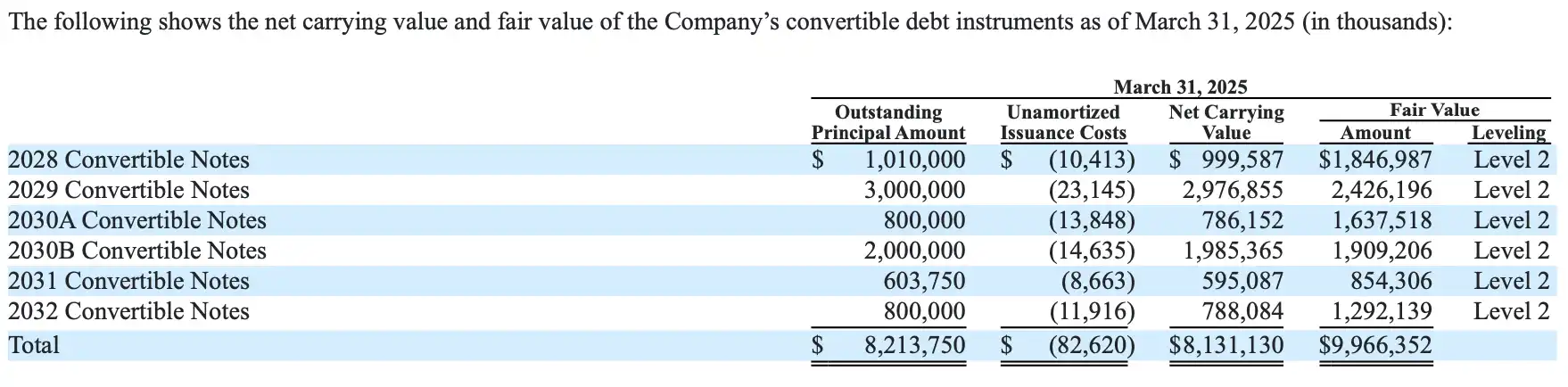
Meanwhile, the cash flow crisis has put the company on thin ice. Strategy's core business — data analytics software — has been unable to generate positive cash flow for several consecutive quarters. However, the company still has to pay $35.1 million in annual debt interest and $146 million in dividends, totaling $181.3 million. If external financing does not keep up, selling Bitcoin is almost the only way out. The document mentions that the $8.22 billion debt (as of the end of March 2025) has created immense repayment pressure, and if the market conditions deteriorate, the company may even be forced to sell at a "loss price" below cost.
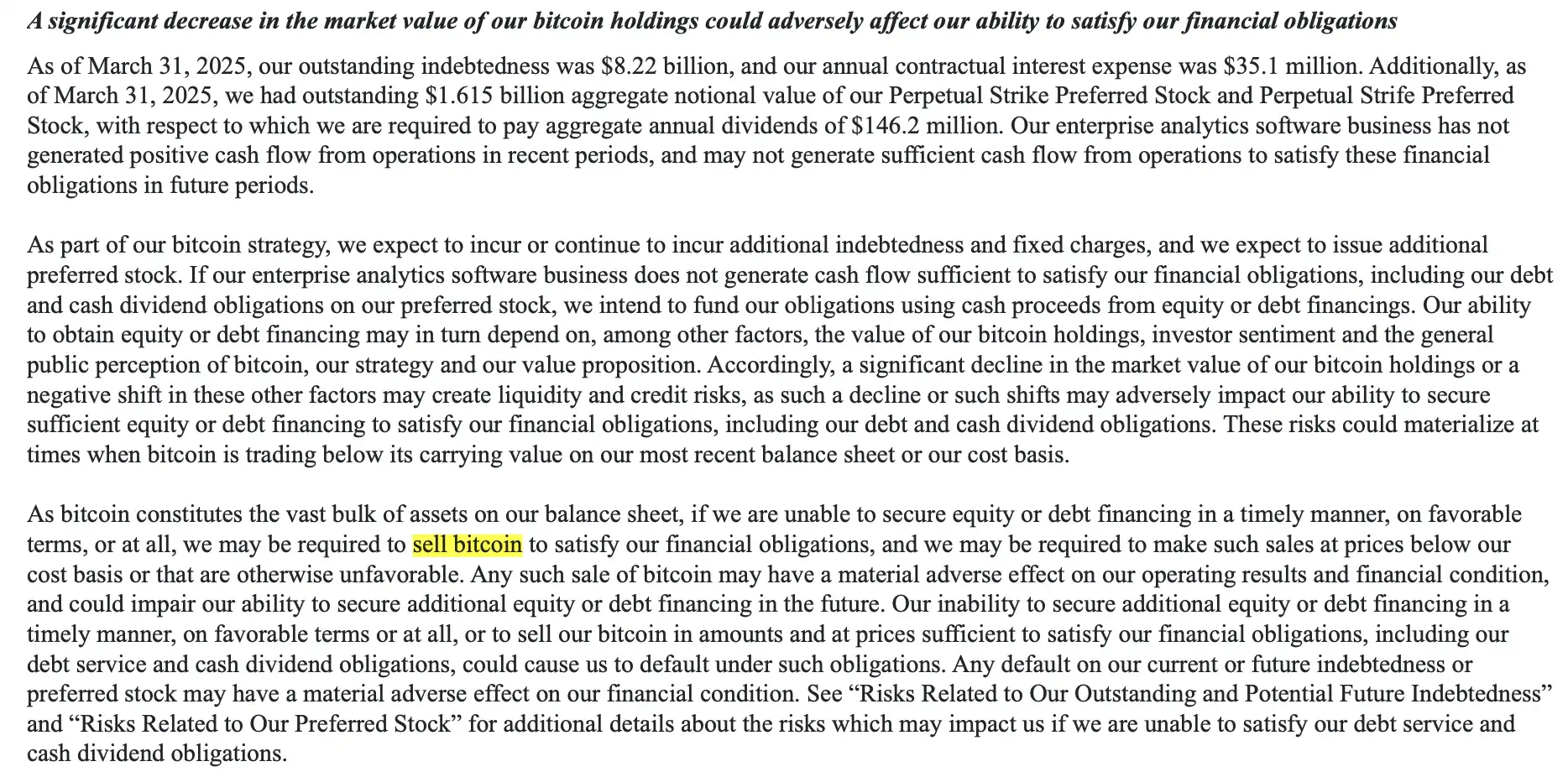
Lastly, market and security factors could serve as unexpected triggers. If a Bitcoin custodian (such as a bank or a third-party custodian) goes bankrupt or experiences a network attack resulting in asset loss, Strategy may be forced to sell the remaining holdings to cover the loss. The document specifically notes that their insurance only covers a small amount of Bitcoin, highlighting the reality of this risk.
Of course, Strategy is not sitting idle. The company plans to alleviate pressure by issuing more shares or issuing new debt. In the first quarter of 2025, it had splurged $7.7 billion, acquiring Bitcoin at an average price of $95,000 per coin. However, after April, as the market declined, this aggressive buying strategy significantly slowed down. If the financing channels are blocked, selling coins would be the last straw.
Related Read: "Is Strategy Restarting the 'Buy, Buy, Buy' Mode? A Comprehensive Analysis of the New Financing Plan"
How Would Potential Selling Pressure Impact the Market?
Strategy's Bitcoin holdings represent around 2.5% of the total Bitcoin supply, and if sold, the market is likely to experience turbulence. The scale of the sell-off depends on the company's specific needs, with the impact escalating accordingly.
If the sell-off is merely to cover short-term expenses, such as paying the annual interest and dividends totaling $181.3 million, approximately 2,318 Bitcoins would need to be sold. This represents less than 0.5% of its total holding of 528,185 coins, resulting in a relatively limited market impact that may only cause minor fluctuations, keeping investors relatively calm. However, if Strategy needs to repay some debt, such as $1 billion, the sell-off scale would increase to around 12,800 Bitcoins, accounting for 2.4% of its holdings. In an environment where Bitcoin's daily trading volume is only $100-300 billion and liquidity is relatively low, such a sell-off could drive the price down by 5% to 10%, creating significant market pressure.
Of greater concern is that if the Strategy is required to repay the entire $8.22 billion debt at once, the scale of selling pressure would surge to approximately 105,000 bitcoins, equivalent to 20% of its holdings. Such a large-scale sell-off would be nearly impossible to absorb in the current market and is likely to trigger a price crash, especially considering the Bitcoin market's sensitivity to large transactions— as evidenced by the recent flash crash from $83,000 to $74,500.
The most extreme scenario would be the company's bankruptcy or forced liquidation, potentially meaning the sale of all 528,185 bitcoins, valued at over $40 billion. This would deal a devastating blow to the market, potentially causing the Bitcoin price to plummet by half or even worse. However, the likelihood of such a comprehensive sell-off is low unless the company faces a systemic crisis, such as a debt default coupled with regulatory forced liquidation. In any scenario, the Strategy's actions could become a significant turning point for the Bitcoin market and are worth close attention.
The other side of the market impact is a chain reaction. If the Strategy sells, other institutions or retail investors may follow suit, causing Bitcoin's price to enter a vicious cycle. The risk asset sell-off sentiment has been exacerbated by Trump's tariff policy, and the Strategy's actions could be the "straw that breaks the camel's back" in the market.
Even more controversial is that this incident also involves Michael Saylor's own credibility. Michael Saylor, as a staunch supporter of Bitcoin, has repeatedly proclaimed on media outlets such as CNBC that he will "never sell his coins," and even stated that he will bequeath his bitcoins to organizations supporting the asset after his death. However, the wording in the SEC filing: "may sell Bitcoin at a price below cost" undermines this commitment.

Will Bitcoin Really Be Sold?
Strategy's Bitcoin strategy began in 2020 when Saylor positioned it as "digital gold" to combat inflation. Through issuing convertible bonds, preferred shares, and ATM issuances, the company has invested a total of $35.6 billion to purchase Bitcoin, with unrealized gains in holdings reaching billions at one point. However, with the recent drop in Bitcoin prices combined with debt pressure, the company has failed to turn a profit for three consecutive quarters.
In fact, the risk of a sell-off mentioned in this SEC filing is not the first. Strategy has submitted a total of 25 8-K filings this year, with 8-K filings labeled "Operating Results and Financial Condition" typically submitted at the beginning of each month. The "Operating Results and Financial Condition" reports at the beginning of each month are routine. As early as the January 6 8-K filing, the risk warning of "possible Bitcoin sales" was mentioned; however, the filings for February and March did not mention this, and this is the first time in three months that the risk warning has been cited in the 8-K form. The blunt language of this 8-K filing, stating "may sell at unfavorable prices," to some extent reflects the escalated pressure currently, likely related to the recent significant Bitcoin price drop and the $5.91 billion unrealized loss.
Looking back at the last bear market, Strategy also faced a severe test, with a negative net asset value, yet it was not forced to sell Bitcoin. This was mainly due to two key factors: first, the long debt maturity date (earliest in 2028), and second, founder Michael Saylor holding 48% of the voting power, making liquidation proposals difficult to pass. Therefore, even if Bitcoin falls below cost, the likelihood of triggering a "death spiral" sell-off is also low. Compared to the last bear market, Strategy now has various tools to respond: issuing debt, issuing more stock, or using its $40 billion Bitcoin holding as collateral for financing.
Furthermore, from a macro trend perspective, Bitcoin is gaining increasing recognition from sovereign funds and institutions, with a positive long-term outlook. Although short-term price volatility may bring financial pressure, Strategy has a long debt maturity, and with improving market conditions, the actual risk of sell-off is limited.
Related Reading: "Michael J. Saylor's Strategic Bet: Bitcoin's Premium Issuance and Capital Control"
In the short term, the market will closely watch its quarterly report and subsequent financing plans. As for whether there will be a sell-off, the market will wait anxiously. The next steps of this company not only concern its own survival but may also influence the future landscape of Bitcoin.
You may also like

Will MicroStrategy fall into a death spiral? What will the macro trend be in the second half of the year?

Morning Report | Illinois signs the strictest digital asset tax law in the U.S.; RWA tokenization market size surpasses $43 billion, institutions accelerate the migration of on-chain assets

Full version of the debut Q&A! Federal Reserve Chairman Waller: Sticking to the 2% inflation target, establishing five special working groups, individual did not submit the dot plot

From Disruptor to Shadow Market: The Crypto Market is Becoming a Colony of Traditional Finance
Dalio's important long article: How to position in the current market environment?

OKX Star analyzes Binance's competitive advantages: when regulation levels the playing field, competition has just begun

New gameplay for participating in initial offerings on cryptocurrency exchanges
Why Is Bitcoin Down Today? What the Hawkish FOMC Means for SpaceX, Gold and Nasdaq

DeepSeek Financing Story

Morning Report | DeepSeek completes over $7 billion in financing, with a valuation exceeding $50 billion; Musk's personal wealth has surpassed the total market value of Bitcoin

Cursor, why did you get on Musk's spaceship?
In the name of charity, for the benefit of the family: How the Trump family turned charity into profit?

Will Gold Break $4,500 After Tonight's Fed Decision? What XAUT and PAXG Traders Need to Know

SharpLink CEO: How to understand that Ethereum developers have just surpassed 1 million?

Morning Report | MiCA grace period expires on July 1; Kalshi's trading volume in the first week of the World Cup breaks $5.1 billion, setting a record

The foundation of SpaceX's trillion-dollar valuation: Who is dividing Musk's annual capital expenditure of tens of billions?
How to exit after asset tokenization?

The stablecoin positioning battle escalates: When compliance is just a ticket to entry, will USD1 become the biggest winner?
Will MicroStrategy fall into a death spiral? What will the macro trend be in the second half of the year?
Morning Report | Illinois signs the strictest digital asset tax law in the U.S.; RWA tokenization market size surpasses $43 billion, institutions accelerate the migration of on-chain assets
Full version of the debut Q&A! Federal Reserve Chairman Waller: Sticking to the 2% inflation target, establishing five special working groups, individual did not submit the dot plot
From Disruptor to Shadow Market: The Crypto Market is Becoming a Colony of Traditional Finance
Dalio's important long article: How to position in the current market environment?
OKX Star analyzes Binance's competitive advantages: when regulation levels the playing field, competition has just begun


