
Michael Saylor has announced that he will destroy all Bitcoin private keys upon his death: Contributing to the global BTC holders


Original Title: "Michael Saylor Announces Intention to Destroy All Bitcoin Private Keys Upon Death: Contribution to Everyone Holding BTC Worldwide"
Original Author: James, BlockTempo
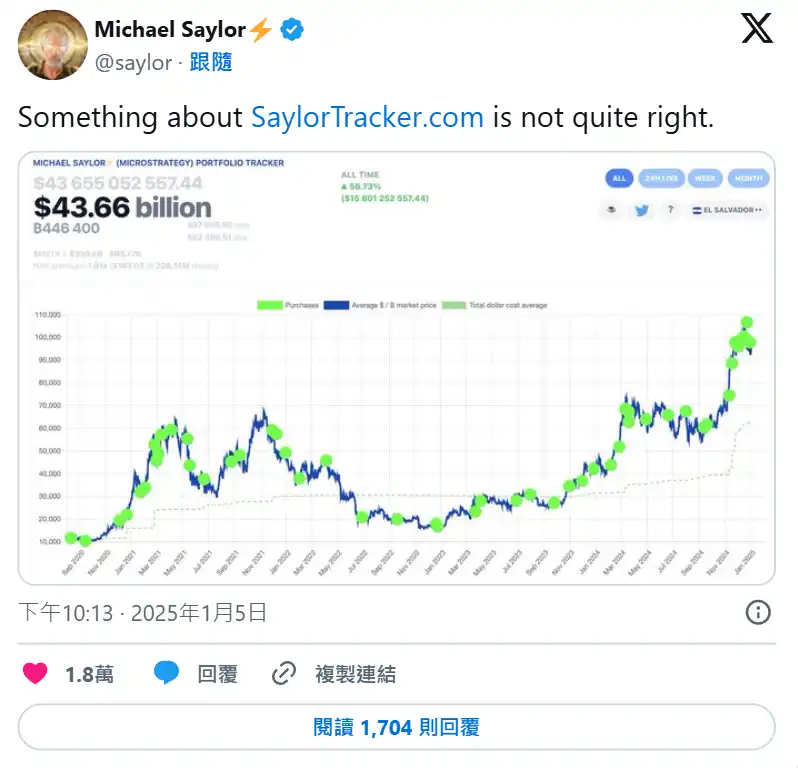
As the new year arrives, the U.S. publicly traded company and Bitcoin whale MicroStrategy continues to accumulate Bitcoin. MicroStrategy's co-founder Michael Saylor shared a tweet on the 5th sharing the MicroStrategy Bitcoin holdings data tracked on SaylorTracker.com.
This marks Michael Saylor's ninth consecutive week of releasing the MicroStrategy Bitcoin holdings data tracking. However, unlike previous times, he candidly stated that "some parts of the website are not quite accurate," hinting at the possibility of MicroStrategy once again increasing its Bitcoin holdings.
Following the established pattern, Michael Saylor has always increased Bitcoin holdings on the day after announcing the holdings data. On SaylorTracker.com, each time MicroStrategy buys Bitcoin, a green dot is marked on the corresponding date, with the Bitcoin price trend line shown in blue.
Last October, MicroStrategy introduced the 21/21 plan, aiming to conduct $21 billion in equity financing over the next three years and issue $21 billion in fixed-income products (including debt, convertible notes, and preferred stock), raising a total of $42 billion to purchase more Bitcoin.
On the 3rd, MicroStrategy announced the latest progress of its 21/21 plan, planning to issue perpetual preferred stock through one or more public offerings to raise up to $2 billion. The purpose is to continue strengthening its balance sheet, acquire more Bitcoin, and is expected to be implemented in the first quarter of 2025.
MicroStrategy currently holds 446,400 Bitcoins, valued at approximately $44.27 billion, with an unrealized profit of up to $16.3 billion.
Reiteration of Intention to Destroy Bitcoin Private Keys After Death
Another noteworthy announcement is that Michael Saylor recently declared in an interview with Fox Business that upon his death, he will destroy his Bitcoin private keys. He described this action as a "proportional contribution to everyone in the world holding Bitcoin."

Michael Saylor advocates that Bitcoin holders should destroy their Bitcoin private keys after death, permanently depriving access to the held Bitcoin. This would reduce the Bitcoin supply in the market, ultimately ensuring the rise of Bitcoin's value, thus benefiting the holders.
Michael Saylor stated that he hopes to be remembered for "taking the torch from Satoshi and pushing Bitcoin forward through enterprise and government adoption long after his demise."
"Michael Saylor had disclosed at the end of 2020 that he personally holds 17,732 Bitcoins. He had previously mentioned that over the years, he not only hasn't sold any Bitcoin but has continued to accumulate more, although the exact number is currently unclear."
The proposal to destroy Bitcoin private keys after death has sparked a wide discussion in the crypto community. From a critical perspective, this action may seem irresponsible and wasteful. If many whales adopt this practice, it could distort the Bitcoin ecosystem. Nevertheless, some community members praise this move as a "very clever diamond hands play."
You may also like

Dialogue with OmenX Founder: Why does the prediction market need an evolution from "spot" to "derivatives"?

When the P2P illicit funds from ten years ago turned into 60,000 bitcoins

Morning News | CME Group launches Nasdaq Cryptocurrency Index futures; Asset management giant Janus Henderson strategically invests in Ethena

Why did Oracle deliver the strongest financial report in history, yet its stock price fell?

Bitcoin Layer 2 Network Botanix: Why Did We Choose to Dissolve?

Morning Report | OpenAI has submitted an S-1 registration statement draft to the U.S. SEC; Morpho completes $175 million financing

Galaxy Deep Research Report: How Hyperliquid's HIP-4 Upgrade Changes the Landscape of Prediction Markets?

Latest research from 13 top universities including Cornell University: The current state, challenges, and misconceptions of the fusion of Crypto and AI
Deconstructing Anthropic: The Best AI Company, Possibly Also a Type of Organizational Invention

Every exchange is a "Universal Exchange."

The counterattack of traditional finance: Alliance chains are quietly reviving
Pantera Capital Partner: How Tokenization is Restructuring the Private Equity and Early Investment Ecosystem?

Mastercard Launches Agent Pay for AI, Plans to Record AI Agent Payment Authorizations on Polygon
Mastercard launched Agent Pay for AI, a new payment protocol designed to help AI agents make small payments such as pay-per-use access to data and APIs. The system plans to record human-granted AI agent permissions on Polygon, focusing on verifiable authorization, identity, and payment controls.

Curve Deploys Llamalend v2 on Optimism With 250,000 OP Incentives
Curve launched Llamalend v2 on Optimism with 250,000 OP incentives from the Optimism Foundation. The upgrade expands Llamalend beyond its earlier crvUSD-focused model, adding broader collateral support, LlamaRisk market reviews, and the ability to use Curve LP tokens as collateral.

Raydium Old Liquidity Pool Reportedly Exploited, With $1.34 Million Moved to Ethereum and Tornado Cash
An old Raydium liquidity pool was reportedly exploited for around $1.34 million in USDC, RAY, and wSOL, with the stolen funds bridged to Ethereum and deposited into Tornado Cash. The incident highlights the tail risks of legacy DeFi pools, old contracts, and cross-chain fund laundering paths.
Kalshi Executive Challenges “SBF Backed AI Unicorns” Narrative, Says Leopold Aschenbrenner Was Key Figure
Kalshi executive John Wang questioned the “SBF backed AI unicorns” narrative, saying Leopold Aschenbrenner was the key figure behind major AI investment decisions.

New York Proposes Stricter Stablecoin Issuer Rules Aligned With Federal GENIUS Act
NYDFS proposed stricter stablecoin issuer rules aligned with the GENIUS Act, covering reserves, custody, redemption timelines, audits, and capital buffers.

CryptoQuant Says Bitcoin Profitable Supply Is Near 45% Pressure Zone as On-Chain Data Points to Market Repricing
CryptoQuant said Bitcoin’s profitable supply is nearing the 45% pressure zone, signaling rising market stress, unrealized losses, and a possible on-chain repricing phase.
Dialogue with OmenX Founder: Why does the prediction market need an evolution from "spot" to "derivatives"?
When the P2P illicit funds from ten years ago turned into 60,000 bitcoins
Morning News | CME Group launches Nasdaq Cryptocurrency Index futures; Asset management giant Janus Henderson strategically invests in Ethena
Why did Oracle deliver the strongest financial report in history, yet its stock price fell?
Bitcoin Layer 2 Network Botanix: Why Did We Choose to Dissolve?
Morning Report | OpenAI has submitted an S-1 registration statement draft to the U.S. SEC; Morpho completes $175 million financing


