
Opportunities for AI Under Tariff Suppression, Crypto May Fall Behind





Original Article Title: More AI Less Crypto
Original Article Author: @DanJablonski_, @BullpenFi Investor
Original Article Translation: zhouzhou, BlockBeats
Editor's Note: The intersection of the Crypto and AI ecosystems is rapidly evolving, with various projects advancing innovations such as intelligent agents, on-chain reasoning, decentralized models, and more. Chaos Labs is building AI researchers, Sentient is introducing on-chain intelligent agents, Gaianet is collaborating with Mira to enhance credibility, Ambient is focusing on real-time reasoning, and Sei is exploring the robot economy. This wave of enthusiasm is sweeping through the Web3 and AI intersection.
The following is the original content (reorganized for better readability):
Across the entire crypto industry, no track has seen faster development than AI. Even in the current downturn of on-chain sentiment, AI still commands the highest attention. The signal is very clear, and too much is happening for silence to be an option. In this tariff-ridden week, we have distilled the core content of the Crypto AI field for you:
If you want to understand the overall trend, the following few lengthy articles are well worth a read. They do not focus on a particular project but rather present where we are, and where we might be headed in the future.
1. Chain of Thought's "The State of the Swarm (I): Dawn"
The AI swarm is the future direction: millions of autonomous intelligent agents will engage in real-time trading and evolution under market mechanisms, forming an "agentic economy."
Teng Yan (@0xPrismatic) has been dedicated to Crypto AI research for almost a year. Recently, his @CoT_Research acquired @OutpostdotAI, becoming a major observatory platform in this field, publishing weekly updates and in-depth insights, exploring how the fusion of AI and crypto is evolving.
2. @YB_Effect: Another key voice in the Crypto AI field
He shared a summary of his conversation with the DeAI (Decentralized AI) founder and investor in an article. The key takeaway: DeAI is gaining attention due to decentralized training, open-source inference, strong network effects, and global accessibility. However, its biggest challenge still remains: how to prove that "decentralization" can truly bring value? Some even argue that without Crypto, open-source AI would not succeed.
3. @Sendaifun Founder @Yashhsm: Thoughts on the "Attention Capital Market" and AI
His key point is: through "vibe coding," AI is making app development faster and cheaper, fueling a wave of "hype-able" tokenized applications. As the barriers to creation lower, "attention" becomes a true moat— and AI tools like @KaitoAI can help us quantify and trade this attention. The biggest issue still lies in "user retention," but AI remains highly promising and could be a key driver for the next wave of crypto adoption.
4. @VariantFund's Legal Counsel and Investment Partner @DBarabander published a post on how crypto is addressing AI's core challenges.
He mentioned Variant's recent investments in projects like @PluralisHQ and @Hyperbolic_Labs.
DBarabander pointed out: Cryptography offers features like economic ownership, verifiability, and self-sovereignty, addressing AI's core issues in resource coordination, modular composition, native payments, and more. This means that AI agents can access shared computation, run in a trustless manner, and autonomously transact, driving the next wave of Crypto AI innovation.
5. @GSR_io's "Integration of Crypto and AI" is a content-rich research report that delves deep into various aspects of the decentralized AI tech stack.
The article extensively analyzes multiple leading teams such as @PrimeIntellect, @NousResearch, @GensynAI, @PluralisHQ, etc., recommending reading to understand how decentralized training, data markets, and AI agent platforms combine to form an ecosystem.
Many crypto podcasts often have noisy content, lacking substantive insights, but this week these two episodes are indeed insightful and worth a quick look:
1. Ejaaz (@cryptopunk7213) in conversation with Decentralised's Saurabh (@Desh_Saurabh)
@Decentralisedco has been consistently producing some of the highest quality and most timely research content in the Web3 space. In this podcast episode, they discuss how the decentralized design of blockchain is reshaping the AI tech stack—opening new pathways for data ownership, collaborative coordination, and computational models.
They point out that AI agents have the potential to significantly simplify the user experience of crypto products. Still, for success, the core needs to align with users' motivations, especially economic incentives.
Episode 37: How AI Agents Are Reshaping DeFi and Crypto Infrastructure (Host: Ejaaz Ahamadeen)
2. @BanklessHQ's "AI Weekly Rollups" has become a must-listen, even a must-watch show every week.
I usually listen to podcasts while running or working out, but Bankless's series has evolved from a "podcast" to a "full-screen sharing show," more like watching a performance than just listening to a conversation.
Very exciting. The program reviews all the key events from the previous week: xAI, Coreweave, Ghibili, Gemini 2.5, and the emerging new generation of AI agents in the crypto world.
Highlight Title: ChatGPT Goes Viral: 60 Minutes Breaks 1 Million Users
Finally, here are the significant progress updates this week from the most innovative teams:
1. @GensynAI launched the highly anticipated Testnet
Gensyn is a decentralized AI network that supports collaborative machine learning. Users can run nodes, train models, track contributions, and build a scalable open ecosystem.
It is currently in the Reinforcement Learning (RL) Swarm stage. The project follows a phased release approach and is gradually moving towards the Mainnet launch under community guidance. The ultimate goal is to operate an AI collaborative network handling real-world economic value.
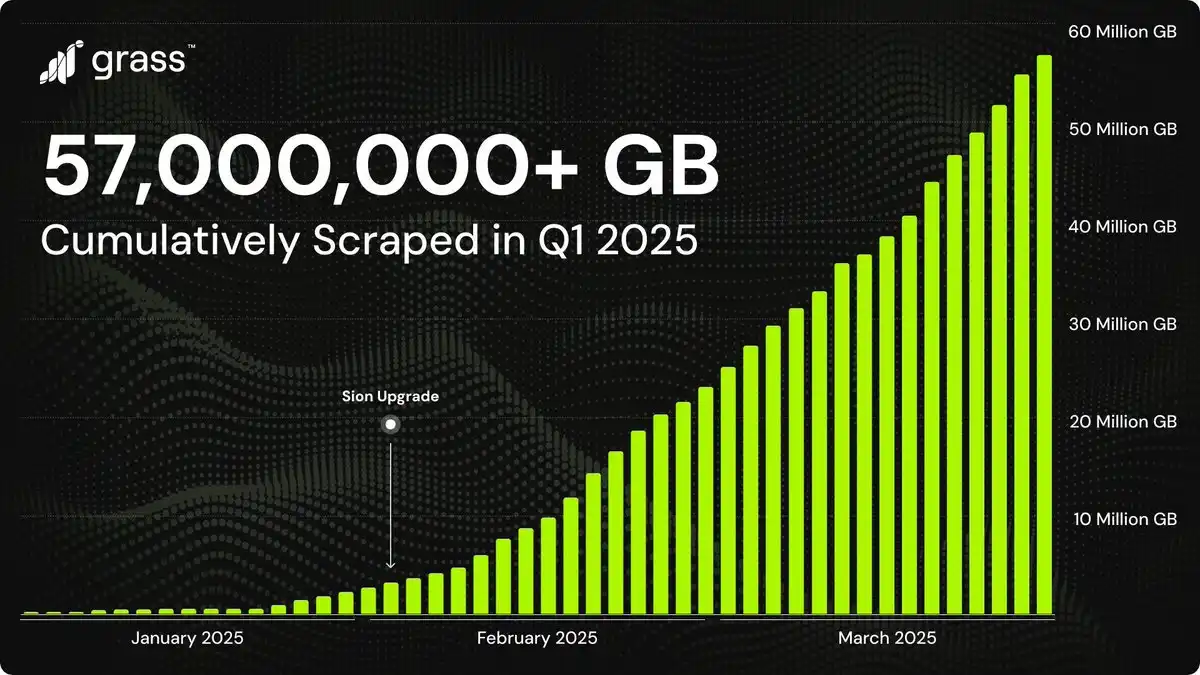
2. @GetGrass_io has seen a 320x increase in web crawling capability post-Sion upgrade.
Grass is a protocol that utilizes over 3 million user nodes to crawl and process public web data for AI model training. With the explosive growth of AI models like ChatGPT, the competition for public data has intensified, sparking deep discussions on "who owns the data." Research institution @FourPillarsFP has released an in-depth analysis of Grass's growth path.
3. @Hyperbolic_Labs has released a comprehensive March update and shared an article on model fine-tuning.
In their March review, Hyperbolic Labs highlighted the rapid growth of their AI cloud platform: GPU rental volume doubled compared to the previous month, the developer count reached 165,000, and added support for models like DeepSeek-V3-0324 and Qwen-QW-32B.
They continue to position themselves as a "high value, developer-friendly" inference service platform and are expected to launch Auto Top Ups, a new Model Playground, and a significant brand upgrade in May.
Furthermore, the team elaborated on various AI fine-tuning techniques, explaining how to adapt pre-trained language models to tasks through carefully curated data to enhance model efficiency, security, and alignment.
Monthly Report Link Article Fine-tuning
4. @Chakra_AI partnered with @FlowAI_xyz to integrate Chakra's open data standard into Flow's AI agent marketplace.
This partnership enables AI agents on the Flow platform to access real-time key datasets hosted by Chakra, enhancing their utility. For example, a DeFi smart agent could retrieve Bitcoin prices from Chakra's data warehouse and respond to user queries. The collaboration aims to expand Flow's AI agent ecosystem, including novel applications such as user-owned agents built on community data sources like Twitter and LinkedIn.
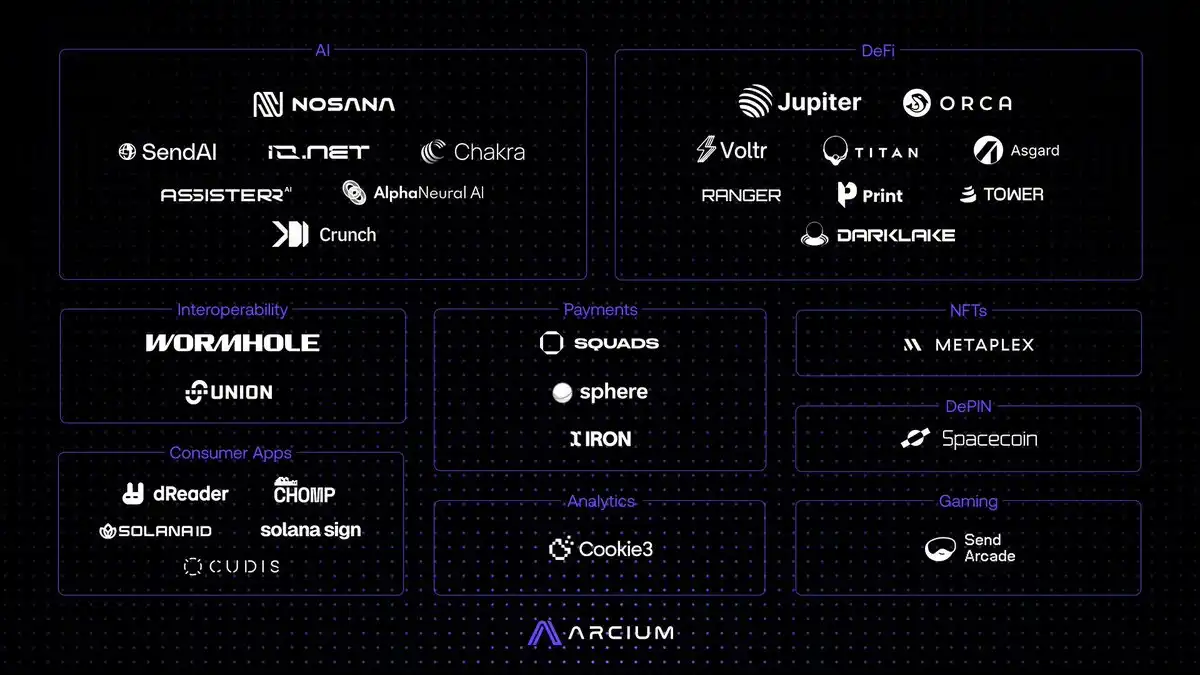
5. Leading MPC protocol @ArciumHQ brought several significant updates this week.
Arcium focuses on building privacy-preserving AI and is developing the world's first encrypted supercomputer. This week, they released a preview of the "Encrypted Ecosystem," announced the launch of their Testnet on April 30th, and successfully closed a fundraising round with the CoinList community.
6. @Chaos_Labs is building the "world's first AI-endowed crypto researcher."
I have already signed up for early access, and their intelligent agent system aims to enhance research depth and investment conviction. Chaos CEO Omar states that the system, akin to an AI swarm, will bring profound and actionable insights to the crypto market.
7. @SentientAGI and @PondGNN collaborate to bring on-chain data-driven AI agents to Sentient Chat.
Sentient is a non-profit organization committed to building a decentralized, open-source AI ecosystem. Through this partnership, Pond's AI models can analyze on-chain data in real-time to provide users with operational insights, enhancing transparency and accountability.
8. @OpenGradient announces integration with @Crossmint to support building AI agents through the Goat SDK.
OpenGradient is a decentralized AI platform focusing on secure, open-source model hosting and scalable on-chain computation. In their March update, they also introduced Flock LLMs, integrated the LangChain workflow, laying the foundation for next-generation web3 AI applications.
9. @Gaianet_AI partners with @Mira_Network to reduce AI hallucinations and bias by 90% through a trustless verification mechanism.
Gaia is a decentralized ecosystem supporting the evolution of AI applications, while Mira focuses on verifiable AI reasoning. Their collaboration, combining Mira's 2.5 million users and Gaia's 280,000 node network, will drive the adoption of AI in high-stakes scenarios such as healthcare and finance.
10. @Ambient_xyz officially emerges from stealth mode.
Ambient is a PoW Layer1, compatible with SVM, focusing on ultra-fast, real-time, verifiable inference on a 6 trillion parameter model. They aim to be a "decentralized OpenAI competitor" and embed AI into the chain's base layer design. Co-founder of @Delphi_Digital, @Shaughnessy119, shared related information.
11. @Sei_FND released its latest research findings in the robotics, DePIN, and AI fields.
The team explored how DePIN and tokenization drive the development of physical AI, achieve robot assetization through blockchain, and incentivize AI participation. AI applications in industries such as healthcare and manufacturing will accelerate adoption, with the Sei chain acting as a critical financial infrastructure.
You may also like

Will MicroStrategy fall into a death spiral? What will the macro trend be in the second half of the year?

Morning Report | Illinois signs the strictest digital asset tax law in the U.S.; RWA tokenization market size surpasses $43 billion, institutions accelerate the migration of on-chain assets

Full version of the debut Q&A! Federal Reserve Chairman Waller: Sticking to the 2% inflation target, establishing five special working groups, individual did not submit the dot plot

From Disruptor to Shadow Market: The Crypto Market is Becoming a Colony of Traditional Finance
Dalio's important long article: How to position in the current market environment?

OKX Star analyzes Binance's competitive advantages: when regulation levels the playing field, competition has just begun

New gameplay for participating in initial offerings on cryptocurrency exchanges
Why Is Bitcoin Down Today? What the Hawkish FOMC Means for SpaceX, Gold and Nasdaq

DeepSeek Financing Story

Morning Report | DeepSeek completes over $7 billion in financing, with a valuation exceeding $50 billion; Musk's personal wealth has surpassed the total market value of Bitcoin

Cursor, why did you get on Musk's spaceship?
In the name of charity, for the benefit of the family: How the Trump family turned charity into profit?

Will Gold Break $4,500 After Tonight's Fed Decision? What XAUT and PAXG Traders Need to Know

SharpLink CEO: How to understand that Ethereum developers have just surpassed 1 million?

Morning Report | MiCA grace period expires on July 1; Kalshi's trading volume in the first week of the World Cup breaks $5.1 billion, setting a record

The foundation of SpaceX's trillion-dollar valuation: Who is dividing Musk's annual capital expenditure of tens of billions?
How to exit after asset tokenization?

The stablecoin positioning battle escalates: When compliance is just a ticket to entry, will USD1 become the biggest winner?
Will MicroStrategy fall into a death spiral? What will the macro trend be in the second half of the year?
Morning Report | Illinois signs the strictest digital asset tax law in the U.S.; RWA tokenization market size surpasses $43 billion, institutions accelerate the migration of on-chain assets
Full version of the debut Q&A! Federal Reserve Chairman Waller: Sticking to the 2% inflation target, establishing five special working groups, individual did not submit the dot plot
From Disruptor to Shadow Market: The Crypto Market is Becoming a Colony of Traditional Finance
Dalio's important long article: How to position in the current market environment?
OKX Star analyzes Binance's competitive advantages: when regulation levels the playing field, competition has just begun


