
 Buy Crypto
- Markets
 Futures
- Spot
- Copy Trade
- Earn
- More
Pantera Partner: Predicting the Market is No Longer a 'Betting Game,' But a Core Financial Asset Class

Original Title: State of Prediction Markets
Original Author: Paul Veradittakit, Partner at Pantera Capital
Original Translator: Saoirse, Foresight News
Abstract
· Prediction markets are not a new concept — they have now finally achieved decentralization. Humans have been betting on predictions since ancient times, but encryption technology has transformed this age-old behavior into a permissionless, transparent global market. In such markets, price aggregation reflects real-time collective intelligence rather than the results of opinion polls.
· Infrastructure and regulation are the dual drivers opening the market's doors. The clear regulatory stance of the U.S. Commodity Futures Trading Commission (CFTC), collaborations in the traditional finance (TradFi) sector, and multi-chain scalability have propelled prediction markets from niche experiments to a track with a weekly trading volume of $3.9 billion, with related platforms directly integrated into brokerage firms, media, and consumer applications.
· "Uncertainty" emerges as a new financial asset class. As prediction markets gradually evolve into core hedging, data, and forecasting infrastructure, platforms that combine liquidity, credibility, and coverage to "price" real-world outcomes globally will continue to accrue value.
For thousands of years, humans have been exploring methods to harness collective wisdom to predict the future. Ancient Greeks would receive specialized tokens to vote through a pipeline system; meanwhile, juries at the time would use solid or perforated stones to express their verdicts. It is safe to assume that the behavior of private betting in the ancient taverns called "kapeleia" was also very common.
In the 17th-century Amsterdam Stock Exchange, merchants would bet on the arrival time of cargo ships; in 19th-century America, political betting venues dominated during elections until they were banned in the 1940s. In addition, commodity futures trading on the Chicago Commodity Exchange falls into this category. It is evident that humans have long understood that investing in predicting outcomes can generate highly valuable informational signals.
Today, prediction markets driven by encryption technology represent a digital rebirth of this ancient practice — but with a key difference: the former is permissionless, transparent, open, and global.
Information Market Revolution: How Does Crypto Prediction Market Stand Out?
Traditional prediction markets require trusted intermediary institutions to hold funds, verify results, and distribute rewards, but encryption technology through blockchain has eliminated these middlemen. When you bet on issues in geopolitics, macroeconomics, or culture on the Polymarket platform — whether it's "Will the Fed cut rates in January?" or "Who will win the 2026 Oscar for Best Picture?" — your funds are held in a smart contract, result verification is fully transparent, and rewards are automatically distributed via USDC. The entire process does not require a bank account, has no geographical restrictions, and there are no intermediary fees or participant qualifications.
Another industry giant, Kalshi, focuses 90% of its business on the sports sector, covering topics such as "PGA Farmers Insurance Open champion attribution" and "Kent State University vs. Akron University basketball game result." The emerging prediction market platform, Novig, also has a strong emphasis on the sports sector.
Inflection Point: Why Now?
The current prediction market has seen explosive growth, with a 7-day trading volume reaching $3.9 billion, driven by three key factors: regulatory maturity, integration with traditional finance, and infrastructure breakthroughs.
From a regulatory standpoint, a significant development was the CFTC approval that cleared the way for platforms to operate in the U.S. For example, in July 2025, Polymarket acquired the CFTC-licensed derivatives trading platform, QCX LLC, and the clearinghouse, QC Clearing LLC. This acquisition enabled traders to confidently participate in prediction market contract trading on the Polymarket platform with clear and precise rules. In December 2025, Kalshi, with a valuation of $11 billion, completed a $1 billion financing round, reflecting institutional investors' confidence in the sector. Overall, regulatory clarity is unlocking institutional funding and retail participation through established brokerage channels.
Intercontinental Exchange (ICE), in addition to investing $2 billion in Polymarket, will also become the global distributor of Polymarket's event-driven data—highlighting the major trend of traditional finance merging with the prediction market.
This convergence has been further deepened through partnerships. Polymarket entered into a multi-year partnership with the TKO Group Holdings company, becoming the official exclusive partner of the Ultimate Fighting Championship (UFC) and Zuffa Boxing, achieving a direct integration of prediction market technology with live fan experiences.
In 2026, Kalshi will partner with Cable News Network (CNN) and Consumer News and Business Channel (CNBC), allowing viewers to see real-time prediction probabilities in the news ticker. Both Polymarket and Kalshi have partnered with Google, while companies like Robinhood, Fanatics, and Coinbase have entered the field through partnerships or native applications. In November 2025, Robinhood's prediction market saw a contract trading volume of 3 billion, a 20% increase month-over-month, confirming the significant retail participation.
Technological advancements have driven infrastructure breakthroughs, including: multi-chain scalability with Polygon, Solana, Base, Gnosis Chain; integration of AI oracles for permissionless instant settlement; and the use of hybrid Automated Market Maker (AMM) and order book models to reduce trading friction and enhance liquidity. In contrast, during its launch, the early platform Augur faced challenges with immature technology and regulatory environment.
Market Insights: Key Players and Challengers
While Polymarket currently holds a dominant position in the industry, its status may face challenges from competitors, providing users with more choices. In fact, in 2025, 12 institutions either submitted a Designated Contract Market (DCM) application or successfully obtained the qualification, representing a 500% increase from the previous year. Additionally, there are companies looking to collaborate with DCMs to offer prediction market services as "Futures Commission Merchants."
Here is a brief comparison between Polymarket and the Opinion platform (Data Period: Last 30 days as of December 3, 2025):
· Polymarket Key Data: Open Interest $2.471 billion; Nominal Trading Volume $43.9 billion; Market Share of 82% of the industry's Total Value Locked (TVL); adopting a historical zero-fee model to drive user growth.
· Opinion Key Data: TVL surged by 110% in the last 30 days (increasing from $30 million to $63 million); Estimated Monthly Trading Volume of $40 billion, posing a potential impact on the existing market share; achieving product-market fit on emerging Layer2 infrastructure.
Network effects and the market landscape of "Winner Takes All" are attracting significant growth capital—these platforms provide scalable diversification options for traditional derivatives and betting products. The revenue models have also transcended the single-fee structure, including: providing real-time probability data to news media, financial terminals, etc.; API integration with social platforms and apps; some companies (like Robinhood) also leverage this for cross-selling core financial services.
User Behavior Shift
Traders are gradually shifting towards prediction markets—these markets have a more sophisticated speculative structure, serving as both hedging tools and providing Alpha returns to decentralized finance (DeFi) portfolios. Due to the real-time predictive accuracy of political and economic forecasts surpassing traditional polling, this migration trend may also extend to more related event contract areas.
Although Polymarket initially gained media attention for political predictions, it is not limited to this area. Its largest open interest markets include:
· Non-Election Politics: $55 million
· Cryptocurrency: $52 million
· Business: $36 million
· Election Field: $22 million
· Pop Culture Field: $20 million
· Sports Field: $20 million
· Total: $242 million
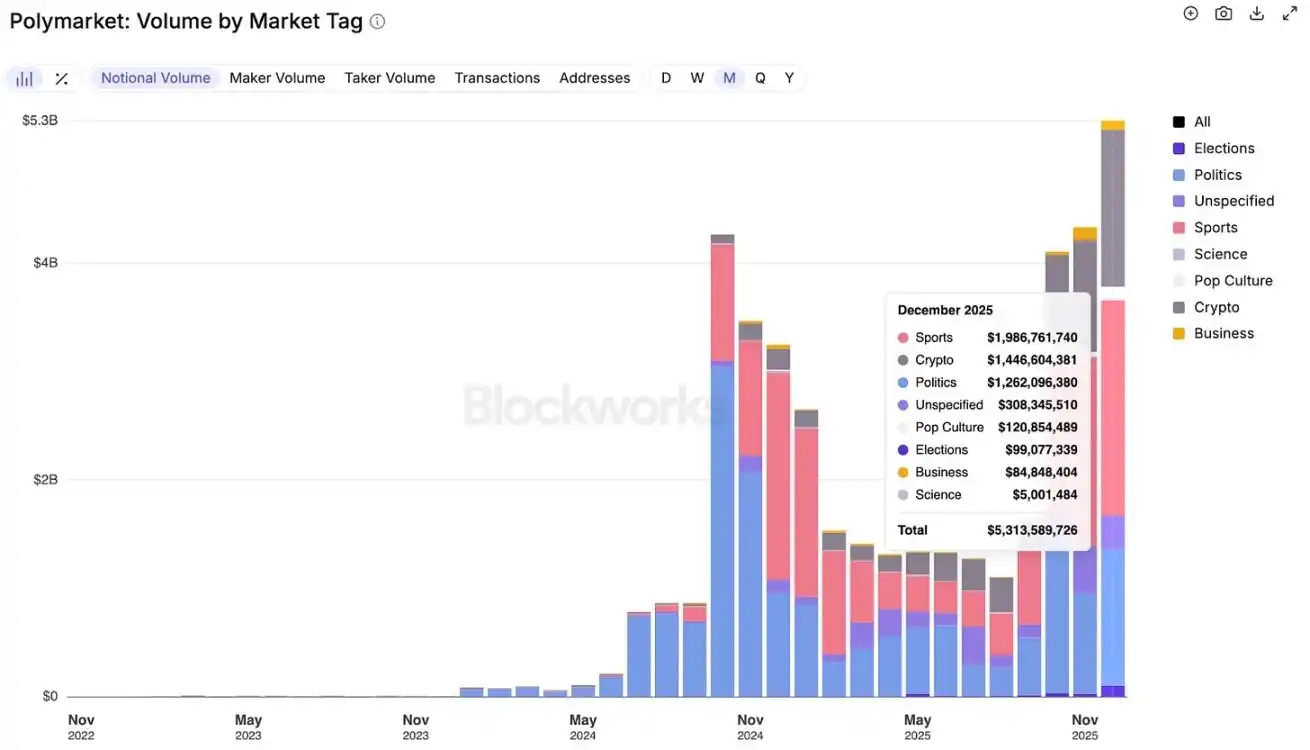
New entrants continue to emerge: Crypto.com partners with Hollywood.com to launch an entertainment-focused prediction market covering topics such as movies, TV shows, theater, actors, musicians, and award outcomes; Limitless focuses on a short-term prediction market for cryptocurrency and stock prices, originating from the X (formerly Twitter) project, with investment support from Coinbase and 1confirmation.
Controversies, Challenges, and Emerging Solutions
The prediction market still faces several pain points, including centralization risks, manipulation issues under traditional oracle models, and settlement delays due to manual reporting systems.
Regulatory gray areas still exist, including the classification dispute of sports betting. For example, in November 2025, a judge in Nevada ruled that Kalshi is a betting platform and cannot be exempt from the state's gambling regulations. However, Kalshi claims that its platform is a federally regulated financial trading platform offering legal derivative contracts (event-based contract swaps) rather than gambling bets. Following the ruling, Kalshi has initiated the appeals process, and similar disputes have arisen in Massachusetts.
Regardless of the case outcome, several issues still need to be addressed, including age restrictions, responsible gambling concerns, etc. Cross-border regulatory arbitrage may also pose a challenge to industry development.
Market manipulation risks also need to be controlled, such as: the influence of whales on low-liquidity markets, wash trading and price manipulation in a decentralized environment, and the balancing act between "permissionless trading" and "market credibility."
The current market structure is continuously evolving, including: the launch of perpetual prediction markets for "continuous outcomes," combinatorial markets to handle complex multivariable events, and binding curve mechanisms to enhance dynamic liquidity. Furthermore, there are multiple opportunities: using prediction market probabilities as inputs for DeFi protocol oracles; enabling secondary trading and leverage through tokenized positions; integrating prediction markets with yield strategies and portfolio hedging.
Emerging solutions focus on three main directions: providing AI-driven instant settlements for permissionless markets; integrating trading platform oracles to reduce frontrunning; developing application chains embedded with a consensus mechanism to ensure oracle credibility.
Future Outlook
From the current perspective, in the short term, three major factors will drive the wider adoption of prediction markets: U.S. platforms approved by the CFTC going live through established brokers; social media platform integrations (such as embedding prediction APIs in tweets); emerging banks embedding prediction markets to merge finance with speculative functions.
Furthermore, as prediction markets gradually evolve into a distinct financial market category, vertically specialized prediction markets for niche areas (such as sports, business, etc.) may emerge. For example, Novig, a sports-centric prediction market, is focusing on creating highly tailored markets and user experiences for sports betting users. As prediction markets become a more common consumer behavior, these specialized platforms may offer a better user experience than one-size-fits-all comprehensive platforms.
In the next 1-3 years, prediction markets focusing on privacy protection may adopt zero-knowledge proof technology; governance applications such as Futarchy and outcome-based decision-making may also gradually develop.
(Note: "Futarchy" is a new governance concept proposed by economist Robin Hanson around 2000. Its core idea is to use "predictions of future outcomes" to guide decision-making, rather than relying on traditional voting, expert judgment, or power hierarchies. Its name is a combination of "future" and "archy," translating directly to "prediction governance system" or "future-oriented governance.")
However, the industry may still face obstacles, including: regulatory tightening, restricting global access or product scope; if the market fails to improve prediction accuracy, it may lead to user fatigue; traditional platforms adopting blockchain technology may trigger intensified competition.
As the integration deepens, prediction markets will bring about various positive social impacts: providing collective wisdom support for resource allocation and policy decision-making; developing decentralized prediction markets into public infrastructure; shifting the media and governance sectors from a "polling model" to a "participatory probabilistic market model."
The current question is no longer "Can prediction markets scale," but "How many prediction markets will emerge in the future," and "Which models can capture this trillion-dollar opportunity—pricing uncertainty in the real world on-chain." These predictions will be a significant complement to human wisdom and forecasting capabilities.
You may also like

From x402 to MPP: Cloudflare's crucial vote, will it go to Coinbase or Stripe?

BlackRock CEO issues annual open letter: The wave of tokenization has arrived, and we will lead this trend

When Backpack backstabs the community

When gold is no longer a safe haven, and Bitcoin continues to panic

Trump, the World's Largest Oil Trader

If the US and Iran have not reached an agreement in 5 days, what other cards does Trump have?

Tether Whale Dumps £12 Million, Backing Crypto’s ‘British Trump’
Ethereum Foundation Post: Rethinking the Division of Work Between L1 and L2 to Build the Ultimate Ethereum Ecosystem

Two Major Prediction Market Platforms Unite Rarely, What Is the Story Behind This New Fund?

WEEX Official Product Launch: Win LALIGA Tickets & Unlock the 3-in-1 Crypto Trading Suite
Trade crypto without downloading an app. Join the WEEX H5, API, SKILLs livestream to explore the new trading experience, win LALIGA VIP tickets, and share 420 USDT rewards.
Dragonfly Partners: Most agents will not engage in autonomous trading, how can crypto payments prevail?

US AI Startup Goes All In on Chinese Mega-Model | Rewire News Morning Brief

Trump Lies Again: A "Five-Day Pause" Psyop, How Wall Street, Bitcoin, and Polymarket Insiders Synced Uposciogen

When a Token Becomes Labor, People Become the Interface

Ceasefire News Leaked Ahead of Time? Large Polymarket Bets on Outcome Before Trump's Tweet
BlackRock CEO's Annual Shareholder Letter: How is Wall Street Using AI to Keep Profiting from National Pension Funds?

Sun Valley Releases 2025 Financial Report: Bitcoin Mining Revenue Reaches $670 Million, Accelerating Transformation to AI Infrastructure Platform
On March 16, 2026, in Dallas, Texas, USA, CanGu Company (New York Stock Exchange code: CANG, hereinafter referred to as "CanGu" or the "Company") today announced its unaudited financial performance for the fourth quarter and full year ended December 31, 2025. As a btc-42">bitcoin mining enterprise relying on a globally operated layout and dedicated to building an integrated energy and AI computing power platform, CanGu is actively advancing its business transformation and infrastructure development.
• Financial Performance:
Total revenue for the full year 2025 was $688.1 million, with $179.5 million in the fourth quarter.
Bitcoin mining business revenue for the full year was $675.5 million, with $172.4 million in the fourth quarter.
Full-year adjusted EBITDA was $24.5 million, while the fourth quarter was -$156.3 million.
• Mining Operations and Costs:
A total of 6,594.6 bitcoins were mined throughout the year, averaging 18.07 bitcoins per day; of which 1,718.3 bitcoins were mined in the fourth quarter, averaging 18.68 bitcoins per day.
The average mining cost for the full year (excluding miner depreciation) was $79,707 per bitcoin, and for the fourth quarter, it was $84,552;
The all-in sustaining costs were $97,272 and $106,251 per bitcoin, respectively.
As of the end of December 2025, the company has cumulatively produced 7,528.4 bitcoins since entering the bitcoin mining business.
• Strategic Progress:
The company has completed the termination of the American Depositary Receipt (ADR) program and transitioned to a direct listing on the NYSE to enhance information transparency and align with its strategic direction, with a long-term goal of expanding its investor base.
CEO Paul Yu stated: "2025 marked the company's first full year as a bitcoin mining enterprise, characterized by rapid execution and structural reshaping. We completed a comprehensive adjustment of our asset system and established a globally distributed mining network. Additionally, the company introduced a new management team, further strengthening our capabilities and competitive advantage in the digital asset and energy infrastructure space. The completion of the NYSE direct listing and USD pricing also signifies our transformation into a global AI infrastructure company."
"As we enter 2026, the company will continue to optimize its balance sheet structure and enhance operational efficiency and cost resilience through adjustments to the miner portfolio. At the same time, we are advancing our strategic transformation into an AI infrastructure provider. Leveraging EcoHash, we will utilize our capabilities in scalable computing power and energy networks to provide cost-effective AI inference solutions. The relevant site transformations and product development are progressing simultaneously, and the company is well-positioned to sustain its execution in the new phase."
The company's Chief Financial Officer, Michael Zhang, stated: "By 2025, the company is expected to achieve significant revenue growth through its scaled mining operations. Despite recording a net loss of $452.8 million from ongoing operations, mainly due to one-time transformation costs and market-driven fair value adjustments, the company, from a financial perspective, will reduce its leverage, optimize its Bitcoin reserve strategy and liquidity management, introduce new capital to strengthen its financial position, and seize investment opportunities in high-potential areas such as AI infrastructure while navigating market volatility."
The total revenue for the fourth quarter was $1.795 billion. Of this, the Bitcoin mining business contributed $1.724 billion in revenue, generating 1,718.3 Bitcoins during the quarter. Revenue from the international automobile trading business was $4.8 million.
The total operating costs and expenses for the fourth quarter amounted to $4.56 billion, primarily attributed to expenses related to the Bitcoin mining business, as well as impairment of mining machines and fair value losses on Bitcoin collateral receivables.
This includes:
· Cost of Revenue (excluding depreciation): $1.553 billion
· Cost of Revenue (depreciation): $38.1 million
· Operating Expenses: $9.9 million (including related-party expenses of $1.1 million)
· Mining Machine Impairment Loss: $81.4 million
· Fair Value Loss on Bitcoin Collateral Receivables: $171.4 million
The operating loss for the fourth quarter was $276.6 million, a significant increase from a loss of $0.7 million in the same period of 2024, primarily due to the downward trend in Bitcoin prices.
The net loss from ongoing operations was $285 million, compared to a net profit of $2.4 million in the same period last year.
The adjusted EBITDA was -$156.3 million, compared to $2.4 million in the same period last year.
The total revenue for the full year was $6.881 billion. Of this, the revenue from the Bitcoin mining business was $6.755 billion, with a total output of 6,594.6 Bitcoins for the year. Revenue from the international automobile trading business was $9.8 million.
The total annual operating costs and expenses amount to $1.1 billion.
Specifically, they include:
· Revenue Cost (excluding depreciation): $543.3 million
· Revenue Cost (depreciation): $116.6 million
· Operating Expenses: $28.9 million (including related-party expenses of $1.1 million)
· Miner Impairment Loss: $338.3 million
· Bitcoin Collateral Receivable Fair Value Change Loss: $96.5 million
The full-year operating loss is $437.1 million. The continuing operations net loss is $452.8 million, while in 2024, there was a net profit of $4.8 million.
The 2025 non-GAAP adjusted net profit is $24.5 million (compared to $5.7 million in 2024). This measure does not include share-based compensation expenses; refer to "Use of Non-GAAP Financial Measures" for details.
As of December 31, 2025, the company's key assets and liabilities are as follows:
· Cash and Cash Equivalents: $41.2 million
· Bitcoin Collateral Receivable (Non-current, related party): $663.0 million
· Miner Net Value: $248.7 million
· Long-Term Debt (related party): $557.6 million
In February 2026, the company sold 4,451 bitcoins and repaid a portion of related-party long-term debt to reduce financial leverage and optimize the asset-liability structure.
As per the stock repurchase plan disclosed on March 13, 2025, as of December 31, 2025, the company had repurchased a total of 890,155 shares of Class A common stock for approximately $1.2 million.



 App
App