
Political Manifesto or Fee Advertisement? Analyzing the Real Potential of Cryptocurrency Strategic Reserves


Original Article Title: Reserve Your Ass
Original Article Author: Foxi_xyz, Crypto Researcher
Article Translation: ChatGPT
Editor's Note: Trump announced that the US Strategic Reserve may add SOL, XRP, and ADA, among other cryptocurrencies, sparking discussions on the meaning of "onshore in the US", the possibility of establishing a cryptocurrency reserve, and the legal and political challenges involved. While seizure of cryptocurrencies through executive orders could bypass congressional appropriations, a full-fledged reserve would still require congressional authorization and raises legal and ethical concerns. While the market speculates that holding a BTC reserve is possible, the author argues that only a BTC reserve should be maintained, as the inclusion of other cryptocurrencies would dilute the seriousness of the reserve. The author views Trump's move as more of a publicity stunt than a substantial policy shift.
The following is the original content (reorganized for better readability):
Trump announced that the US Strategic Reserve may add SOL, XRP, and ADA.
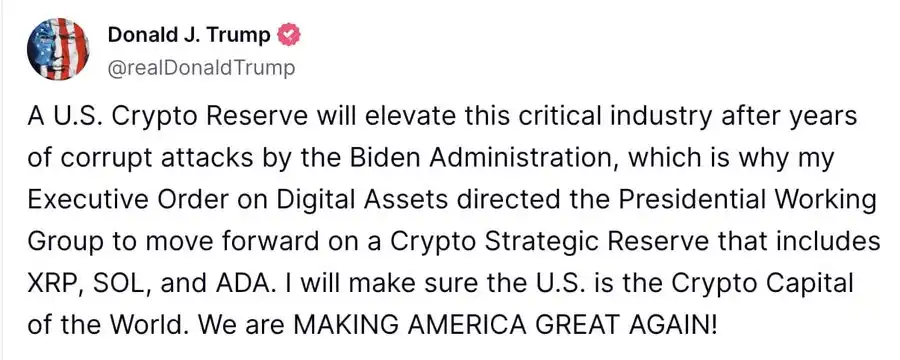
Except for SOL, I think most speculators (including myself) are in a wait-and-see mode. This may be the most significant event since the BTC ETF, with many implications:
· What does "onshore in the US" really mean?
· How likely is it that the US establishes a strategic cryptocurrency reserve?
· In what ways can the Treasury influence the formation of a cryptocurrency reserve?
I am not a political science major, but I have seen many interesting discussions. I will summarize these discussions and add my personal views. Now that Trump is involved, we must acknowledge that the rules have changed, so how do we proceed?
(Yes, I know he also mentioned BTC and ETH, but that was clearly to make the ad less glaring)
What Does "Onshore in the US" Really Mean?
Thanks to @SonicAssistant's research, most onshore US cryptocurrency companies have a "Foundation" established overseas, with no legal means of issuance in the US:
· ADA, SOL, ETH - Switzerland
· XRP - Estonia
· HBAR, MATIC, SUI, APTOS, OP, ARB - Cayman Islands
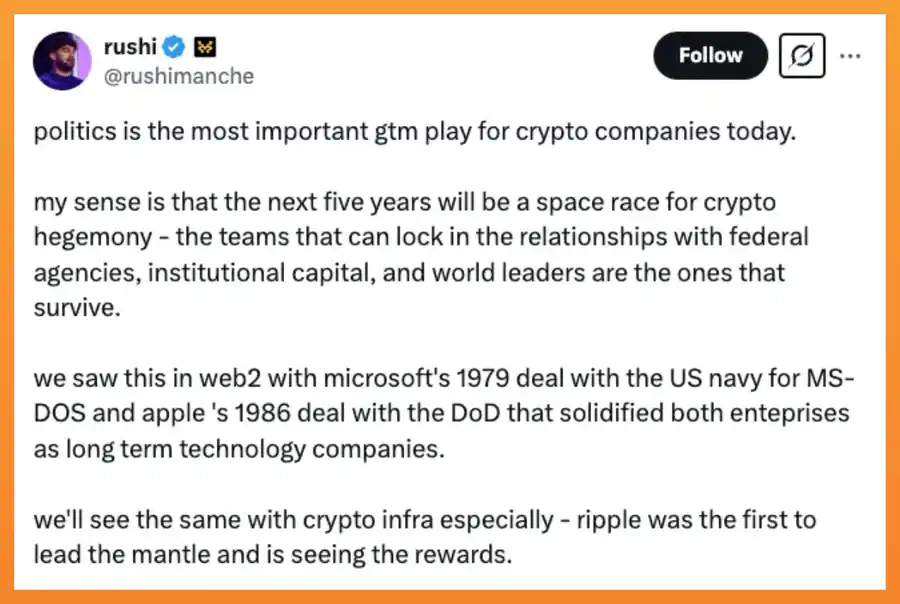
As Movement founder @rushimanche put it, "Politics is the most critical market entry strategy for today's cryptocurrency companies." He predicts that in the next five years, only teams that establish strong relationships with federal agencies, institutional capital, and world leaders will survive. This vision reinforces how genuine U.S. domestic influence depends on how companies effectively engage in politics and institutional power—the U.S. CABAL.
Mint Venture partner @xuxiaopengmint also shared his take on this reserve announcement:
"Since Trump took office, SOL, XRP, and ADA have made frequent visits to Mar-a-Lago (Florida) and provided significant support to Trump, such as donations to his inauguration fund. Behind the scenes, various indirect benefits transfer may be even more widespread. In return, Trump has now provided a significant 'ad slot' using presidential power for these tokens."
What is the likelihood of establishing a cryptocurrency strategic reserve?
TL;DR: The likelihood is quite low.
Executive Order Authority?
The President can issue an executive order to initiate or guide cryptocurrency reserves, but the order itself is not a magic wand. It must operate within existing legal frameworks or present emergency justifications. If there is no explicit legal authorization to hold private cryptocurrency assets, the order may be deemed illegal or void unless backed by Congress. Trump could order research or pilot projects, or instruct the Treasury Department to explore using the Exchange Stabilization Fund (ESF) for cryptocurrency operations, but a permanent, large-scale reserve of BTC, XRP, SOL, ADA, etc., may require congressional authorization first.
Bypassing Congress?
The U.S. Constitution primarily vests control over federal expenditures and asset purchases in Congress ("power of the purse"). Therefore, circumventing Congress to establish a cryptocurrency reserve is legally tricky. The President cannot appropriate funds to purchase assets—only Congress can authorize federal spending. In practice, this means that any direct purchase of cryptocurrency as a reserve would require appropriated funds approved by Congress (or reallocating existing funds in a manner permitted by Congress).
However, the federal government occasionally seizes cryptocurrency from criminal cases (e.g., Silk Road bitcoins, dark web drug markets). Typically, these are auctioned off for cash, but Trump's team has the idea of directly incorporating these cryptocurrencies into the national reserve.
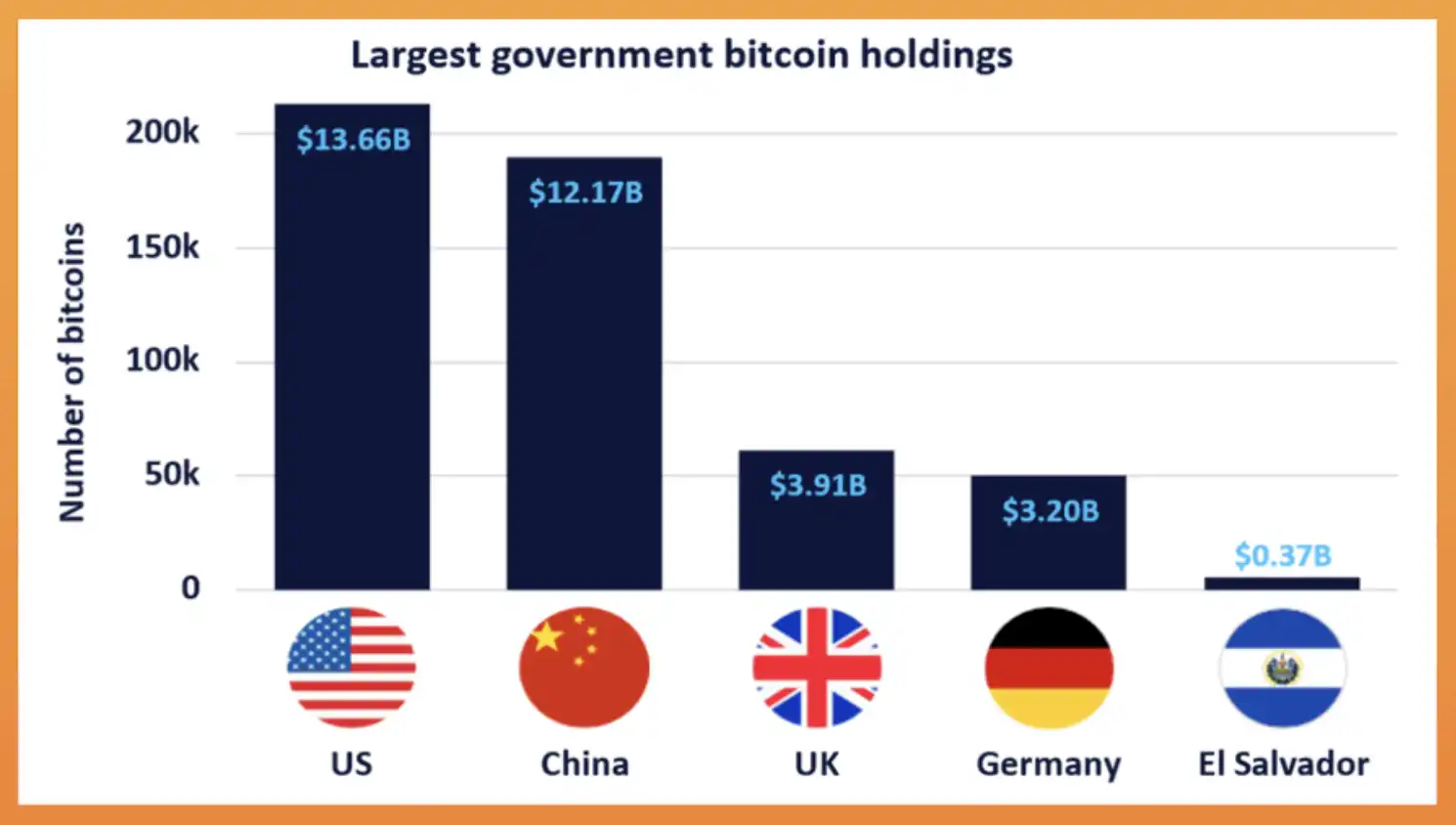
2024 Data, Not Updated
Utilizing seized cryptocurrency in this manner can circumvent the need for Congressional appropriations since these assets are already government property. This is essentially an asset transfer rather than new spending. Importantly, this approach has been explicitly considered: "Trump's cryptocurrency team plans to look into using seized cryptocurrency from enforcement actions to create a reserve." (From Reuters)
However, under existing forfeiture laws, proceeds from forfeited property are typically required to go to specific funds (such as the Department of Justice's Asset Forfeiture Fund) or victims—repurposing them for a strategic reserve may necessitate changes to these rules or present national security justifications. Therefore, there is some legal groundwork to be done before XRP or SOL can be included in a reserve.
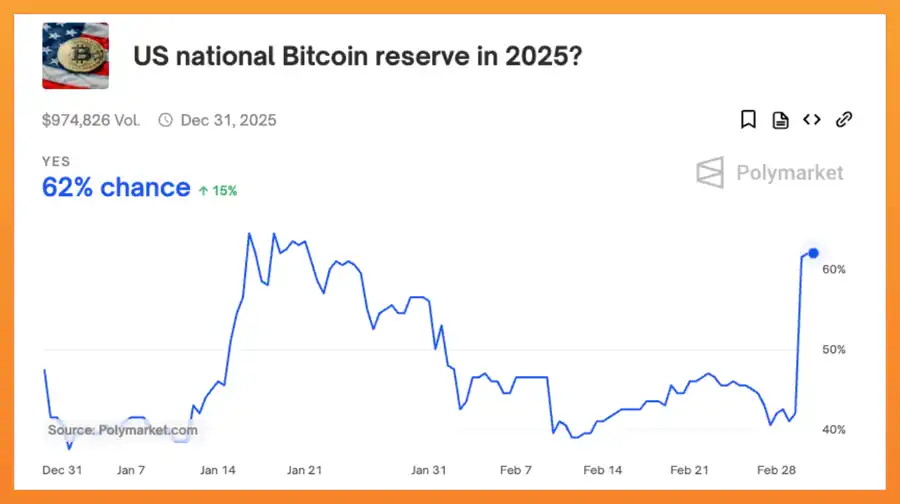
The market believes holding BTC in the reserve is possible (ps not through purchase)
Accepting Token Donations vs. Purchasing for Reserve
One way to avoid using taxpayer funds and requiring Congressional appropriations is to accept cryptocurrency donations into the reserve. The idea suggests that cryptocurrency companies or wealthy holders might donate tokens (e.g., giving a large amount of XRP or ADA to the U.S. government for free) to kickstart a strategic reserve. While this may seem convenient, this approach raises significant legal and ethical issues.
Current regulations (such as the Treasury's gift acceptance rules) typically require any gifts (e.g., XRP given to the Treasury) to be liquidated and used to reduce the national debt. To successfully incorporate XRP and ADA into the reserve, we would need new legislation or reinterpretations where any donated assets would generally not be sold, but rather held as reserves. This would create a locking effect and provide significant publicity for U.S.-based cryptocurrency projects.
Possible Forms of Cryptocurrency Reserves
Based on the information provided earlier, the most likely scenarios are:
· Holding onto existing government-held Bitcoin instead of liquidating it
· Allowing cryptocurrency companies to pay taxes in cryptocurrency (e.g., Bitcoin)
· Accepting token donations from cryptocurrency companies
I personally only hope for the first scenario, where “the existing government-held Bitcoin is kept rather than liquidated,” to occur. Promoting ADA and XRP, or even ETH, as reserve assets is absurd. Such a move would undermine the seriousness of a dedicated Bitcoin reserve and further reduce the likelihood of federal-level BTC reserve legislation.
Through @worldlibertyfi's actions, we slowly understand that the whole game is just an advertisement. If you provide enough interest to Trump's cryptocurrency team, they will advertise for you. This is a very profitable business because Trump is the U.S. president, more powerful than 99.9% of existing market institutions.
Conclusion
Legally, although the president can direct executive agencies through orders or working groups, existing regulations (especially those governing the Fed and Treasury) would limit unilateral creation of such reserves. Moreover, Trump may lean towards non-cash finances—such as locking up government-held crypto, encouraging crypto tax payments, or accepting donations—bringing additional legal and ethical challenges, as current laws often require any donated crypto to be liquidated to reduce debt.
Politically, including alternative tokens like SOL, XRP, and ADA in reserves seems to be about offering a public “ad space” for favored projects. However, such a move may dilute the seriousness of any dedicated Bitcoin reserves and face significant hurdles in Congress, as the GOP's fragile majority makes comprehensive legislative reform less likely.
I believe we need only a BTC reserve, not ETH, XRP, ADA, or SOL, just BTC.
You may also like

Mergers and acquisitions in the cryptocurrency market are exceptionally active

SpaceX Stock Prediction After the IPO: Can SPCX Reach $200 Before QQQ Inclusion?

Congratulations to Carl Moon on His Historic Ferrari Challenge Le Mans Podium Triumph
Crypto influencer and racing enthusiast Carl Moon finished third in the Ferrari Challenge Le Mans Coppa Shell class, marking his best result of the year. As his racing partner and sponsor, WEEX celebrates this remarkable achievement and continues to lead crypto’s journey beyond boundaries, uniting the innovation of digital assets with the passion of motorsport.

A16Z: The sun bears witness, SpaceX is worth 7.5 trillion

The stablecoin positioning battle escalates: When compliance is just a ticket to entry, will USD1 become the biggest winner?

Can the CLARITY Act Become Law by July 4? Everything You Need to Know About the Final Battle

How to exit after asset tokenization?

The foundation of SpaceX's trillion-dollar valuation: Who is dividing Musk's annual capital expenditure of tens of billions?

France vs Senegal World Cup 2026: Mbappe’s New Era Begins Against a Historic Rival

SharpLink CEO: How to understand that Ethereum developers have just surpassed 1 million?

Morning Report | MiCA grace period expires on July 1; Kalshi's trading volume in the first week of the World Cup breaks $5.1 billion, setting a record

What is the connection between Huang Zheng of Pinduoduo and blockchain?

Morning Report | Prediction market platforms like Kalshi and Polymarket jointly sue Kentucky over 14.25% trading tax; Bridgewater founder discusses decision-making in the AI era: principled thinking should run parallel to AI, human insight remains irre...

If the AI bubble has already burst, who will truly remain?
Paul Graham: How to Make a Billion Dollars

After 18 years, blockchain has finally started to head towards the main channel
Claude enforces "facial recognition for household registration," starting in July, no ID card means no access?

On the day of SpaceX's IPO, the first real test of the three perpetual mechanisms
Mergers and acquisitions in the cryptocurrency market are exceptionally active
SpaceX Stock Prediction After the IPO: Can SPCX Reach $200 Before QQQ Inclusion?
Congratulations to Carl Moon on His Historic Ferrari Challenge Le Mans Podium Triumph
Crypto influencer and racing enthusiast Carl Moon finished third in the Ferrari Challenge Le Mans Coppa Shell class, marking his best result of the year. As his racing partner and sponsor, WEEX celebrates this remarkable achievement and continues to lead crypto’s journey beyond boundaries, uniting the innovation of digital assets with the passion of motorsport.
A16Z: The sun bears witness, SpaceX is worth 7.5 trillion
The stablecoin positioning battle escalates: When compliance is just a ticket to entry, will USD1 become the biggest winner?
Can the CLARITY Act Become Law by July 4? Everything You Need to Know About the Final Battle


