
 Buy Crypto
- Markets
 Futures
- Spot
- Copy Trade
- Earn
- More
Stop obsessing over Alpha, the Beta the market gives you is more important

Original Article Title: Pray for Beta, Not Alpha
Original Article Author: Nick Maggiulli, Author of "Just Keep Buying"
Original Article Translation: Felix, PANews
The investment world generally believes that excess return (Alpha), the ability to outperform the market, is the goal investors should pursue. This is entirely logical. Under other equal conditions, Alpha is always a good thing.
However, having Alpha does not always mean a better investment return. Because your Alpha always depends on the market performance. If the market performs poorly, Alpha may not necessarily make you profitable.
For example, imagine two investors: Alex and Pat. Alex is very good at investing and outperforms the market by 5% every year. Pat, on the other hand, is a poor investor and underperforms the market by 5% every year. If Alex and Pat invest during the same time period, Alex's annual return is always 10% higher than Pat's.
But what if Pat and Alex start investing at different times? Is there a situation where, even though Alex is more skilled, Pat's return exceeds Alex's?
The answer is yes. In fact, if Alex invested in US stocks from 1960 to 1980, and Pat invested in US stocks from 1980 to 2000, then 20 years later, Pat's investment return will exceed Alex's. The following image illustrates this:
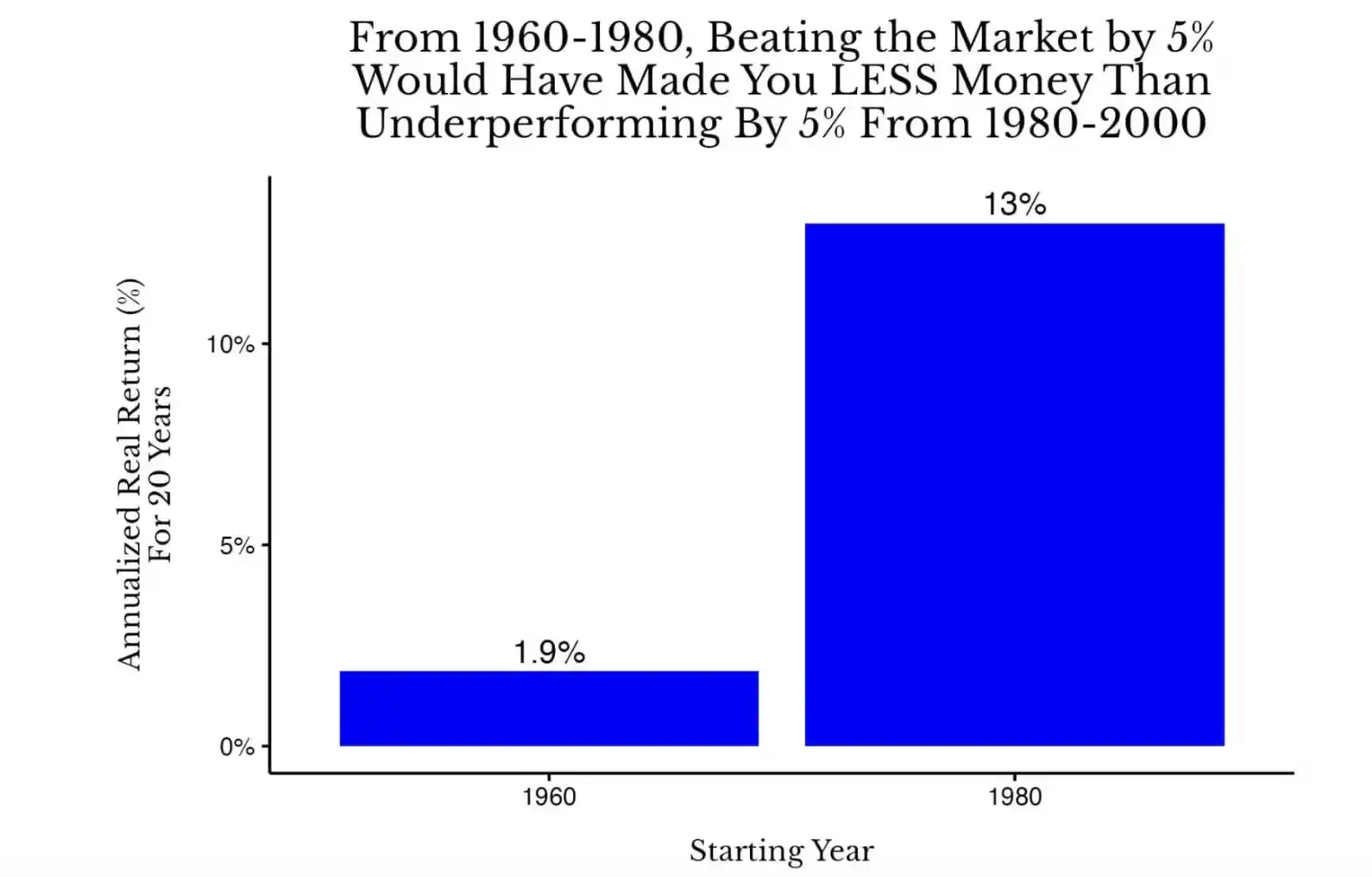
20-Year Annualized Actual Total Return Comparison of US Stocks from 1960 to 1980 and 1980 to 2000
In this case, Alex's annual return from 1960 to 1980 is 6.9% (1.9% + 5%), while Pat's annual return from 1980 to 2000 is 8% (13% - 5%). Despite Pat's inferior investment ability to Alex, Pat's performance is more outstanding in terms of total return adjusted for inflation.
But what if Alex's opponent is a true investor? Currently, let's assume Alex's competitor is Pat, a person who lags behind the market by 5% annually. But in reality, Alex's true opponent should be an index investor who matches the market's annual return.
In this scenario, even though Alex outperformed the market by 10% annually from 1960-1980, he would still lag behind the index investor from 1980-2000.
While this is an extreme example (i.e., an outlier), you would be surprised to find that having Alpha leads to a high frequency of underperformance relative to historical performance. As shown in the graph below:
Probability of Alpha size underperforming the index in all 20-year periods in the U.S. stock market from 1871 to 2005
As you can see, when you have no Alpha (0%), the probability of outperforming the market is essentially equivalent to flipping a coin (about 50%). However, as Alpha returns increase, while the compounding effect of returns does reduce the frequency of underperforming the index, the magnitude of the increase is not as significant as imagined. For example, even with an annual alpha return of 3% over a 20-year period, there is still a 25% probability of underperforming the index fund during other periods in U.S. market history.
Of course, some may argue that relative returns are the most important, but I do not subscribe to this view. Ask yourself, would you prefer to receive market average returns during normal times or would you rather "lose slightly less money" than others during a depression period (i.e., receive positive Alpha returns)? I, for one, would choose index returns.
After all, most of the time, index returns bring quite decent gains. As shown in the chart below, the real annualized return of the U.S. stock market fluctuates by decade but is mostly positive (Note: Data for the 2020s only shows returns up to 2025):
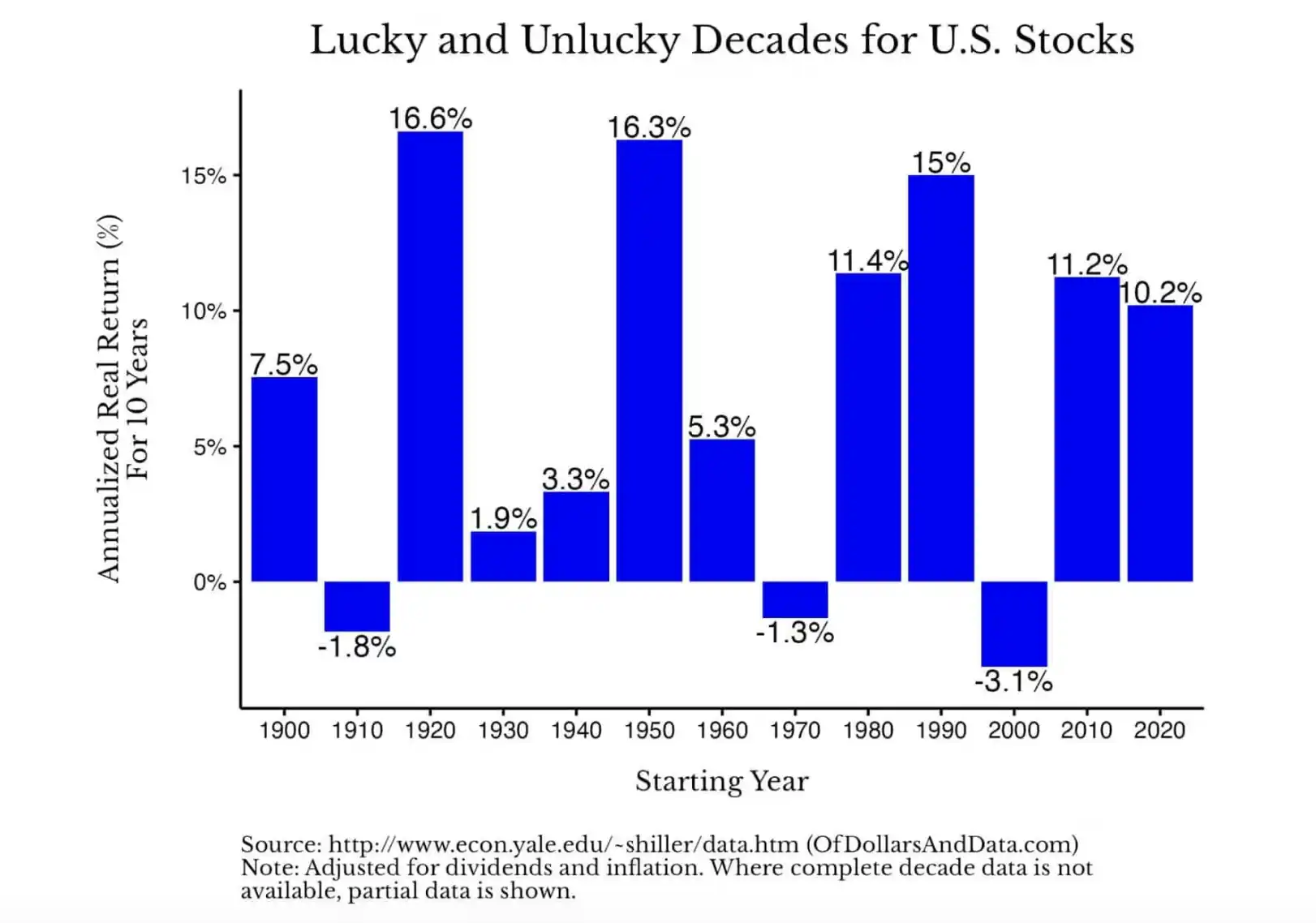
All of this indicates that while investment skill is important, many times market performance is key. In other words, hail Beta, not Alpha.
Technically, β (Beta) measures the magnitude of an asset's return relative to market movement. If a stock has a Beta of 2, it is expected to increase by 2% when the market rises by 1% (and vice versa). But for simplicity, market returns are usually referred to as Beta (i.e., Beta coefficient of 1).
The good news is, if the market does not provide enough "Beta" in a period, it may make up for it in the next cycle. You can see this in the chart below, which shows the 20-year rolling real annualized returns of U.S. stocks from 1871 to 2025:
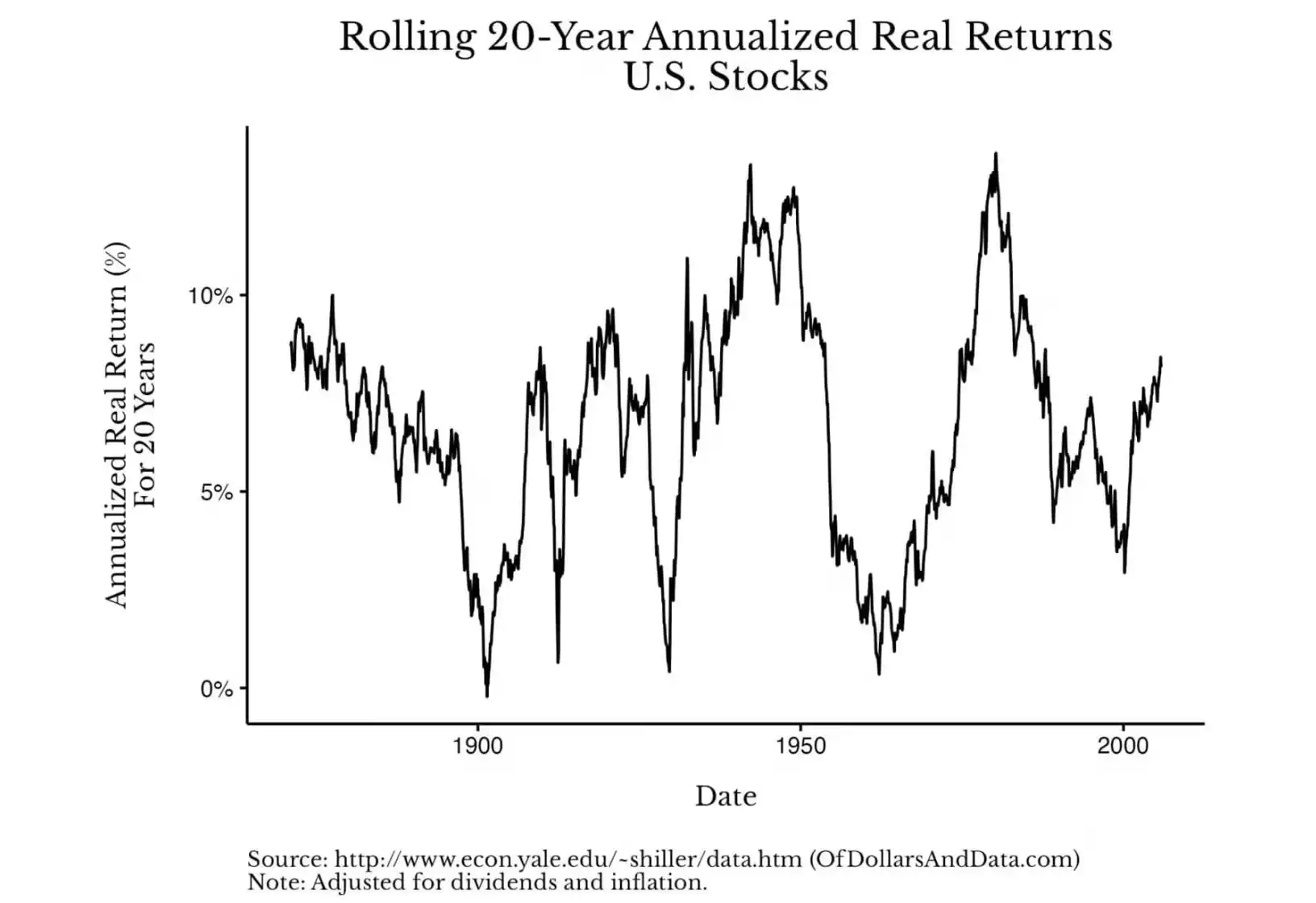
This chart vividly illustrates how returns can strongly rebound after a period of underperformance. Taking U.S. stock market history as an example, if you invested in U.S. stocks in the year 1900, your annualized real return for the next 20 years would be close to 0%. However, if you invested in 1910, your annualized real return for the next 20 years would be around 7%. Similarly, if you invested at the end of 1929, the annualized return would be about 1%; but if you invested in the summer of 1932, the annualized return would be as high as 10%.
This significant difference in returns once again confirms the importance of overall market performance (Beta) compared to investment skill (Alpha). You might ask, "I can't control how the market behaves, so why is this important?"
It is important because it is a form of liberation. It frees you from the pressure of "beating the market," allowing you to focus on things that are truly within your control. Instead of feeling anxious that the market is beyond your command, consider it as one less thing to worry about. See it as a variable you don't need to optimize because you can't optimize it at all.
So what should you optimize instead? Optimize your career, savings rate, health, family, and so on. Over the long arc of life, the value created in these areas is far more meaningful than agonizing over a few percentage points of excess return in your investment portfolio.
Do the math: a 5% raise or a strategic career move can increase your lifetime earnings by six figures or more. Likewise, maintaining good health is an effective risk management strategy that can significantly offset future medical expenses. Providing companionship to your family sets a positive example for their future. The benefits of these decisions far outweigh what most investors can reasonably expect to gain by trying to outperform the market.
In 2026, focus your energy on the right things, pursue Beta, not Alpha.
You may also like

Cyber Taoist Fortune Teller: Fake Taoist, AI Fortune Telling, and Northeastern Metaphysics History

Bloomberg: Stablecoin Payments Emerge as Crypto VC's Newest Favorite Thing
BeatSwap is evolving towards a full-stack Web3 infrastructure, covering the entire lifecycle of IP rights.
BeatSwap, a global Web3 Intellectual Property (IP) infrastructure project, is attempting to overcome the current fragmentation limitations of the Web3 ecosystem, building a full-stack system that covers the entire lifecycle of IP rights.
Currently, most Web3 projects are still in the stage of functional fragmentation, often focusing only on a single aspect, such as IP asset tokenization, transaction functionality, or a simple incentive model. This structural dispersion has become a key bottleneck hindering the industry's scale application.
BeatSwap's approach is more integrated, integrating multiple core modules into the same system, including:
· IP authentication and on-chain registration
· Authorization-based revenue sharing mechanism
· User-engagement-driven incentive system
· Transaction and liquidity infrastructure
Through the above integration, the platform builds an end-to-end closed-loop path, allowing IP rights to complete a full cycle of "creation, use, and monetization" within the same ecosystem.
BeatSwap is not limited to existing crypto users but is attempting to take the global music industry as a starting point, actively creating new market demand. Its core strategies include:
Exploring and incubating music creators (Artist discovery)
Building a fan community
Igniting IP-centric content consumption demand
The current global music industry is valued at around $260 billion, with over 2 billion digital music users. This means that the potential market corresponding to the tokenization and financialization of IP far exceeds the traditional crypto user base.
In this context, BeatSwap positions itself at the intersection of "real-world content demand" and "on-chain infrastructure," attempting to bridge the structural gap between content production and financial flow.
BeatSwap's upcoming core product "Space" is scheduled to launch in the second quarter of 2026. This product is defined as the SocialFi layer in the ecosystem, aiming to directly connect creators with users and achieve deep integration with other platform modules.
Key designs include:
A fan-centric interactive mechanism
Exposure and distribution logic based on $BTX staking
User paths connected to DeFi and liquidity structures
Thus, a complete user behavior loop is formed within the platform: Discovery → Participation → Consumption → Rewards → Trading
$BTX is designed to be a core utility asset within the ecosystem, rather than just a simple incentive token, with its value directly tied to platform activity and IP use cases.
Main features include:
· Yield distribution based on on-chain authorized actions
· Value reflection based on IP usage and user engagement dynamics
· Support for staking and DeFi participation mechanisms
· Value growth driven by ecosystem expansion
With the increased frequency of IP use, the utility and value support of $BTX will enhance simultaneously, helping alleviate the "disconnect between value and utility" issue present in traditional Web3 token models to some extent.
Currently, $BTX has been listed on several mainstream exchanges, including:
Binance Alpha
Gate
MEXC
OKX Boost
As the launch of "Space" approaches, BeatSwap is actively pursuing more exchange listings to further enhance liquidity and global accessibility, laying a foundation for future market expansion.
BeatSwap's goal is no longer limited to the traditional Web3 narrative but aims to target over 2 billion digital music users and a trillion KRW-scale content market.
By integrating content creators, users, capital, and liquidity into a blockchain framework centered around IP rights, BeatSwap is striving to build a next-generation infrastructure focused on "IP tokenization."
BeatSwap integrates IP authentication, authorization distribution, incentive mechanism, transaction system, and market construction to establish a unified structure that bridges the full lifecycle path of IP rights.
With the launch of the Q2 2026 "Space," the project is expected to become a key infrastructure connecting content and finance in the IP-RWA (Real World Assets) track.

Mag 7 Evaporates $2 Trillion | Rewire News Morning Edition

Losing $19K per Coin Mined, Bitcoin Mining Firms Collective AI Defection

Morning Report | Tom Lee predicts that the cryptocurrency winter will end in April; xStocks introduces a new on-chain private equity fund; Sui mainnet upgraded to V1.68.1

Polymarket rules have changed, how should airdrop participants respond?

Crypto ETF Weekly | Last week, the net outflow of Bitcoin spot ETFs in the U.S. was $296 million; the net outflow of Ethereum spot ETFs in the U.S. was $206 million

This Week's Key News Preview | The U.S. Releases March Non-Farm Payroll Data; Polymarket Expands Fee Structure

Slow Down, That's the Answer to the Age of the Agent

From Cash to Cryptocurrency: Moving Towards a Unified Regulatory Path for Illegal Payments
Who will own the most Bitcoin in 2026

A private feud lasting 10 years, if not for OpenAI's "hypocrisy," would not have led to the world's strongest AI company, Anthropic

"Crypto Tsar" steps down: 130 days of political performance come to an end, how much of Trump's crypto promise remains?

From Utopian Narratives to Financial Infrastructure: The "Disenchantment" and Shift of Crypto VC
A decade-long personal feud, if not for OpenAI's "hypocrisy," there would be no globally leading AI company Anthropic

a16z: The True Meaning of Strong Chain Quality, Block Space Should Not Be Monopolized
a16z: The True Meaning of Strong Chain Quality, Block Space Should Not Be Monopolized
Cyber Taoist Fortune Teller: Fake Taoist, AI Fortune Telling, and Northeastern Metaphysics History
Bloomberg: Stablecoin Payments Emerge as Crypto VC's Newest Favorite Thing
BeatSwap is evolving towards a full-stack Web3 infrastructure, covering the entire lifecycle of IP rights.
BeatSwap, a global Web3 Intellectual Property (IP) infrastructure project, is attempting to overcome the current fragmentation limitations of the Web3 ecosystem, building a full-stack system that covers the entire lifecycle of IP rights.
Currently, most Web3 projects are still in the stage of functional fragmentation, often focusing only on a single aspect, such as IP asset tokenization, transaction functionality, or a simple incentive model. This structural dispersion has become a key bottleneck hindering the industry's scale application.
BeatSwap's approach is more integrated, integrating multiple core modules into the same system, including:
· IP authentication and on-chain registration
· Authorization-based revenue sharing mechanism
· User-engagement-driven incentive system
· Transaction and liquidity infrastructure
Through the above integration, the platform builds an end-to-end closed-loop path, allowing IP rights to complete a full cycle of "creation, use, and monetization" within the same ecosystem.
BeatSwap is not limited to existing crypto users but is attempting to take the global music industry as a starting point, actively creating new market demand. Its core strategies include:
Exploring and incubating music creators (Artist discovery)
Building a fan community
Igniting IP-centric content consumption demand
The current global music industry is valued at around $260 billion, with over 2 billion digital music users. This means that the potential market corresponding to the tokenization and financialization of IP far exceeds the traditional crypto user base.
In this context, BeatSwap positions itself at the intersection of "real-world content demand" and "on-chain infrastructure," attempting to bridge the structural gap between content production and financial flow.
BeatSwap's upcoming core product "Space" is scheduled to launch in the second quarter of 2026. This product is defined as the SocialFi layer in the ecosystem, aiming to directly connect creators with users and achieve deep integration with other platform modules.
Key designs include:
A fan-centric interactive mechanism
Exposure and distribution logic based on $BTX staking
User paths connected to DeFi and liquidity structures
Thus, a complete user behavior loop is formed within the platform: Discovery → Participation → Consumption → Rewards → Trading
$BTX is designed to be a core utility asset within the ecosystem, rather than just a simple incentive token, with its value directly tied to platform activity and IP use cases.
Main features include:
· Yield distribution based on on-chain authorized actions
· Value reflection based on IP usage and user engagement dynamics
· Support for staking and DeFi participation mechanisms
· Value growth driven by ecosystem expansion
With the increased frequency of IP use, the utility and value support of $BTX will enhance simultaneously, helping alleviate the "disconnect between value and utility" issue present in traditional Web3 token models to some extent.
Currently, $BTX has been listed on several mainstream exchanges, including:
Binance Alpha
Gate
MEXC
OKX Boost
As the launch of "Space" approaches, BeatSwap is actively pursuing more exchange listings to further enhance liquidity and global accessibility, laying a foundation for future market expansion.
BeatSwap's goal is no longer limited to the traditional Web3 narrative but aims to target over 2 billion digital music users and a trillion KRW-scale content market.
By integrating content creators, users, capital, and liquidity into a blockchain framework centered around IP rights, BeatSwap is striving to build a next-generation infrastructure focused on "IP tokenization."
BeatSwap integrates IP authentication, authorization distribution, incentive mechanism, transaction system, and market construction to establish a unified structure that bridges the full lifecycle path of IP rights.
With the launch of the Q2 2026 "Space," the project is expected to become a key infrastructure connecting content and finance in the IP-RWA (Real World Assets) track.


 App
App