
 Buy Crypto
- Markets
 Futures
- Spot
- Copy Trade
- Earn
- More
Tether, which has "enriched" itself through stablecoins, is now heavily investing in AI

Original Title: "AI Industry, Here Comes Cash-Rich Tether"
Original Author: Kuri, Deep Tide TechFlow
Tether earned $13 billion in 2024.
This number may not mean much to you. Let's put it another way: OpenAI had $3.7 billion in revenue in 2024 but lost $5 billion. Anthropic had $1 billion in revenue but also lost $5 billion.
The combined losses of these two reputable AI companies are still less than what Tether earned in a year.
Tether has 150 employees, while OpenAI has over 3000 employees. The difference in per capita output is approximately:
60 times.
How does Tether make money? You buy 1 USDT for $1, they take that $1 and buy US Treasury bonds. The bond interest goes to them, not you.
The essence of this is that Tether does not pay interest. Banks have to pay interest on deposits, but Tether doesn't. When you exchange your money for USDT, holding it, you earn zero interest. They take your money to buy US Treasury bonds, and in 2024 alone, they earned $7 billion in interest.
With 150 people overseeing over $130 billion in Treasury bonds, they don't have to do anything, as the interest comes in by itself.
Anybody would want to take it easy with such a business.
But when you have a lot of money, you have to spend it somehow. Tether chose a direction:
AI.
And it's not just about randomly investing in a couple of projects.
Let's talk about computational power first.
AI computation requires GPUs, the more, the better, and the more expensive, the better. Tether provided a loan of over $600 million to a German company, Northern Data.
What does this company do?
It's Europe's largest GPU cloud service provider. With over ten thousand Nvidia H100 GPUs, the same type used by OpenAI to train GPT, each costing two to three thousand dollars.
This cluster of GPUs ranks 26th in the world's TOP500 supercomputers. The $600 million that Tether poured in is essentially buying an AI training base in Europe.
Talking Data.
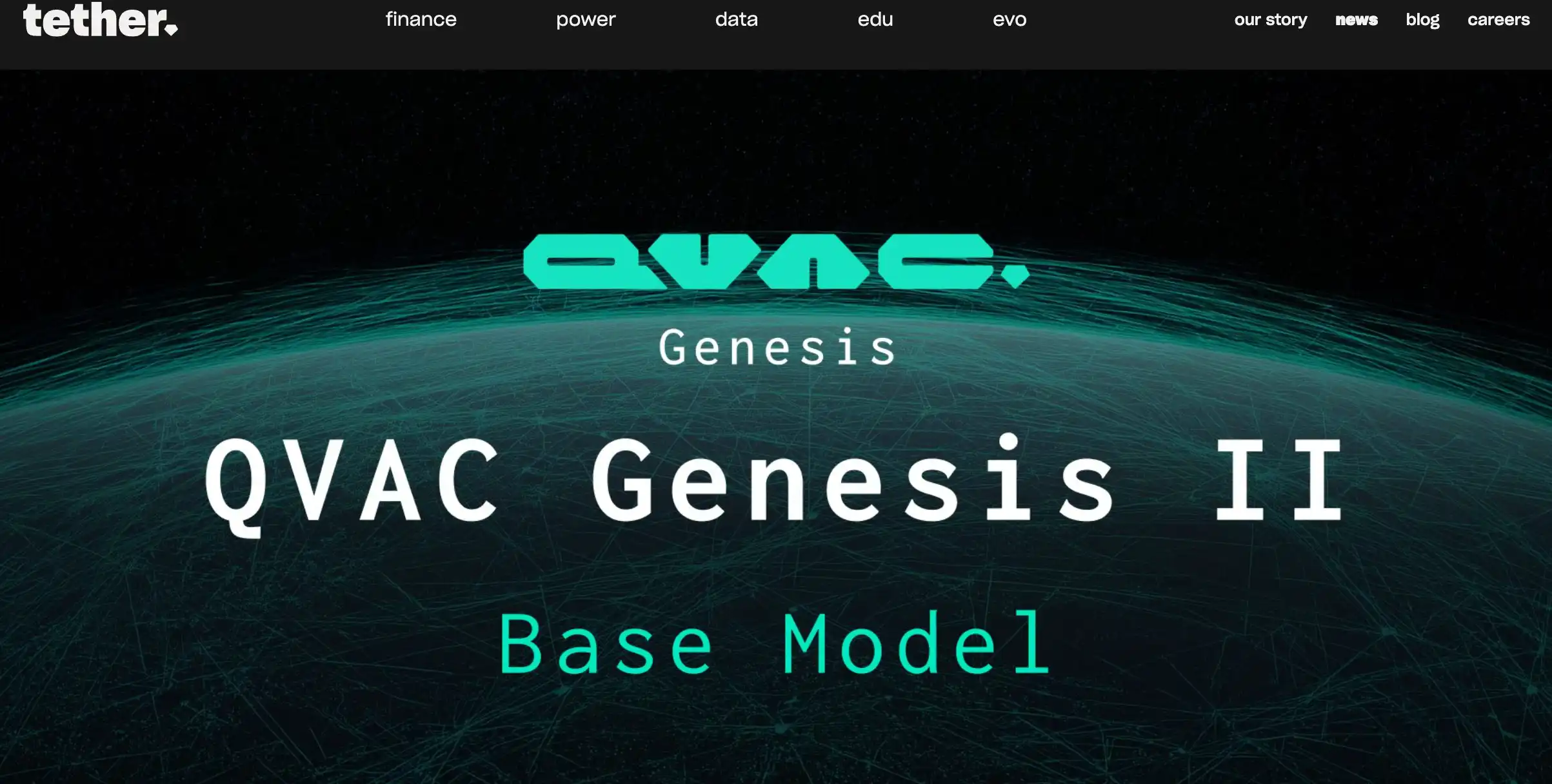
Training AI requires feeding data. Last week, Tether released a dataset called QVAC Genesis, covering 19 subjects including mathematics, physics, chemistry, and computer science. They claim it to be the world's largest open-source AI training data.
Note that the training data from OpenAI and Anthropic is not public, but Tether released theirs directly for free for anyone to use.
Now onto the more futuristic part.
In April 2024, Tether spent $200 million to acquire a company called Blackrock Neurotech. Despite the name similarities, it has no relation to BlackRock the asset manager.
This company works on brain-computer interfaces. They implant chips into people's brains, allowing paralyzed individuals to type with their mind, control wheelchairs, or operate robotic arms. It sounds like science fiction, but they started back in 2008, eight years before Musk's Neuralink.
How impressive is this company?
A total of 35 people globally have brain-computer interface chips, with 31 of them using Blackrock's technology. In 2016, a fully paralyzed patient controlled a robotic arm with their device and fist-bumped Obama. The chip in their sensory cortex allowed them to "feel" the President's hand.
Last year, this brain-computer interface company enabled an ALS patient to "speak" again, with the chip in their brain translating thoughts into speech at a rate of 62 words per minute.
Tether spent $200 million to become a major shareholder in this company.
Altogether, Tether has invested close to $1 billion in AI-related fields. It is said that they are also in talks to acquire a German robotics company for $1.2 billion. If successful, their total investment will approach $2 billion.
What does this mean?
Anthropic raised $35 billion in funding throughout 2024. The investment by Tether, from one company, is close to half of what a top-tier AI company raises.
OpenAI spent $6.7 billion on R&D in the first half of 2025. With the profits, Tether, with spare change, could play the role of a big daddy in the AI realm.
Why would a stablecoin issuer venture into AI?
We see two possibilities.
The first is anxiety. The Fed is cutting rates, bond yields are falling. Earning $7 billion in interest while lying down in 2024, things might not be as good from 2025 onwards. The money printer also needs a new narrative.
The second is ambition. The whole world is talking about AI—investors, the media, politicians. If you say you're a stablecoin company, no one pays much attention. But if you say you're working on AI, brain-machine interfaces, humanoid robots, then you are:
A technology leader.
But what's most amusing is this.
Tether is venturing into AI, chanting slogans like "decentralization," "on-device computation," and "returning intelligence to individuals."
But Tether, itself, is the most centralized company in the crypto world.
He decides when to issue coins, he decides the reserve amount. In its ten years of existence, it has never been audited. Only he knows where users' money is.
Now, this company wants to teach the world what "decentralized AI" means.
It's really quite like a casino owner offering classes on quitting gambling.
But it's not impossible.
After all, OpenAI is still losing money, projected to stop burning cash in 2029. Anthropic is in a similar situation, projected to break even in 2028. Sam Altman is fundraising everywhere, Dario Amodei is fundraising everywhere. These two companies together have lost $10 billion and are still storytelling to investors.
Tether doesn't need to do that. The money is already in his pocket.
What's the biggest challenge facing the entire AI industry? The business model.
How do you make money? Don't know. When will you make money? Don't know. Can you make money? Don't know.
Tether doesn't have this worry. His business model is simply:
Not doing AI.
The money earned from stablecoins is used to invest in AI. Making the right investment is foresight, making the wrong one is a tuition fee. In any case, it doesn't affect the core business.
Those doing AI are losing money, those not doing AI are making money. Those doing AI are fundraising, those not doing AI are investing.
The best AI business model in 2026 may be not doing AI at all.
Get your money printer right first.
You may also like

PUMP Valuation Breakdown: On-chain Data Disproves the "Fake Volume" Theory, Where Does the Real Discount Come From?

Tiger Research: What AI services do cryptocurrency companies offer?

The war not only drives up oil prices but also causes Circle's stock price to soar

When agents become consumers, who will rewrite the underlying logic of internet commerce?

AI Agents in Action Summit: March 31, Hong Kong Cyberport, focusing on the deep waters of AI implementation

29 Days In, What Are America’s Options on Iran?

Flash Crash Down 97%+ with Ongoing Unlocking, WLD Completes $65 Million Off-chain Funding: Who Is Still Buying?

Bitcoin for Real Estate? Fannie Mae Teams Up with Coinbase to Launch Crypto Mortgage
Tether Hires Big Four Auditor, USDT Enters First Attestation Phase

Google AI Paper Destroys $900B Storage Stock, Accused of Faking Experiment
Evaporate $2 Trillion, U.S. Stocks See Worst Start in 4 Years, Why is the Market Bearish?

The speed at which AI discovers vulnerabilities has surpassed the speed at which it patches vulnerabilities.
AI Crypto Trading Bot Explained: Aurora's Multi-Factor Strategy in WEEX Hackathon
Aurora demonstrates how structured, multi-agent AI Trading systems can deliver more adaptive and resilient performance in the WEEX AI Trading Hackathon.

Cyber Taoist Fortune Teller: Fake Taoist, AI Fortune Telling, and Northeastern Metaphysics History

Bloomberg: Stablecoin Payments Emerge as Crypto VC's Newest Favorite Thing
BeatSwap is evolving towards a full-stack Web3 infrastructure, covering the entire lifecycle of IP rights.
BeatSwap, a global Web3 Intellectual Property (IP) infrastructure project, is attempting to overcome the current fragmentation limitations of the Web3 ecosystem, building a full-stack system that covers the entire lifecycle of IP rights.
Currently, most Web3 projects are still in the stage of functional fragmentation, often focusing only on a single aspect, such as IP asset tokenization, transaction functionality, or a simple incentive model. This structural dispersion has become a key bottleneck hindering the industry's scale application.
BeatSwap's approach is more integrated, integrating multiple core modules into the same system, including:
· IP authentication and on-chain registration
· Authorization-based revenue sharing mechanism
· User-engagement-driven incentive system
· Transaction and liquidity infrastructure
Through the above integration, the platform builds an end-to-end closed-loop path, allowing IP rights to complete a full cycle of "creation, use, and monetization" within the same ecosystem.
BeatSwap is not limited to existing crypto users but is attempting to take the global music industry as a starting point, actively creating new market demand. Its core strategies include:
Exploring and incubating music creators (Artist discovery)
Building a fan community
Igniting IP-centric content consumption demand
The current global music industry is valued at around $260 billion, with over 2 billion digital music users. This means that the potential market corresponding to the tokenization and financialization of IP far exceeds the traditional crypto user base.
In this context, BeatSwap positions itself at the intersection of "real-world content demand" and "on-chain infrastructure," attempting to bridge the structural gap between content production and financial flow.
BeatSwap's upcoming core product "Space" is scheduled to launch in the second quarter of 2026. This product is defined as the SocialFi layer in the ecosystem, aiming to directly connect creators with users and achieve deep integration with other platform modules.
Key designs include:
A fan-centric interactive mechanism
Exposure and distribution logic based on $BTX staking
User paths connected to DeFi and liquidity structures
Thus, a complete user behavior loop is formed within the platform: Discovery → Participation → Consumption → Rewards → Trading
$BTX is designed to be a core utility asset within the ecosystem, rather than just a simple incentive token, with its value directly tied to platform activity and IP use cases.
Main features include:
· Yield distribution based on on-chain authorized actions
· Value reflection based on IP usage and user engagement dynamics
· Support for staking and DeFi participation mechanisms
· Value growth driven by ecosystem expansion
With the increased frequency of IP use, the utility and value support of $BTX will enhance simultaneously, helping alleviate the "disconnect between value and utility" issue present in traditional Web3 token models to some extent.
Currently, $BTX has been listed on several mainstream exchanges, including:
Binance Alpha
Gate
MEXC
OKX Boost
As the launch of "Space" approaches, BeatSwap is actively pursuing more exchange listings to further enhance liquidity and global accessibility, laying a foundation for future market expansion.
BeatSwap's goal is no longer limited to the traditional Web3 narrative but aims to target over 2 billion digital music users and a trillion KRW-scale content market.
By integrating content creators, users, capital, and liquidity into a blockchain framework centered around IP rights, BeatSwap is striving to build a next-generation infrastructure focused on "IP tokenization."
BeatSwap integrates IP authentication, authorization distribution, incentive mechanism, transaction system, and market construction to establish a unified structure that bridges the full lifecycle path of IP rights.
With the launch of the Q2 2026 "Space," the project is expected to become a key infrastructure connecting content and finance in the IP-RWA (Real World Assets) track.

Mag 7 Evaporates $2 Trillion | Rewire News Morning Edition



 App
App