
Token VS Equity: The Aave Controversy

On December 17, Aave founder and CEO Stani.eth posted on social media that after four years, the U.S. Securities and Exchange Commission had completed its investigation into the Aave protocol.
This was supposed to be an inspiring milestone. However, as Web2 finished its entanglement with the SEC, Aave found itself facing a "backyard fire" in Web3 instead. Over the past half month, Aave's community governance dispute has been a hot topic in the English-speaking community. Around this dispute, there have been a series of events including whale sells, founder "buybacks," governance, and trust issues.
Let's take a look at the background of this event.
Cause: Revenue Distribution Sparks Controversy
On December 4, Aave Labs switched the default Swap feature on its front-end interface aave.com from ParaSwap to CoWSwap.
What was originally just a minor update, Aave DAO's senior governance participant and independent delegate EzR3aL discovered that the fee revenue generated by aave.com's default Swap feature was no longer flowing into the Aave DAO treasury as before but rather into an address controlled by Aave Labs. Based on on-chain investigation, EzR3aL stated that at the time of his post, the recent income transfer by Aave Labs was worth at least $200,000, with a rough estimate of at least $10 million in annual loss for Aave DAO based on the weekly revenue data.
However, Aave Labs did not proactively mention the change in fee revenue distribution, leaving many $AAVE holders feeling "betrayed."
Aave Labs responded multiple times to EzR3aL's post, with the main arguments being:
The protocol and the product are different concepts. The frontend interface that sparked the revenue distribution dispute is a product operated by Aave Labs, completely separate from the protocol managed by Aave DAO, and Aave Labs have the right to decide how to operate and profit.
Maintaining the frontend interface requires significant resources, and Aave DAO was never required to bear these costs.
In the original Paraswap-integrated technical architecture, the donation mechanism was based on surplus. When the actual execution price was higher than the quoted price, the surplus would be donated to Aave DAO. This was not a protocol fee, nor was it a mandatory requirement to give to Aave DAO. With the design changes, the original donation mechanism was naturally discontinued.
The new CoWSwap routing option can improve execution quality, including providing MEV protection for interface users, and this routing option was concocted by Aave Labs with its own resources, and it does not replace or disable the adapters owned by the Aave DAO at the protocol level, allowing the Aave DAO to let any interface integrate its owned adapters to enable swap functionality.
Contention Upgrade: Who Owns "Aave"?
Aave Labs' response to EzR3aL's post has not been understood and accepted by the community.
On December 13, @DefiIgnas published a lengthy article titled "Who Owns Aave: Aave Labs or Aave DAO?," which sparked widespread discussion.
On December 16, former Aave Labs CTO Ernesto released a governance proposal titled "$AAVE Alignment Phase 1: Ownership," advocating for Aave DAO and Aave token holders to explicitly control core rights such as protocol IP, brand, equity, and revenue. Aave service providers representative Marc Zeller and others publicly endorsed the proposal, calling it "one of the most influential proposals in Aave's governance history."
In the proposal, Ernesto mentioned, "Due to some events in the past, some previous posts and comments have shown strong animosity towards Aave Labs. However, this proposal aims to remain neutral. The proposal does not imply that Aave Labs should not contribute to the DAO or lacks the legitimacy or ability to contribute, but the decision should be made by Aave DAO."
On December 18, Aave founder and CEO Stani.eth replied to the proposal, stating that they would strengthen communication between Aave Labs and the community but would vote against the proposal because it simplifies a complex legal and operational issue into a simple "yes or no" vote without a practical solution, affecting Aave's overall development progress.
This further escalated the dispute.
Whale Sell-off, Founder's Market "Rescue"
On December 22, according to on-chain analyst yujianguo's monitoring, the whale address holding the second-largest amount of AAVE sold off 230,000 AAVE tokens (approximately $38 million), causing a short-term price drop of over 10%. The whale exchanged all AAVE for 227.8 WBTC and 5869.4 stETH between 5:40 and 7:05 a.m., reportedly acquiring these AAVE from late last year to early this year at an average cost of about $223.4. This selloff at an average price of around $165 is estimated to incur a loss of $13.45 million.
Shortly after the Whale's exit, Aave Labs announced that the issue needed formal governance decision-making and officially initiated a 3-day snapshot vote.
On December 23, Aave founder and CEO Stani.eth spent 1699 ETH (5.15 million USD) to buy 32,660 AAVE tokens at an average price of 157.78 USD. Including this purchase, he bought a total of 84,033 AAVE tokens within a week at an average price of around 176 USD, spending approximately 14.8 million USD.
However, despite the founder's "market rescue," the price turmoil continued. On December 24, the address starting with "0x3c7," known for "Large AAVE Short," opened a 7x leveraged AAVE short position with a 2.42 million USD position size at an average price of 151 USD and a liquidation price of 173 USD.
There were many doubts and concerns in the market regarding the founder's "market rescue" as well. DeFi strategist and liquidity expert Robert Mullins stated in a post that the purpose of this purchase was to increase Kulechov's voting power to support a proposal in an upcoming vote that directly harms the best interests of the token holders. He added: "This is a clear example that the token mechanism has not been adequately designed to effectively deter governance attacks."
Renowned crypto KOL Sisyphus also expressed similar concerns, suggesting that Kulechov may have sold millions of dollars worth of AAVE tokens between 2021 and 2025 and questioned the economic motives behind this buyback.
Outcome
On December 26, Wintermute's founder and CEO Evgeny Gaevoy stated that Wintermute would vote against the ARFC governance proposal to transfer the "brand asset control of AAVE to the holders."
Evgeny mentioned that the current proposal lacks specific details, and it is not clear how the entity owning the front end and brand would govern, whether it is for-profit, and how it operates. Token value capture is a core issue facing AAVE, and there is a clear mismatch in expectations between Aave Labs and a large number of token holders. Wintermute has been investing in AAVE since 2022 and has participated in its governance. Evgeny hopes that Aave Labs will address the issue of token value capture seriously, which will serve as a reference for other tokens.
The voting results were also released this morning, with the proposal ultimately not passing, resulting in 55.29% against, 41.21% abstaining, and only 3.5% in favor.
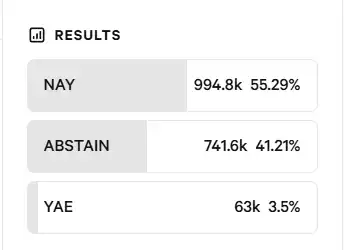
So, is this the end of the dispute? Apparently not, as the lack of trust between the community and Aave Labs remains unresolved. What seemed to be a conflict triggered by poor communication is actually a manifestation of the long-standing contradiction in the crypto world between development/operation teams and governance, where rights and interests are unclear and lack institutional constraints. The entanglement between Aave Labs and Aave DAO actually underscores Aave's success, as there are too many similar examples in the crypto world where such high-quality discussions do not even have the opportunity to occur in an attempt to resolve issues (related reading: Why are projects in the crypto space not asking for tokens in acquisitions?).
This is the problem Aave must face, and it is a problem that the entire cryptocurrency industry will sooner or later have to confront.
You may also like

Morning Report | OpenAI has submitted an S-1 registration statement draft to the U.S. SEC; Morpho completes $175 million financing

Galaxy Deep Research Report: How Hyperliquid's HIP-4 Upgrade Changes the Landscape of Prediction Markets?

Latest research from 13 top universities including Cornell University: The current state, challenges, and misconceptions of the fusion of Crypto and AI

Deconstructing Anthropic: The Best AI Company, Possibly Also a Type of Organizational Invention

Every exchange is a "Universal Exchange."

The counterattack of traditional finance: Alliance chains are quietly reviving
Pantera Capital Partner: How Tokenization is Restructuring the Private Equity and Early Investment Ecosystem?

Mastercard Launches Agent Pay for AI, Plans to Record AI Agent Payment Authorizations on Polygon
Mastercard launched Agent Pay for AI, a new payment protocol designed to help AI agents make small payments such as pay-per-use access to data and APIs. The system plans to record human-granted AI agent permissions on Polygon, focusing on verifiable authorization, identity, and payment controls.

Curve Deploys Llamalend v2 on Optimism With 250,000 OP Incentives
Curve launched Llamalend v2 on Optimism with 250,000 OP incentives from the Optimism Foundation. The upgrade expands Llamalend beyond its earlier crvUSD-focused model, adding broader collateral support, LlamaRisk market reviews, and the ability to use Curve LP tokens as collateral.

Raydium Old Liquidity Pool Reportedly Exploited, With $1.34 Million Moved to Ethereum and Tornado Cash
An old Raydium liquidity pool was reportedly exploited for around $1.34 million in USDC, RAY, and wSOL, with the stolen funds bridged to Ethereum and deposited into Tornado Cash. The incident highlights the tail risks of legacy DeFi pools, old contracts, and cross-chain fund laundering paths.
Kalshi Executive Challenges “SBF Backed AI Unicorns” Narrative, Says Leopold Aschenbrenner Was Key Figure
Kalshi executive John Wang questioned the “SBF backed AI unicorns” narrative, saying Leopold Aschenbrenner was the key figure behind major AI investment decisions.

New York Proposes Stricter Stablecoin Issuer Rules Aligned With Federal GENIUS Act
NYDFS proposed stricter stablecoin issuer rules aligned with the GENIUS Act, covering reserves, custody, redemption timelines, audits, and capital buffers.

CryptoQuant Says Bitcoin Profitable Supply Is Near 45% Pressure Zone as On-Chain Data Points to Market Repricing
CryptoQuant said Bitcoin’s profitable supply is nearing the 45% pressure zone, signaling rising market stress, unrealized losses, and a possible on-chain repricing phase.

Bitcoin Falls Below 200-Week Moving Average as On-Chain Data Shows Over Half of Supply in Loss
Bitcoin dropped below its 200-week moving average as on-chain data showed over 50% of circulating supply is now in loss, signaling rising market stress.

CFTC Reportedly Plans New Prediction Market Rules Focused on Manipulation Risk and Public Interest Review
The CFTC is reportedly preparing new prediction market rules focused on manipulation risk, public interest review, and retail trader protections.

Meet the new WEEX trial fund—your gateway to greater profits

WEEX Labs Lands at Dutch Blockchain Week: A Disruptive Crypto × AI Conversation Sets Sail in Amsterdam
SK Hynix Reportedly Plans U.S. ADR Listing as Early as August, With SEC Approval Possible in Late June
SK Hynix may pursue a U.S. ADR listing as early as August, with SEC approval reportedly possible in late June amid strong AI chip supply chain demand.
Morning Report | OpenAI has submitted an S-1 registration statement draft to the U.S. SEC; Morpho completes $175 million financing
Galaxy Deep Research Report: How Hyperliquid's HIP-4 Upgrade Changes the Landscape of Prediction Markets?
Latest research from 13 top universities including Cornell University: The current state, challenges, and misconceptions of the fusion of Crypto and AI
Deconstructing Anthropic: The Best AI Company, Possibly Also a Type of Organizational Invention
Every exchange is a "Universal Exchange."
The counterattack of traditional finance: Alliance chains are quietly reviving


