
Under the Deadly "Tariff Drug" Impact, How to Interpret the Crypto Market? | Trader's Observation

Today's financial market turmoil can be described as a global synchronized event, where participants in the stock market and crypto sphere are witnessing the dawn of a chaotic era, whether it's the "buy the dip" meme or the "gold trap."
Related Reading: "Global Stock Markets See Worst 3-Day Performance in 50 Years, Can the Cryptocurrency Market Hold Up?"
The Federal Reserve hesitated to cut interest rates, leading the market to speculate about its weakening ability to provide a safety net. Meanwhile, Trump's tariff games have shattered market confidence, intensifying external uncertainty. At the same time, under the dual pressure of technical and emotional factors, the cryptocurrency market continues to slide, with multiple key support levels at risk. This article explores macro, policy, market data, and technical analysis dimensions, summarizing traders' observations on the current market for readers' reference.
Macro Analysis
I believe one of the reasons why this round of sell-off still has room to go down is the lack of the possibility of a "Fed put" or a "Trump put." The following content mainly explains why the "Fed put" has become difficult to materialize:
1. The premise of this market decline is based on the assumption that the Fed will cut rates five times this year. However, all FOMC members have stated that they need to see more "certainty" before cutting rates again. Even by June, the Fed may not get a clear enough inflation signal. If companies keep hoarding goods until June (which I believe they are), even if more widespread price increases eventually occur, they will not materialize until the second half of the year. The Fed must wait for a clearer inflation signal.
2. The issue also lies in the Fed's own expectations and judgment. If they still see the current situation as similar to 2022 and are concerned about inflation expectations "unanchoring," then even if the stock market drops another 20%, it will not shake their resolve (just like 2022). From the Fed's assessment of inflation risks at the March meeting, they still view the current situation as another 2022.
3. The Fed also relies on major Wall Street investment banks' inflation forecasts. Several large banks have already predicted that core PCE will rise to 4%-5%. These forecasts will further dampen their willingness to cut rates.
4. The Fed values "hard data" more. For example, news like DOGE layoffs may not be reflected in nonfarm payrolls until the end of the third or fourth quarter. However, upward inflation data is easier and quicker to materialize. In other words, the Fed itself is a lagging adjuster.
5. Powell is mindful of his 'historical positioning,' hoping to be seen as the Volcker of a new generation. At the same time, he is carefully maintaining the Fed's independence, so he remains neutral in his statements to avoid angering the White House. I say 'trying' because if you listen closely, you will discover that he is actually deliberately downplaying the hawkish stance within the FOMC and the Fed staff system.
6. In the recessions of the 1970s and 1980s, nominal long-term rates bottomed out only after the economy hit rock bottom. In other cycles, rates often bottomed out earlier. The current macro environment is more like the '70s and '80s than other milder recessions.
1. Trump's equivalent tariff specific final version is on the 9th, so before the 9th, it's more of a negotiation period. At this time, defining the overall extent of this tariff and its impact on the economy is premature, so it's best not to hastily define whether Trump will be impeached.
2. The core of Trump's strategy of starting high in tariffs is to have bargaining chips and leverage at the negotiation table, so it's not necessary to actually raise tariffs by that much to self-destruct or damage his approval ratings.
3. Inflict a loss of a thousand to suffer an eight-hundred loss. Trump won't be hurt, nor will MAGA; it's the old money of America, the dollar capital group. So they panicked first, then pushed for nationwide protests, leveraging a sense of national righteousness to compel Trump to compromise.
But who told you Trump must insist on adding these tariffs, insisting on raising them so high? If the goal of the negotiations has been achieved during the process, Trump would not recommend reducing the tariff increase, right?
Looking from a godly perspective, Trump's seemingly outrageous or hasty equivalent tariff proposal makes the world think he's crazy or stupid. Using this opportunity to complete the negotiations at the table, stimulate opponents to make a move and incite public opinion to pressure himself, exposing all hidden enemies, and then on the 9th announce a reasonable tariff equivalent policy, wouldn't that be killing multiple birds with one stone?
Of course, this perspective still needs to wait for the outcome on the 9th.
4. Trump's impact on the current market is generally in line with our expectations. Back during the election period, I don't know if my friends still remember; we once said that Trump's inauguration would have a 'painful period,' and it is indeed painful now.
However, what exceeds our expectations is that no one expected the 'pain' to be so strong that we think he is a madman.
Of course, now we curse Trump just because we are victims of risk assets, we are the injured party in Trump's "revolution." However, if we change our perspective, all friends who understand history should know that revolutions and innovations throughout history in various countries all require a period of pain. And the beginnings of these revolutions and innovations were not understood, and they were also entrapped by the "national righteousness" brought about by the instigation of demonstrations and protests at that time.
What we see in history only remembers the success of the revolution, but does not truly remember the pain they endured. I believe that what Trump is doing now is the same.
Many people think that Trump wants to crash the economy. However, if we look at it from a different perspective, even if Trump is artificially creating a recession now, if the economy quickly recovers after the recession and shows enough vitality, then who cares about the current pain?
History is always written by the victors, and clearly Trump is not yet victorious, so let's not rush to judgment.
Of course, we originally thought that Trump was going to perform a "major surgery" on the United States, but it turns out to be more of a "bitter medicine," so the pain is too intense. Of course, if we find out a year later that the successful treatment has given the United States another 50 years of life, I bet by then everyone will be praising Trump as "great."
5. Regarding the pressure tariffs bring to inflation, Powell has always said that we need to see if the inflation transmitted to goods due to tariffs results in a one-time price surge. If it does, then inflation may not be as terrifying because a short-term surge in prices will cause people to abandon consumption or seek substitutes.
Indeed, if that is the case, then inflation may experience a weak short-term rebound, but it will bring about a weakening of demand, leading to a slowdown in economic growth, most likely resulting in stagflation, and the next step after stagflation is an economic recession.
As for the Fed, its policy must be lagged, as it cannot outpace the speed of the economy and must wait to see economic issues before adjusting its strategy. However, even though policy lags, Professor Powell's expectation management can be proactive. If stagflation really occurs, the market will anticipate a recession, and at this time, Professor Powell can once again use his title as a master of expectation management to adjust market confidence, thereby intervening at a critical moment, preventing the economy from truly declining while demonstrating the Fed's independence even more effectively.
Of course, the worst result of tariffs causing inflation is a monthly increase in inflation. This would directly lead to a continuous rise in long-term inflation expectations, which is the most pessimistic scenario. Let's hope it doesn't come to that.
6. As for the decrease in Trump's support rate due to tariffs, this is an inevitable short-term response, and the possibility of impeachment is also there, but I believe the probability is not high.
Many of Trump's current actions make me feel like it's a high-stakes gamble, and once he wins the gamble, support will naturally return, and the "defected" Republican members will also come back. Impeachment may just be a short-term danger signal and may not necessarily lead to actual impeachment proceedings.
When you lose at gambling, it naturally leads to a mess. Even if you get impeached, who else is capable of turning the tide? Faced with this mess, don't expect the Democratic Party to come and take the blame, right? I reckon, at this stage, not even the Democratic Party would want to take over, after all, they fear getting burned by this hot potato.
So, all we can do is hope that Lady Luck is on Trump's side in the end.
Currently, negotiations are still ongoing among all parties. Therefore, until the 9th, we can only discuss from multiple angles. Who knows, while we are discussing fervently on our end, negotiations on the other end might have concluded, tariffs might have been unexpectedly reduced, and everything might be peaceful and harmonious?
BTC drops by 5.5%, ETH plunges over 10%.
There is no clear negative news, and the trading volume is not high. It doesn't look like institutional dumping; rather, it seems more like short-term hedging.
It may be the release of anticipation for the Monday EU and US tariff retaliations. There is no major panic on-chain, the structure remains intact, and most selling is from exchange inventories.
If US stock futures continue to weaken tonight, the Asian session might continue the panic. However, as long as there is no economic recession, I believe 70K remains a reasonable support level.
This time, I will continue to buy the dip, but with a small position and caution. I will wait for the tariffs to take effect and GDP data before making further investment decisions.
When there is no apparent reason for a downturn, that is actually when we should pay the most attention.
Technical Analysis
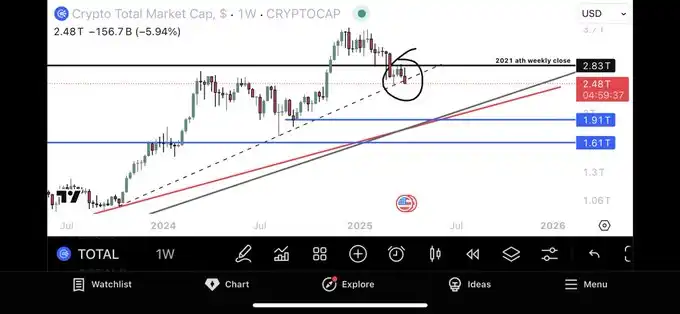
Latest update on the overall cryptocurrency market cap trend:
It has now dropped below the dotted trendline on the weekly chart. If this breakdown is confirmed, the next reasonable support level is at $1.91 trillion,
where the red bullish trendline and the long-term trendline intersect (both are diagonal supports).
Of course, it is also possible to further dip to the $1.61 trillion mark (might be just a wick, but honestly, not certain). If it does reach this level, the market's pain level will be unimaginable, so please make sure to prepare in advance... By the way, if this scenario occurs, the possible bottoming time would be in April.
I have started placing some lowball orders for altcoins in a range well below the current price. Also, since the current candle still has nearly 5 hours until close, I am still observing.
One step at a time.
Actually, this weekend is no different from the past few weekends, even similar to the weekend of February 3rd, all featuring bearish trends on Saturdays and Sundays, with a small-to-large crash on Sunday night, followed by a stabilization from Monday afternoon to evening.
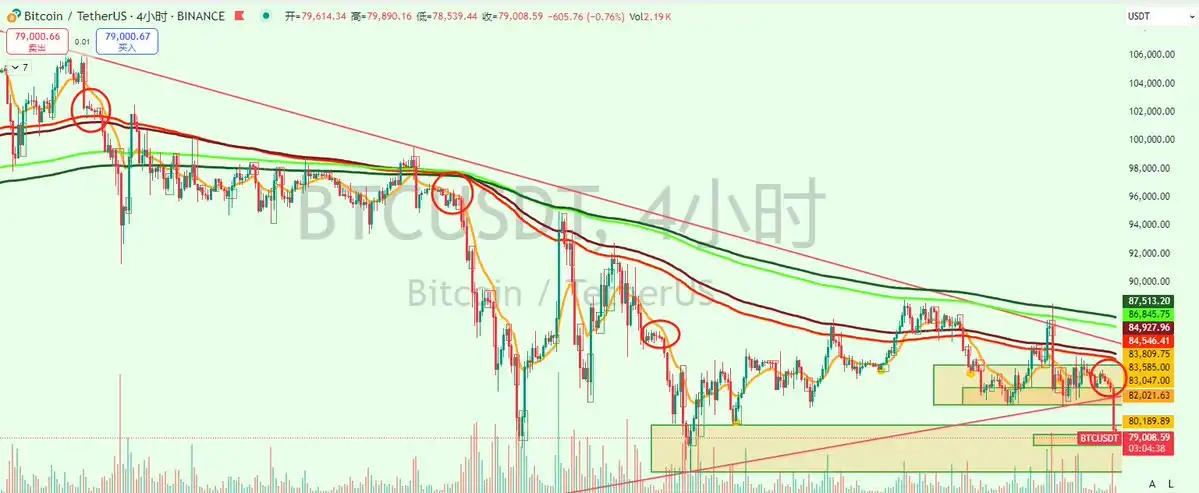
A slow rebound within a downtrend will only lead to a more intense sell-off later.
66-72k, who agrees? Who disagrees?
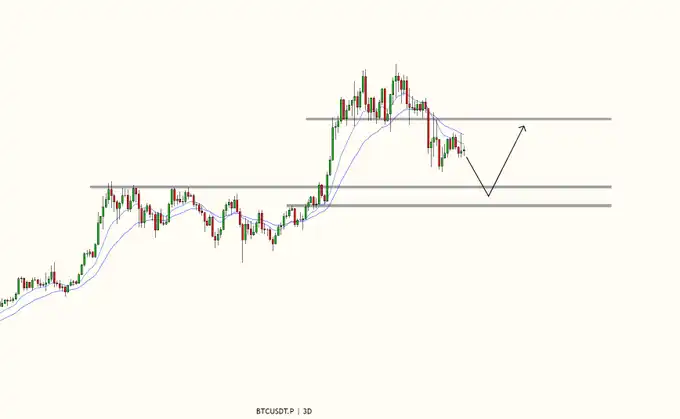
I have been holding a bearish view recently. As I mentioned two days ago, the 72K-66K range is about to be tested. At that time, I will assess the rebound situation to decide whether to enter a long position.
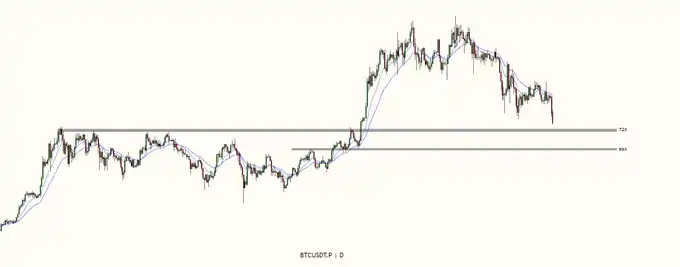
Black Monday: BTC Revisits the Downside
ETH falls below 1600, triggering circuit breakers in the Taiwan and Japanese stock markets. Once again, we are witnessing history.
I know that such a downturn can be psychologically challenging for most people. This article will focus on BTC and, from an on-chain data analysis perspective, will directly outline the previously mentioned key levels for your reference.
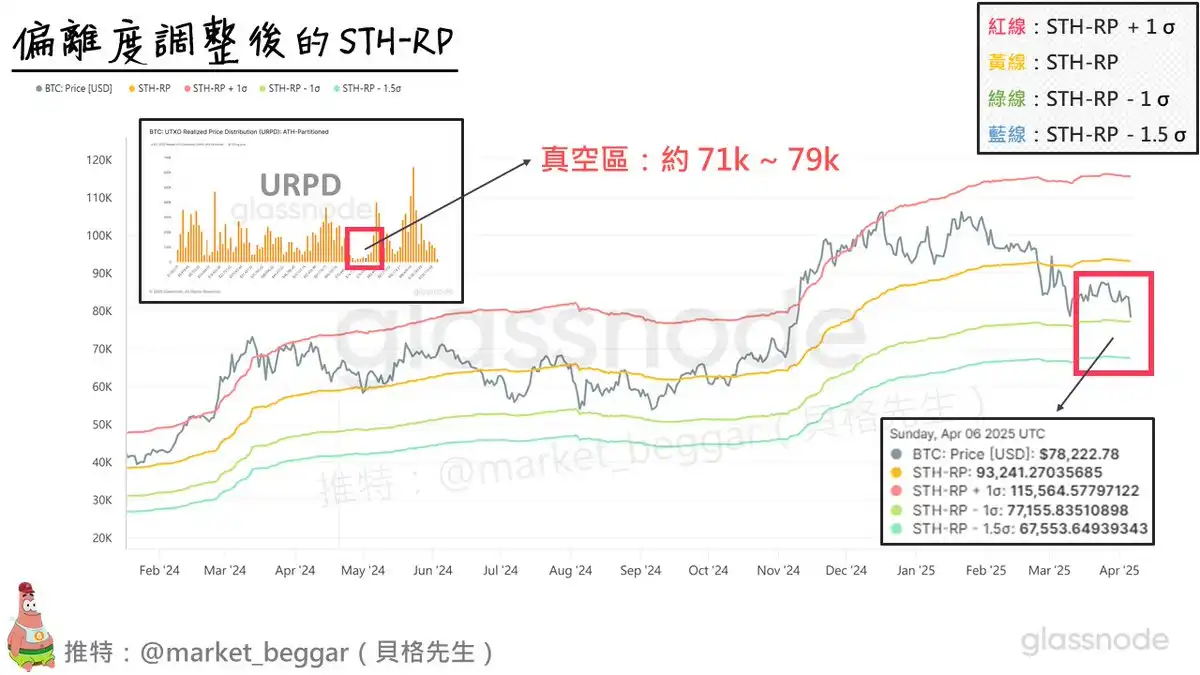
First is the "Deviation Adjusted STH-RP" model, currently:
Green Line = 77,156
Blue Line = 67,554
And the 71K ~ 79K range is still the URPD's relatively empty area, so from the on-chain data perspective, individuals are more inclined to wait for positions below 71K.
Due to the higher-level downtrend, any long positions will be considered by me as "counter-trend trades." I'm not sure how many readers can understand my point, but this is the path of least resistance in the market.
I know most people prefer to try to swing trade, but counter-trend trading is indeed one of the easiest mistakes for most retail traders to make, and it is also a lesson I learned a few years ago as a newcomer. I hope everyone can learn from it.
Trading is a process of "realizing cognition"; when the market difficulty significantly increases, "not trading" is also a form of action.
There is no need to chase every minor price swing. The smaller the timeframe, the more the price movement resembles Brownian motion; identify the major trend, stick to the strike zone, and let patience and discipline take care of the rest.
The smoke of the 2025 melee has already risen, and you and I are both witnesses to history.
You may also like

Morning Report | Illinois signs the strictest digital asset tax law in the U.S.; RWA tokenization market size surpasses $43 billion, institutions accelerate the migration of on-chain assets

Full version of the debut Q&A! Federal Reserve Chairman Waller: Sticking to the 2% inflation target, establishing five special working groups, individual did not submit the dot plot

From Disruptor to Shadow Market: The Crypto Market is Becoming a Colony of Traditional Finance
Dalio's important long article: How to position in the current market environment?

OKX Star analyzes Binance's competitive advantages: when regulation levels the playing field, competition has just begun

New gameplay for participating in initial offerings on cryptocurrency exchanges
Why Is Bitcoin Down Today? What the Hawkish FOMC Means for SpaceX, Gold and Nasdaq

DeepSeek Financing Story

Morning Report | DeepSeek completes over $7 billion in financing, with a valuation exceeding $50 billion; Musk's personal wealth has surpassed the total market value of Bitcoin

Cursor, why did you get on Musk's spaceship?
In the name of charity, for the benefit of the family: How the Trump family turned charity into profit?

Will Gold Break $4,500 After Tonight's Fed Decision? What XAUT and PAXG Traders Need to Know

SharpLink CEO: How to understand that Ethereum developers have just surpassed 1 million?

Morning Report | MiCA grace period expires on July 1; Kalshi's trading volume in the first week of the World Cup breaks $5.1 billion, setting a record

The foundation of SpaceX's trillion-dollar valuation: Who is dividing Musk's annual capital expenditure of tens of billions?
How to exit after asset tokenization?

The stablecoin positioning battle escalates: When compliance is just a ticket to entry, will USD1 become the biggest winner?

A16Z: The sun bears witness, SpaceX is worth 7.5 trillion
Morning Report | Illinois signs the strictest digital asset tax law in the U.S.; RWA tokenization market size surpasses $43 billion, institutions accelerate the migration of on-chain assets
Full version of the debut Q&A! Federal Reserve Chairman Waller: Sticking to the 2% inflation target, establishing five special working groups, individual did not submit the dot plot
From Disruptor to Shadow Market: The Crypto Market is Becoming a Colony of Traditional Finance
Dalio's important long article: How to position in the current market environment?
OKX Star analyzes Binance's competitive advantages: when regulation levels the playing field, competition has just begun
New gameplay for participating in initial offerings on cryptocurrency exchanges


