
 Buy Crypto
- Markets
 Futures
- Spot
- Copy Trade
- Earn
- More
What Happened to Ethereum?

Original Title: What happened to Ethereum?
Original Author: @paramonoww
Translation: Peggy, BlockBeats
Editor's Note: Recently, Vitalik Buterin published a lengthy article pointing out that with Ethereum's L1 scaling capabilities significantly improved and L2 lagging behind in evolving to "Phase 2," the previous idea of viewing L2 as "Ethereum's brand of sharding" is no longer feasible. He emphasized that L1 is accelerating its return to the scalability axis and no longer needs L2 as a performance extension "crutch."
This rewriting of L2's positioning has sparked widespread community discussion. Beyond price, this article will refocus on Ethereum itself: from the retreat of the "ultrasound money" narrative, the back-and-forth of the Rollup roadmap, to the absence of financial incentives and the loss of core talent, the problem does not stem from external competition but rather from a lack of clear direction and structural internal friction.
As Vitalik reflects on the existing roadmap and the Ethereum Foundation drives internal reform, Ethereum is standing at the threshold of a crucial turning point. Whether it can transition from ideology to clear goals and execution efficiency will determine whether it regains vitality or continues to test the market's patience.
Against this backdrop, Vitalik suggests that L2 reposition its value towards directions of differentiation such as privacy enhancement, deep optimization for specific applications, ultimate scalability, non-financial scenarios, ultra-low latency architecture, or built-in oracles; if continuing to handle ETH-related assets, it should at least reach Stage 1 and strengthen interoperability with the Ethereum mainnet as much as possible.
The following is the original article:
This article is mainly inspired by Vitalik's recent tweet about change and the current market situation. In a market where everything is trending downward, it's really hard to blame any one person, and I don't intend to do so.
I write this article based on this identity: I have collaborated with many Ethereum teams, invested in multiple protocols built on Ethereum on behalf of a venture capital fund, and have long been a staunch supporter and fan of Ethereum and its EVM ecosystem.
Unfortunately, today I find it hard to say the same things again. Because I feel that Ethereum is losing its direction (and I am not the only one who feels this way).
I don't want to discuss ETH's price trends, but I also can't ignore the fact that as the world's second-largest cryptocurrency by market capitalization, ETH's performance is full of uncertainty. Regardless of how the global market moves, ETH's behavior is more like a stablecoin that is "de-pegging."
This article aims to discuss: what has Ethereum been up to in the past few years, and why more and more people are losing confidence, or have already lost confidence entirely. Ethereum is not losing to Solana or any other project; Ethereum is losing to itself.
Rollup Centralization Roadmap
When Ethereum proposed the "Rollup-centric roadmap," almost everyone was excited. The vision it painted was this: Rollup (and Validium) would handle scalability, with end-user transactions primarily taking place on Rollup, while Ethereum would exist as the security layer — meaning, it would prioritize being the L1 for Rollup, rather than a direct-to-user L1.
Compared to developing an entirely new L1, Rollup has seen faster development and lower costs, hence the future of "thousands of Rollups coexisting" seems both realistic and optimistic.
What could possibly go wrong?
As it turns out, almost everything could go wrong, and almost everything has: meaningless debates, putting ideology above real needs, long-standing internal community conflicts, identity crises, and hesitation and procrastination-style abandonment of the Rollup centralization vision.
Everything that could go wrong did go wrong. Most in the community once viewed Max Resnick as an incompetent and "evil" figure, only to later realize that he was right on almost all key issues.
During his time at Consensys, Max repeatedly pointed out the changes Ethereum needed to make to move forward, but he was met with mostly criticism, with very little genuine support.
The most absurd moment was when the entire industry began earnestly discussing questions like: whether an L2 really counts as part of Ethereum, such as:
Viewpoint A: "Base is an extension of Ethereum, and we contribute greatly to the Ethereum ecosystem."
Viewpoint B: "Base is not an extension of Ethereum; it is an independent system."
What on earth are we even discussing?
How does this discussion help Ethereum and its ecosystem move towards a better future? Why is everyone so seriously debating "what is Ethereum" and "what is not Ethereum"? Don't we have more critical issues to address?
If we determine that because Rollups use ETH as gas, they are an extension of Ethereum — that seems to make sense; if we determine that Rollups are not an extension of Ethereum but applications built on and benefiting from Ethereum — that also seems to make sense.
Right? Actually, that's completely wrong.
This so-called "ideological discussion" is not a discussion at all, but rather two self-absorbed echo chambers attacking each other, trying to prove their own righteousness. We don't need PvP; we need PvE. The issue is not "us versus them," but "us together facing problems and the future."
Technology Ideology Trumps User Needs
Based Rollup, Booster Rollup, Native Rollup, Gigagas Rollup, Keystore Rollup.
Which one is better? Which one is the future? How do they all interconnect?
"This one is the future." "No, that one is the future." "There's no reason not to build on Based Rollup." "Native Rollup is more Ethereum-aligned and will overtake the entire ecosystem."
All these debates... yet Arbitrum and Base are the ones who continue to win.
Technological superiority does bring advantages, but only when we're not splitting hairs between apples and oranges, or oranges and oranges. These solutions are so similar that users simply don't care. Beyond the bubble, no one cares about these nuances. One more precompile, one less precompile won't make or break it.
"Oh, we are the true Ethereum-aligned one, we are closer to Ethereum, embodying its core values, users will definitely choose us."
I have to ask: What exactly are those values? And which batch of users will choose you because of them?
@0xFacet became the first Stage 2 Rollup, a model of "Ethereum alignment."
But where is it now? Where are its users? Where are the developers? Where are the technical KOLs? Where are those supporters who loudly advocated for Ethereum ecosystem alignment? How many people have heard of Facet? And how many apps are on Facet?
I personally have no bias against Facet. I have had multiple conversations with its founder and have great respect for him; he's a great person. But where are those who once shouted, "We need more Stage 2 Rollups"? I don't know, and neither do you.
Financial incentives are much stronger than technical incentives. I used to be a loyal supporter of Taiko and especially appreciated their research around Based Rollup: stronger anti-censorship, neutrality, no sequencer outage risk, and L1 validators being able to earn more.
So what's the issue?
The issue lies in the economic logic behind this model. You can't force someone to give up their income for the sake of "alignment."
Arbitrum promised a decentralized sequencer; Scroll promised it; Linea, zkSync, Optimism all promised it. Where are they now? Where are those sequencers?
Almost every Rollup's documentation has a sentence like this: "We are currently using a centralized sequencer, but have a strong intention to decentralize in the future." But very few have actually delivered on that promise. Metis did, but whether fortunately or unfortunately, hardly anyone cares about Metis.
Do I believe they initially overpromised to please influential ETH maximalists? Yes.
Do I believe they truly wanted a decentralized sequencer? Yes. But economically, it doesn't make sense.
Coinbase (Base) has a legal obligation to maximize profit for the company, as do other teams. Why voluntarily cut off your source of income? It doesn't make any sense.
Only about 5% of Base's revenue goes to Ethereum. Rollups were never meant to be Ethereum's extension.
There was a time when Taiko actually paid more in fees to Ethereum for sequencing than the fees they collected from user transactions. And companies like Taiko not only pay Ethereum but also have significant other operational costs.
The vision of a Based Rollup or "Ethereum-aligned" Rollup can only be achieved if the team is willing to give up their own income.
I'm not denying the importance of decentralization, security, and permissionlessness. But if your sole goal is to be "ideologically correct" rather than user-centric, then it's all meaningless.
It is precisely because of this that such vulnerability and the promise of "Ethereum alignment" have attracted a large number of speculators and scammers to this field.
Consequences of the Rollup Centralization Roadmap
Eclipse, Movement, Blast, Gasp (Mangata), Mantra: These protocols were not designed for the long term from the beginning. They are easily dressed up as "Ethereum-aligned," "making Ethereum better," "bringing SVM to Ethereum," and so on.
The result is that without exception, they have all in different ways "rugged." All Rollups eventually realize that their tokens are almost useless because fees are paid in ETH, and their tokens have almost no practical use. Speculators also realize that as long as enough hype is created around the centralized narrative of Rollup, they can dump their almost worthless tokens at a high price to retail investors.
Ethereum has never truly acknowledged Polygon as an L2, despite its important role in ETH locking and value transfer. If you believe Rollup is an "cultural extension" of Ethereum, then why not acknowledge a project that is highly tied to Ethereum in terms of security and utility?
Polygon was crucial to Ethereum in the 2021 bull market, making a significant contribution to the growth of ETH as an asset. But because it "doesn't count as L2," it doesn’t deserve recognition from the Ethereum community. If Polygon were an L1, its valuation would probably be much higher.
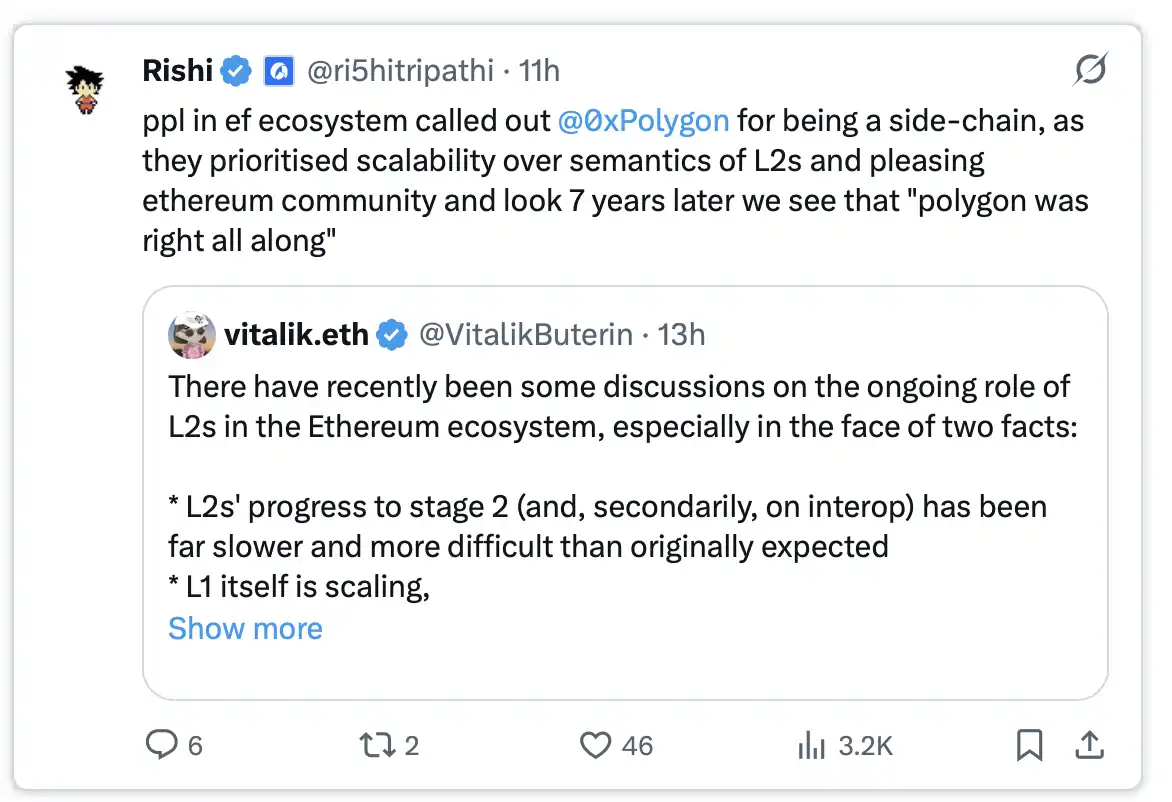
Rishi reviewed the long-standing controversy within the Ethereum ecosystem regarding Polygon: In the early years, Polygon was criticized by some of the Ethereum community for not being a "traditional" enough L2 due to being seen as a "sidechain," but Polygon chose to prioritize solving scalability issues at the time, rather than catering to L2 semantics or community ideology. Looking back seven years later, Rishi believes that the facts prove that "Polygon was right from the start": the practical scalability-first approach has stood the test of time.
Rishi reviewed the long-standing controversy within the Ethereum ecosystem regarding Polygon: In the early years, Polygon was criticized by some of the Ethereum community for not being a "traditional" enough L2 due to being seen as a "sidechain," but Polygon chose to prioritize solving scalability issues at the time, rather than catering to L2 semantics or community ideology.
Looking back seven years later, Rishi believes that the facts prove that "Polygon was right from the start": the practical scalability-first approach has stood the test of time.
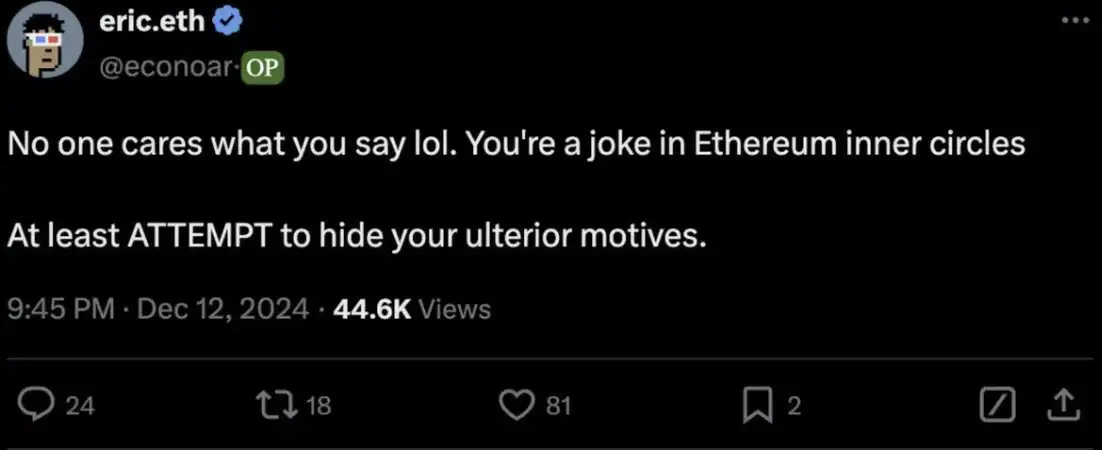
First is the narrative of "ultrasound money": After EIP-1559 and The Merge, ETH's economic model was shaped into a deflationary asset, touted to be a better store of value than Bitcoin. However, by 2024, ETH's annual inflation rate turned positive again.
In other words, did the vision of "ultrasound money" only last for three years? In this way, it cannot become a store of value. This narrative is dead — and more importantly, it was never valid from the start. Because ETH was never designed for "store of value"; that's Bitcoin's mission, and you can't compete with it on that dimension.
Next, Ethereum couldn't decide what its token really is:
Is it a commodity? Not valid — because the supply is dynamic and there is a staking mechanism;
More like a tech stock? Also not valid — because Ethereum doesn't have enough revenue to be valued like a tech company.
Some people even argue that ETH is not a "currency" at all. So what is happening now? We have to take sides.
Ethereum cannot be everything to everyone — either you have a global clear, unified direction, or you will fall behind.
Financial Incentives... Once Again
I still can't understand how a chief engineer like Péter Szilágyi only receives approximately $100,000 in salary per year. He has been involved since the earliest days of the project, helping Ethereum grow from almost zero to a $450 billion market cap, yet he receives a return equivalent to 0.0001% of the market cap.
In the wake of Bitcoin, the most influential and successful protocol in crypto history, it neither provides incentives nor equity. People easily defend this with the idea of "decentralized, open-source, permissionless": "We're not here to make money; we're here to drive progress."
But the problem is, even the most loyal soldier must be given incentives; otherwise, they will either leave or work on other projects in private. Péter left, Danny Ryan left, Dankrad Feist went straight to Tempo.
In 2024, Justin Drake and Dankrad took on advisory roles at EigenLayer and received token allocations, prompting immediate community backlash.
These individuals in the Ethereum Foundation receiving a "modest salary" (compared to FAANG companies and AI research labs), just because they want to make some money while helping an "Ethereum-improvement-adjacent-but-not-Ethereum-proper" independent protocol, have faced collective resentment.
Isn't this absurd? Sometimes I really feel: if you are an honest, hardworking person in Ethereum, it seems you are not allowed to earn money and can only toil for a lifetime for "recognition" from the Ethereum community.
The Ethereum Foundation has been selling ETH to fund various operations, projects, and research. But perhaps, should researcher salaries be prioritized instead?
Zero Tolerance for Adaptation
"Day One. Ethereum will definitely win. It is the most decentralized, highest uptime blockchain."
We hear this rhetoric every day, just like we hear Ethereum defending itself every day.
Yes, Ethereum is expensive and slow. But we have Rollup, use Rollup, Rollup is Ethereum!
Yes, ETH's price underperforms everything. But Ethereum has the largest developer ecosystem, a strong foundation, demand will catch up eventually.
Ethereum is the most decentralized blockchain! Solana is bad, it lacks client diversity.
Ethereum is 100% uptime! Solana is bad, it has crashed multiple times.
Ethereum's network activity is not as high as Solana? That's because Solana is filled with spam transactions and meme-chasing gamblers, we are the "ethical chain"!
Over the years, it has always been the same excuses, the same answers, the same self-assurance. Except for Ethereum and Rollup, everything else is garbage; if Ethereum underperforms on any metric, we say "it's still Day 1", we know what we are doing, there is no better place in the world than Ethereum.
Everyone is tired of the community's repetitive excuses.
Ethereum is becoming more like an elderly, wealthy grandmother, almost unable to walk, refusing any innovation, just mindlessly giving money to her children and grandchildren, letting them leech off her.
Reform
Just a few hours before I finished this article, Vitalik tweeted acknowledging: the Rollup-centric roadmap has failed, a new path needs to be found, shifting towards L1 scalability.
Did you know? I'm actually happy when people can realize their mistakes. It takes courage to publicly admit mistakes. But I'm worried that it might be a little too late. Ethereum has once again found a long-awaited direction, but progress as a whole is still slow.
There have been some recent changes in the Ethereum Foundation: new leadership, treasury transparency, R&D structure adjustments, and more. At the same time, the Foundation has started to introduce some young new faces into developer relations and market direction, such as Abbas Khan, Binji, Lou3e, and others.
But change must happen quickly enough. Ethereum must go all out to prove everyone wrong.
Let's wait and see: after these reforms and changes, can Ethereum once again become an exciting entity rather than one filled with blind faith and disappointment.
You may also like

WEEX Official Product Launch: Win LALIGA Tickets & Unlock the 3-in-1 Crypto Trading Suite
Trade crypto without downloading an app. Join the WEEX H5, API, SKILLs livestream to explore the new trading experience, win LALIGA VIP tickets, and share 420 USDT rewards.

Dragonfly Partners: Most agents will not engage in autonomous trading, how can crypto payments prevail?

US AI Startup Goes All In on Chinese Mega-Model | Rewire News Morning Brief

Trump Lies Again: A "Five-Day Pause" Psyop, How Wall Street, Bitcoin, and Polymarket Insiders Synced Uposciogen

When a Token Becomes Labor, People Become the Interface

Ceasefire News Leaked Ahead of Time? Large Polymarket Bets on Outcome Before Trump's Tweet

BlackRock CEO's Annual Shareholder Letter: How is Wall Street Using AI to Keep Profiting from National Pension Funds?

Sun Valley Releases 2025 Financial Report: Bitcoin Mining Revenue Reaches $670 Million, Accelerating Transformation to AI Infrastructure Platform
On March 16, 2026, in Dallas, Texas, USA, CanGu Company (New York Stock Exchange code: CANG, hereinafter referred to as "CanGu" or the "Company") today announced its unaudited financial performance for the fourth quarter and full year ended December 31, 2025. As a btc-42">bitcoin mining enterprise relying on a globally operated layout and dedicated to building an integrated energy and AI computing power platform, CanGu is actively advancing its business transformation and infrastructure development.
• Financial Performance:
Total revenue for the full year 2025 was $688.1 million, with $179.5 million in the fourth quarter.
Bitcoin mining business revenue for the full year was $675.5 million, with $172.4 million in the fourth quarter.
Full-year adjusted EBITDA was $24.5 million, while the fourth quarter was -$156.3 million.
• Mining Operations and Costs:
A total of 6,594.6 bitcoins were mined throughout the year, averaging 18.07 bitcoins per day; of which 1,718.3 bitcoins were mined in the fourth quarter, averaging 18.68 bitcoins per day.
The average mining cost for the full year (excluding miner depreciation) was $79,707 per bitcoin, and for the fourth quarter, it was $84,552;
The all-in sustaining costs were $97,272 and $106,251 per bitcoin, respectively.
As of the end of December 2025, the company has cumulatively produced 7,528.4 bitcoins since entering the bitcoin mining business.
• Strategic Progress:
The company has completed the termination of the American Depositary Receipt (ADR) program and transitioned to a direct listing on the NYSE to enhance information transparency and align with its strategic direction, with a long-term goal of expanding its investor base.
CEO Paul Yu stated: "2025 marked the company's first full year as a bitcoin mining enterprise, characterized by rapid execution and structural reshaping. We completed a comprehensive adjustment of our asset system and established a globally distributed mining network. Additionally, the company introduced a new management team, further strengthening our capabilities and competitive advantage in the digital asset and energy infrastructure space. The completion of the NYSE direct listing and USD pricing also signifies our transformation into a global AI infrastructure company."
"As we enter 2026, the company will continue to optimize its balance sheet structure and enhance operational efficiency and cost resilience through adjustments to the miner portfolio. At the same time, we are advancing our strategic transformation into an AI infrastructure provider. Leveraging EcoHash, we will utilize our capabilities in scalable computing power and energy networks to provide cost-effective AI inference solutions. The relevant site transformations and product development are progressing simultaneously, and the company is well-positioned to sustain its execution in the new phase."
The company's Chief Financial Officer, Michael Zhang, stated: "By 2025, the company is expected to achieve significant revenue growth through its scaled mining operations. Despite recording a net loss of $452.8 million from ongoing operations, mainly due to one-time transformation costs and market-driven fair value adjustments, the company, from a financial perspective, will reduce its leverage, optimize its Bitcoin reserve strategy and liquidity management, introduce new capital to strengthen its financial position, and seize investment opportunities in high-potential areas such as AI infrastructure while navigating market volatility."
The total revenue for the fourth quarter was $1.795 billion. Of this, the Bitcoin mining business contributed $1.724 billion in revenue, generating 1,718.3 Bitcoins during the quarter. Revenue from the international automobile trading business was $4.8 million.
The total operating costs and expenses for the fourth quarter amounted to $4.56 billion, primarily attributed to expenses related to the Bitcoin mining business, as well as impairment of mining machines and fair value losses on Bitcoin collateral receivables.
This includes:
· Cost of Revenue (excluding depreciation): $1.553 billion
· Cost of Revenue (depreciation): $38.1 million
· Operating Expenses: $9.9 million (including related-party expenses of $1.1 million)
· Mining Machine Impairment Loss: $81.4 million
· Fair Value Loss on Bitcoin Collateral Receivables: $171.4 million
The operating loss for the fourth quarter was $276.6 million, a significant increase from a loss of $0.7 million in the same period of 2024, primarily due to the downward trend in Bitcoin prices.
The net loss from ongoing operations was $285 million, compared to a net profit of $2.4 million in the same period last year.
The adjusted EBITDA was -$156.3 million, compared to $2.4 million in the same period last year.
The total revenue for the full year was $6.881 billion. Of this, the revenue from the Bitcoin mining business was $6.755 billion, with a total output of 6,594.6 Bitcoins for the year. Revenue from the international automobile trading business was $9.8 million.
The total annual operating costs and expenses amount to $1.1 billion.
Specifically, they include:
· Revenue Cost (excluding depreciation): $543.3 million
· Revenue Cost (depreciation): $116.6 million
· Operating Expenses: $28.9 million (including related-party expenses of $1.1 million)
· Miner Impairment Loss: $338.3 million
· Bitcoin Collateral Receivable Fair Value Change Loss: $96.5 million
The full-year operating loss is $437.1 million. The continuing operations net loss is $452.8 million, while in 2024, there was a net profit of $4.8 million.
The 2025 non-GAAP adjusted net profit is $24.5 million (compared to $5.7 million in 2024). This measure does not include share-based compensation expenses; refer to "Use of Non-GAAP Financial Measures" for details.
As of December 31, 2025, the company's key assets and liabilities are as follows:
· Cash and Cash Equivalents: $41.2 million
· Bitcoin Collateral Receivable (Non-current, related party): $663.0 million
· Miner Net Value: $248.7 million
· Long-Term Debt (related party): $557.6 million
In February 2026, the company sold 4,451 bitcoins and repaid a portion of related-party long-term debt to reduce financial leverage and optimize the asset-liability structure.
As per the stock repurchase plan disclosed on March 13, 2025, as of December 31, 2025, the company had repurchased a total of 890,155 shares of Class A common stock for approximately $1.2 million.

The US AI Startup Is Loving China's Open Source Model

Three Weeks of the US-Iran War: Who's Making Money, Who's Paying the Bill?

Interpreting Polymarket's Major Update Last Night: Fee Expansion, Self-Regulation, and New Incentives

From Human Application to Intelligent Collaboration: How GOAT Network Builds the Next Generation Digital Economy

CZ Washington Dialogue: Crypto Entrepreneurs are Accelerating Their Return to the United States

Morning Report | Strategy increased its holdings by 1,031 bitcoins last week; Katana Blockchain acquires IDEX; NYSE completes rule change to eliminate trading limits on crypto ETF options

WEEX P2P now supports JOD, USD & EUR—Merchant Recruitment Now Open
To make crypto deposits easier, WEEX has officially launched its P2P trading platform and continues to expand fiat support. We're excited to announce that the Jordanian Dinar (JOD), United States Dollar (USD ) and Euro (EUR) are now available on WEEX P2P!

Electric Capital: Tracking 501 types of yield-generating RWA assets, we discovered these patterns
Those who are cut off by AI will not disappear; they will become the creators of the next round of the economy

Stablecoins reshaping cross-border payments in Asia? Strategic panorama and investment opportunity analysis
WEEX Official Product Launch: Win LALIGA Tickets & Unlock the 3-in-1 Crypto Trading Suite
Trade crypto without downloading an app. Join the WEEX H5, API, SKILLs livestream to explore the new trading experience, win LALIGA VIP tickets, and share 420 USDT rewards.


 App
App