
 Buy Crypto
- Markets
 Futures
- Spot
- Copy Trade
- Earn
- More
What is the $HYPE Market Cap of DAT Company?

Original Title: PURR's HYPE Bid Is Not What You Think
Original Author: @ericonomic
Translation: Peggy, BlockBeats
Editor's Note: In discussions about DAT PURR's HYPE, the market often only focuses on one question: how much "ammo" does it have left to buy into HYPE. However, this article attempts to point out that the key is not the balance, but the mechanism. By interpreting the S-1 document and DAT's issuance logic, the author reveals a fact that is widely overlooked: in the presence of mNAV premium and real liquidity, ATM issuance can allow the "firepower" to dynamically expand with trading volume, rather than linearly deplete.
This also redefines PURR's incentive to buy, as it is not just about capital consumption, but may be about maintaining momentum and amplifying future fundraising capabilities. The article further explains why most DATs will fail, while HYPE has avoided typical traps in asset properties and structural design.
The following is the original text:
Most people focus on PURR (previously known as Hyperliquid Strategies or HSI) for one reason only: it is one of HYPE's DATs (and currently the largest in scale), continuously accumulating HYPE.
So, everyone's mental model is simple: "PURR still has millions in capacity, which can continue to hold or push up the price."
This model is useful. But it is not complete.
Because in the background, there is a mechanism that can quietly transform the "remaining firepower" into almost unlimited ammunition.
Once you see this, you will no longer see PURR as a "wallet with a balance." You will start to see it as something else.

Bob Diamond, HSI Chairman
Before proceeding, if you want to delve deeper into PURR and its relationship with HYPE, I recommend first reading my previous article, especially point 3, where I specifically discussed this issue. Some of the data in it may be slightly outdated, but we will revisit this point later in this article.
As before, all information in this article is sourced from the officially published S-1 document. Additionally, I will also incorporate some interview content and make certain reasonable assumptions in the article.
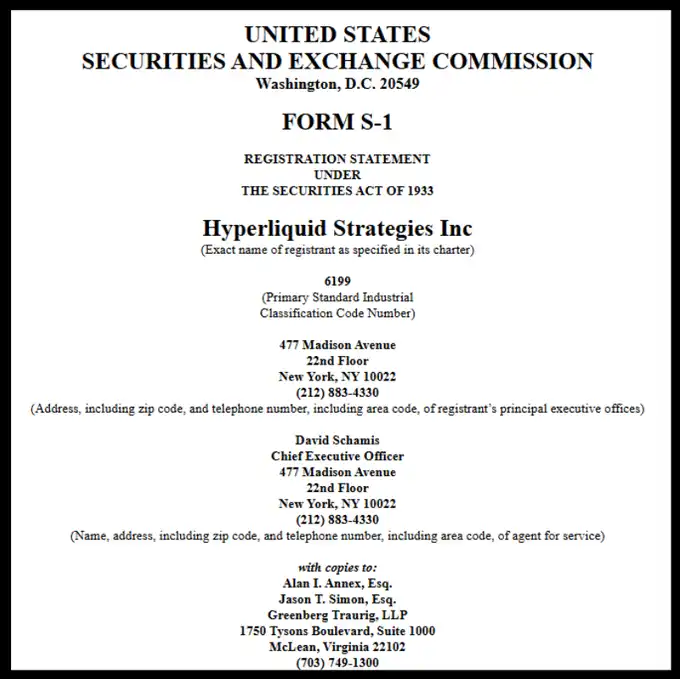
HSI's S-1 Document
Let's get straight to the point.
Other than the fact that "PURR may still have over $100 million to acquire HYPE," what else do you need to know?
The crux of the matter is this: their "firepower" may be more than just $100 million; it may not be limited to a fixed-size war chest but can be amplified dynamically by mNAV and market liquidity.
To understand this, we need to start with the basic mechanism of DAT.
Basic Mechanism of DAT

Bobby Starts Reckoning
Digital Asset Treasury (DAT) companies are a type of company with the core objective of continuously accumulating crypto assets. Their sources of funds typically come from three main avenues:
Investors wishing to gain exposure to crypto assets at a discount provide cash, and DAT issues shares to them in exchange instead of directly providing crypto assets;
Holders wishing to "exit" their crypto asset positions surrender their crypto assets, and DAT pays them cash, but the transaction price is usually below the current market price;
Issuance and sale of new shares (this point is critical).
The situation for PURR is slightly more complex because it is the result of a merger of multiple companies; but to simplify the discussion, we can initially assume that it primarily raised funds through (1) and (2).
One thing to be clear about is: their core objective should, at least theoretically, be to maximize shareholder returns rather than to "pump" a particular crypto asset.
However, in reality, most DATs have taken the old path of "pump and dump," ending up failing almost like a rug pull.
This is where Market Net Asset Value (mNAV) comes in. mNAV is an indicator used to determine whether a company's stock is trading at a discount or a premium.
Let's take a simple example: suppose there is a DAT with HYPE as its core asset: holding $1 billion equivalent of HYPE; no debt, no additional cash; a total of 500,000 shares issued, priced at $2,000 per share.
Then, its mNAV calculation is: (500,000 × 2,000) / 1,000,000,000 = 1
mNAV = 1, meaning the company's stock is fairly priced.
If the stock price is higher, mNAV > 1, indicating the company is trading at a premium;
If the stock price is lower, mNAV < 1, it means the company is trading at a discount.
Now, let's revisit the earlier mentioned point (3), which is the most crucial and often overlooked part of the DAT mechanism: where and how DAT issues new shares. This is where the story truly forks.
Forking Point: How DAT Issues New Shares
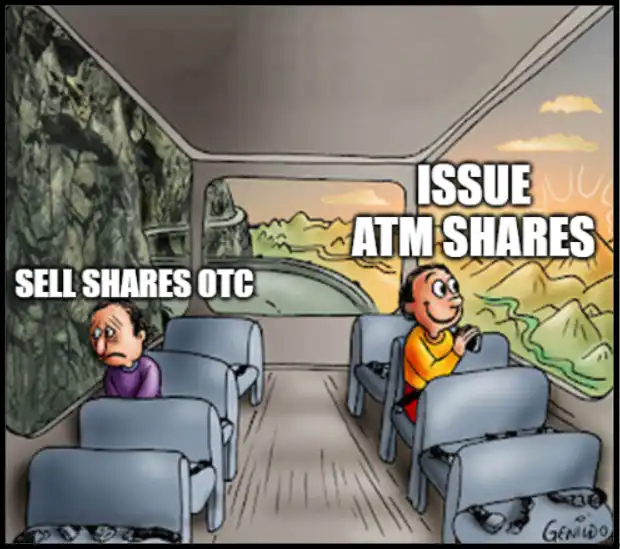
The Two Paths of Issuing New Shares
Some DATs choose to issue additional shares and sell them over-the-counter (OTC) at a discount to specific buyers while setting a shorter lock-up period.
This often triggers the classic "death spiral": once the lock-up period ends, buyers sell off in concentration; the stock price drops; to continue fundraising, larger discounts must be given; mNAV further decreases; rinse and repeat.
Another type of DAT chooses to issue new shares through ATM when mNAV is at a premium.
ATM (At-The-Market) issuance refers to a company gradually issuing and selling new shares on the open market while strictly adhering to liquidity and volume constraints.
The pricing of these ATM new shares is not through discounted OTC but rather anchored to the market price (usually based on VWAP, Volume-Weighted Average Price).
There is a subtle but very important mechanism difference, which is especially crucial in practical operation.
Due to ATM issuance referencing VWAP instead of the latest transaction price, in a strong uptrend, the spot price often briefly trades above VWAP. At this time, new shares can be absorbed by the market at a slightly lower level than the spot price without offering any explicit discount or special terms.
For example: if PURR quickly spikes from $10 to $12 within a day, and at that time the VWAP is still at $10.80, then the ATM new shares are actually sold at a price about 10% lower than the spot price. Although by the rules, they are still considered "issued at the market price."
As higher-priced trades accumulate, VWAP naturally moves up and catches up to the spot price.
As expected, PURR chose the second path. And it is here where things really start to get interesting.
The next question is: When will PURR issue new shares, and how many can be issued?
According to some interview content, David Schamis (@dschamis) mentioned that when PURR's trading price is above 1 times mNAV, they would consider initiating an ATM offering.
And according to @Keisan_crypto's calculation, PURR's current mNAV is about 1.10, which means that if they are willing, they already meet the conditions to issue new shares.
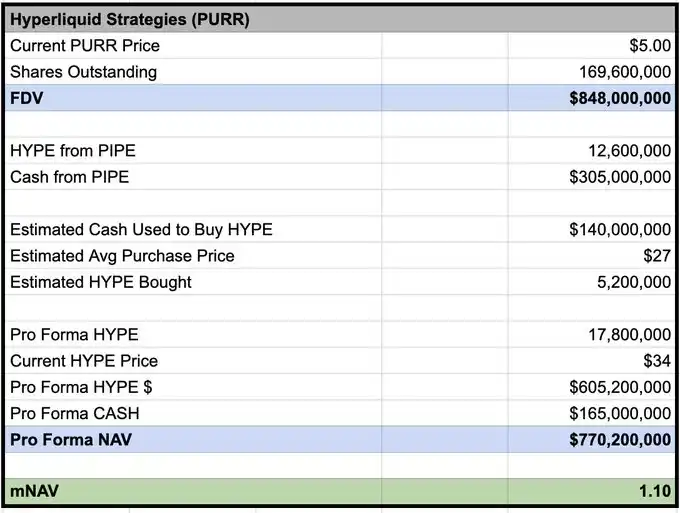
Keisan's mNAV calculation based on 03/02 price
But the question is: How much can they issue? Most people stop here. And the real advantage starts from here.
The S-1 Mechanism Most People Don't Understand
According to the S-1 filing disclosure, as an intermediary selling shares in the market, Chardan's beneficial ownership cap is 4.99%. Based on the current price estimate, this means it can temporarily hold shares of PURR worth around $50 million at most.
But this does not mean they can only issue $50 million worth of new shares.
What it really means is: at any given point in time, Chardan cannot "hoard" more than this share of the float. As long as shares are continuously sold into the market, completing distributions, more new shares can be issued.
Additionally, in actual operation, Chardan is also constrained by trading rules and market manipulation restrictions. Typically, this would cap the daily trading volume of ATM issuances at around 20% of the daily volume.
Using the most recent trading day as an example: PURR had a daily trading volume of around 7 million shares (approximately $42 million); at this rate, Chardan can sell approximately $8.4 million in shares through ATM each day.
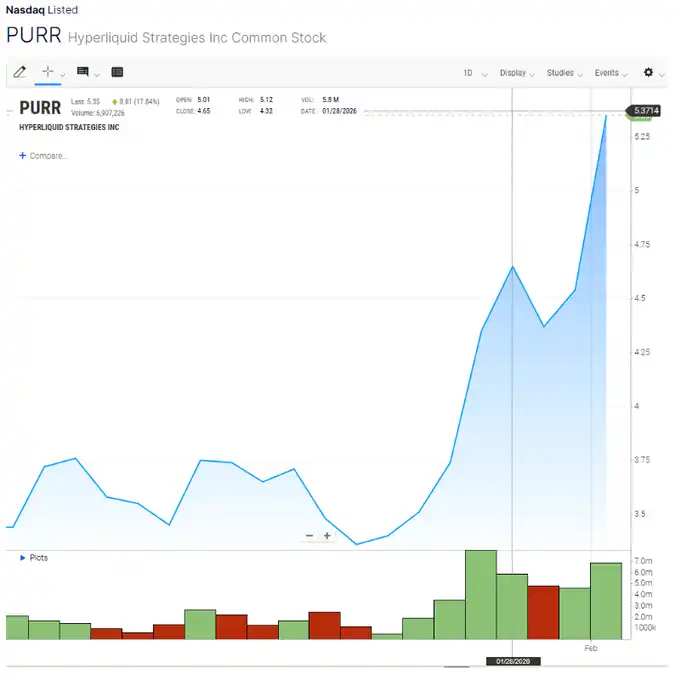
PURR Chart
Key Takeaway (The punchline)
In other words: If the volume can sustain at the current level, PURR could potentially add about $8 million in firepower daily to buy into HYPE.
Once again, this does not mean they will blindly sweep the market, buying at the top; but the incentive structure here is completely different from PIPE.
PIPE Financing: Funds are available upfront, no urgency, you can hold onto cash and wait for the sell pressure to emerge.
ATM Issuance: The incentive structure will change.
If the issuance capacity expands along with the volume and momentum, and higher PURR trading volumes can consistently open the ATM window, then maintaining the strong momentum of HYPE may actually increase future issuance and financing capabilities.
In this structure, actively buying on the way up is no longer irrational. It can be a means to maintain liquidity, increase trading volume, and maximize the funds that the ATM can raise over time.
This is not "blindly buying the top." It means that under certain conditions, rapidly absorbing sell pressure, or even adding to positions with the trend, is a strategically rational choice.
This is the part that most people overlook.
They model PURR as a buyer whose balance keeps decreasing; but if the ATM is open (mNAV premium), and liquidity is indeed present, then the real constraint is no longer "how much money is left?" but rather: without turning oneself into the "entire market," how much liquidity can you continuously feed into the market while maintaining momentum and trading activity?
If Almost All DATs Have Failed, Why Could This Time Be Different?
Because most DAT failures stem from structural issues and poor asset selection, not because "the very idea of DAT is inherently flawed".
They failed usually because:
1. Poor Issuance Mechanism
Discounted OTC + short unlock period essentially create their own "forced sellers";
2. Underlying Asset Lacks Self-Sustaining Ability
If the asset has no (or very little) intrinsic revenue, it must rely on price appreciation to sustain the loop; once the price stagnates, the narrative immediately collapses;
3. Inflationary Supply Narrative
If the underlying asset is inflationary (or heavy emission), it's akin to fighting against structural headwinds;
4. Shareholder-Level Disastrous Sentiment
Issuing more when mNAV < 1 is self-harming behavior: severe dilution, emotional destruction, and setting up the next round of funding to be worse.
HYPE avoids the majority of the above failure paths: protocol revenue ultimately converts into demand for HYPE and value capture; under continued usage, the supply is deflationary, not structurally inflationary; there are no large unlock schedules or VCs still unlocking.
This combination is crucial. Because it determines whether this is a story of "only numba go up can work" or a structure of "as long as fundamentals are sound, it can continue to function even in market turbulence".
Of course, failure paths still exist: compressed mNAV, dwindling volume, ATM pauses, or weakening HYPE narrative. But structurally, HYPE is one of the few DAT cycles that is not inherently a "scam machine" asset.
I've Been "Midcurved" Here Before
Finally, some may think: PURR is a bad investment due to continuous dilution, issuance will suppress the stock price.
I used to think this way too (a typical mid-curve). But please remember: when traditional finance truly understands how this "barbell structure" operates, things could get very exaggerated.
Historical Cases:
MSTR: 3.3× mNAV
Metaplanet: 8.3×
BMNR: 5.6×
And to be honest, these assets are not that great. Just imagine what a "good" one can achieve.

Bobby starts printing money.
Go ahead, Bobby, fire up the printing press.
Hyperliquid.
You may also like

From x402 to MPP: Cloudflare's crucial vote, will it go to Coinbase or Stripe?

BlackRock CEO issues annual open letter: The wave of tokenization has arrived, and we will lead this trend

When Backpack backstabs the community

When gold is no longer a safe haven, and Bitcoin continues to panic

Trump, the World's Largest Oil Trader

If the US and Iran have not reached an agreement in 5 days, what other cards does Trump have?

Tether Whale Dumps £12 Million, Backing Crypto’s ‘British Trump’
Ethereum Foundation Post: Rethinking the Division of Work Between L1 and L2 to Build the Ultimate Ethereum Ecosystem

Two Major Prediction Market Platforms Unite Rarely, What Is the Story Behind This New Fund?

WEEX Official Product Launch: Win LALIGA Tickets & Unlock the 3-in-1 Crypto Trading Suite
Trade crypto without downloading an app. Join the WEEX H5, API, SKILLs livestream to explore the new trading experience, win LALIGA VIP tickets, and share 420 USDT rewards.
Dragonfly Partners: Most agents will not engage in autonomous trading, how can crypto payments prevail?

US AI Startup Goes All In on Chinese Mega-Model | Rewire News Morning Brief

Trump Lies Again: A "Five-Day Pause" Psyop, How Wall Street, Bitcoin, and Polymarket Insiders Synced Uposciogen

When a Token Becomes Labor, People Become the Interface

Ceasefire News Leaked Ahead of Time? Large Polymarket Bets on Outcome Before Trump's Tweet
BlackRock CEO's Annual Shareholder Letter: How is Wall Street Using AI to Keep Profiting from National Pension Funds?

Sun Valley Releases 2025 Financial Report: Bitcoin Mining Revenue Reaches $670 Million, Accelerating Transformation to AI Infrastructure Platform
On March 16, 2026, in Dallas, Texas, USA, CanGu Company (New York Stock Exchange code: CANG, hereinafter referred to as "CanGu" or the "Company") today announced its unaudited financial performance for the fourth quarter and full year ended December 31, 2025. As a btc-42">bitcoin mining enterprise relying on a globally operated layout and dedicated to building an integrated energy and AI computing power platform, CanGu is actively advancing its business transformation and infrastructure development.
• Financial Performance:
Total revenue for the full year 2025 was $688.1 million, with $179.5 million in the fourth quarter.
Bitcoin mining business revenue for the full year was $675.5 million, with $172.4 million in the fourth quarter.
Full-year adjusted EBITDA was $24.5 million, while the fourth quarter was -$156.3 million.
• Mining Operations and Costs:
A total of 6,594.6 bitcoins were mined throughout the year, averaging 18.07 bitcoins per day; of which 1,718.3 bitcoins were mined in the fourth quarter, averaging 18.68 bitcoins per day.
The average mining cost for the full year (excluding miner depreciation) was $79,707 per bitcoin, and for the fourth quarter, it was $84,552;
The all-in sustaining costs were $97,272 and $106,251 per bitcoin, respectively.
As of the end of December 2025, the company has cumulatively produced 7,528.4 bitcoins since entering the bitcoin mining business.
• Strategic Progress:
The company has completed the termination of the American Depositary Receipt (ADR) program and transitioned to a direct listing on the NYSE to enhance information transparency and align with its strategic direction, with a long-term goal of expanding its investor base.
CEO Paul Yu stated: "2025 marked the company's first full year as a bitcoin mining enterprise, characterized by rapid execution and structural reshaping. We completed a comprehensive adjustment of our asset system and established a globally distributed mining network. Additionally, the company introduced a new management team, further strengthening our capabilities and competitive advantage in the digital asset and energy infrastructure space. The completion of the NYSE direct listing and USD pricing also signifies our transformation into a global AI infrastructure company."
"As we enter 2026, the company will continue to optimize its balance sheet structure and enhance operational efficiency and cost resilience through adjustments to the miner portfolio. At the same time, we are advancing our strategic transformation into an AI infrastructure provider. Leveraging EcoHash, we will utilize our capabilities in scalable computing power and energy networks to provide cost-effective AI inference solutions. The relevant site transformations and product development are progressing simultaneously, and the company is well-positioned to sustain its execution in the new phase."
The company's Chief Financial Officer, Michael Zhang, stated: "By 2025, the company is expected to achieve significant revenue growth through its scaled mining operations. Despite recording a net loss of $452.8 million from ongoing operations, mainly due to one-time transformation costs and market-driven fair value adjustments, the company, from a financial perspective, will reduce its leverage, optimize its Bitcoin reserve strategy and liquidity management, introduce new capital to strengthen its financial position, and seize investment opportunities in high-potential areas such as AI infrastructure while navigating market volatility."
The total revenue for the fourth quarter was $1.795 billion. Of this, the Bitcoin mining business contributed $1.724 billion in revenue, generating 1,718.3 Bitcoins during the quarter. Revenue from the international automobile trading business was $4.8 million.
The total operating costs and expenses for the fourth quarter amounted to $4.56 billion, primarily attributed to expenses related to the Bitcoin mining business, as well as impairment of mining machines and fair value losses on Bitcoin collateral receivables.
This includes:
· Cost of Revenue (excluding depreciation): $1.553 billion
· Cost of Revenue (depreciation): $38.1 million
· Operating Expenses: $9.9 million (including related-party expenses of $1.1 million)
· Mining Machine Impairment Loss: $81.4 million
· Fair Value Loss on Bitcoin Collateral Receivables: $171.4 million
The operating loss for the fourth quarter was $276.6 million, a significant increase from a loss of $0.7 million in the same period of 2024, primarily due to the downward trend in Bitcoin prices.
The net loss from ongoing operations was $285 million, compared to a net profit of $2.4 million in the same period last year.
The adjusted EBITDA was -$156.3 million, compared to $2.4 million in the same period last year.
The total revenue for the full year was $6.881 billion. Of this, the revenue from the Bitcoin mining business was $6.755 billion, with a total output of 6,594.6 Bitcoins for the year. Revenue from the international automobile trading business was $9.8 million.
The total annual operating costs and expenses amount to $1.1 billion.
Specifically, they include:
· Revenue Cost (excluding depreciation): $543.3 million
· Revenue Cost (depreciation): $116.6 million
· Operating Expenses: $28.9 million (including related-party expenses of $1.1 million)
· Miner Impairment Loss: $338.3 million
· Bitcoin Collateral Receivable Fair Value Change Loss: $96.5 million
The full-year operating loss is $437.1 million. The continuing operations net loss is $452.8 million, while in 2024, there was a net profit of $4.8 million.
The 2025 non-GAAP adjusted net profit is $24.5 million (compared to $5.7 million in 2024). This measure does not include share-based compensation expenses; refer to "Use of Non-GAAP Financial Measures" for details.
As of December 31, 2025, the company's key assets and liabilities are as follows:
· Cash and Cash Equivalents: $41.2 million
· Bitcoin Collateral Receivable (Non-current, related party): $663.0 million
· Miner Net Value: $248.7 million
· Long-Term Debt (related party): $557.6 million
In February 2026, the company sold 4,451 bitcoins and repaid a portion of related-party long-term debt to reduce financial leverage and optimize the asset-liability structure.
As per the stock repurchase plan disclosed on March 13, 2025, as of December 31, 2025, the company had repurchased a total of 890,155 shares of Class A common stock for approximately $1.2 million.



 App
App