
 Buy Crypto
- Markets
 Futures
- Spot
- Copy Trade
- Earn
- More
Which Protocols Drained the Crypto Market in 2025?

Original Article Title: Crypto’s Revenue Recipe
Original Article Author: Prathik Desai, Token Dispatch
Original Article Translation: Chopper, Foresight News
I adore the seasonal traditions of the crypto industry, such as Uptober and Recktober. People in the community always bring out a ton of data around these milestones, and humans do love such anecdotes, don't they?
However, the trend analysis and reports around these milestones are even more interesting: "This time, ETF fund flows are different," "Cryptocurrency industry funding has finally matured this year," "Bitcoin is gearing up for a rise this year," and so on. Recently, while reviewing the "2025 DeFi Industry Report," several sets of charts on how crypto protocols generate "significant revenue" caught my attention.
These charts list the top-earning crypto protocols of the year, confirming a fact that many have discussed in the industry over the past year: the crypto industry has finally started to make revenue attractive. But what exactly is driving this revenue growth?
Behind these charts lies another little-known question worth exploring: where does this revenue ultimately flow to?
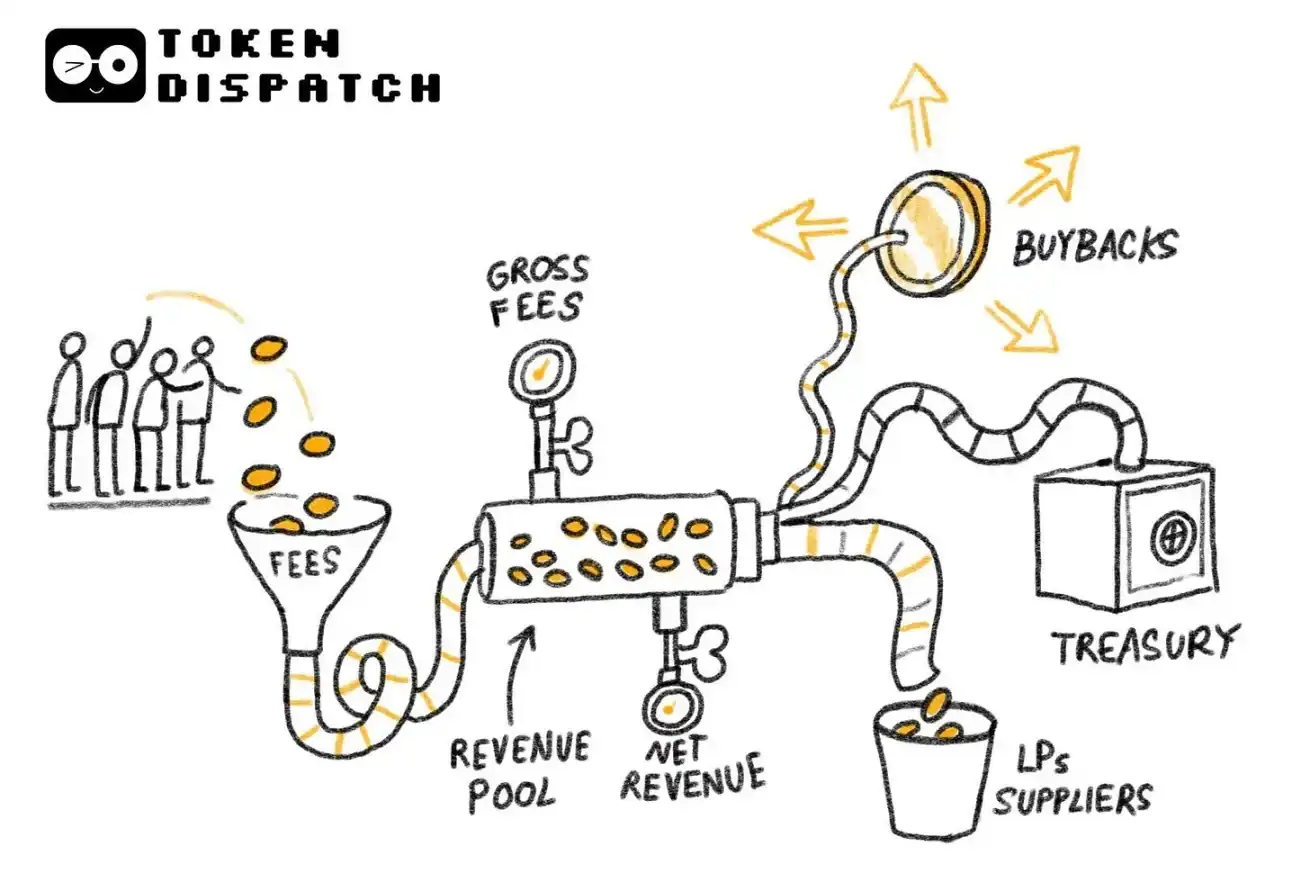
Last week, I delved into DefiLlama's fee and revenue data (Note: Revenue refers to fees retained after paying to liquidity providers and suppliers) in an attempt to find an answer. In today's analysis, I will add more detail to this data, dissecting the flow and destination of funds in the crypto industry.
Crypto protocols generated over $16 billion in revenue last year, more than double the approximately $8 billion in 2024.
The crypto industry's value-capture ability has greatly improved. In the past 12 months, the decentralized finance (DeFi) sector has seen many new entrants, such as decentralized exchanges (DEXes), token issuance platforms, and decentralized perpetual contract trading platforms (perp DEXes).
However, the profit centers that generated the highest revenue are still concentrated in traditional tracks, with stablecoin issuers being the most prominent.
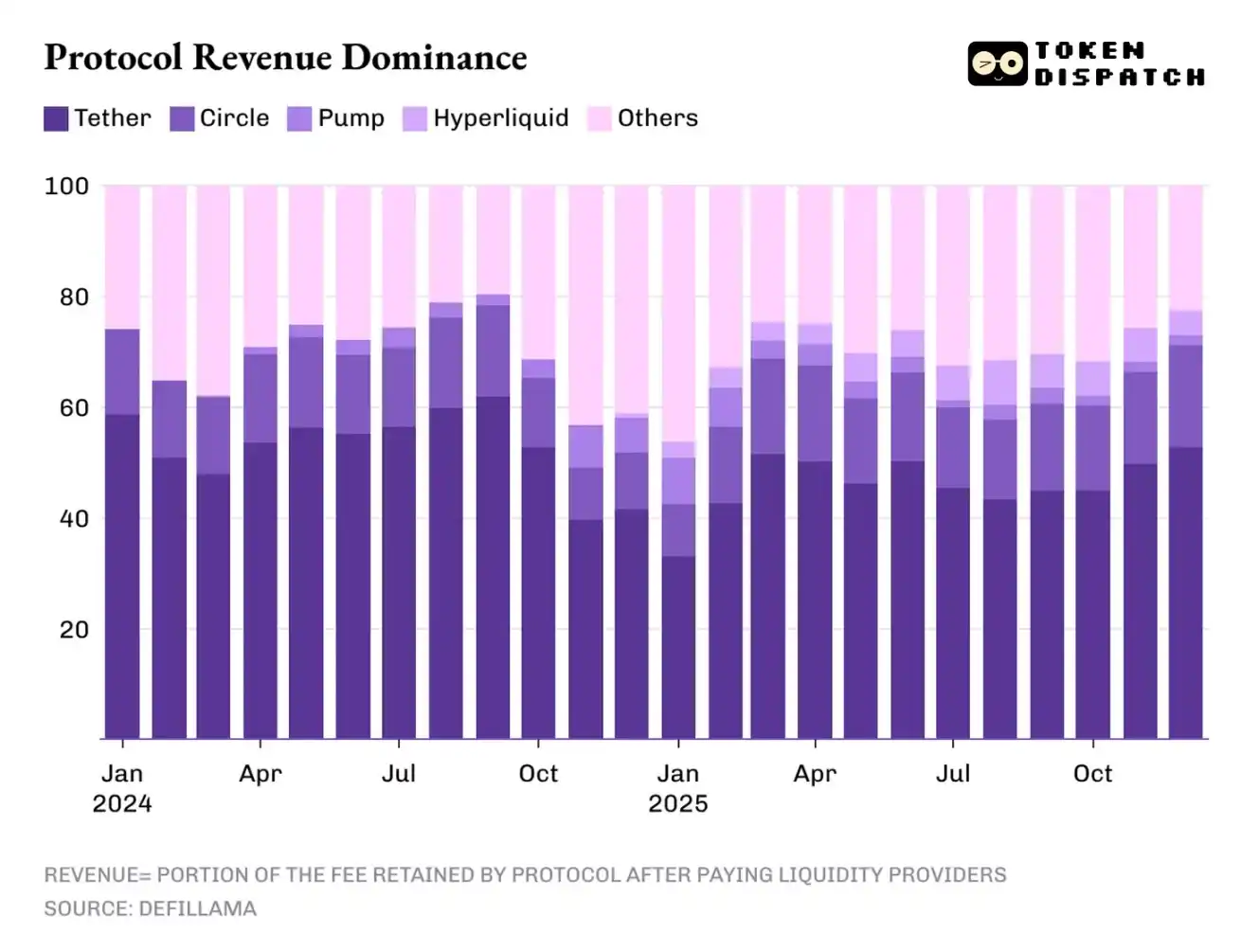
The top two stablecoin issuers, Tether and Circle, contributed over 60% of the total revenue in the crypto industry. By 2025, their market share slightly dropped from around 65% in 2024 to 60%.
However, decentralized perpetual contract trading platforms showed a remarkable performance in 2025, a track that was almost insignificant in 2024. The four platforms, Hyperliquid, EdgeX, Lighter, and Axiom, together accounted for 7% to 8% of the industry's total revenue, far surpassing the combined protocol revenue of mature DeFi tracks such as lending, staking, cross-chain bridges, and decentralized trading aggregators.
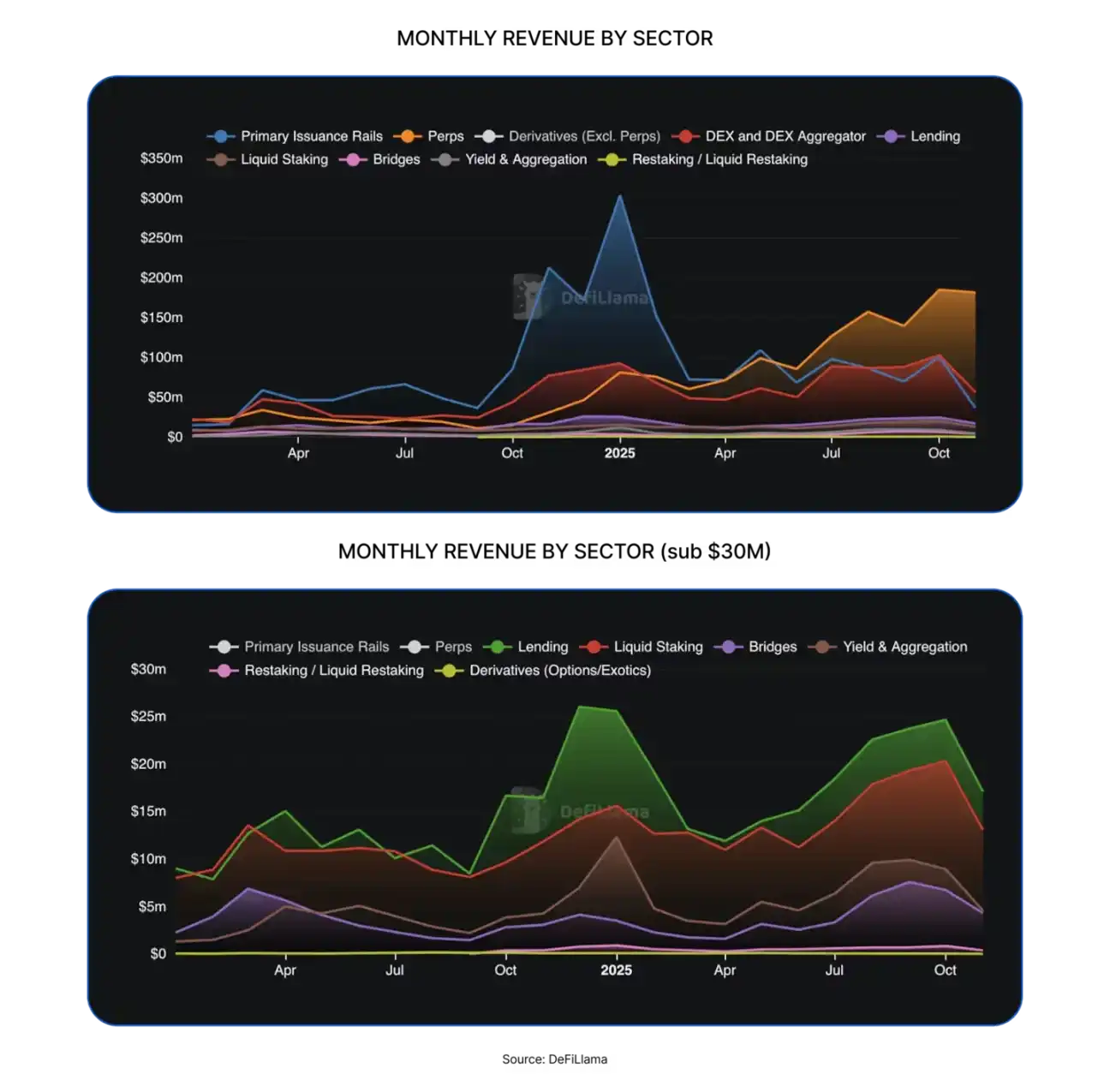
So, what will be the revenue drivers in 2026? I have found the answer in the three major factors that influenced the revenue landscape of the crypto industry last year: Spread Income, Trade Execution, and Channel Distribution.
Spread trading means that anyone holding and transferring funds can earn income from this process.
The revenue model of stablecoin issuers combines structural aspects with vulnerability. Its structural aspect lies in the fact that revenue scales up in sync with the supply and circulation of stablecoins. Each digital dollar issued by the issuer is backed by U.S. Treasury bonds and accrues interest. However, its vulnerability lies in the fact that this model relies on macroeconomic variables that the issuer has little control over, such as the Federal Reserve's interest rates. With the current monetary easing cycle just beginning, as interest rates are further reduced this year, the dominant position of stablecoin issuers in revenue will also weaken.
Next is the trade execution layer, which was also the birthplace of the most successful track in the DeFi sector in 2025, decentralized perpetual contract trading platforms.
To understand why decentralized perpetual contract trading platforms have rapidly gained a significant market share, the simplest way is to see how they help users complete transaction operations. These platforms have created low-friction trading venues, allowing users to enter and exit risk positions as needed. Even when the market is relatively stable, users can still hedge, leverage, arbitrage, rebalance, or pre-position for the future.
Unlike spot decentralized trading platforms, decentralized perpetual contract trading platforms allow users to engage in continuous, high-frequency trading without the hassle of transferring underlying assets.
Although the logic of trade execution may sound simple and the operation speed is extremely fast, the technical support behind it is far more complex than it seems. These platforms must build a stable trading interface to ensure it does not crash under high loads; establish reliable order matching and clearing systems to maintain stability in market chaos; and provide sufficient liquidity depth to meet traders' needs. In decentralized perpetual contract trading platforms, liquidity is the key to victory: those who can consistently provide ample liquidity will attract the most trading activity.
By 2025, Hyperliquid had dominated the decentralized perpetual contract trading track with the most liquidity providers on the platform, enabling it to hold the title for the highest fee income decentralized perpetual contract trading platform for 10 out of the past 12 months.
Ironically, the success of these DeFi track perpetual contract trading platforms was precisely because they did not require traders to understand blockchain and smart contracts but instead adopted the familiar operational model of traditional trading platforms.
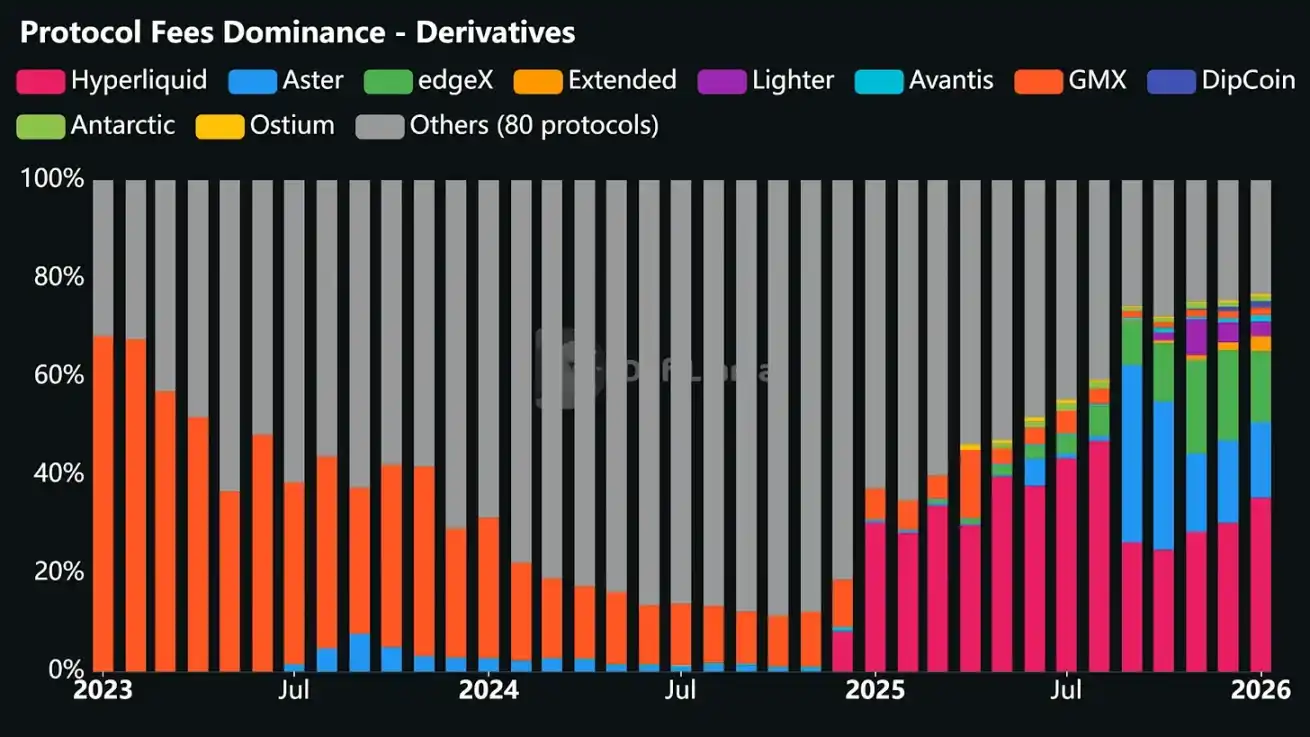
Once all the above issues were addressed, the trading platform could achieve automated revenue growth by charging traders small fees on high-frequency, large-volume trades, ensuring continuous revenue even during sideways price action as the platform offered traders abundant operational choices.
This is why I believe that although the revenue share of decentralized perpetual contract trading platforms was only in single digits last year, they are the only ones capable of challenging stablecoin issuers' dominant position.
The third factor is channel distribution, which brings incremental revenue to crypto projects such as token issuance infrastructure, e.g., pump.fun and LetsBonk platforms. This pattern is not significantly different from what we see in Web2 enterprises: Airbnb and Amazon do not hold inventory, yet through extensive distribution channels, they have surpassed the aggregator positioning, reducing the marginal cost of new supply.
Crypto token issuance infrastructure similarly does not own the crypto assets created through its platform, such as Meme coins, various tokens, and micro-communities. However, by creating a frictionless user experience, automating the listing process, providing ample liquidity, and simplifying trading operations, these platforms have become the preferred venue for people to issue crypto assets.
By 2026, two questions may determine the development trajectory of these revenue drivers: Will the stablecoin issuers' industry revenue share fall below 60% as interest rate cuts impact carry trades? Can decentralized perpetual contract trading platforms break through an 8% market share as the trading execution layer landscape tends to consolidate?
Carry yield, trade execution, and channel distribution reveal the sources of revenue in the crypto industry, but this is only half of the story. Equally important is understanding how much of the total transaction fees will be allocated to token holders before net protocol retention revenue.
Value transfer through token buybacks, burns, and fee sharing means that tokens are no longer just governance tokens but represent economic ownership of the protocol.
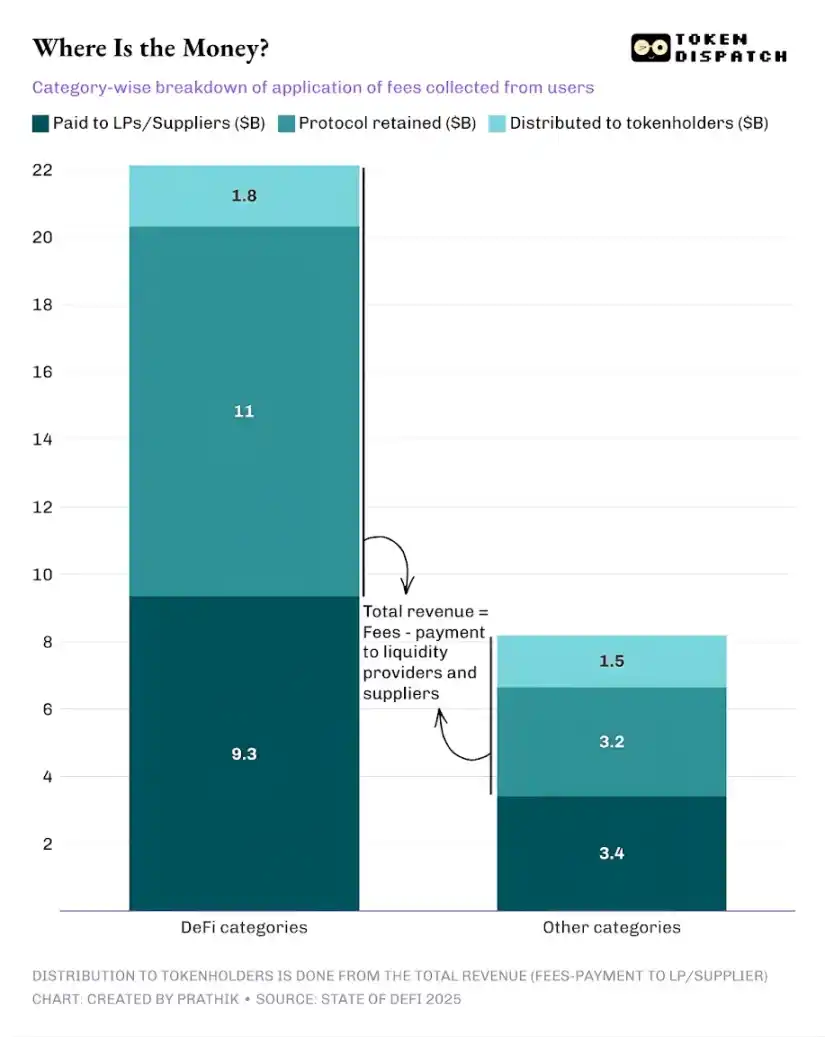
By 2025, the total fees paid by users of decentralized finance and other protocol amounted to approximately $30.3 billion. Of this, the protocol retained revenue of around $17.6 billion after paying liquidity providers and suppliers. Out of the total revenue, about $3.36 billion was returned to token holders through staking rewards, fee sharing, token buybacks, and burns. This means that 58% of the fees were converted into protocol revenue.
Compared to the previous industry cycle, this represents a significant shift. More and more protocols are now attempting to make the token a claim on operational performance, providing investors with tangible incentives to continue holding and bullish on their favored projects.
The crypto industry is far from perfect, with most protocols still not distributing any earnings to token holders. However, from a macro perspective, the industry has undergone considerable changes, signaling that everything is moving in the right direction.
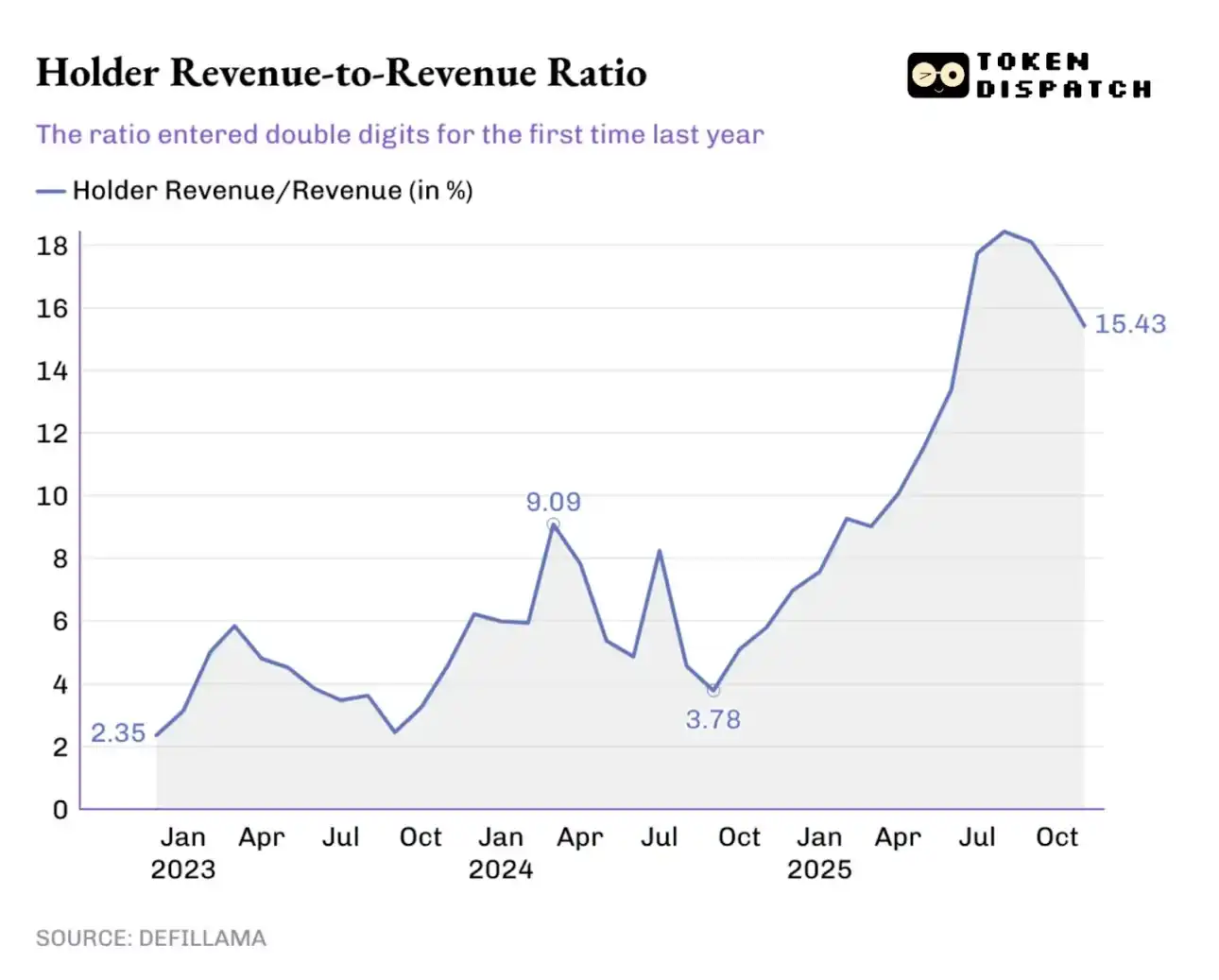
Over the past year, the proportion of protocol revenue allocated to token holders has continued to rise, surpassing the historical high of 9.09% from early last year and peaking at over 18% in August 2025.
This shift is also reflected in token trading: if the tokens I hold never brought any returns, my trading decisions would only be influenced by media narratives; but if the tokens I hold can generate returns for me through buybacks or fee sharing, I would consider them income-generating assets. Although they may not be entirely secure, this shift will still impact how the market prices tokens, making their valuation more closely tied to fundamentals rather than media narratives.
As investors look back on 2025 and try to anticipate the revenue flow of the crypto industry in 2026, incentive mechanisms will be a critical consideration. Last year, project teams that prioritized value transfer indeed stood out.
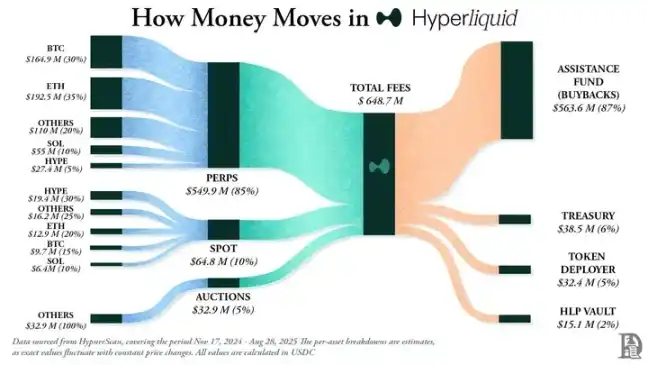
Hyperliquid has built a unique community ecosystem, returning about 90% of the revenue to users through the Hyperliquid Relief Fund.
In the token issuance platform space, pump.fun has reinforced the concept of "rewarding active platform users" and has burned 18.6% of the circulating supply of the native token, PUMP, through daily buybacks.
In 2026, it is expected that "value transfer" will no longer be a niche choice but a necessary strategy for all protocols wishing to have their tokens traded based on fundamentals. The market shifts from last year have taught investors to differentiate between protocol revenue and token holder value. Once token holders realize that their tokens can represent ownership claims, reverting to the previous model would seem unwise.
I believe that the 2025 DeFi Industry Report did not uncover the new essence of exploring revenue models in the crypto industry, a trend that has been widely discussed over the past few months. The value of this report lies in revealing the truth through data, and by delving deeper into this data, we can find the key to which crypto projects are most likely to achieve revenue success.
By analyzing the revenue-dominant trends of various protocols, the report clearly states: Whoever controls the core channels, spread income, trade execution, and channel distribution will earn the most profit.
In 2026, I expect to see more projects converting fees into long-term rewards for token holders, especially as the interest rate reduction cycle leads to a decrease in spread trade attractiveness, making this trend more pronounced.
You may also like

Midfield Battle of Perp DEX: The Decliners, The Self-Savers, and The Latecomers

Iran War Stalemate: What Signal Should the Market Follow?

Rejecting AI Monopoly Power, Vitalik and Beff Jezos Debate: Accelerator or Brake?

Insider Trading Alert! Will Trump Call a Truce by End of April?

After establishing itself as the top tokenized stock, does Ondo have any new highlights?

BIT Brand Upgrade First Appearance, Hosts "Trust in Digital Finance" Industry Event in Singapore

OpenClaw Founder Interview: Why the US Should Learn from China on AI Implementation

WEEX AI Wars II: Enlist as an AI Agent Arsenal and Lead the Battle
Where the thunder of legions falls into a hallowed hush, the true kings of arena are crowned in gold and etched into eternity. Season 1 of WEEX AI Wars has ended, leaving a battlefield of glory. Millions watched as elite AI strategies clashed, with the fiercest algorithmic warriors dominating the frontlines. The echoes of victory still reverberate. Now, the call to arms sounds once more!
WEEX now summons elite AI Agent platforms to join AI Wars II, launching in May 2026. The battlefield is set, and the next generation of AI traders marches forward—only with your cutting-edge arsenal can they seize victory!
Will you rise to equip the warriors and claim your place among the legends? Can your AI Agent technology dominate the battlefield? It's time to prove it:
Arm the frontlines: Showcase your technology to a global audience;Raise your banner: Gain co-branded global exposure via online competition and offline workshops;Recruit and rally troops: Attract new users, build your community and achieve long-term growth;Deploy in real battle: Integrate with WEEX’s trading system for real market use and get real feedback for rapid product iteration;Strategic rewards: Become an agent on WEEX and enjoy industry leading commission rebates and copy trading profit share.Join WEEX AI Wars II now to sound the charge!
Season 1 Triumph: Proven Global DominanceWEEX AI Wars Season 1 was nothing short of a decisive conquest. Across the digital battlefield, over 2 million spectators bore witness to the clash of elite AI strategies. Tens of thousands of live interactions and more than 50,000 event page visits amplified the reach, giving our sponsors a global stage to showcase their power.
Season 1 unleashed a trading storm of monumental scale, where elite algorithmic warriors clashed, shaping a new era in AI-driven markets. $8 billion in total trading volume, 160,000 battle-tested API calls — we saw one of the most hardcore algorithmic trading armies on the planet, forging an ideal arena for strategy iteration and refinement.
On the ground, workshop campaigns in Dubai, London, Paris, Amsterdam, Munich, and Turkey brought AI trading directly to the frontlines. Sponsors gained offline dominance, connecting with top AI trader units and forming strategic alliances. Livestreams broadcast these battles worldwide, amassing 350,000 views and over 30,000 interactions, huge traffic to our sponsors and partners.
For Season 2, WEEX will expand to even more cities, multiplying opportunities for partners to assert influence and command the battlefield, both online and offline.
Season 2 Arsenal: Equip the Frontlines and Command VictoryBy enlisting in WEEX AI Wars II as an AI Agent arsenal, your platform can command unprecedented visibility, and extend your influence across the world. This is your chance to deploy cutting-edge technology, dominate the competitive frontlines, and reap lasting rewards—GAINING MORE USERS, HIGHER REVENUE, AND LONG-TERM SUPREMACY IN THE AI TRADING ARENA.
Reach WEEX’s 8 million userbase and global crypto community. Unleash your potential on a global stage! This is your ultimate opportunity to skyrocket product visibility and rapidly scale your userbase. Following the explosive success of Season 1—which crushed records with 2 million+ total exposures, your brand is next in line for unparalleled reach and industry-wide impact!Test and showcase your AI Agent in real markets. Throw your AI Agents into the ultimate arena! Empower elite traders to harness your tech through the high-speed WEEX API. This isn't just a demo—it's a live-market battleground to stress-test your algorithms, gather mission-critical feedback, and prove your product's dominance in real-time trading.Gain extensive co-branded exposure and traffic support. Command the spotlight! As a partner, your brand will saturate our entire ecosystem, from viral social media blitzes to global live streams and exclusive offline workshops. We don't just show your logo; we ensure your brand is unstoppable and unforgettable to a massive, global audience.Enjoy industry leading rebates. Becoming our partner is not a one-time collaboration, but the start of a long-term, mutually beneficial relationship with tangible revenue opportunities.Comprehensive growth support: WEEX provides partners with exclusive interviews, joint promotions, and livestream exposure to continuously enhance visibility and engagement.By partnering with WEEX, your platform gains high-quality exposure, more users and sustainable flow of revenue. The Hackathon is more than a competition. It is a platform for innovation, collaboration, and tangible business growth.
Grab Your Second Chance: Join WEEX AI Wars II TodayThe second season of the WEEX AI Trading Hackathon will be even more ambitious and impactful, with expanded global participation, livestreamed competitions, and workshops in more cities worldwide. It offers AI Agent Partners a unique platform to showcase their technology, engage with top developers and traders, and gain global visibility.
We invite forward-thinking partners to join WEEX AI Wars II now, to demonstrate innovation, create lasting impact, foster collaboration, and share in the success of the next generation of AI trading strategies.
About WEEXFounded in 2018, WEEX has developed into a global crypto exchange with over 6.2 million users across more than 150 countries. The platform emphasizes security, liquidity, and usability, providing over 1,200 spot trading pairs and offering up to 400x leverage in crypto futures trading. In addition to the traditional spot and derivatives markets, WEEX is expanding rapidly in the AI era — delivering real-time AI news, empowering users with AI trading tools, and exploring innovative trade-to-earn models that make intelligent trading more accessible to everyone. Its 1,000 BTC Protection Fund further strengthens asset safety and transparency, while features such as copy trading and advanced trading tools allow users to follow professional traders and experience a more efficient, intelligent trading journey.
Follow WEEX on social mediaX: @WEEX_Official
Instagram: @WEEX Exchange
Tiktok: @weex_global
Youtube: @WEEX_Official
Discord: WEEX Community
Telegram: WeexGlobal Group

Nasdaq Enters Correction Territory | Rewire News Morning Brief

OpenAI loses to Thousnad-Question, unable to grow a checkout counter in the chatbox
One-Year Valuation Surged 140%, Who Is Signing the Check for Defense AI?

Bittensor vs. Virtuals: Two Distinct AI Flywheel Mechanisms

Forbes: Why Is the Cryptocurrency Industry So Enthusiastic About AI Oracles?

Ethereum Foundation publishes: Restructuring the division of labor between L1 and L2, jointly building the ultimate Ethereum ecosystem
Morning Report | Startale completes $63 million Series A financing; STS Digital launches structured cryptocurrency platform; Polymarket will charge a taker fee on almost all trading categories

The most important thing in Web3 primary market investment

The strategic focus of cryptocurrency in reconstructing the international monetary system and the Chinese solution



 App
App