
 Buy Crypto
- Markets
 Futures
- Spot
- Copy Trade
- Earn
- More
WSJ Reveals: A Silicon Valley-Clad Startup Has Become Venezuela's Crypto Hub

Original Article Title: How a Silicon Valley Startup Became a Crypto Lifeline for Venezuela
Original Article Author: Ben Foldy, The Wall Street Journal
Original Article Translation: Luffy, Foresight News
The founder of the financial technology startup Kontigo enthusiastically embraced Silicon Valley's playbook: moving the company into a San Francisco residential building, hosting hackathons suitable for viral TikTok spreads, using buzzwords in pitches claiming to build the "New Bank of Latin America," and even making grandiose statements about pioneering the Martian economy.
This approach allowed this small-scale, flamboyant crypto startup to successfully join the top-tier Y Combinator accelerator and raise over $20 million in funding in December last year from well-known Silicon Valley investors like Coinbase Ventures.
However, recent U.S. military actions in Venezuela have thrust Kontigo's business's highly contentious side into the spotlight: it has become a critical channel for funds in and out of Venezuela's heavily sanctioned economy.
Now, Kontigo is facing disruptions in banking and payment network services, including JPMorgan Chase, Stripe, and Bridge, while also dealing with undisclosed allegations of ties to the ousted Maduro regime, which Kontigo denies.
A Kontigo spokesperson declined to answer questions about business details but stated in a release that the company is reviewing its operational model.
"Kontigo is committed to expanding financial access to underserved populations," the spokesperson said. "We are conducting an internal review and will provide updates at the appropriate time. We abide by U.S. laws, including regulations related to U.S. sanctions, and are evaluating existing sanctions compliance processes and mechanisms to improve them if necessary."
Founded in 2023 by Venezuelan Jesus Castillo, Kontigo positioned himself as a "David" about to defeat mainstream banking giants. The company claims its 1.2 million users in Latin and South America have processed over $1 billion in funds through the platform. The app allows users to convert fiat currency into a U.S. dollar-pegged stablecoin to facilitate payments and access the traditional banking system.
Outside of Venezuela, the image the company portrays to investors is that of a platform helping the average Latin American facing hyperinflation. But within Venezuela, it has become a workaround for U.S. sanctions, which aim to sever key sectors of the Maduro regime from the international financial system.
According to a presentation slide shown at an invitation-only partner introduction event in Caracas last December, an economist invited by Kontigo explained how the company's technology helps the Maduro regime evade U.S. sanctions on the country's oil exports and repatriate oil sales revenue back into the domestic economy in cryptocurrency form.
With sanctions cutting off Venezuela's traditional financial channels, the government has increasingly relied on stablecoins for oil sales. The economist showcased at the event that in the second half of last year, nearly 80% of the country's oil revenue was received in stablecoin form. These funds were then exchanged into bolivars through banks, informal exchange desks, and government-authorized crypto trading platforms like Kontigo.
One slide read: "Crypto Market to the Rescue."
For months, Kontigo facilitated transfers between users' accounts at JPMorgan Chase, most of which were subject to sanction prohibitions, through intermediary channels.
At the end of last year, JPMorgan Chase suddenly took steps to cut off these channels. Sources revealed that Stripe, which had processed payments and transactions for Kontigo, has also terminated its cooperation with the company.
Sources stated that when Kontigo reached an agreement with another U.S. financial institution, company executives informed them that they had no actual operations within Venezuela. The recent partner has taken steps to terminate its relationship with Kontigo.

Amid U.S. Sanctions, Venezuela Turns to Stablecoins for Oil Sales
Domestically in the U.S.: A High-Profile Startup
Castillo co-founded Kontigo with the aim of using blockchain technology to address Venezuela's daily financial woes, where hyperinflation and lack of credit make it difficult for people to preserve their savings. The platform allows users to convert bolivars into a USD-pegged, more stable cryptocurrency.
To U.S. investors, Castillo packaged his startup as a group of immigrant dreamers working hard, early investors said they were drawn to this vision of helping those truly in need.
In promotional materials, the company referred to Castillo and colleagues taking turns driving for Uber to make ends meet while building the company, with a focus on creating a financial system adapted to the "multi-planetary abundance era" to avoid "exporting Earth's monetary and economic failures to Mars."
In mid-2025, according to a promotional video released on LinkedIn, Kontigo began offering users a JPMorgan Chase-sponsored free "virtual" U.S. bank account. Sources familiar with the matter stated that these accounts were provided through another fintech startup called Checkbook, and JPMorgan Chase had no direct banking relationship with Kontigo. Nevertheless, Kontigo still used the Chase bank brand logo in its advertising.
In December of last year, just weeks before the attempted U.S. invasion to overthrow the Maduro regime, Kontigo announced that it had secured a $20 million funding round, with investors including Coinbase Ventures, Alumni Ventures, and DST Capital. Coinbase, Alumni, and DST did not respond to requests for comments.
Following the funding round, Castillo posted a video on LinkedIn boasting about his purported "$23 million" Silicon Valley mansion, where he and his team of 7 would reside without external interruptions, aiming to increase their annual revenue to $100 million within 60 days.
"If you are not willing to move the entire team to San Francisco, lock yourself in a house until the goal is met, then you are not serious enough, you do not have our level of thirst for success, you are bound to fail," Castillo stated.
According to a promotional video, the funding coincided with a rebranding effort for the company, with Kontigo claiming to enable users worldwide to buy and sell USD-pegged cryptocurrency without providing identification documents.
"Jamie Dimon, here we come," Castillo posted on LinkedIn, calling out the JPMorgan Chase CEO and once again boasting about building the "world's largest bank."
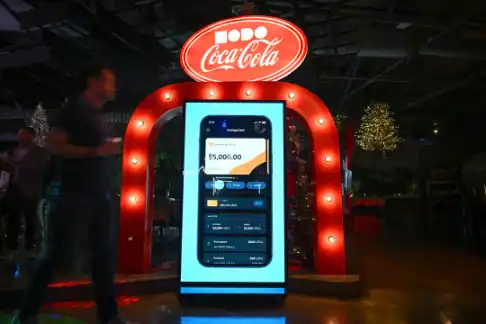
Display of a large screen showcasing the Kontigo cryptocurrency app interface, with a $5,000 balance and transaction history
Within Venezuela: Another Narrative
In Venezuela, Kontigo operates with a license issued by the country's cryptocurrency regulator, Sunacrip, and has government approval to conduct crypto business. The license was granted to a Venezuelan company named Oha Technology, signed by the Venezuelan Minister of Finance.
Afterwards, Kontigo seemed to attempt to distance itself from Oha, stating that it collaborates with local institutions in all markets. However, until recently, Kontigo's official website still displayed its operational license issued by Sunacrip and listed Oha as a subsidiary in Venezuela. Castillo's personal website shows that he served as the Chief Operating Officer of Oha AI. In private group chat messages seen by The Wall Street Journal, Castillo celebrated obtaining the Sunacrip license in January 2025 and shared the license documents.
During an invitation-only launch event in Caracas, a company spokesperson emphasized the increasingly important role of cryptocurrency in the Venezuelan economy. Economist Asdrúbal Oliveros told the audience that revenue from sanctioned oil sales is received in stablecoin form, which then flows into Kontigo and its licensed crypto platform competitors like Crixto.
Venezuelan Kontigo users can use the application to transfer funds to their Venezuelan bank accounts, even if the bank is under sanctions by the U.S. Department of the Treasury.
Turning Point
Shortly after announcing a successful funding round, Kontigo's situation took a sharp turn.
At the end of last December, an article in The Information exposed the news that Kontigo had been cut off from services by JPMorgan Chase.
Days later, a U.S. military operation overthrew President Maduro. Shortly after, influential independent fintech journalist Jason Mikula wrote an article accusing Kontigo of having a secret relationship with one of Maduro's sons.
Kontigo promptly fought back.
When Sebastian Siemiatkowski, CEO of the payment platform Klarna, shared Mikula's article on Platform X, Kontigo's official account replied, stating that the company "will hold accountable those spreading this false information as they harm the company's business reputation."
Subsequently, Kontigo informed users that the platform had suffered a hacker attack, with a total of 1005 users losing approximately $341,000. The company stated that it had fully compensated users for their losses.
In a 9-minute video posted on social media on January 12th, Castillo stated in Spanish that the platform was under simultaneous attack by hackers and critics and denied any association between Kontigo and the Maduro regime.
“The fact is, Kontigo's success is the result of years of hard work, resilience, and perseverance. We are not anyone's son-in-law, nephew, or cousin,” he said.
Nevertheless, as the issue continued to escalate, the company's operations seemed to be facing increasing challenges. According to sources familiar with the matter, both Stripe and Bridge have terminated their partnerships with Kontigo, and users reported that PayPal is no longer processing payments for the app. The Venezuelan crypto regulatory license held by Oha Technology expired on January 8.
The main public encrypted wallet featured on Kontigo's official website has seen little to no transaction activity in the past few days. In the preceding months, the wallet had a weekly transaction volume in the hundreds of thousands of dollars, but since January 19, only a few transactions of about $1 each have been recorded.
You may also like

From x402 to MPP: Cloudflare's crucial vote, will it go to Coinbase or Stripe?

BlackRock CEO issues annual open letter: The wave of tokenization has arrived, and we will lead this trend

When Backpack backstabs the community

When gold is no longer a safe haven, and Bitcoin continues to panic

Trump, the World's Largest Oil Trader

If the US and Iran have not reached an agreement in 5 days, what other cards does Trump have?

Tether Whale Dumps £12 Million, Backing Crypto’s ‘British Trump’
Ethereum Foundation Post: Rethinking the Division of Work Between L1 and L2 to Build the Ultimate Ethereum Ecosystem

Two Major Prediction Market Platforms Unite Rarely, What Is the Story Behind This New Fund?

WEEX Official Product Launch: Win LALIGA Tickets & Unlock the 3-in-1 Crypto Trading Suite
Trade crypto without downloading an app. Join the WEEX H5, API, SKILLs livestream to explore the new trading experience, win LALIGA VIP tickets, and share 420 USDT rewards.
Dragonfly Partners: Most agents will not engage in autonomous trading, how can crypto payments prevail?

US AI Startup Goes All In on Chinese Mega-Model | Rewire News Morning Brief

Trump Lies Again: A "Five-Day Pause" Psyop, How Wall Street, Bitcoin, and Polymarket Insiders Synced Uposciogen

When a Token Becomes Labor, People Become the Interface

Ceasefire News Leaked Ahead of Time? Large Polymarket Bets on Outcome Before Trump's Tweet
BlackRock CEO's Annual Shareholder Letter: How is Wall Street Using AI to Keep Profiting from National Pension Funds?

Sun Valley Releases 2025 Financial Report: Bitcoin Mining Revenue Reaches $670 Million, Accelerating Transformation to AI Infrastructure Platform
On March 16, 2026, in Dallas, Texas, USA, CanGu Company (New York Stock Exchange code: CANG, hereinafter referred to as "CanGu" or the "Company") today announced its unaudited financial performance for the fourth quarter and full year ended December 31, 2025. As a btc-42">bitcoin mining enterprise relying on a globally operated layout and dedicated to building an integrated energy and AI computing power platform, CanGu is actively advancing its business transformation and infrastructure development.
• Financial Performance:
Total revenue for the full year 2025 was $688.1 million, with $179.5 million in the fourth quarter.
Bitcoin mining business revenue for the full year was $675.5 million, with $172.4 million in the fourth quarter.
Full-year adjusted EBITDA was $24.5 million, while the fourth quarter was -$156.3 million.
• Mining Operations and Costs:
A total of 6,594.6 bitcoins were mined throughout the year, averaging 18.07 bitcoins per day; of which 1,718.3 bitcoins were mined in the fourth quarter, averaging 18.68 bitcoins per day.
The average mining cost for the full year (excluding miner depreciation) was $79,707 per bitcoin, and for the fourth quarter, it was $84,552;
The all-in sustaining costs were $97,272 and $106,251 per bitcoin, respectively.
As of the end of December 2025, the company has cumulatively produced 7,528.4 bitcoins since entering the bitcoin mining business.
• Strategic Progress:
The company has completed the termination of the American Depositary Receipt (ADR) program and transitioned to a direct listing on the NYSE to enhance information transparency and align with its strategic direction, with a long-term goal of expanding its investor base.
CEO Paul Yu stated: "2025 marked the company's first full year as a bitcoin mining enterprise, characterized by rapid execution and structural reshaping. We completed a comprehensive adjustment of our asset system and established a globally distributed mining network. Additionally, the company introduced a new management team, further strengthening our capabilities and competitive advantage in the digital asset and energy infrastructure space. The completion of the NYSE direct listing and USD pricing also signifies our transformation into a global AI infrastructure company."
"As we enter 2026, the company will continue to optimize its balance sheet structure and enhance operational efficiency and cost resilience through adjustments to the miner portfolio. At the same time, we are advancing our strategic transformation into an AI infrastructure provider. Leveraging EcoHash, we will utilize our capabilities in scalable computing power and energy networks to provide cost-effective AI inference solutions. The relevant site transformations and product development are progressing simultaneously, and the company is well-positioned to sustain its execution in the new phase."
The company's Chief Financial Officer, Michael Zhang, stated: "By 2025, the company is expected to achieve significant revenue growth through its scaled mining operations. Despite recording a net loss of $452.8 million from ongoing operations, mainly due to one-time transformation costs and market-driven fair value adjustments, the company, from a financial perspective, will reduce its leverage, optimize its Bitcoin reserve strategy and liquidity management, introduce new capital to strengthen its financial position, and seize investment opportunities in high-potential areas such as AI infrastructure while navigating market volatility."
The total revenue for the fourth quarter was $1.795 billion. Of this, the Bitcoin mining business contributed $1.724 billion in revenue, generating 1,718.3 Bitcoins during the quarter. Revenue from the international automobile trading business was $4.8 million.
The total operating costs and expenses for the fourth quarter amounted to $4.56 billion, primarily attributed to expenses related to the Bitcoin mining business, as well as impairment of mining machines and fair value losses on Bitcoin collateral receivables.
This includes:
· Cost of Revenue (excluding depreciation): $1.553 billion
· Cost of Revenue (depreciation): $38.1 million
· Operating Expenses: $9.9 million (including related-party expenses of $1.1 million)
· Mining Machine Impairment Loss: $81.4 million
· Fair Value Loss on Bitcoin Collateral Receivables: $171.4 million
The operating loss for the fourth quarter was $276.6 million, a significant increase from a loss of $0.7 million in the same period of 2024, primarily due to the downward trend in Bitcoin prices.
The net loss from ongoing operations was $285 million, compared to a net profit of $2.4 million in the same period last year.
The adjusted EBITDA was -$156.3 million, compared to $2.4 million in the same period last year.
The total revenue for the full year was $6.881 billion. Of this, the revenue from the Bitcoin mining business was $6.755 billion, with a total output of 6,594.6 Bitcoins for the year. Revenue from the international automobile trading business was $9.8 million.
The total annual operating costs and expenses amount to $1.1 billion.
Specifically, they include:
· Revenue Cost (excluding depreciation): $543.3 million
· Revenue Cost (depreciation): $116.6 million
· Operating Expenses: $28.9 million (including related-party expenses of $1.1 million)
· Miner Impairment Loss: $338.3 million
· Bitcoin Collateral Receivable Fair Value Change Loss: $96.5 million
The full-year operating loss is $437.1 million. The continuing operations net loss is $452.8 million, while in 2024, there was a net profit of $4.8 million.
The 2025 non-GAAP adjusted net profit is $24.5 million (compared to $5.7 million in 2024). This measure does not include share-based compensation expenses; refer to "Use of Non-GAAP Financial Measures" for details.
As of December 31, 2025, the company's key assets and liabilities are as follows:
· Cash and Cash Equivalents: $41.2 million
· Bitcoin Collateral Receivable (Non-current, related party): $663.0 million
· Miner Net Value: $248.7 million
· Long-Term Debt (related party): $557.6 million
In February 2026, the company sold 4,451 bitcoins and repaid a portion of related-party long-term debt to reduce financial leverage and optimize the asset-liability structure.
As per the stock repurchase plan disclosed on March 13, 2025, as of December 31, 2025, the company had repurchased a total of 890,155 shares of Class A common stock for approximately $1.2 million.



 App
App