
ZEN Rises for 3 Consecutive Days, Can "Grayscale Exclusive" Buy Alongside?


Original Article Title: "ZEN Sees 3-Day Consecutive Gains, Can Grayscale Trust Holdings Follow the Buy Signal?"
Original Article Link: shaofaye123, Foresight News
Recently, Grayscale has successively launched the Optimism Trust Fund and the Lido Trust Fund. Despite a temporary pullback, assets in the trust funds, including SUI and ZEN, have continued to rise. Are Grayscale's trust funds truly a collection of blue-chip tokens, and are they profitable in the long term? This article takes you through an overview of the 26 crypto trusts currently offered by Grayscale and their investment returns.
Grayscale Crypto Trust Overview
Grayscale is a digital asset management company established in 2013, primarily offering various cryptocurrency trust funds aimed at providing investors with a legitimate, regulated investment channel. As one of the world's largest cryptocurrency asset management firms, it manages billions of dollars in assets. To date, Grayscale has launched 26 crypto trusts.
Grayscale Trust Funds are a series of cryptocurrency investment products provided by Grayscale, allowing investors to indirectly hold cryptocurrencies such as Bitcoin and Ethereum without the need to directly purchase and manage the assets. Each trust fund is pegged to a specific cryptocurrency, such as the Grayscale Bitcoin Trust Fund (GBTC) and the Grayscale Ethereum Trust Fund (ETHE). Through these trust funds, investors can buy and sell shares of cryptocurrency on the public market akin to investing in traditional stocks.
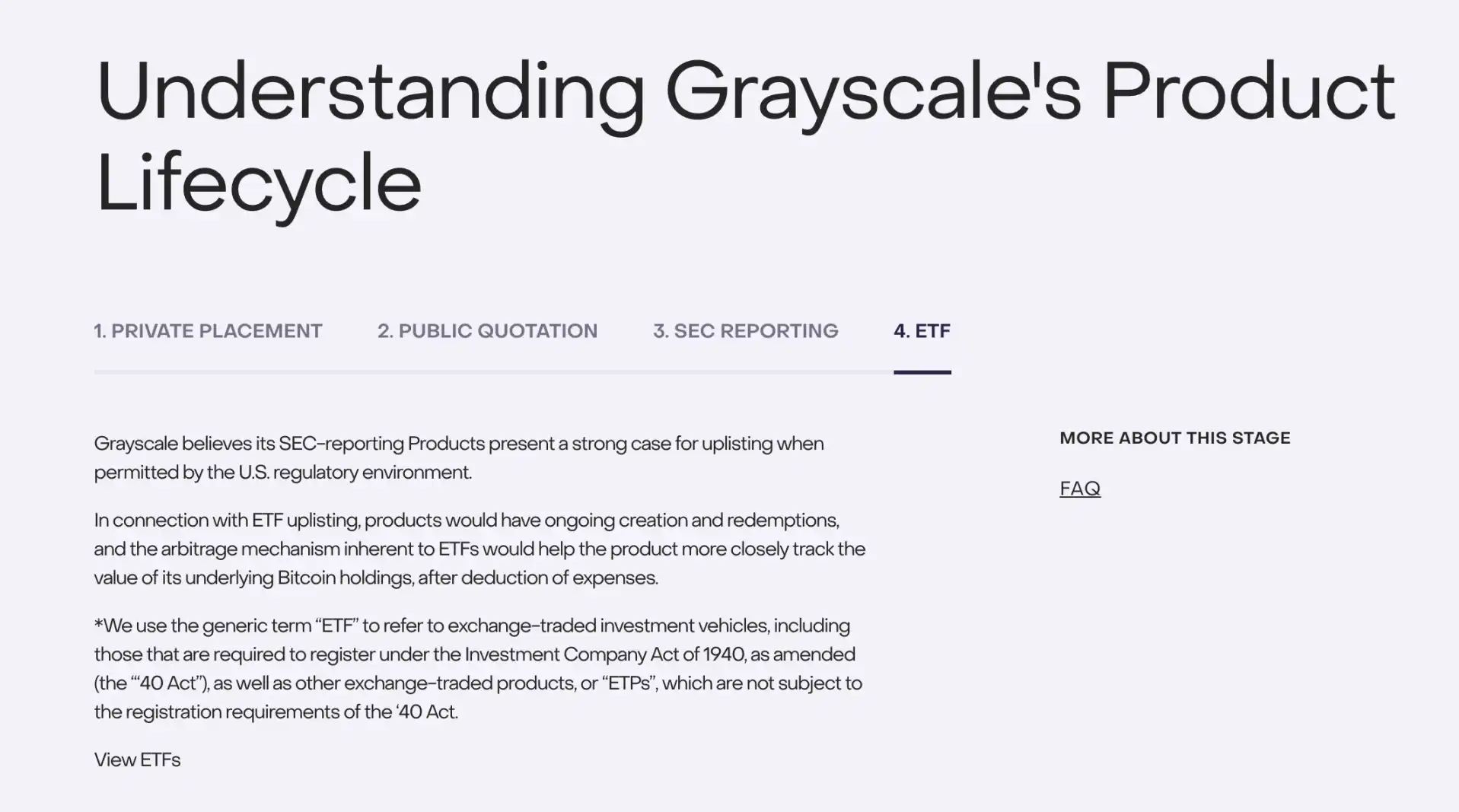
In addition to single-currency trust funds, Grayscale's combination funds of various coins also hold significant investment reference value. The crypto trusts under Grayscale currently go through three main stages in their product cycles, excluding ETFs.
· PRIVATE PLACEMENT: Initially, Grayscale products are offered through private placements, allowing eligible investors to participate in cryptocurrency investments. The shares purchased in private placements have an initial lock-up period of one year. Currently, trusts like the Grayscale Sui Trust and Grayscale Lido DAO Trust are in this stage.
· PUBLIC QUOTATION: In the form of public trading, this stage allows all investors to participate in cryptocurrency investments. However, due to the lack of a continuous buyback plan, publicly traded shares may trade at a premium or discount to the value of their underlying assets. Currently, assets like MANA, GLNK, and DEFG are in this stage.
· SEC REPORTING: Grayscale is the first company to report to the SEC. The SEC reporting requirement will further enhance the disclosure level, provide greater transparency to investors, and subject the products to additional regulatory oversight. Currently, ETCG, ZCSH, HZEN, and others are in this phase.
In the Long Run, Beating BTC Is Challenging
According to reports, Grayscale had a significant impact on the cryptocurrency market during the bull run from 2020 to 2021, when Grayscale significantly increased the asset under management of the Bitcoin Trust, bringing in a large number of institutional investors into the crypto space. However, other crypto assets launched by Grayscale during this period have shown mixed short-term performance and have struggled to outperform BTC in the long term.
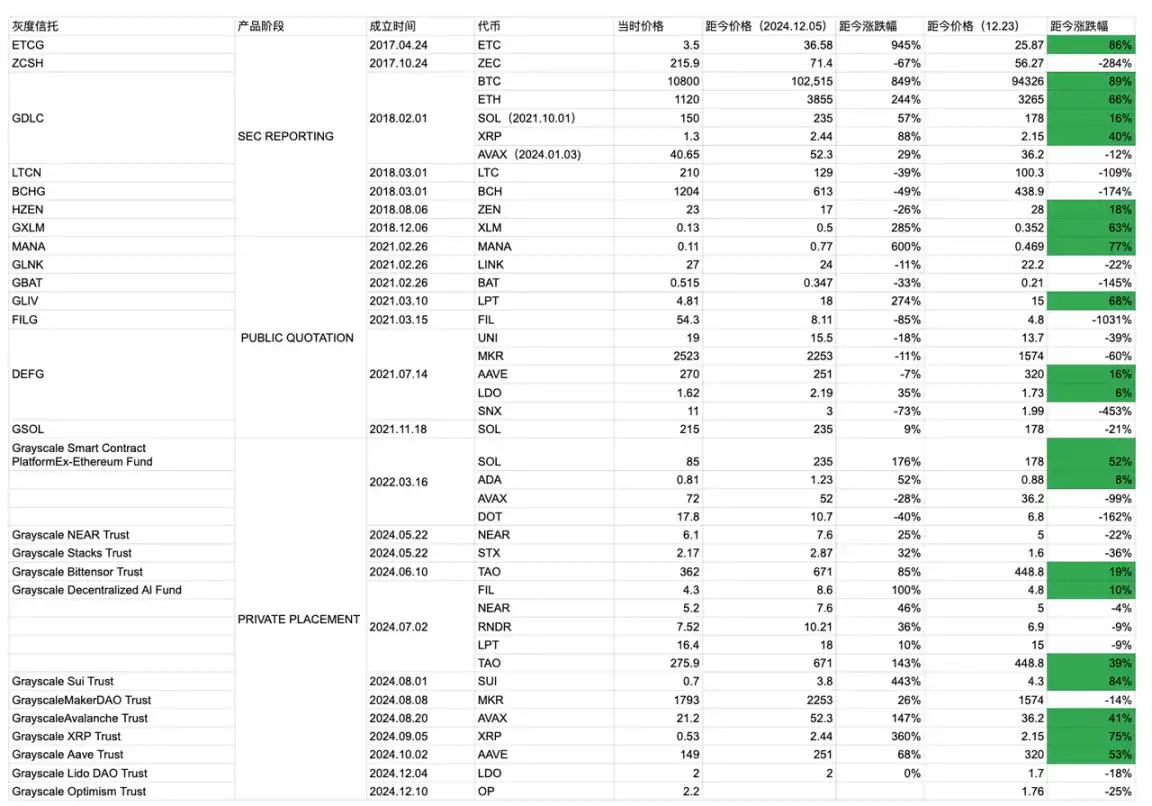
To track the investment return of Grayscale funds, the author recorded the token prices at the launch of Grayscale funds and on December 23, forming the above chart. Over time, Grayscale's launch of crypto trust products was concentrated before 2018 and 2021, and these were mostly at high points or later stages of bull markets. This phenomenon may be related to the fact that Grayscale's fund launches require a relatively long period and a mature market. And this December, Grayscale has once again started to concentrate on launching trust funds, whether this time it can break the cycle of short-term peaks.
In terms of investment return, in the long term, (including BTC, ETH), tokens showing positive investment return account for only about 48%, which is lower than the random 50% probability of a coin flip. Moreover, their investment return is far below that of BTC, showing a negative EV in the long run.
In the short term, the tokens launched by Grayscale did indeed have glorious moments, but most of them occurred before their launch. Even though XRP has experienced a strong rebound, it has not yet surpassed its previous high, and after three consecutive days of gains, ZEN can barely maintain an 18% return on investment. Although some star tokens have reached their highs after launch, when viewed from a long-term annualized perspective, after holding for a long 7 years, their return rate is even below 10%. However, different entry timing has a more significant impact on investment return, with Grayscale concept coins almost all outperforming the average bull market increase if they accumulate during a bear market bottom. Observing assets that have not shown significant movements at this time may lead to decent gains next year.
Grayscale's holdings of tokens have different indicative roles at different times in the market cycles, in this sense, Grayscale's strict selection process indeed has an impact.
You may also like

Bloomberg: As Bitcoin Weakens, Stablecoins and RWA Continue to Drive Expansion in Crypto Businesses
In June, Bloomberg reported that despite Bitcoin falling below $60,000 last week, wiping out about $235 billion in market value within seven days, and dropping close to 50% from last year’s peak, some core businesses in the crypto industry are still expanding, mainly in stablecoins, real-world asset tokenization (RWA), payments, and infrastructure. The report also noted that overall altcoin activity has contracted significantly: altcoin market capitalization has fallen from a peak of about $431 billion in November 2021 to around $170 billion, and among the tens of millions of tokens issued in recent years, fewer than 1,700 still maintain meaningful trading activity.

Galaxy Deep Research Report: How Hyperliquid's HIP-4 Upgrade Changes the Landscape of Prediction Markets?

Binance Research: RWA Market Expected to Expand Nearly 6x from Early 2025, with Public Equities and Onchain Payments Heating Up Together
In June, Binance Research said in its monthly market report that the real-world asset (RWA) market is expected to grow by about 589% from the beginning of 2025. Bond- and money market fund-related RWA expanded by about $6.5 billion, up 83% year over year, while publicly traded equity RWAs grew by about 422%. The report also noted that monthly crypto debit card transaction volume exceeded $747 million in May, up 48.6% year to date.

Japan to Assess a Framework for Yen Stablecoins and Crypto ETFs as Asia’s Compliant Payments Narrative Heats Up
Recently, according to the original report, Japan is considering the launch of yen stablecoins and cryptocurrency ETFs. Public information remains limited at this stage, and there is still no complete policy text, regulatory draft, or clear implementation timeline, so this is better characterized as a “policy discussion” rather than formal implementation. The original wording also noted that advancing stablecoin regulation in Asia is driving XRP usage and supporting growth in the XRPL ecosystem. However, based on currently available public information, there is not enough evidence to directly establish a clear causal relationship between this round of discussion in Japan and XRP or XRPL.

ZachXBT: Humanity private key leak and abnormal surge in H token should be viewed separately
On June 9, according to related disclosures, on-chain investigator ZachXBT posted an update on Humanity’s roughly $31 million security incident, saying that after further analyzing fund flows, he currently tends to believe the project team was not involved in an “inside job” or a self-staged attack. According to him, the official explanation about the private key leak was broadly accurate, but before the token unlock, the price of H had been artificially pushed higher, and the hacker later took advantage of that market environment; therefore, the private key leak and the earlier abnormal price pumping should be regarded as two separate and independent events. This reframing has shifted the market’s understanding of the nature of the incident. Earlier discussion around Humanity had focused on whether the team directly participated in the attack or used the security incident to cover up internal operations. ZachXBT’s latest remarks shift the focus from “whether it was self-theft” to “whether there were pre-unlock market structure issues.” He also questioned whether the team may have.

Morning Report | OpenAI has submitted an S-1 registration statement draft to the U.S. SEC; Morpho completes $175 million financing

Morning Report | BitMine increased its holdings by 126,971 ETH last week; trader Eugene announced his exit from the crypto market

Wang Chuan: How can one not feel anxious after the neighbor Old Wang made thirty times profit by investing in storage stocks? (Seven) - A quarter-century cycle

Cryptocurrency CEXs are flocking to sell US stocks, and traditional brokerages are facing an "uninvited guest."
$75 billion in foreign capital has fled, and South Korean retail investors have absorbed it all using leverage

Japan’s Three Megabanks Plan Joint Stablecoin Issuance in Fiscal 2026
MUFG, SMBC, and Mizuho reportedly plan to jointly issue fiat-pegged stablecoins in fiscal 2026, signaling Japan’s growing push into bank-led digital payment infrastructure.

Humanity Discloses H Token Dual-Chain Attack Details, With Losses on Ethereum and BSC Exceeding $36 Million
Humanity said the H token attack across Ethereum and BSC caused more than $36 million in losses after leaked ProxyAdmin keys enabled malicious contract upgrades and token minting.
White House Discusses CLARITY Act With Law Enforcement Ahead of Senate Vote
The White House discussed the CLARITY Act with law enforcement ahead of a Senate vote, focusing on illicit finance risks and developer protections.

Bitcoin Trading Guide 2026: Strategies for Experienced Traders

What Is XAUT and PAXG? Why Tokenized Gold Is Booming in 2026

Will the SpaceX IPO Hurt Bitcoin? Here's What Traders Are Watching

Foreign selling in the South Korean stock market accelerates, with cumulative net sales reportedly reaching $75 billion this year
On June 9, The Kobeissi Letter, citing Goldman Sachs data, reported that global investors are selling South Korean stocks at an unusually rapid pace. In the latest trading session, foreign investors sold about $801 million worth of Kospi constituent stocks again; total foreign outflows last week reached about $10 billion, and the market has been in net foreign selling on nearly every trading day over the past month. According to the data cited in the report, foreign investors have sold about $75 billion worth of South Korean stocks so far this year. Meanwhile, South Korean retail and institutional investors together recorded roughly $69 billion in net buying over the same period, suggesting that the market’s main buying support has come from domestic capital rather than returning overseas funds. The information currently disclosed still mainly comes from The Kobeissi Letter’s retelling and Goldman Sachs data summaries, while public details on the statistical period and the specific definition of “selling” remain relatively limited.

Fortune Warns of Strategy’s Financing Structure Risks as Bitcoin Premium Narrows
Fortune warned that Strategy’s Bitcoin treasury model faces growing financing risks as MSTR’s net asset premium narrows and preferred stock dividend pressure increases.
Bloomberg: As Bitcoin Weakens, Stablecoins and RWA Continue to Drive Expansion in Crypto Businesses
In June, Bloomberg reported that despite Bitcoin falling below $60,000 last week, wiping out about $235 billion in market value within seven days, and dropping close to 50% from last year’s peak, some core businesses in the crypto industry are still expanding, mainly in stablecoins, real-world asset tokenization (RWA), payments, and infrastructure. The report also noted that overall altcoin activity has contracted significantly: altcoin market capitalization has fallen from a peak of about $431 billion in November 2021 to around $170 billion, and among the tens of millions of tokens issued in recent years, fewer than 1,700 still maintain meaningful trading activity.
Galaxy Deep Research Report: How Hyperliquid's HIP-4 Upgrade Changes the Landscape of Prediction Markets?
Binance Research: RWA Market Expected to Expand Nearly 6x from Early 2025, with Public Equities and Onchain Payments Heating Up Together
In June, Binance Research said in its monthly market report that the real-world asset (RWA) market is expected to grow by about 589% from the beginning of 2025. Bond- and money market fund-related RWA expanded by about $6.5 billion, up 83% year over year, while publicly traded equity RWAs grew by about 422%. The report also noted that monthly crypto debit card transaction volume exceeded $747 million in May, up 48.6% year to date.
Japan to Assess a Framework for Yen Stablecoins and Crypto ETFs as Asia’s Compliant Payments Narrative Heats Up
Recently, according to the original report, Japan is considering the launch of yen stablecoins and cryptocurrency ETFs. Public information remains limited at this stage, and there is still no complete policy text, regulatory draft, or clear implementation timeline, so this is better characterized as a “policy discussion” rather than formal implementation. The original wording also noted that advancing stablecoin regulation in Asia is driving XRP usage and supporting growth in the XRPL ecosystem. However, based on currently available public information, there is not enough evidence to directly establish a clear causal relationship between this round of discussion in Japan and XRP or XRPL.
ZachXBT: Humanity private key leak and abnormal surge in H token should be viewed separately
On June 9, according to related disclosures, on-chain investigator ZachXBT posted an update on Humanity’s roughly $31 million security incident, saying that after further analyzing fund flows, he currently tends to believe the project team was not involved in an “inside job” or a self-staged attack. According to him, the official explanation about the private key leak was broadly accurate, but before the token unlock, the price of H had been artificially pushed higher, and the hacker later took advantage of that market environment; therefore, the private key leak and the earlier abnormal price pumping should be regarded as two separate and independent events. This reframing has shifted the market’s understanding of the nature of the incident. Earlier discussion around Humanity had focused on whether the team directly participated in the attack or used the security incident to cover up internal operations. ZachXBT’s latest remarks shift the focus from “whether it was self-theft” to “whether there were pre-unlock market structure issues.” He also questioned whether the team may have.
Morning Report | OpenAI has submitted an S-1 registration statement draft to the U.S. SEC; Morpho completes $175 million financing


