
Nexus Token Price: NEX Price, Catalysts, Risks


The nexus token price is getting attention because Nexus Labs' NEX token entered public price discovery in May 2026 with a large nominal supply, heavy early trading volume, and a market story tied to verifiable finance, zero-knowledge computation, and exchange infrastructure.
As of market data checked on May 21, 2026, CoinMarketCap showed Nexus (NEX) trading around $0.000005229, up about 20.14% over 24 hours, with 24-hour volume near $119.31 million, market cap around $313.77 million, and 60 trillion NEX in circulating supply. Those figures can change quickly after a new listing, so readers should treat them as a dated snapshot rather than a fixed valuation.
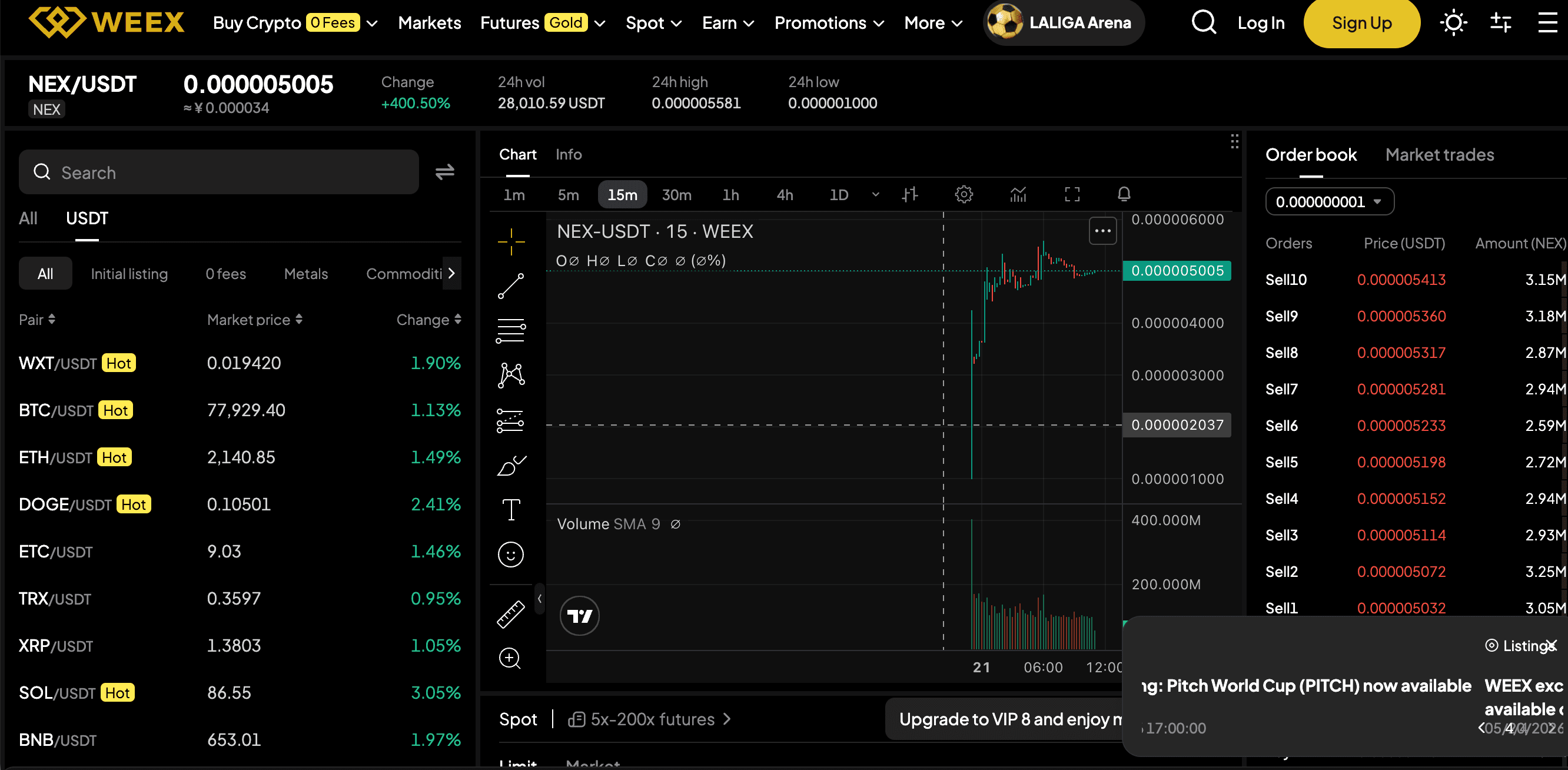
The first practical point: this article is about NEX, the Nexus Labs token linked to the newer Nexus Layer 1 project. Search results for Nexus can also surface NXS, an older Nexus coin. Always verify the ticker, contract, exchange pair, and market page before buying anything with a similar name.
For background on the listing narrative, readers can review WEEX's guide to Introducing Nexus ($NEX). For live trading context, check the NEX/USDT spot market on WEEX before placing an order.
Nexus Token Price Today: The Fast Read
The nexus token price is still in its early trading window, which means the chart is less mature than large-cap crypto assets. Early candles often reflect listing access, liquidity depth, market-maker activity, airdrop or allocation behavior, and trader positioning more than long-term fundamentals.
| Metric | Recent reference | Why it matters |
|---|---|---|
| Token | Nexus Labs (NEX) | Not the older NXS coin |
| Recent price | Around $0.000005229 | Percentage moves can look dramatic |
| 24h volume | Around $119.31M | Shows launch turnover |
| Market cap | Around $313.77M | Better than unit price |
| Circulating supply | 60T NEX | Large float magnifies value shifts |
| Max supply | 100T NEX | Important for FDV |
| FDV | Around $522.96M | Shows full-supply valuation |
| Main pair | NEX/USDT | Spread decides execution quality |
The main lesson is simple: do not judge NEX by the number of zeros in the price. A token trading at fractions of a cent can still carry a large market cap when supply is measured in tens of trillions.
NEX vs NXS: Which Nexus Token Is This?
Search confusion is a real risk here. "Nexus token price" can lead to at least two different assets:
| Ticker | Common name | What to know |
|---|---|---|
| NEX | Nexus Labs / Nexus | Newer 2026 token linked to Nexus Layer 1, verifiable finance, and exchange infrastructure |
| NXS | Nexus | Older crypto project with a separate history, supply profile, and price page |
This matters because a trader who only searches "Nexus price" may land on the wrong chart. The unit price, market cap, supply, contract address, and exchange availability can all differ. Before trading, confirm the ticker is NEX, the pair is the one you intend to trade, and the market page matches the Nexus Labs project rather than a similarly named asset.
That is not a minor detail. In newly listed tokens, many losses come from basic execution mistakes: buying the wrong asset, using the wrong chain, copying an unofficial contract address, or assuming one price page represents every market with the same name.
What Is Nexus Token (NEX) and Why Does It Trade?
Nexus is positioning itself as a Layer 1 blockchain for verifiable finance. Official Nexus documentation describes a high-performance blockchain architecture built around exchange computation, an Ethereum-compatible NexusEVM environment, NexusCore co-processors, NexusBFT consensus, and zero-knowledge verification through the Nexus zkVM.
In plain English, Nexus is trying to move exchange-style financial infrastructure on-chain without giving up the speed and orderbook experience traders expect from centralized venues. The project frames this around verifiable execution: orders, trades, settlement, and liquidations should be executed transparently and checked cryptographically rather than left as a trust assumption.
NEX is the token tied to that network. CoinMarketCap's project summary describes NEX as being used for transaction fees, verifiable compute jobs, staking and network security, and future Nexus Exchange-related utility. WEEX's Nexus overview also notes that NEX is linked to gas, staking, governance, and the broader compute network.
The better way to understand the nexus token price is not "cheap token, many zeros." It is "newly listed infrastructure token trying to prove whether a verifiable exchange-focused Layer 1 can attract real usage."
How It Works: Why NEX Price Links to Network Demand
NEX price depends on two layers of demand. The first is market demand from traders buying or selling NEX on spot markets such as NEX/USDT. The second is network demand from people who may need NEX for gas, staking, compute payments, governance, or future exchange-related functions.
Those two layers do not always move together. A token can rally before its network usage is mature if listings and narrative are strong. It can also fall even after good product news if early holders sell into liquidity or if the broader altcoin market weakens.
That is why the nexus token price should be read as a mix of current trading pressure and expected future utility. The market is not only pricing today's transactions. It is also pricing whether Nexus can turn NexusEVM, NexusCore, NexusBFT, USDX, and its exchange roadmap into activity that matters after the launch cycle.
Why Is the Nexus Token Price Moving Now?
The first driver is launch-phase price discovery. NEX began trading publicly around the May 2026 launch window, and newly listed assets often move sharply because the market has little chart history. There are no old support zones, no mature volatility range, and no long record of how buyers behave under stress.
The second driver is narrative density. Nexus touches several strong crypto themes at once: Layer 1 infrastructure, zero-knowledge proofs, AI-era computation, on-chain finance, stablecoin settlement, and orderbook trading. When a token has multiple active narratives, traders may price it aggressively early, especially if listings and social attention arrive together.
The third driver is supply optics. With a max supply shown at 100 trillion NEX and circulating supply shown at 60 trillion NEX, the unit price is extremely small. That can pull in speculative demand from traders who like low nominal prices. The risk is that low nominal price can obscure valuation. A move of one micro-cent can represent a large shift in market cap.
The fourth driver is product expectation. Nexus documentation describes exchange infrastructure and alpha-stage trading resources, including a Nexus Exchange Alpha test environment. That creates a roadmap story, but it also creates execution risk. A strong thesis still has to become active users, reliable liquidity, useful applications, and durable token demand.
What Traders Should Watch Before Buying NEX
Start with volume quality. High launch volume is useful, but not all volume is equally durable. If the nexus token price rises while volume keeps expanding and spreads stay tight, the move is healthier. If price rises while volume fades, late buyers may be paying into a weaker market.
Watch market cap and FDV together. A $0.000005229 token can feel cheap, but at 60 trillion circulating supply it already implies a nine-figure market cap. If you model a higher target, calculate the implied market cap before accepting a bullish price call.
Check whether the exchange and verifiable finance roadmap is turning into real usage. The more important point is not whether Nexus has a strong concept. It is whether traders, developers, validators, and liquidity providers start using the system after the first listing cycle.
Be careful with margin. Newly listed tokens can gap through levels, wick hard, and move faster than stop-loss orders can protect. If liquidity is thin at the exact moment you need to exit, the live price on the screen may not be the fill price you receive.
| Signal to watch | Bullish interpretation | Risk interpretation |
|---|---|---|
| Rising spot volume | More traders are participating | Could still be short-term launch churn |
| Tight NEX/USDT spreads | Easier execution | May widen during volatility |
| New exchange access | More liquidity and visibility | Listing spikes can fade after the event |
| Nexus Exchange progress | Better utility story for NEX | Delays can weaken the thesis |
| Stablecoin and USDX updates | Stronger finance-stack narrative | Backing, access, and compliance details matter |
| Large social attention | More demand discovery | Attention-driven rallies can reverse quickly |
The practical market view: NEX is interesting because it is attached to a fresh infrastructure narrative, but the launch chart should be treated as unstable until deeper liquidity and clearer product traction appear.
Nexus Price Prediction: Three Scenarios
No serious Nexus price prediction should pretend to know the exact NEX price next week. A scenario framework is more useful because NEX is still young as a traded asset.
| Scenario | What happens | What it means |
|---|---|---|
| Bullish continuation | Volume stays high and product progress is visible | NEX can extend above its early range |
| Base case | Launch excitement cools but liquidity holds | NEX forms a volatile range |
| Bearish retracement | Volume fades or roadmap expectations slip | NEX can retrace sharply |
The base view is cautious but not dismissive. Nexus has a clearer thesis than many micro-priced launch tokens because it is trying to connect verifiable computation with exchange infrastructure. But the nexus token price already reflects a meaningful market cap, so future upside needs real follow-through rather than only launch excitement.
Examples: What Can Defend or Break the NEX Setup
The best example of a healthy setup would be rising spot volume alongside tighter spreads, visible Nexus Exchange progress, and fresh documentation on NEX utility. That would not guarantee a higher price, but it would make the rally easier to defend because demand would look broader than launch speculation.
The opposite example is a price spike with falling volume, thin order books, vague roadmap updates, and heavy selling into every bounce. That pattern would make the nexus token price harder to defend, even if the long-term technology pitch remains interesting.
To prevent a weak entry, do the basic market work first. Check the current NEX/USDT spread, compare market cap with FDV, review whether Nexus has published new product updates, and avoid treating a low unit price as an automatic bargain.
How to Track or Trade NEX on WEEX
If you are researching the asset, start with the WEEX Nexus explainer and then check the NEX/USDT market data before making any trade. The explainer gives useful background on the token, while the market page gives the live execution context: price, spread, volume, and order-book depth.
For broader trading preparation, WEEX's guide to risk management in trading is more useful than trying to guess every launch candle. Position size, liquidity, and stop planning matter more when the token has limited trading history.
Before buying NEX, check:
- The correct ticker, contract, and market pair.
- Whether you are trading spot or a margin product.
- Current spread and order-book depth.
- Whether volume is broadening or fading.
- Whether your position size can be exited without heavy slippage.
- Whether the thesis is a short-term listing trade or a longer-term Nexus network bet.
That last distinction matters. A listing trade is about timing and liquidity. A network thesis is about whether Nexus can make verifiable finance useful enough that NEX demand persists after the first wave of attention.
Bottom Line
The nexus token price is in launch-phase discovery. NEX has a compelling market story: a Layer 1 built around verifiable finance, exchange-focused execution, zero-knowledge computation, and future product catalysts. That story explains why traders are paying attention.
But attention is not the same as durable value. The early NEX chart is likely to remain volatile while the market tests liquidity, supply, roadmap credibility, and actual network usage. The disciplined approach is to watch market cap, volume quality, spread, and product progress rather than treating a low unit price as proof that NEX is cheap.
For traders, NEX may be worth monitoring on WEEX, but it should be sized like a new, high-volatility asset. The opportunity is the fresh infrastructure narrative. The risk is paying too much before the network proves that the narrative can become sustained demand.
FAQ
What is the nexus token price today?
As of market data checked on May 21, 2026, CoinMarketCap showed Nexus (NEX) around $0.000005229, with 24-hour volume near $119.31 million and market cap around $313.77 million. Live prices change constantly, so check the current NEX/USDT market before trading.
Is Nexus token NEX or NXS?
This article covers NEX, the Nexus Labs token linked to the newer Nexus Layer 1 and verifiable finance project. NXS is an older Nexus coin that also appears in search results. Always verify the ticker and market page before buying.
Why is the Nexus token price volatile?
NEX is newly listed, so the market is still forming its first trading range. Launch-phase tokens can move sharply because of changing liquidity, listing news, early holder behavior, market-maker flows, and speculative attention.
What is NEX used for?
Public project summaries describe NEX as being used for transaction fees, verifiable compute jobs, staking and network security, and future Nexus Exchange-related utility. Traders should watch official updates because token mechanics can evolve as the network matures.
Can NEX keep rising after launch?
It can if volume stays strong, liquidity deepens, and Nexus converts its verifiable finance roadmap into real usage. The main risks are fading launch momentum, weak liquidity, high volatility, and disappointment around product milestones.
Is the Nexus token price cheap because it has many zeros?
Not necessarily. NEX has a very large supply, so the low unit price does not automatically mean low valuation. Market cap and fully diluted valuation are more useful than the number of zeros in the price.
Where can I learn more about Nexus?
You can read WEEX's Introducing Nexus ($NEX) guide for a market-facing overview and the official Nexus documentation for technical architecture details.
Risk Warning
NEX and other crypto assets are volatile and may result in partial or total loss. Newly listed tokens carry additional risks, including thin historical data, fast price swings, slippage, contract or ticker confusion, margin liquidation, exchange access changes, and roadmap execution risk. This article is general information, not financial advice. Always verify live market data, use appropriate position sizing, and never trade more than you can afford to lose.
You may also like

GitHub Security: What the VS Code Extension Breach Means
GitHub’s internal repository breach shows how poisoned developer tools can expose code, credentials, and crypto infrastructure risk.

How WEEX TradFi Connects Crypto Traders to Gold, Oil, Stocks, and Global Markets
Discover how WEEX TradFi helps crypto traders access traditional assets with USDT, including gold, oil, stocks, commodities, and indices in one platform.
What Is WEEX TradFi? A Beginner’s Guide to Trading Global Assets with USDT
Learn what WEEX TradFi is, how it lets users trade gold, oil, stocks, commodities, and indices with USDT, and what beginners should know before trading TradFi futures.
MTFR Crypto: What Mom Trust Fund Reserve Really Is
MTFR Crypto is a Solana meme token built around trust-fund satire. Learn how it works, where it trades, and the biggest risks.

Venice Token Price Prediction: VVV Outlook for 2026-2030
Venice Token price prediction for 2026-2030, covering VVV tokenomics, AI utility, burns, bullish catalysts, risks, and forecast scenarios.

Reserve Bank of India Surplus: Why the RBI Dividend Matters
Reserve Bank of India surplus explained: latest RBI dividend, why it rose, how it affects India’s fiscal outlook, rupee liquidity, and crypto markets.

What Is Public Asset Control (PAC) Token? Risks and Reality
Public Asset Control token is a Solana-based PAC token with asset-control branding. Learn what PAC is, what is verified, and the risks to check.
GOOG Stock: Alphabet’s 2026 AI Rally, Valuation and Risks
GOOG stock trades near record highs after Alphabet’s strong Q1 2026 results. Here’s what investors should watch in AI, cloud, valuation and risk.
Mastering Zest Protocol ($ZEST) Initial Listing on WEEX
WEEX is thrilled to announce the launch of Zest Protocol ($ZEST), offering users a pathway to engage with this project.

Where Can I Buy WCOR Coin? It Is Worth Buying in 2026
Where can I buy WCOR coin? Read the latest WCOR price, market data, risks, and whether World Collective Oil Reserve is worth buying on WEEX.

E Token MP: Online Fertilizer Token Booking Guide for Farmers
Learn what E Token MP is, how Madhya Pradesh farmers can book fertilizer tokens online, required documents, eligibility, and common issues.
WEEX Welcome Rewards: Unlock Up to 10,000 USDT
Join the WEEX Welcome Rewards event for new users. Complete sign-up, app login, deposit, futures trading, Trade to Earn, and Auto Earn tasks to unlock up to 10,000 USDT.
Dominion Energy Stock: Dividend, Merger News and 2026 Outlook
Dominion Energy stock now trades around a merger story dividend income and regulated utility growth. Here is what D investors should watch in 2026.
Global Digital Oil Reserve: What GDOR Traders Must Check
Learn what Global Digital Oil Reserve (GDOR) is, why its oil-reserve claim needs proof, and how to check liquidity, contracts, and risk.
Can I Trade Futures with $200? Beginner’s Guide on WEEX
Many newcomers to crypto wonder if starting futures trading with just $200 is realistic, especially when platforms promise…
Is $CHIP a Scam? Decoding the Crash and Pump Dump Red Flags
The $CHIP token has sparked heated debates in the crypto community, with its rapid price swings raising questions…
$CHIP Hype vs Reality: Is This the Next Crypto Trap?
The buzz around $CHIP token has exploded lately, with social media ablaze about its potential as the next…
What is Hormuz Reserve Protocol (HRP) Coin
Hormuz Reserve Protocol (HRP) Coin is a unique geopolitical DeFi narrative token on the Solana blockchain that captures…
GitHub Security: What the VS Code Extension Breach Means
GitHub’s internal repository breach shows how poisoned developer tools can expose code, credentials, and crypto infrastructure risk.
How WEEX TradFi Connects Crypto Traders to Gold, Oil, Stocks, and Global Markets
Discover how WEEX TradFi helps crypto traders access traditional assets with USDT, including gold, oil, stocks, commodities, and indices in one platform.
What Is WEEX TradFi? A Beginner’s Guide to Trading Global Assets with USDT
Learn what WEEX TradFi is, how it lets users trade gold, oil, stocks, commodities, and indices with USDT, and what beginners should know before trading TradFi futures.
MTFR Crypto: What Mom Trust Fund Reserve Really Is
MTFR Crypto is a Solana meme token built around trust-fund satire. Learn how it works, where it trades, and the biggest risks.
Venice Token Price Prediction: VVV Outlook for 2026-2030
Venice Token price prediction for 2026-2030, covering VVV tokenomics, AI utility, burns, bullish catalysts, risks, and forecast scenarios.
Reserve Bank of India Surplus: Why the RBI Dividend Matters
Reserve Bank of India surplus explained: latest RBI dividend, why it rose, how it affects India’s fiscal outlook, rupee liquidity, and crypto markets.


