
Renowned Crypto Influencer Embroiled in "Donation Fraudgate," Accused of Faking Hong Kong Fire Donation Receipt, Sparking Public Outcry

 Prefer us on Google

A serious fire at Wang Fuk House in Tai Po, Hong Kong, has caused hundreds of casualties and property damage. Charitable organizations such as Yan Chai Hospital promptly set up an emergency relief fund to support the affected residents. The cryptocurrency industry has also seen many companies and individuals providing assistance, including industry giants like Binance and Matrixport donating millions of Hong Kong dollars. However, on December 1, a prominent figure in the cryptocurrency community, known as KOL @Elizabethofyou, found herself embroiled in a "Donation Fraud" scandal when the community noticed that the proof of her HK$200,000 donation appeared to be photoshopped.
A "Expose the Fraud" Movement Triggered by a Screenshot
On December 1, Elizabeth, a cryptocurrency influencer with 130,000 followers, posted a tweet on the social media platform X (formerly Twitter), stating that she had donated HK$200,000 to Yan Chai Hospital to support the victims of the Tai Po fire. The tweet included a screenshot of the transaction confirmation and a caption urging others to "show kindness in the face of disaster." The act of kindness quickly garnered over 600,000 views and 1500 likes, initially being seen as a demonstration of positive energy in the industry.
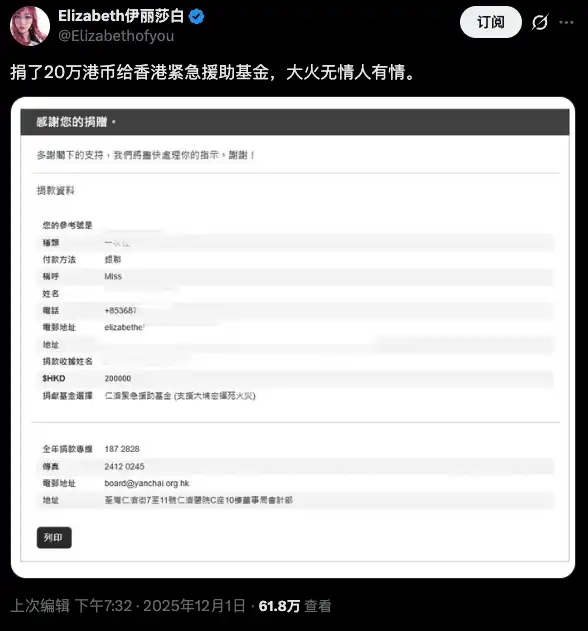
However, public opinion took a sharp turn within hours. Several members of the crypto community on the Twitter platform, such as @CryptoNyaRu and @abyssofgambling, analyzed the screenshot and pointed out multiple suspicious elements:
1. Irregular Font: The number "2" in the amount "200,000" in the screenshot had a noticeably thinner font, inconsistent with the font style of the "Annual Donation Hotline" number below.
2. Misalignment: The amount line and the text below could not be aligned, showing a significant discrepancy in pixel height typical of image editing software (such as Photoshop) manipulation.
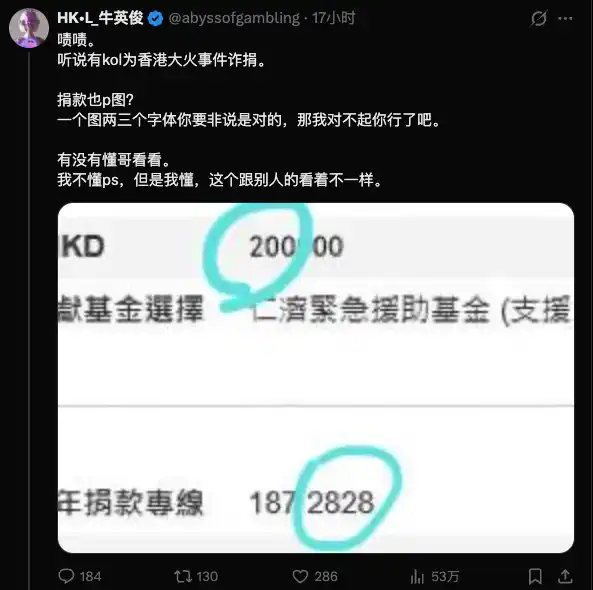
The suspicions quickly escalated, turning the likes into dislikes. The community believed that if this was indeed a fraud, using a significant tragedy to deceive people's compassion was incredibly heinous, and they hoped Elizabeth could provide evidence to prove the authenticity of her donation.
Response from the Involved Party and Escalation of Public Opinion
Faced with overwhelming doubts, Elizabeth released a response video on the evening of the 1st. In the video, she insisted that she had "donated with a clear conscience" and stated that this would be her final response. She then displayed another screenshot as evidence.
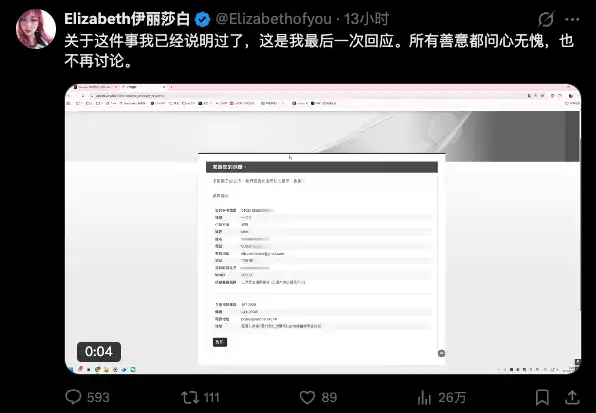
This screenshot is different from the first one. The phone number is different, and the video demonstration is of a static webpage without dynamic refreshing. Additionally, netizens believe that the evidence she provided is not convincing as there is no bank transaction record or an official receipt from Renji Hospital.

After releasing a response, Elizabeth ignored numerous requests for self-verification in the comments and continued to post commercial ad tweets. This handling of the situation further enraged the public.
According to the Hong Kong Theft Ordinance, if misleading the public through false statements to gain benefits (including advertising collaboration opportunities due to traffic, brand image enhancement, etc.), it may constitute "fraud" or "obtaining property by deception." Upon conviction for such offenses, the maximum penalty can be 10 to 14 years of imprisonment. Netizens have started reaching out to donation organizations for verification and believe that if the fraudulent donation is confirmed, there should be legal consequences. Some Key Opinion Leaders (KOLs) have also compared donation verification evidence for authenticity. As of now, there has been no latest response from donation organizations regarding Elizabeth.
Historical Warning: The Cost of Celebrity "Donation Fraud"
Using charity for false publicity is not uncommon in the history of public figures.
One of the most famous cases is international actress Zhang Ziyi. During the 2008 Wenchuan earthquake, Zhang Ziyi claimed to donate 1 million RMB. However, in 2010, netizens discovered that the actual amount received was only 840,000 RMB, and the whereabouts of the millions of dollars she claimed to have raised in Cannes were unknown.
After the incident broke out, Zhang Ziyi's public image plummeted, facing an unprecedented crisis of trust. Eventually, her agent apologized for "management negligence," made up the shortfall, and hired an auditing firm to audit and disclose the foundation's accounts. Despite taking remedial measures, the "donation fraud" label followed her for many years.
In 2015, well-known actress Yang Mi promised to donate typewriters and white canes to a special education school in Chengdu while promoting the movie "I Am a Witness." However, it wasn't until 2018 that the school stated they never received the supplies.
Yang Mi's studio explained that it was due to the negligence of an "intermediary" that the donation was not fulfilled, and they promptly donated the supplies and publicly apologized. Although it was not legally classified as fraud, the incident was characterized by the public as "hypocritical," greatly undermining her integrity as a public figure.
-- Price
This content is provided for general informational purposes only and doesn't constitute financial, investment, legal, or tax advice. Any events, rewards, online promotions, or related information mentioned herein should not be considered a recommendation, solicitation, or invitation to purchase, sell, trade, or otherwise deal in any crypto assets. Crypto assets are highly volatile and may result in loss. The availability of WEEX services, products, and related events may vary by region. You are responsible for ensuring that your participation is in accordance with applicable local laws and regulations.
You may also like

The 2000 UAH Banknote Will Not Affect Inflation or the Hryvnia Exchange Rate

Gold vs Bitcoin in 2026: Which Market Is Giving Traders Better Opportunities?

Best Oil Trading Platform for Crypto Users in 2026

European Startup Raises $450 Million to Challenge SpaceX

ARK Asks SEC To Approve Tokenized Share Class of Venture Fund

TOP Crypto AI 2026: Why Comparing Qubic, TAO, Render, FET and NEAR by Price No Longer Makes Sense

Castle lets users convert STRC dividends into Bitcoin

Bitcoin could get the dollar drop bulls want this week without getting the liquidity rally they need

Altcoin Market Drops 58% Since Peak, Anonymous Cryptos Gain 213%
Turbulent Market, Preserved Capital: The Video of Steady Lads' First Anniversary is Here!

Used Car Prices in September 2026: How Much Do the Most Sought-After Models Cost?

MIT Study Warns of Extreme Gaps in Food, Water, and Energy by 2050

Proteomic clocks link accelerated aging to higher risk of death and disease

Qatar Faces Record Quarterly Deficit Since 2016 Following LNG Collapse

Response to Labor Shortage: How Artificial Intelligence is Transforming Ukrainian Business

Innovation Week 2026: AI to be Discussed in 41 Activities
Joe Biden's Son's LAPTOP Memecoin Shunned Before Its First Trade
Kalshi court split could fragment US prediction markets: expert
Wholesale dollar falls below $1.510 and the gap with the ceiling of the band holds at 25%
Tether AI Wallet Spending Limits, WDK Leaves Responsibility to Developers
ETF Flows: How to Read Inflows and Outflows of Capital in Cryptocurrency Funds

Arthur Hayes: Dollar Weakness and Yen Strength Transition Triggering Cryptocurrency Rally
European Funds Leave the US: A Chance for France and Bitcoin?

Nansen becomes first front end to support Outcome.xyz HIP-4 markets
Treasury Bonds: The Darkest Performance in Over 200 Years Reveals a New Paradigm

ChatGPT, Claude, and Grok All Go Down: Why Is Everyone Suspecting Cloudflare?

Changpeng Zhao: Kyrgyzstan has made a leap to become a crypto hub in just one year, a process that usually takes up to 9 years
Weekly Net Purchases by Listed Companies Decrease by 48%, Strategy Did Not Increase Bitcoin Holdings Last Week

Weekly Net Purchases by Listed Companies Decrease by 48% as Strategy Holds No Bitcoin

Credit in pesos falls again: consumption declined in August and delinquency continues to pressure
The 2000 UAH Banknote Will Not Affect Inflation or the Hryvnia Exchange Rate
Gold vs Bitcoin in 2026: Which Market Is Giving Traders Better Opportunities?
Best Oil Trading Platform for Crypto Users in 2026
European Startup Raises $450 Million to Challenge SpaceX
ARK Asks SEC To Approve Tokenized Share Class of Venture Fund
TOP Crypto AI 2026: Why Comparing Qubic, TAO, Render, FET and NEAR by Price No Longer Makes Sense